How I Buy Furniture Online Without Sitting on It First
How I Buy Furniture Online Without Sitting on It First
I have bought fourteen pieces of furniture online since 2022: two bed frames, a dresser, a TV stand, a dining set, four bar stools, a bookshelf, a nightstand pair, a desk, and a coffee table. Thirteen of them worked out. One did not — a loveseat that arrived in a color I can only describe as “hospital waiting room beige,” with legs wobblier than a folding card table.
That loveseat taught me something no showroom visit ever could: when you buy furniture online, the risk is not the quality of the furniture. The risk is skipping the homework. So I built myself a system — seven rules, refined over four years of flat-pack boxes and one very patient delivery driver. Here is the whole thing.
Rule 1: When You Buy Furniture Online, Measure Three Things First
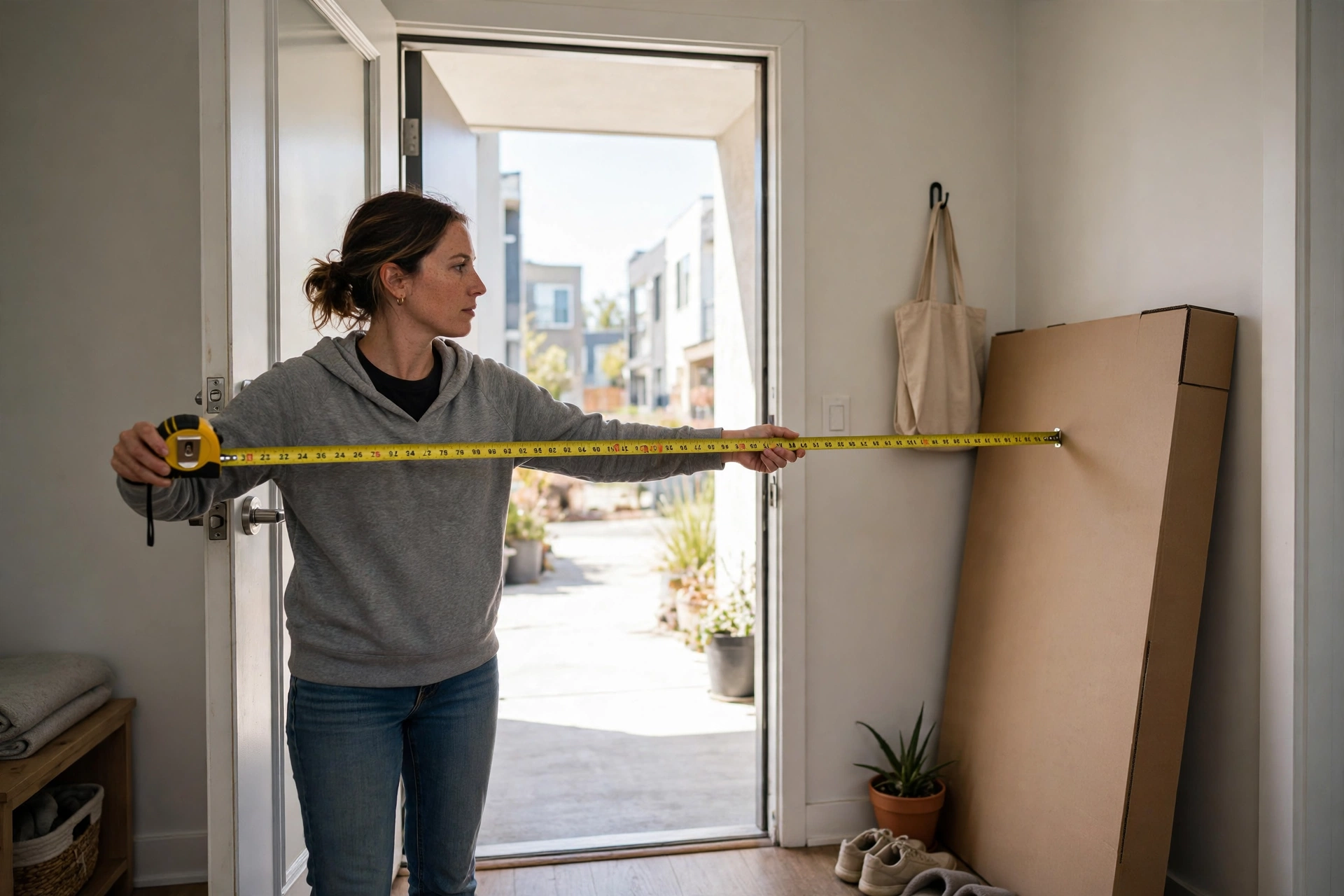
Every furniture-buying disaster I have heard about starts the same way: the piece fit the room but not the journey to the room. Before you click anything, measure three things.
First, your doorways, hallways, and stairwells — including the front door diagonal, which is usually two to three inches more generous than the straight width. My building’s hallway door is 32 inches wide; a packaged queen bed frame box at 16.3 inches wide cleared it, but only because I checked before ordering, not after.
Second, the room footprint with painter’s tape. I lay out the full dimensions on the floor — for a queen bed frame that is 87.8 by 61.8 inches — and live with the tape for a day. Walking around a tape rectangle tells you more than any room-planner app.
Third, the elevator or stairs. A 62-pound flat-pack box is one person’s workout and another person’s blocked stairwell. If you live above the third floor with no elevator, check the package dimensions (mine arrived in a 65.7-by-16.3-inch box) against your stair turns before you buy furniture online — not while the box is wedged on the landing.
Rule 2: Read the Spec Sheet Like an Engineer
Online listings bury the truth in plain sight: the spec table. This is where I spend most of my time, and it is why thirteen of my fourteen purchases worked out.
Start with materials. “Particle board” is not a dirty word — my $288 queen bed frame is particle board with a steel slat system, and it has held up fine for daily use. But particle board in a humid bathroom is a different story than particle board in a dry bedroom. Match the material to the room.
Then check weight capacity and support structure. Thirteen heavy metal slats and nine support legs tells you the frame will not sag in the middle. A vague “sturdy construction” with no numbers tells you the listing was written by someone who has never assembled the thing.
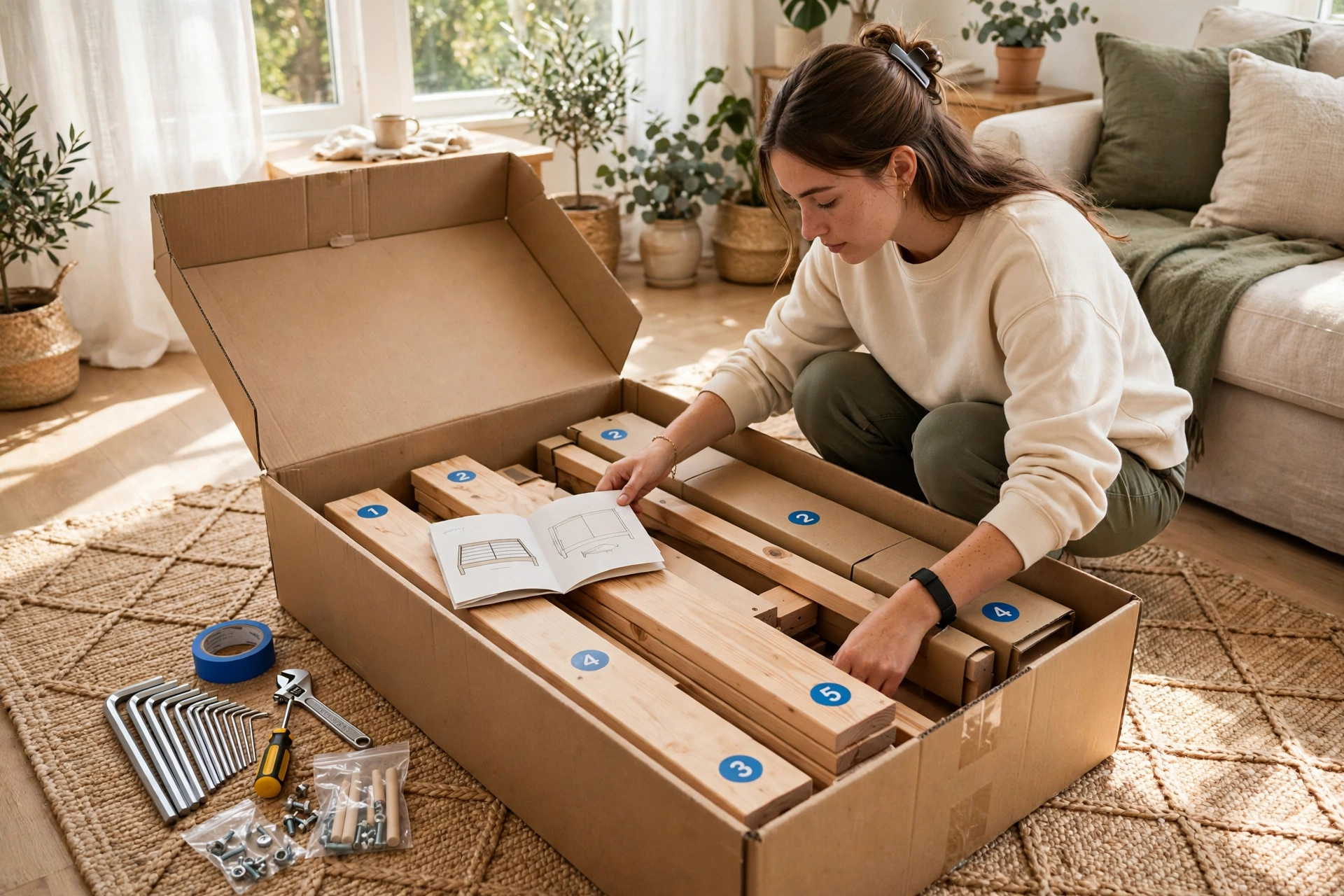
Finally, read the assembly notes. “Parts are labeled and numbered; one person can assemble” is a green flag. “Professional installation recommended” on a $200 item is a polite way of saying your Saturday is gone. I also check the package weight — 58.52 pounds assembled versus 62.3 pounds shipped tells me I can carry the box in alone, with one careful trip.
Rule 3: My 3-Pass Method for Reading Furniture Reviews
Star ratings lie by averaging. A 4.6-star product with two hundred reviews can still be wrong for you. I read reviews in three passes, and it takes about ten minutes.
Pass one: sort by most recent. Furniture listings get quietly redesigned — thinner slats, cheaper hardware — and the listing copy rarely changes. Reviews from the last three months describe the product you will actually receive.
Pass two: read only the 3-star reviews. Five-star reviews are celebrations; one-star reviews are usually shipping complaints. The 3-star reviews are where thoughtful people write “good for the price, but…” — and that “but” is the information you need.
Pass three: search the reviews for three words: “assembly,” “smell,” and “scratch.” Assembly complaints tell you the real build time (multiply the listing’s estimate by two). “Smell” flags off-gassing finishes — real, and worth knowing if the piece goes in a bedroom. “Scratch” tells you whether the finish survives actual life.
Rule 4: The Swatch-and-Screen Trick for Fabric and Color
My beige loveseat disaster was a color problem, not a quality problem. Screens lie about color — every phone renders gray a little differently, and “greige” on a product photo can read warm tan on your couch in person.
The fix is boring but effective: order a fabric swatch whenever the store offers one, and compare it to your existing furniture in daylight, not under your kitchen LEDs. If no swatch is available, screenshot the product and look at it on two different screens — your phone and your laptop. If the color shifts dramatically between them, pick a safer shade.
I also photograph my room, then hold the phone photo next to the product photo. It sounds silly. It has saved me from three clashing purchases, including one “walnut” finish that was, in reality, orange.
Rule 5: Do the Return-Policy Math Before You Click Buy
This is the rule that separates a confident purchase from a gamble. When you buy furniture online, you are trading the showroom test-sit for a return window — so know exactly what that window costs you.
“Free returns” usually means free for small parcels. A 62-pound bed frame is freight, and many stores charge return shipping of $50 to $150 on oversized items (my estimate based on standard freight quotes; check your store’s policy page for the exact number). Some charge a 10 to 25 percent restocking fee on top.
So before I buy, I do thirty seconds of math: item price minus potential return cost equals my real risk. A $288 bed frame with a $75 return shipping fee means I am risking $75, not $288. If that number feels acceptable, I click buy. If it does not, I keep looking. This single habit is why I sleep fine after every order.
Rule 6: Pick Your Delivery Tier on Purpose
Furniture delivery is not one thing — it is usually three, at three prices. Threshold delivery (the box lands at your door) is cheapest and fine if you can haul a 62-pound box yourself. Room-of-choice delivery gets it to the bedroom but not assembled. White glove includes assembly and packaging removal, and it can cost as much as the furniture on budget pieces.
My rule: match the tier to the piece. A flat-pack bed frame with numbered parts and clear instructions? Threshold delivery, and I assemble it myself with a podcast on. A 150-pound dresser with drawers that need leveling? That is when white glove earns its fee. Paying for assembly on a piece designed for one person to build is just donating money.
Rule 7: My 7-Item Buy-Furniture-Online Checklist
Here is the actual checklist I run through before every order — it lives in my phone notes:
- Measurements: doorway diagonal, room tape layout, stair/elevator clearance — all confirmed.
- Specs: materials matched to the room, weight capacity and support structure verified with real numbers.
- Reviews: 3-pass method done — recent reviews, 3-star reviews, searched “assembly,” “smell,” “scratch.”
- Color: swatch checked in daylight, or product photo compared across two screens.
- Return math: worst-case return cost calculated and acceptable.
- Delivery tier: threshold, room-of-choice, or white glove — chosen deliberately, not by default.
- Assembly plan: who builds it, when, and whether I need a second pair of hands for the heavy step.
What the Numbers Say About Buying Furniture Online
I am not the only one doing this. Statista’s U.S. furniture retail data (updated May 2026) puts U.S. furniture e-commerce revenue at nearly $134 billion in 2025, against a broader U.S. furniture market above $250 billion. The average American spent about $648 on furniture in 2024, per the same Statista dataset.
Globally, Mordor Intelligence sizes the online furniture market at $131.4 billion in 2025, with North America holding a 36.17 percent share — the largest of any region. And industry research summarized by Reanin finds that over 65 percent of furniture buyers now start their search online, with more than 40 percent completing the purchase digitally.
The takeaway: buying furniture online is no longer the risky alternative. It is the default. The shoppers who do it well are not braver — they just measure first.

The verdict: Four years and fourteen pieces later, my system has a simple shape: measure the journey, read the specs, mine the reviews, verify the color, price the return, choose the delivery, and plan the assembly. It takes about twenty minutes per piece, and it turned online furniture shopping from a gamble into a routine.
If you want a concrete example to practice on, look at a listing with real numbers — the queen bed frame with a charging station lists its full dimensions (87.8 by 61.8 by 39.2 inches), its slat count (13 metal slats), its support legs (9), and its package weight — exactly the kind of spec transparency this whole guide depends on. Browse the full furniture collection the same way: specs first, photos second.
Ready to shop with confidence?
Start with the pieces that carry full specs and honest measurements — see the exact $288 bed frame I used as my measuring example, or explore everything at FLNORW MALL.