I Bought a $199 Farmhouse Coffee Bar Cabinet. My Drive-Thru Habit Never Stood a Chance.
Every weekday at 7:40 in the morning, I am the car at the front of the drive-thru line ordering the same large latte. Same order, same nod from the barista who now recognizes my voice through the speaker. With tip, it lands around six bucks. I did the phone math sitting in that lane one Tuesday: Toast’s restaurant trends data put the median café latte at $5.60 in late 2024, up nearly 4% from the year before, and the World Coffee Portal’s Project Café USA 2025 report pegged the average 16-ounce latte at more than $5 across a $54 billion US branded coffee shop market with 42,700-plus outlets. My habit, at 250 workdays, cost roughly $1,400 a year.
But here is the unglamorous part that kept me from quitting the drive-thru: my kitchen had nowhere to put a proper coffee setup. The drip maker lived wedged behind the toaster. Mugs were stacked two deep in the cabinet over the sink. The bag of beans sat clipped shut next to the microwave. Brewing coffee at home felt like assembling and tearing down a lemonade stand every single morning, so I kept driving to the window instead.
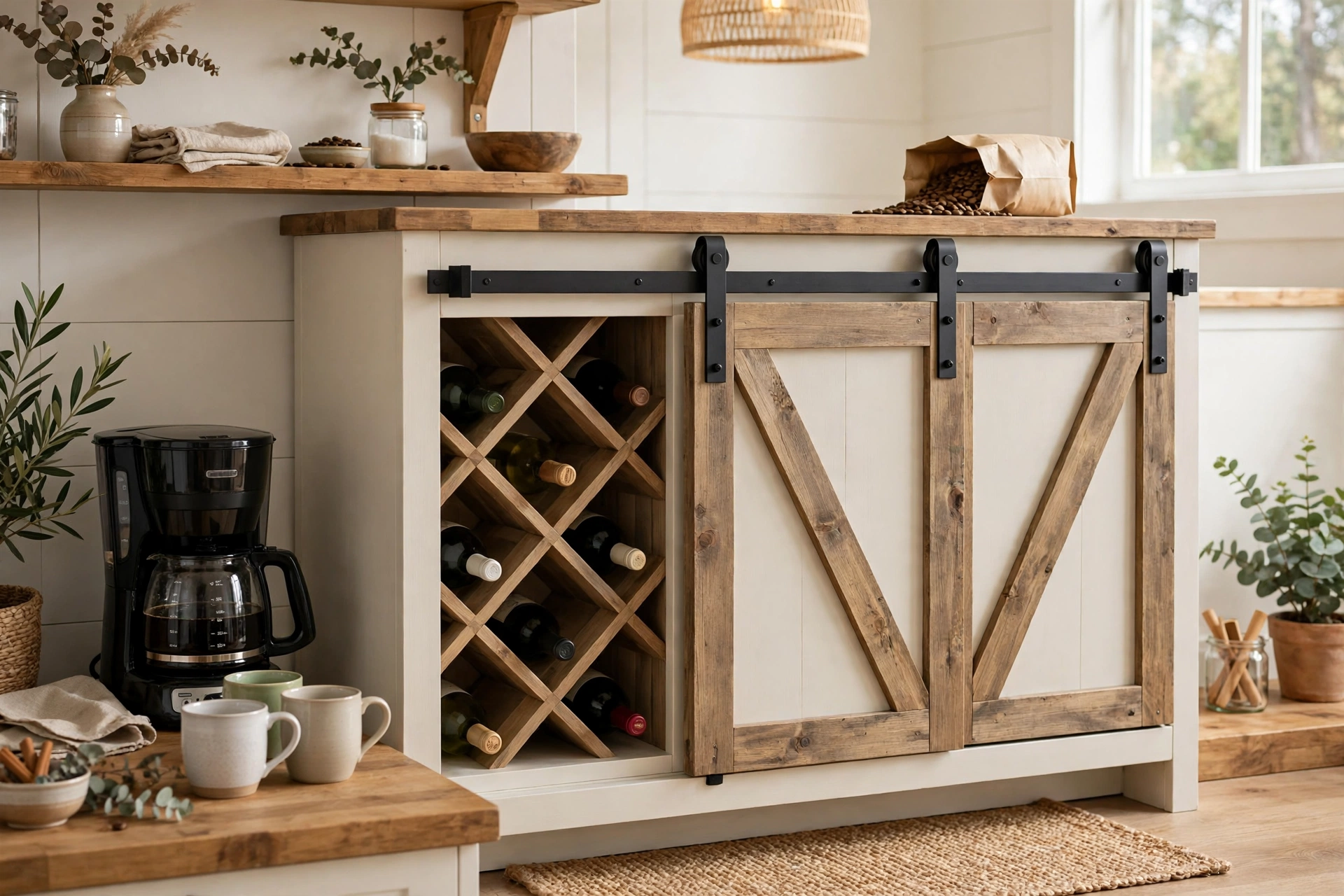
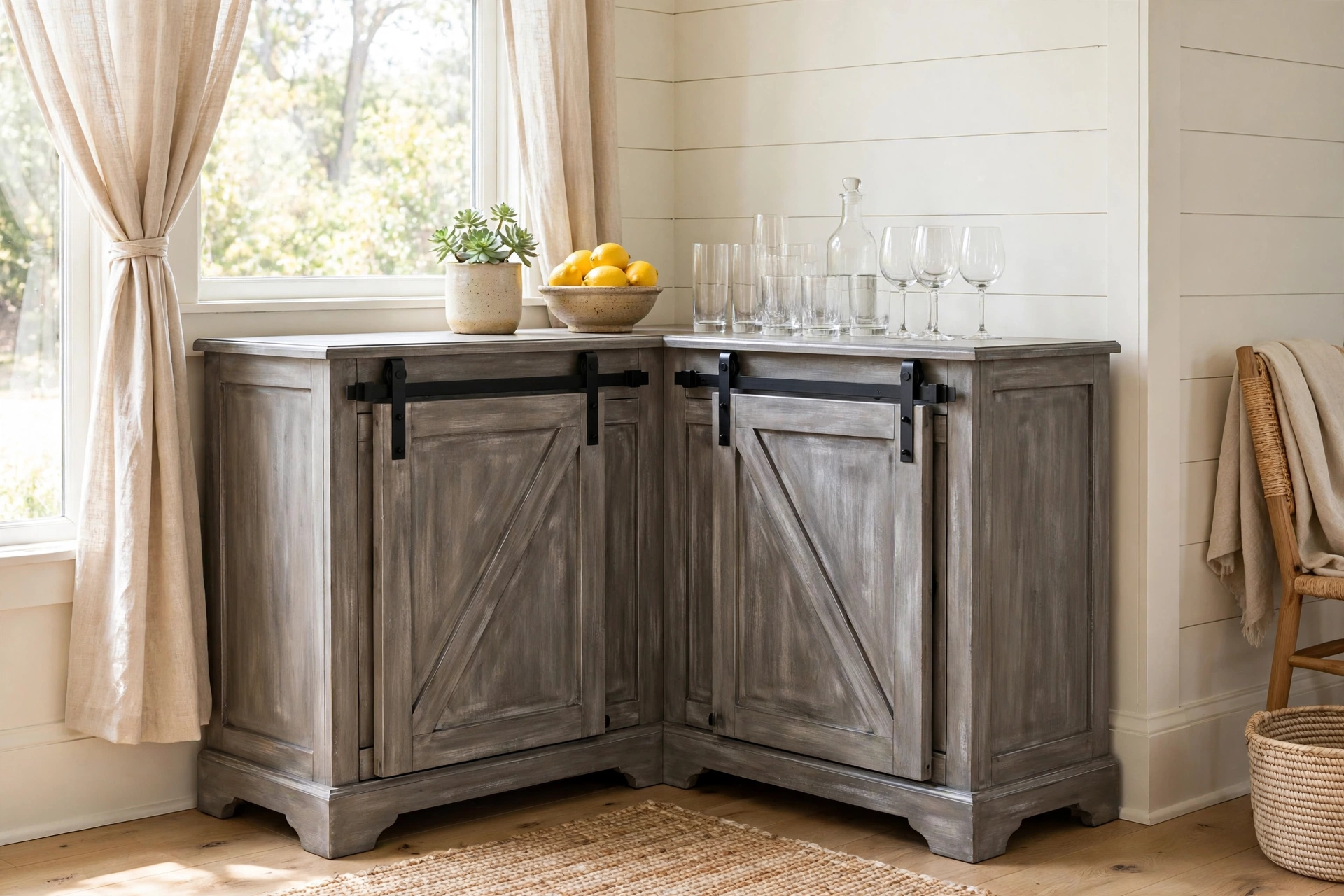
The fix, as it turned out, was furniture — not willpower. I bought the Farmhouse Coffee Bar Cabinet with Wine Rack from FLNORW MALL. $199, in stock, item code W2275P149107: a gray-wash MDF sideboard, 31.5 inches wide, 15.75 deep, 31.5 tall, weighing 61.6 pounds, with a 9-bottle wine rack, a drawer, adjustable shelves, and sliding barn doors with a vintage metal handle. Three months later, here is the honest accounting — including the café math that convinced my skeptical spouse.
What the $199 actually gets you
Strip away the marketing language and you get a compact, 31.5″ x 15.75″ x 31.5″ buffet cabinet in gray wash (there is also an Espresso option) built from MDF. The top compartment is a 9-bottle wine rack flanked by two big storage bays for glasses, the middle holds a single drawer and adjustable shelves behind sliding barn doors, and the whole thing rides on a vintage metal handle design that does most of the farmhouse aesthetic work. All parts arrive labeled in numerical order with picture-based instructions — the product page is blunt about this being a one-person, one-afternoon job, and it was.
The footprint is what sold me first. At barely 16 inches deep, it fits a wall nook or the end of a counter run where a standard 24-inch-deep buffet would jut out and collect hip bruises. The 61.6-pound weight is the sweet spot: heavy enough that it does not shimmy when you slam the barn door, light enough that two people can reposition it without a dolly.
The café math that sold me
I am not a spreadsheet person, but I made one for this. Here are the numbers, with the home-brew cost flagged as a rough estimate:
- Café latte (Toast, Q3 2024 median): $5.60
- Home latte (my rough estimate: milk + beans): about $1.00
- Saved per cup: roughly $4.60
- 250 workdays at the drive-thru: about $1,400 a year
- Cabinet cost: $199
Divide $199 by $4.60 and the cabinet “pays for itself” in about 43 coffee days — roughly two months of skipping the line. Everything after that is money you simply never spend again, year after year. And the 9-bottle wine rack comes along for free inside the same $199, which matters because a standalone wooden wine rack of similar capacity is its own purchase you no longer have to make.
Does the math assume you actually stop buying lattes? Yes. In my case, the station made home coffee easier than the drive-thru — everything in arm’s reach, no setup — and that is the part of the equation people leave out. A coffee station you have to assemble every morning does not replace anything. This one did.
Building my home coffee station on top of it
The 31.5-inch top is exactly enough real estate for a working station without clutter. My 12-cup drip maker is 9 inches wide; it sits left. A mug tree with six mugs sits right. Between them, the bean canister and a small pour-over dripper, with room to spare for the travel mug I grab on the way out. The single drawer swallowed the chaos: pods, paper filters, the little scoop, two spare lids, sugar packets my kids steal for their oatmeal.
The adjustable shelves were the quiet win. I dropped one shelf a notch to stand the 11-inch French press upright inside the cabinet instead of leaving it on the counter, and raised another to clear the tall oat-milk carton. That is the kind of flexibility a fixed-shelf cabinet cannot fake. The surface is smooth MDF — per the product page it cleans with a damp cloth, and three months of coffee rings confirm it: wipe, gone, no staining. I did put a cork trivet under the coffee maker anyway, because heat and steam are how MDF edges get sad over time.
The wine rack earns its keep on Fridays
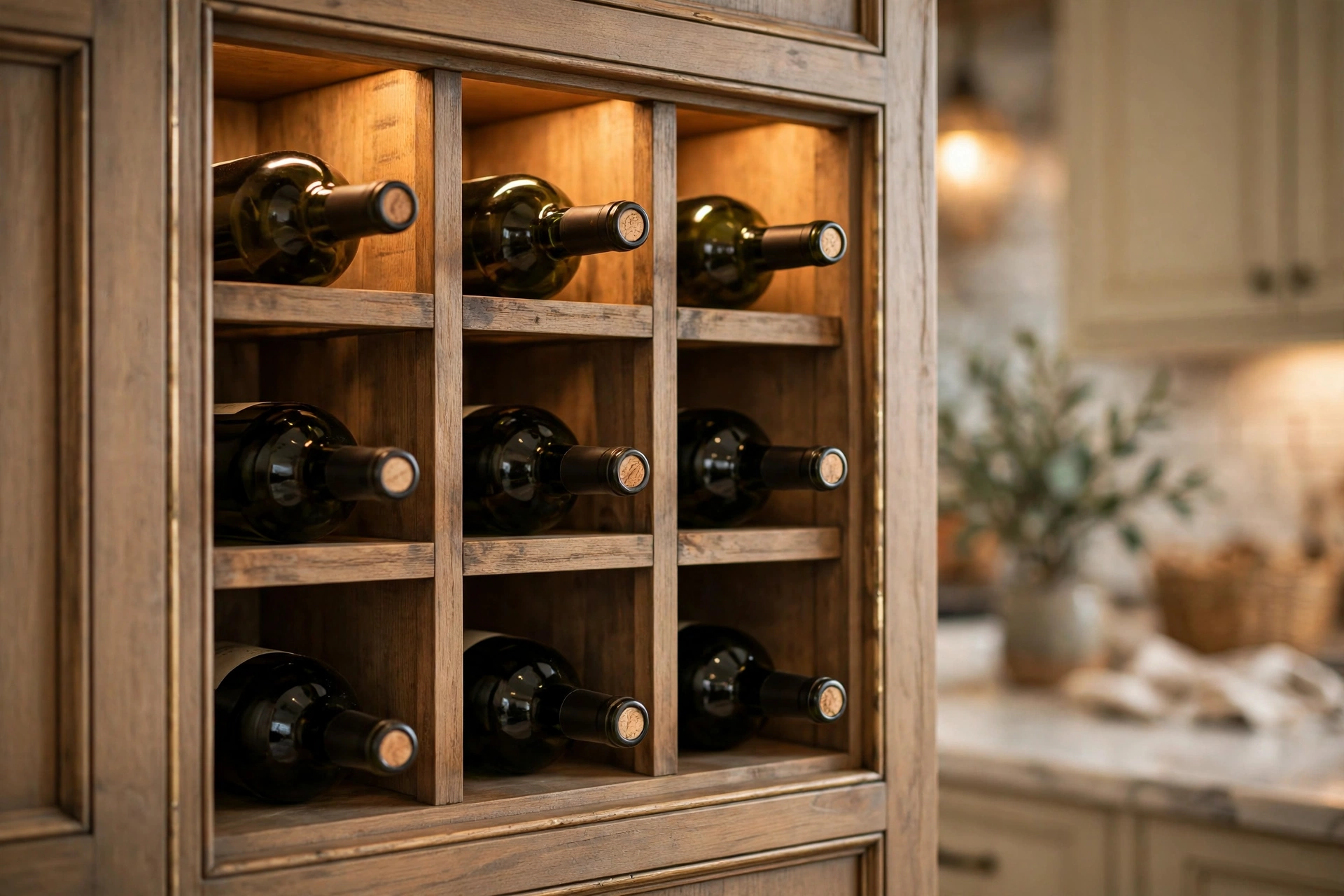
The 9-bottle wine rack was the feature I bought for and the feature I underestimated. Weeknights, it holds the six bottles we actually drink plus a couple of gift bottles aging in the dark of the cabinet. On Fridays, my wife and I pick one without opening a closet or digging behind the pantry cans. When my brother-in-law shows up with bourbon, the two big storage bays swallow the glasses and the bottle without a reorganization meeting.
Dinner-party math: eight guests, one cabinet, everything — bottles, glasses, the corkscrew in the drawer — in a 16-inch-deep footprint against the dining room wall. Before this, the same event meant the kitchen counter disappeared under clutter and someone’s wine glass lived dangerously close to the stove. The barn doors slide closed and the whole operation vanishes when the night is over.
Five rooms it actually works in
I have now mentally moved this cabinet through half the house. It works in all of these:
- Kitchen nook — the coffee station, obviously. Sixteen inches deep means it tucks beside the fridge or under a window without blocking traffic.
- Dining room — as a buffet: wine rack loaded, serving dishes on top, linens in the cabinet. The barn doors close between meals and it just looks like a sideboard.
- Entryway — keys and mail in the drawer, a bowl on top, shoes banished to the closet. Guests see farmhouse charm instead of your life admin.
- Living room corner — as a small buffet sideboard under a mirror: plants, framed photos, and the wine rack quietly holding the good bottles.
- Home office corner — the 3 p.m. slump station: coffee maker on top, snacks in the cabinet, no more kitchen expeditions that turn into twenty lost minutes.
Assembly day and living with MDF
Assembly took me about 45 minutes with a Phillips screwdriver and no swearing — the parts really are numbered and the pictures do the talking. One tip from experience: tighten the barn-door rail screws, then re-tighten them after the first month. Mine had loosened a hair from daily sliding, and a quarter-turn fixed the slight wobble permanently.
Living with MDF requires exactly one rule: water does not sit on it. Wipe spills immediately and it looks new; let a puddle linger and the edges will tell on you in a year. Beyond that, maintenance is a damp cloth and a coaster under anything hot or constantly damp. The vintage metal handle has not tarnished, the gray wash hides dust better than any white furniture I own, and the barn doors still glide on the rail with one finger.
Two honest gripes
No review is honest without them. First: one drawer, not two. A coffee station generates small-item chaos — pods, filters, stirrers, spare lids — and I fill the single drawer to capacity. If you are a serious wine collector or a maximum-storage person, look at the $269 Farmhouse Buffet Cabinet on FLNORW MALL: same barn-door farmhouse look, but 39.37 inches wide, two drawers, and 12 removable wine racks instead of 9. It costs $70 more and weighs 90 pounds, so you are trading compactness for capacity.
Second: measure your appliances before you buy. The 31.5-inch height is perfect for drip makers and pour-overs, but some tall espresso machines with top-loading water reservoirs need more vertical clearance than this cabinet’s top-plus-wall space allows. And the color range is just Espresso and Gray — if your kitchen is all white shaker cabinets, the gray wash will contrast rather than match. If you want a lighter, display-forward look instead, the $288 glass-door storage cabinet in white steel and tempered glass is the airier alternative on the same site.
Verdict: the $199 test
Three months in, my drive-thru visits have dropped from five a week to maybe one — the Friday treat run, which I have decided to keep on principle. The cabinet paid for itself around week nine by my math, and the wine rack turned Friday nights into a ritual instead of a rummage. It is not heirloom furniture; it is honest, compact, good-looking MDF that does two jobs — home coffee station and wine rack cabinet — in a footprint smaller than a dishwasher.
If you spend $4 or more a day at a café and have a 32-inch patch of wall anywhere in your home, the math is not close. And if you need more storage than this one offers, the $269 Farmhouse Buffet Cabinet with its 12 wine racks and double drawers is the natural step up — both are on FLNORW MALL, both in stock as I write this.
Get the Farmhouse Coffee Bar Cabinet with Wine Rack — $199 at FLNORW MALL