I Swapped My Dog’s Ugly Wire Crate for a $288 Furniture Crate. Two Months Later, the Honest Verdict.
For three years, the single ugliest object in my living room was a black wire dog crate. It sat in the corner by the window, rattling every time my beagle mix stretched, collecting dust on bars I could never quite clean, and photobombing every picture I took of my “nice” living room. I tried a crate cover. It looked like a tablecloth draped over a jail cell. Then a friend sent me a link to something called dog crate furniture — a crate disguised as an end table — and I laughed, then clicked, then bought the $288 one. Two months later, here is the full honest accounting.
What dog crate furniture actually is
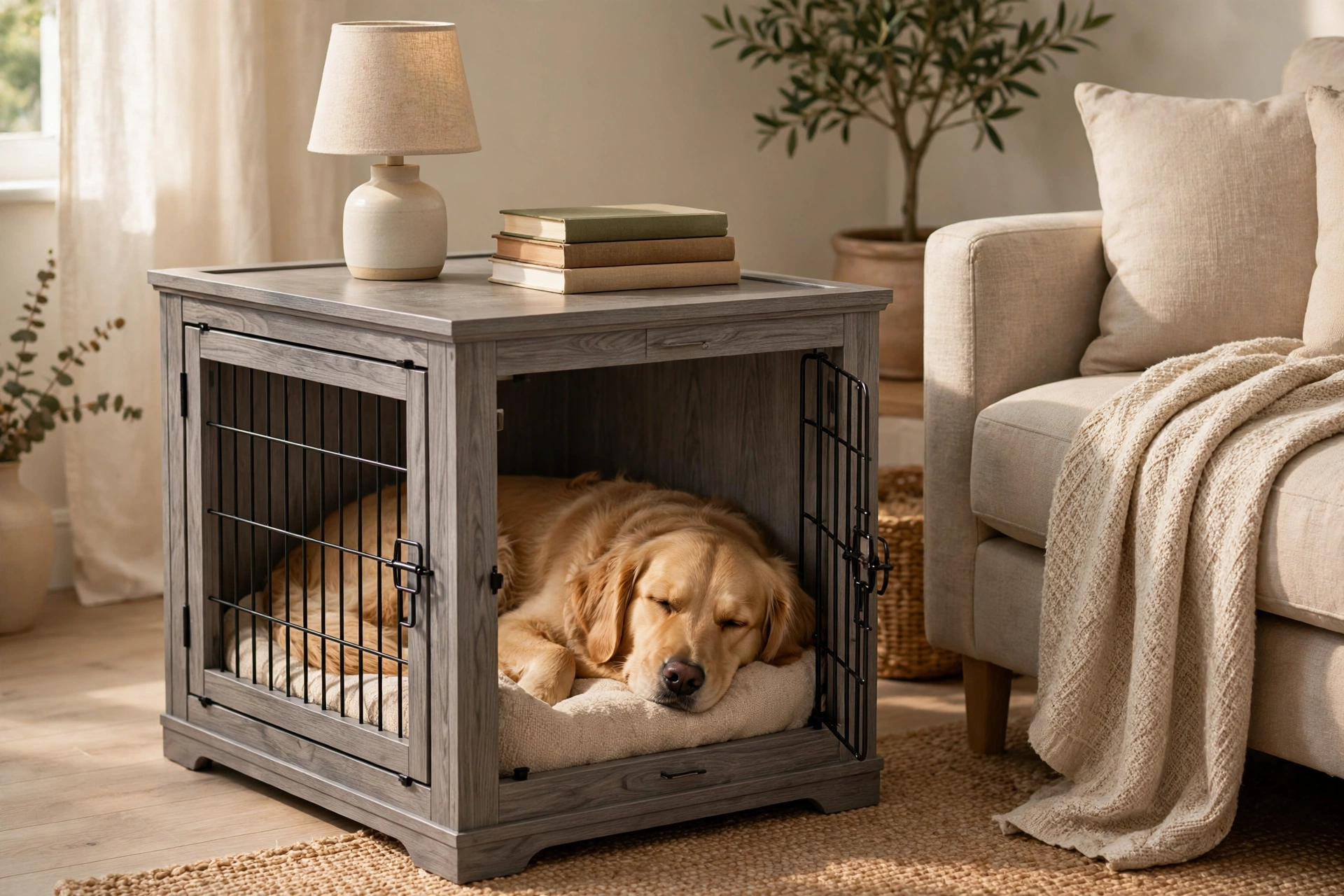
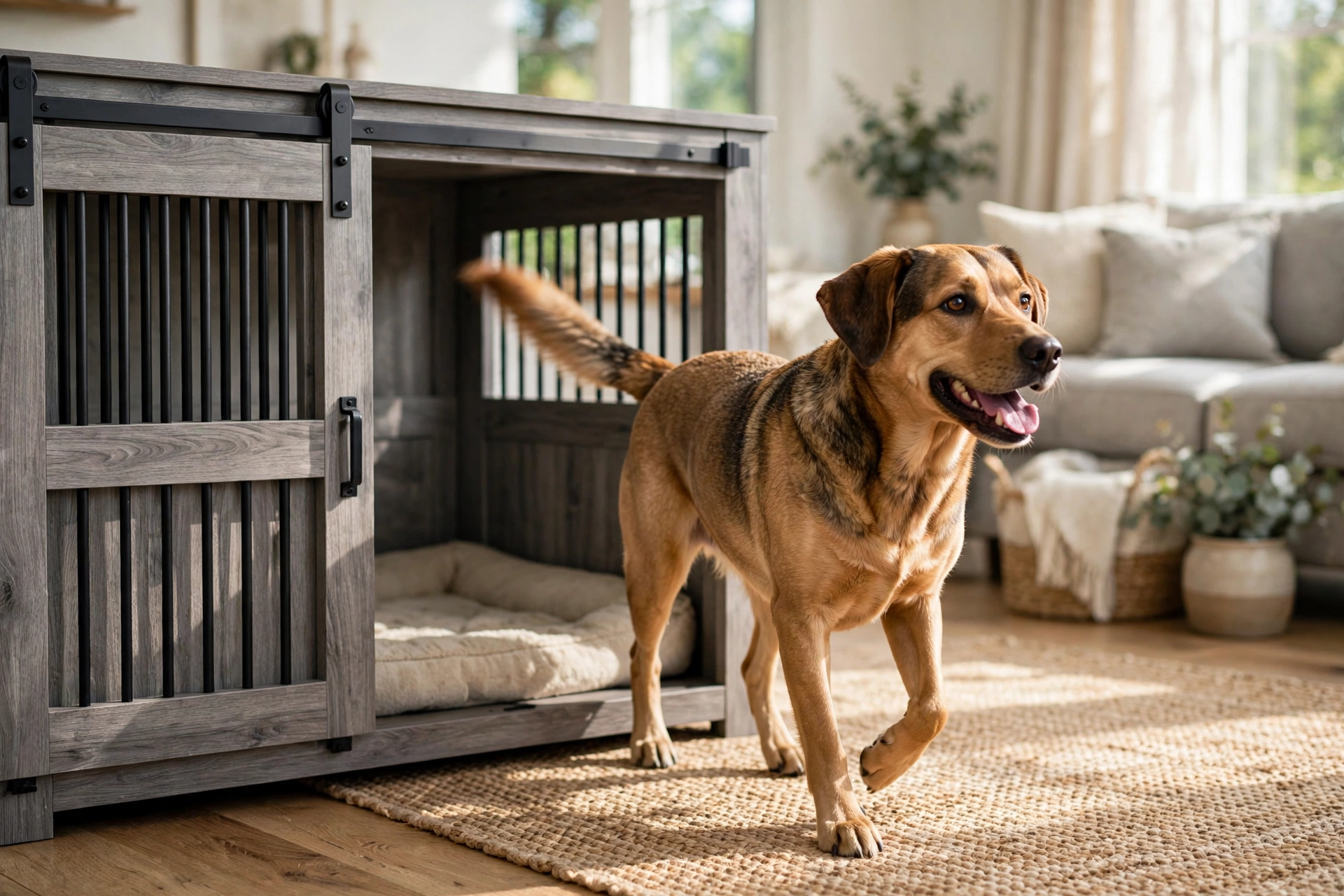
Strip away the marketing and it is a simple idea: a dog crate built inside a wooden cabinet. The one I bought measures 43.7 inches wide, 30 deep, and 33.7 tall, weighs 86.9 pounds, and is made of particle-board panels wrapped around a reinforced iron-frame door. The door slides sideways instead of swinging. A soft mat comes in the box, so there is no separate cushion to buy. It comes in grey and rustic brown — I got grey — and the top is a flat wooden surface explicitly meant to hold things: the product page suggests magazines, family photos, books, and a lamp.
Assembly took me about 40 minutes with a screwdriver and one annoyed dog supervising. The package weighed 95.7 pounds, so if your delivery driver leaves it at the curb, recruit help — I am not embarrassed to admit my neighbor carried one end up the porch steps.
The wire-crate shame is real, and I am done pretending otherwise
Here is the part nobody writes in reviews: a wire crate makes your living room look like a kennel annex. Mine sat next to a sofa I had carefully chosen, and every guest got the same tour moment — “oh, and that is Biscuit’s… area.” I started angling it behind furniture for photos. When my sister visited with her toddler, the first thing the kid did was rattle the bars like a xylophone.
The furniture style dog crate ended all of that in an afternoon. It now sits exactly where the wire crate sat, but guests see an end table with a lamp on it. Twice now, visitors have set their coffee on it before noticing the dog inside. Biscuit, for the record, could not care less what the outside looks like — but I can, and I do.
The sizing math: measure your dog, not your room
This is where most crate purchases go wrong, so here is the rule straight from the manufacturer’s own guidance: the crate should be about 4 to 6 inches longer than your dog’s body length (nose to base of tail) and 4 to 6 inches taller than the shoulder height. At 43.7 inches long, this crate comfortably fits dogs up to roughly 37 inches long — think beagles, corgis, French bulldogs, cocker spaniels, and smaller border collies. My Biscuit is 34 pounds and 30 inches nose-to-tail, and she can stand, turn, and sprawl without touching a wall.
Measure like this:
- Have your dog stand. Measure nose to base of tail, then add 4 to 6 inches. That is your minimum crate length.
- Measure floor to top of the shoulder (or ears, whichever is taller), then add 4 to 6 inches. That is your minimum height.
- If your dog is still growing, size for the adult dog — buying twice is the most expensive option.
- When in doubt between sizes, go bigger. A slightly roomy crate beats one your dog outgrows in six months.
Yes, the top genuinely works as a side table
I was skeptical. An 87-pound cabinet with a dog shifting around inside — would my lamp wobble every time Biscuit turned over? Two months in: no. The cabinet is heavy and rigid enough that the top is dead stable. I keep a table lamp, a coaster, and whatever novel I am reading on it. The product page is not exaggerating when it calls out headroom for lamps and books.
One honest note: the manufacturer does not publish a top weight rating, so I keep it to normal side-table duty — lamp, books, a small plant, maybe 25 pounds total at my rough guess. It has never complained. Do not put your 50-pound aquarium on it. Use judgment.
The sliding door is the feature nobody talks about
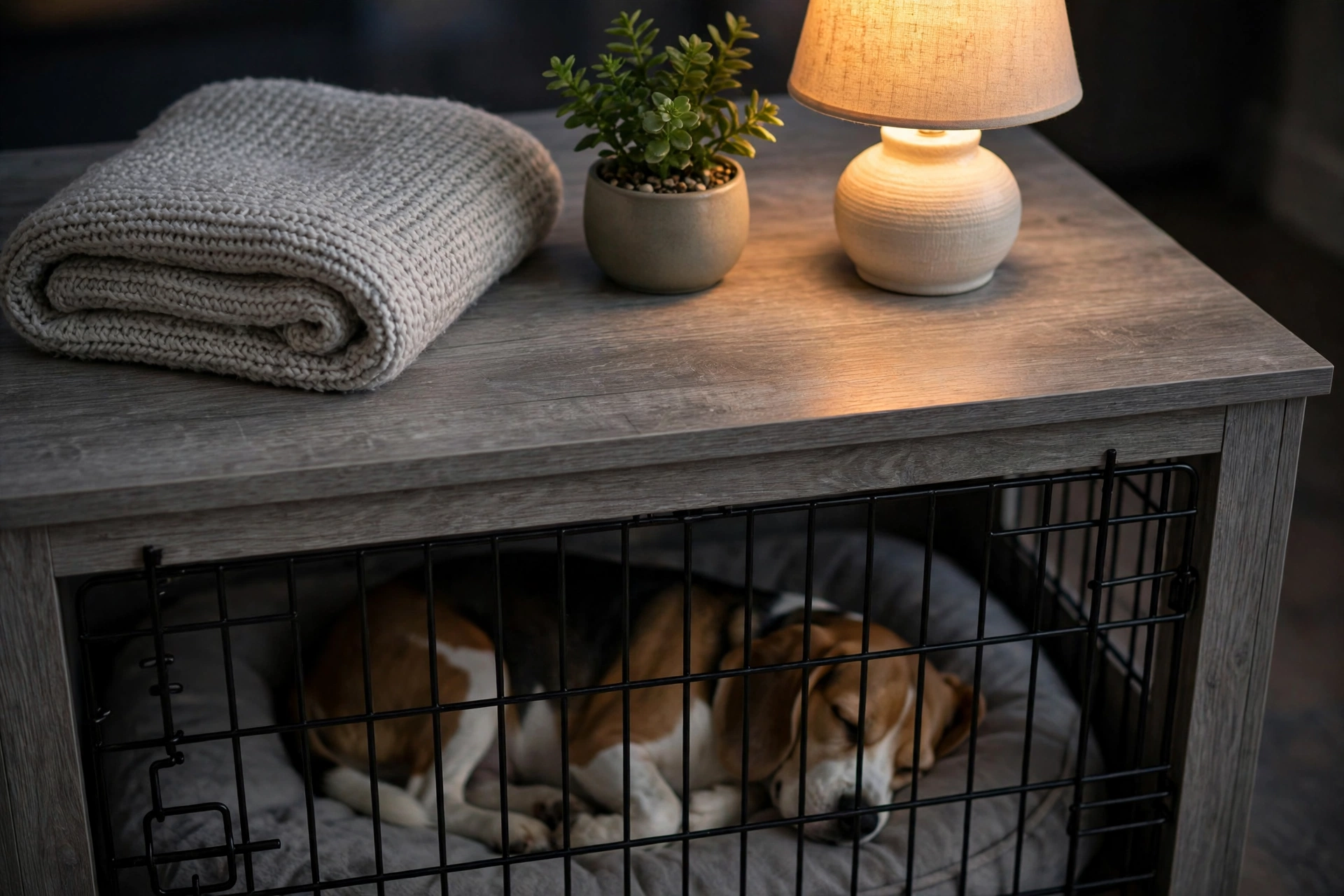
Every wire crate I have owned had a swing door, and every swing door needed two feet of clearance to open. In a small living room, that clearance is real estate. This crate’s iron door slides sideways on a track, so the crate can sit flush against a wall or in a hallway nook and still open fully. It is the kind of detail you do not appreciate until you have lived with the alternative.
The slide action works one-handed — useful when you are carrying a leash, a treat bag, and a coffee. The latch is a simple sliding bolt. A clever toddler could probably figure it out, but so far Biscuit has shown zero interest in engineering her way out.
Two honest complaints
First: it is particle board, not solid wood. That is how you get a good-looking crate for $288 instead of $800. The panels are thick and the finish looks convincing, but this is not heirloom furniture. If your dog is a serious chewer who gnaws furniture, this is not your crate — a determined dog will eventually win against particle board, and you should be looking at a steel crate instead.
Second: the included mat is thin. Fine as a starter, and Biscuit used it happily for a week, but I upgraded to a thicker orthopedic pad within days. Budget another twenty or thirty dollars for a real cushion if your dog is older or bony — that is my estimate, but a realistic one.
The cost math: $288 versus a wire crate plus an end table
Let us do the honest arithmetic, with rough numbers flagged as rough. A decent large wire crate runs about $70 to $100. A decent-looking end table runs $80 to $150. Bought separately, you are at $150 to $250 — and you still have a wire crate ruining the corner. The furniture crate is $288, so the “disguise premium” is roughly $40 to $140 over the piecemeal route.
Now compare upward: custom or boutique dog-crate furniture — the kind from specialty pet-furniture shops — routinely runs $800 to $1,500 and up, often with a six-week lead time. Against that, $288 looks less like a splurge and more like the sensible middle. My verdict on price: fair, not a steal, and worth it if the crate lives anywhere guests can see it.
And the broader market says this category is no fad. The American Pet Products Association’s 2023-2024 survey found that 66% of U.S. households — 86.9 million homes — own a pet, with 59.1 million households owning dogs, and Americans spent $147 billion on their pets in 2023. When nearly two-thirds of the country has an animal in the house, pet gear stops being garage equipment and starts being furniture.
The verdict
Who should buy it: anyone whose dog’s crate lives in a living room, bedroom, or anywhere visible; owners of calm, crate-trained dogs past the destructive chewing phase; renters who want furniture that does double duty; or anyone simply tired of apologizing for a wire box in the corner.
Who should skip it: owners of escape artists or power chewers — for those dogs, a heavy-duty steel crate with dual latches is the honest answer, and at $299 it is built like a tank. Skip it too for giant breeds: at 43.7 inches long, this is a medium-dog crate, not a Great Dane apartment.
Two months in, the $288 furniture dog crate is the rare purchase I would make again without hesitation. It solved the actual problem — the wire-crate eyesore — without creating new ones: Biscuit sleeps in it nightly, the lamp on top has never wobbled, and my living room finally photographs the way I decorated it. It is particle board, not walnut; the mat needed upgrading; and heavy chewers should look elsewhere. But for a calm medium-size dog in a home where the crate is visible, this is the best $288 I have spent on pet gear in years. For more honest, hands-on reviews like this one, browse the FLNORW MALL blog — and if you are still shopping the range, start at flnorw.com.
Ready to hide the crate? Get the Furniture Dog Crate with Mat — $288, in grey or rustic brown.