Full Over Twin Bunk Bed for Kids: What 90 Days with Our $512 Triple Bed Taught Me
I did not wake up one morning wanting a full over twin bunk bed for kids. I woke up wanting my living room back. We moved in August, and the kids — 12, 9, and 6 — got one shared bedroom, 11 by 12 feet, because the second bedroom had to become my home office. By week three the air mattresses had become campground chic, and my mother-in-law had started visiting monthly. Four sleepers, one room, a $600 budget ceiling. That is how I ended up staring at the full-over-twin triple bunk bed on FLNORW MALL: $512, steel, InStock, one full bed plus two twins. Ninety days later, here is the honest verdict.
Why a Full Over Twin Bunk Bed for Kids Beat the Twin Over Twin
My first instinct was the standard move: a twin over twin, ladder, done. Then I measured my 12-year-old daughter, who is 5’2” and shows no signs of stopping. A twin is 75 inches long. She would outgrow the top bunk in about two years, and I did not want to buy this twice. The full bed on this unit is the bottom sleeping surface — wider, longer feeling, and honestly the bed an adult can sleep on when the in-laws visit and the guest plan falls apart.
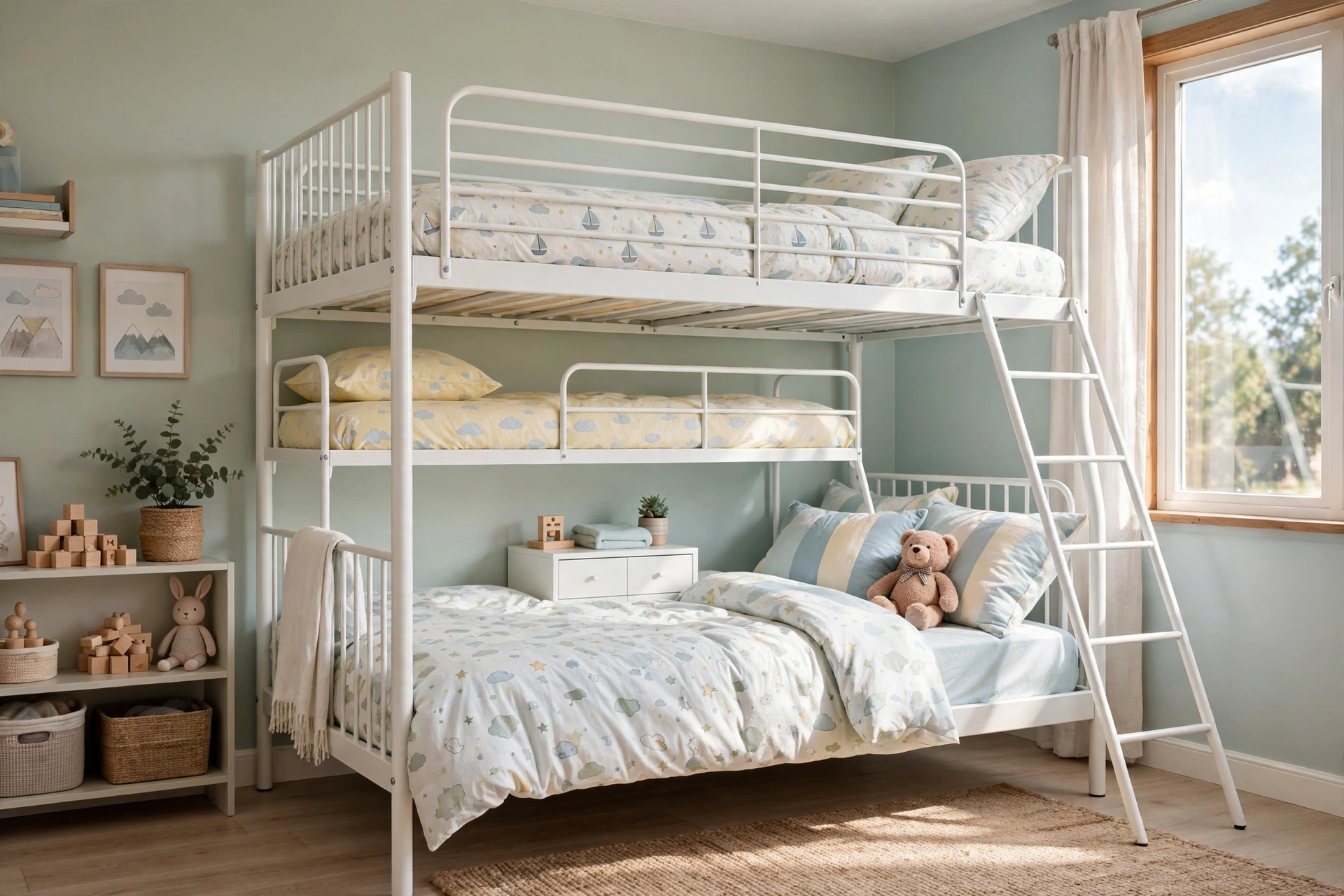
Here is the arrangement: the full goes to my daughter, the top twin to my 9-year-old, the lower twin to the 6-year-old. Three kids, one footprint of roughly 51 square feet in the corner. A separate $268 twin-over-twin metal bunk bed with trundle was the budget alternative I nearly clicked — and for two younger kids it would be the smarter buy — but the full-over-twin layout solved the growing-teenager problem in a way the twin stack could not.
The Specs I Actually Checked Before Paying $512
I have bought enough flat-pack furniture to read spec sheets like a detective. The lines that mattered on this one:
- Weight capacity: 600 lbs upper bed, 400 lbs lower. This is the standout number. Most budget metal bunks rate the top at 200–250 lbs, which means a parent can’t sit up there during a bedtime story. At 600 lbs, my 180-lb self is not a rounding error on this frame.
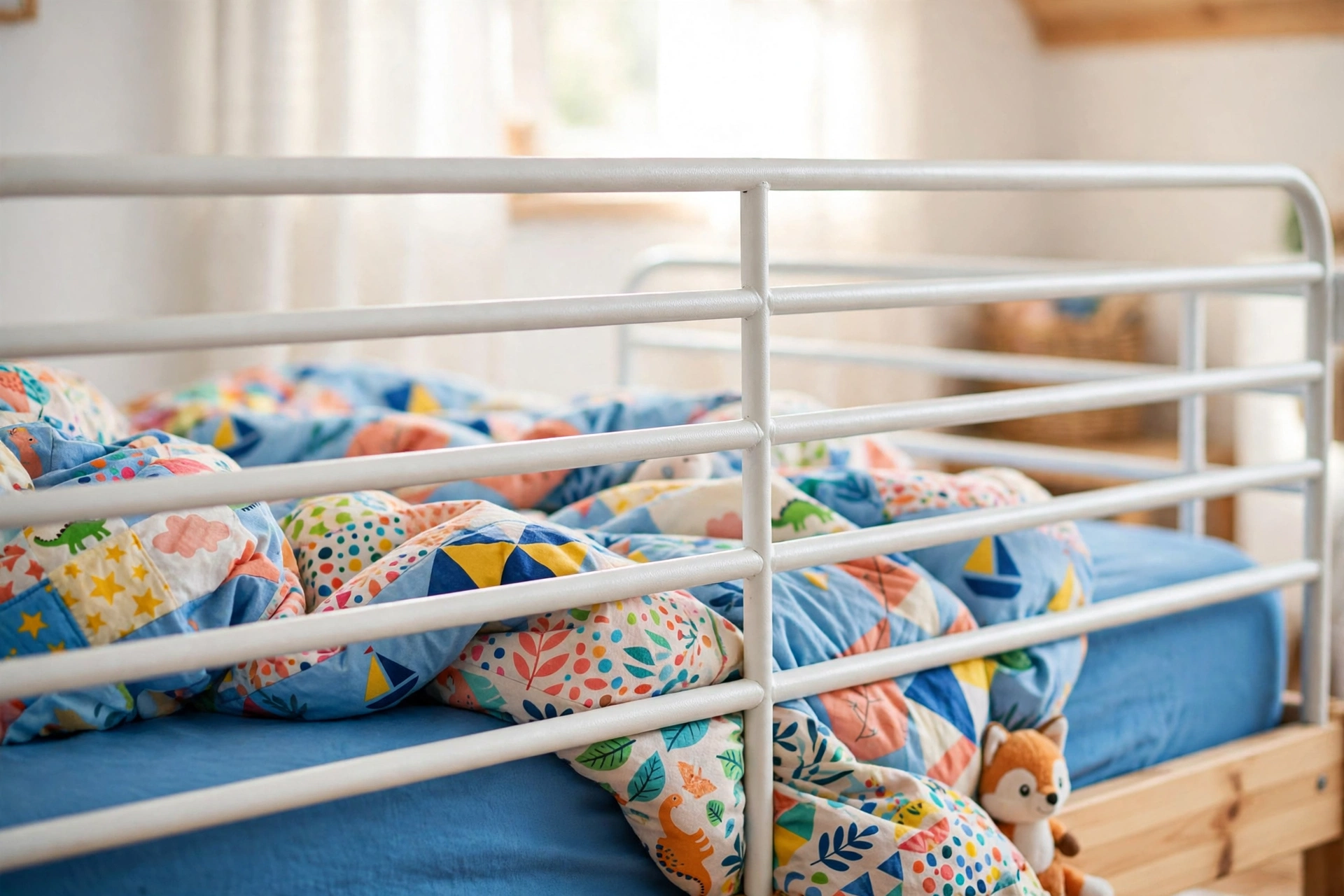
- Full-length guardrail on the upper bed. Not a half rail. The injury data says falls are the whole ballgame with kids’ bunks, and a full-length rail is the single cheapest insurance on the page.
- Overall dimensions: 96.9” L x 76” W x 69” H. I measured the ceiling (8 feet) and the doorway (30 inches — the boxes are flat-packed, it fit) before ordering. Always measure the ceiling; 69 inches tall plus a sitting kid needs that clearance.
- Steel frame, 239.36 lbs total weight. Heavy is a feature here. Light frames announce every toss and turn. This one does not move.
- Built-in nightstand in the center of the lower bed. More on this below — it turned out to be the sleeper feature, no pun intended.
- Item W1162S00007, mattresses not included, some assembly required. White finish.
Ninety Days of Kid-Level Durability Testing
Durability with kids is not a lab test; it is a question of whether the thing survives being used as furniture, a fort, a launch pad, and occasionally a drum kit. Three months in, the report is good and specific. Nothing creaks. Nothing wobbles — I shove-test the top rail every couple of weeks and the whole 239-lb frame barely flexes. The inclined ladder has taken my 9-year-old’s full weight twice a day without a complaint.
The white finish has picked up three small chips, all on the ladder rails, all from toy collisions my children swear had nothing to do with them. A paint marker hides them. The bolts needed one retightening at week six — I found two that had backed out maybe an eighth of a turn, which is why the monthly bolt check exists. That is it. For a steel frame at this price, “nothing loosened beyond a nudge in three months” is about the best durability verdict I can honestly give.
The Built-In Nightstand Does More Than You Think
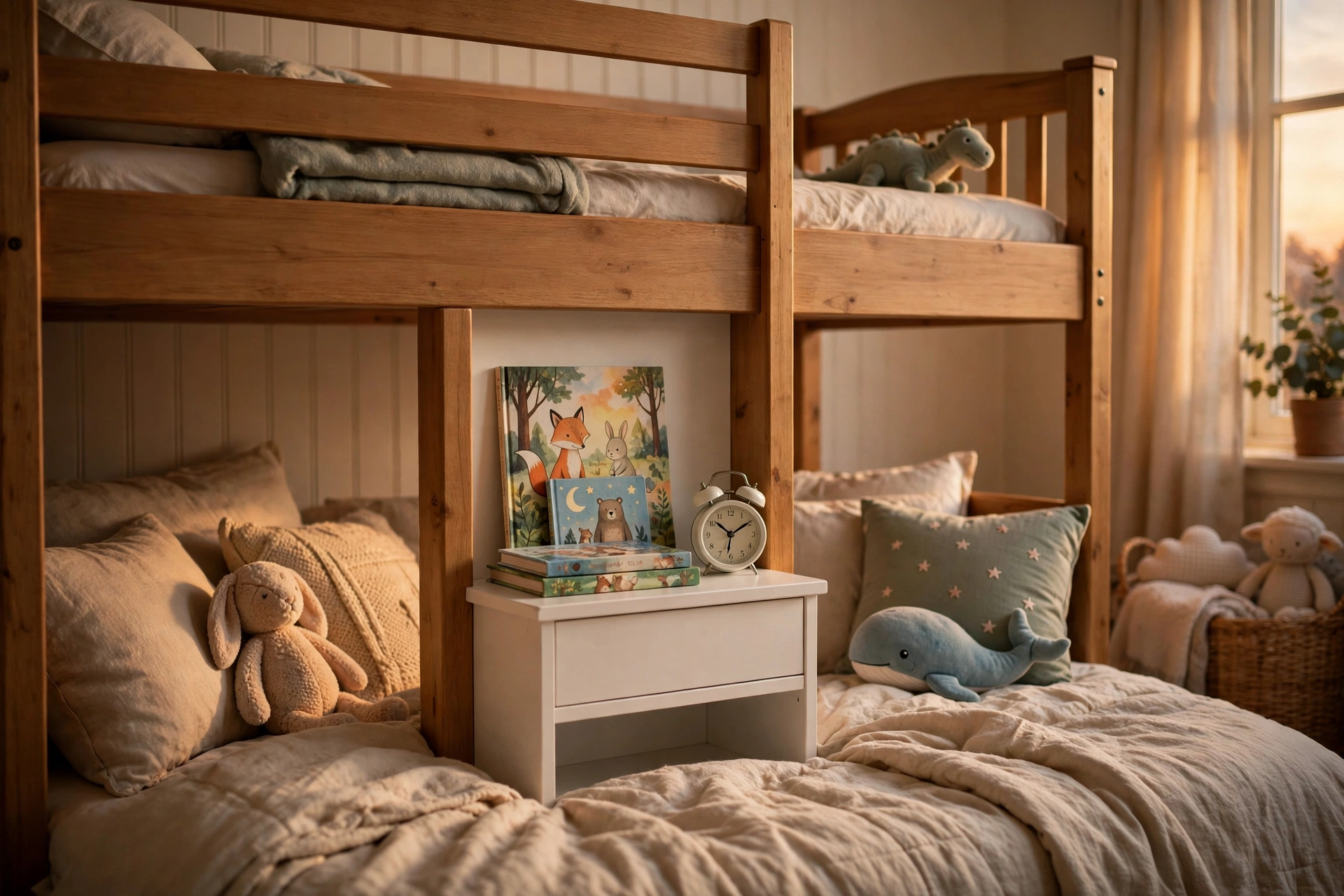
I expected the nightstand to be decorative. It is not. It sits in the center of the lower bed, and in practice it belongs to the kid on the bottom — my 6-year-old, whose entire world now fits in that cubby: a water cup, the alarm clock she demanded after watching her sister’s routine, three picture books, and a headlamp she uses to read under the covers, which I have chosen not to know about.
The dollars work quietly too. A standalone kids’ nightstand runs $30 to $60 and eats two square feet of floor we do not have. This one came free with the bed and occupies space the frame already owned. It is a small thing, but in an 11-by-12 room small things are the whole game.
The $512 Math: Four Sleepers, One Footprint
Three separate twin bed frames at the budget end run about $150 each — $450 before mattresses, and they need roughly 75 square feet of floor once you add walking space and a nightstand or two. We do not have 75 square feet. We have a corner.
The $512 triple bed sleeps four in 51 square feet. Per sleeper, that is $128 — and that figure folds in the nightstand, the full-size bed my teenager will not outgrow, and a frame rated to 600 lbs on top. Stretch the cost over five years (1,825 nights, my rough estimate) and it works out to about $0.28 a night. That is the number that ended the debate with my wallet.
For context on the market I was buying into: the kids’ furniture market was valued at $31.6 billion in 2024, with the beds segment alone at $10 billion, projected to reach $14 billion by 2035 (WiseGuyReports). North America holds roughly 34.7% of a $28.15 billion global market (Fortune Business Insights). The growth is in exactly this corner — beds that stack functions in small rooms, because square footage is expensive and furniture that multiplies sleepers per square foot is how small rooms win.
The Honest Complaints
Nothing is perfect, and I would not trust a review that found nothing wrong.
Assembly is a two-person job. The page says “some assembly required,” which translates to about an hour and ten minutes with my brother-in-law, two very heavy boxes (over 260 lbs across two packages), and one moment of staring at the ladder diagram. Nothing had to be undone, which in flat-pack terms is a win — but do not plan to do this solo.
Mattress thickness is a safety number, not a suggestion. Mattresses are not included, and here is the trap: the federal guidance calls for the rail to extend at least 5 inches above the mattress top — I put a 6-inch twin on top and an 8-inch full below, and measured the rail clearance myself. Put a 10-inch pillow-top up there and you have turned a full-length guardrail into a decorative suggestion.
It is a ladder bed, not a stairs bed. My 6-year-old handles the inclined ladder fine in daylight, but the 2 a.m. bathroom trip is a parent-escort situation. If you have a kid under eight climbing nightly, stairs beat ladders — I wrote up the full comparison in our house bunk bed with stairs review, and the conclusion holds: pay for stairs if the midnight climb is a daily reality.
White shows everything. Scuffs, fingerprints, the mysterious sticky spot. If your kids are under seven, pick a darker finish or keep a paint marker in the nightstand. Ask me how I know.
The Safety Rules We Enforce (Because the Data Scared Me Straight)
Before this bed arrived I read our bunk bed safety guide twice. Researchers analyzing US emergency department data from 2001–2004 estimated about 23,000 children aged 0 to 9 treated each year for bunk-bed fall injuries, including roughly 14,600 under 6, with about 3.2% hospitalized (Injury Prevention, 2007). The older CPSC record behind the mandatory safety standard — effective June 19, 2000 — reported 91 bunk-bed-related deaths of children under 15 between 1990 and 1999, and roughly 34,300 injuries in 1998 alone. Falls from the top bunk during sleep caused 35.1% of accidents in a 218-case retrospective. In March 2025, the CPSC recalled about 1,172 Interior Resources children’s steel bunk beds for guardrail spacing wider than federal rules allow.
Our house rules, stolen wholesale from that reading:
- Nobody under 6 on the top bunk. The 6-year-old sleeps below. Non-negotiable.
- The 5-inch rail check. Tape measure, mattress in place, rail top to mattress top, both sides. Ours clears it with room.
- First Sunday bolt check. Five minutes, quarter-turn test on every bolt. The week-six loosening was caught this way.
- No jumping on any bunk. Every weight rating assumes a sleeping child, not a trampoline audition.
- Night light at the ladder. A six-dollar plug-in LED at the ladder base. Cheapest safety upgrade on earth.
Who Should Buy This — and Who Shouldn’t
Buy this full over twin bunk bed for kids if you have three or more sleepers and one room, if one of your kids is growing out of twin territory, if you want a frame a parent can sit on without doing structural math, or if your guest plan regularly collapses into “someone sleeps in the kids’ room.” The 600-lb top rating and the full-size bottom surface are what make it a 10-year purchase instead of a 3-year one.
Skip it if you have low ceilings (69 inches plus a sitting kid needs the full 8 feet), if your youngest is under six and would live on the top bunk, or if your midnight ladder traffic runs through an under-eight-year-old — in that case, look at a stairs model instead. And if it is just two small kids, the cheaper twin-over-twin will do the same job for half the money.
The verdict. Ninety days, three kids, one paint marker: this full over twin bunk bed for kids earned its $512 — four sleepers in 51 square feet, a nightstand that saved me a separate purchase, guardrails that pass a tape measure, and a frame heavy enough that the house’s small earthquakes register as nothing. In an 11-by-12 room with a $600 ceiling, I would make this trade again tomorrow.
Shop the bed: see the full specs, photos, and current price of the Full Over Twin & Twin Metal Triple Bunk Bed with Nightstand and Guardrails at FLNORW MALL — or compare it with the $268 twin-over-twin metal bunk bed with trundle if your crew is smaller and your budget tighter.