Living Room Lighting: My Three-Layer Plan That Finally Made It Cozy
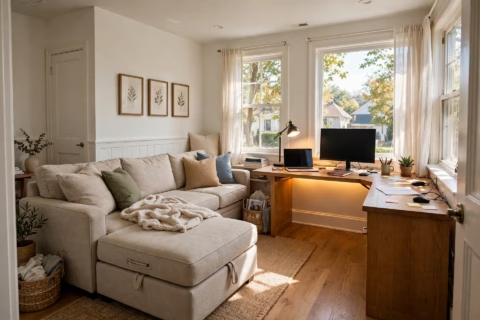
For three years, my living room had exactly one light source: a sad flush-mount fixture that made the whole room look like a dentist’s waiting room. I bought a floor lamp. Then a nicer floor lamp. The room still felt flat. What finally fixed it wasn’t a bigger budget — it was learning that good living room lighting is a plan, not a purchase. This living room lighting guide is the three-layer plan I wish someone had handed me on day one: real fixtures, real prices, and the lumen math that keeps you from buying the wrong thing twice.
Living Room Lighting Guide: What the Three-Layer Plan Actually Is
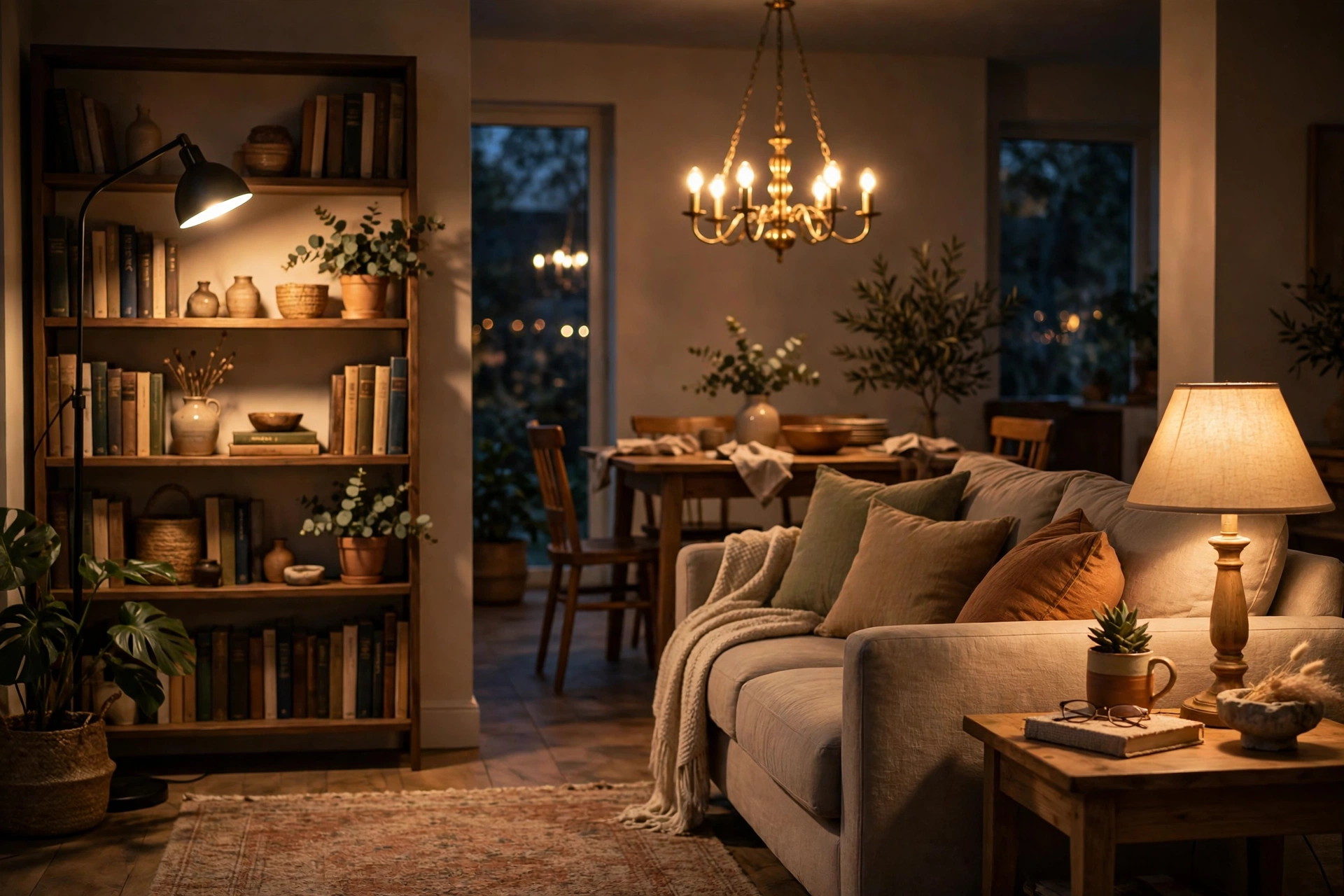
The idea is simple: every well-lit room has three kinds of light doing three different jobs. Ambient light is the general wash that lets you walk around without tripping. Task light is the focused pool where you read, do homework, or find your keys. Accent light is the decorative layer — the glow that makes a room feel finished instead of merely functional.
I resisted this for an embarrassingly long time because it sounded like interior-designer upsell. Then I sat in a friend’s living room that felt unreasonably cozy despite thoroughly ordinary furniture, and the difference was three small lamps and a dimmer. The furniture was nothing special. The light was planned. That night I went home and counted my light sources: one. One fixture trying to do three jobs, failing at all of them.
Layer One: Ambient Light — Let the Ceiling Do the Heavy Lifting
Ambient light is the foundation, and the ceiling is where it lives. For years I treated my ceiling fixture as decoration. Wrong job. Its job is to lay an even, glare-free wash across the room so no corner goes cave-dark.
In my 12-by-15-foot living room, I eventually installed a 19.7-inch dimmable LED ceiling fan with light — $129 at FLNORW MALL, with a 6-speed DC motor and a full remote. Two upgrades in one box: the fan moves air in summer, and the integrated LED kit replaced the sad flush-mount as my ambient source. The dimmer is the whole point. I run it near full brightness when I’m cleaning, and down around 20 percent for movie night. Same fixture, two completely different rooms.
Small lived-in detail: the remote has migrated permanently to the side table, and the 1-hour/2-hour sleep timer gets used more than I’d like to admit. I fall asleep on the couch with some regularity, and the light politely turns itself off.
Chandelier Height: The 30-to-36-Inch Rule Over a Dining Table
Our dining nook sits open to the living room, so it needed its own statement — and chandeliers come with the most useful sizing rule in home lighting. The American Lighting Association recommends hanging a chandelier so its bottom edge sits 30 to 36 inches above the table surface, and choosing a fixture roughly one-half to two-thirds as wide as the table is long.
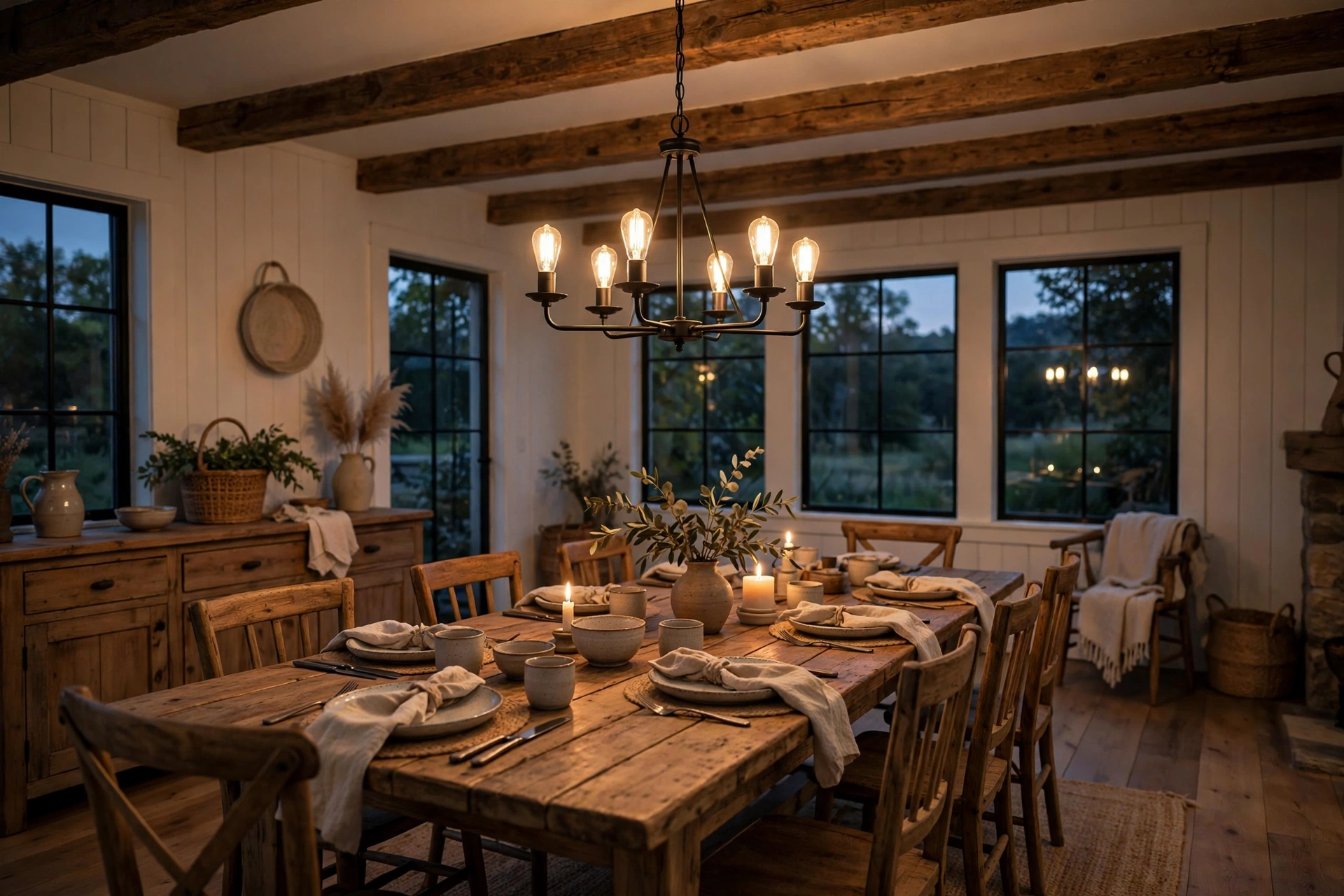
I measured twice before shortlisting two real fixtures. The 5-light farmhouse chandelier — $198, 31.5 inches long in black iron, taking five E26 bulbs up to 60W each — lands at about 52 percent of my 60-inch table. Right in the band. Five sockets times roughly 800 lumens per 60W-equivalent LED is about 4,000 lumens aimed down at the table, which comfortably covers the dining zone and then some.
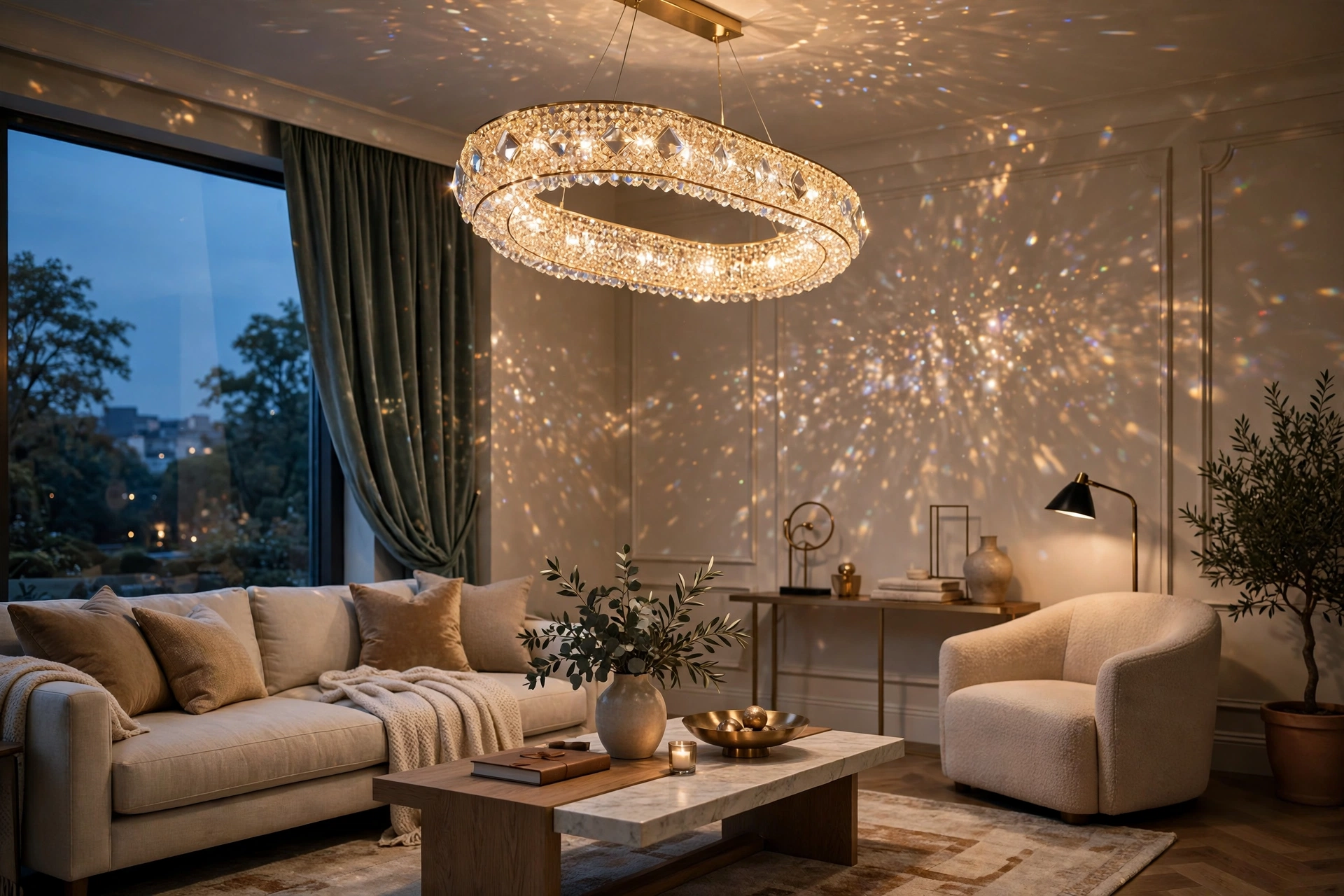
The runner-up for the living-room side was the champagne gold oval crystal chandelier at $239 — 39.4 by 11.8 inches, K9 crystal on a metal frame, hanging from a 49.2-inch chain. It takes six E12 candelabra bulbs, so the light is softer and more decorative — a statement piece that happens to illuminate, where the farmhouse fixture is the workhorse.
One honest catch on both fixtures: bulbs are not included. Budget another $25 to $40 for decent LEDs, and pick them before installation weekend arrives. Matching five or six bulbs is its own small project — do it once, do it right.
Layer Two: Task Lighting for the Spots You Actually Use
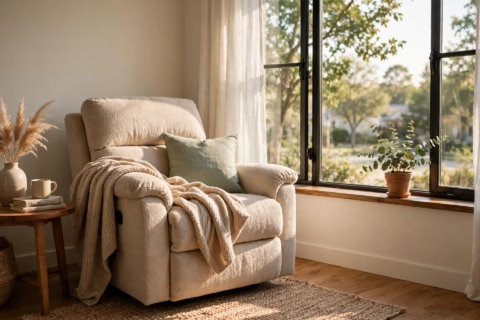
Task light is the most practical layer, and the one I had accidentally half-covered. The farmhouse chandelier over the dining table doubles as task light for homework and board games — 4,000 lumens aimed straight down is genuinely useful. My reading chair got a different treatment: a simple shaded lamp at shoulder height, aimed at the page, not at my eyes.
The number that matters here comes from the Illuminating Engineering Society: roughly 30 to 50 footcandles for reading tasks (ANSI/IES RP-1-2013), versus only 10 to 20 for general ambient light. In plain terms, your reading spot wants about triple the light level of the room around it. If your eyes get tired after twenty minutes, the room isn’t too dark — your spot is too dim relative to the room.
Layer Three: Accent Light — The Cheap Fix That Changes Everything
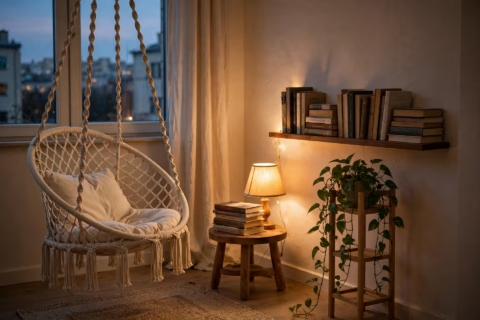
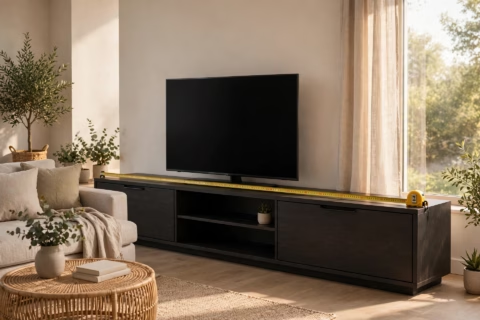
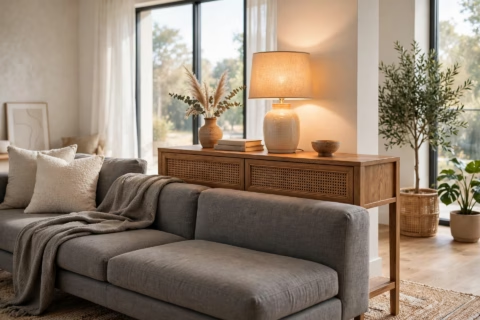
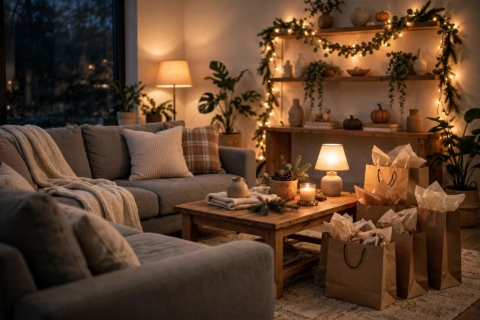
This is the layer almost everyone skips, and it’s the cheapest of the three. Accent light has no job except looking good: a small lamp washing a bookshelf, an LED strip behind the TV console, a picture light over a framed print. It creates the pools of warm light and soft shadow that make a room feel designed instead of merely lit.
I added a $30 plug-in picture light over a framed print — the highest cozy-per-dollar purchase in the entire project. Total accent-layer spend: under $60, and it’s the part guests actually comment on. Nobody has ever complimented my ambient footcandles.
The Lumen Math I Wish Someone Had Given Me
Here is the whole calculation, and it takes about ninety seconds:
- Measure the room: 12 × 15 feet = 180 square feet.
- Pick your target: 10–20 footcandles for ambient living-room light, per IES guidance.
- Multiply: 180 × 15 = 2,700 lumens for comfortable ambient light.
- Divide by per-bulb output: a 60W-equivalent LED makes about 800 lumens, so 2,700 ÷ 800 ≈ 3.4 bulbs’ worth.
- Split it across layers: the ceiling fixture covers the base load, and task and accent lights add the rest exactly where you need it.
That is the entire secret. Nobody at the big-box store told me this in three years of buying lamps. A $129 ceiling fan with an integrated LED, a $198 five-light chandelier, and a $30 picture light — planned around 2,700 lumens instead of vibes.
Living Room Lighting Guide: What Three Real Fixtures Cost
The ceiling fan with dimmable LED light: $129, installed in my living room, remote and sleep timer included in the experience. The 5-light farmhouse chandelier: $198 plus roughly $30 in LED bulbs. The champagne gold crystal chandelier: $239 plus six candelabra LEDs. All three were InStock at FLNORW MALL as I wrote this.
Then the running cost, because this is where LEDs quietly win. Five 60W incandescents in the farmhouse fixture draw 300 watts; five 9W LED equivalents draw 45 watts. At five hours a day, that’s roughly 548 kWh a year versus 82 kWh. At about $0.17 per kWh — the recent US residential average per the EIA, so treat my arithmetic as rough — the incandescent setup costs around $93 a year to run and the LED setup about $14. The roughly $79 annual difference pays for the LED bulbs several times over. ENERGY STAR’s standing claim backs this up: LED bulbs use at least 75% less energy and last up to 25 times longer than incandescent bulbs. My fixture will outlive my sofa at this rate.
My Bulb Mistakes (So You Can Skip Them)
- I bought “daylight” 5000K bulbs for the living room first. It looked like a hospital ward. 2700–3000K warm white is the living-room answer; save 4000K and up for the garage.
- I once put a non-dimmable LED on a dimmer switch. It flickered like a haunted house. Match dimmable bulbs to dimmer controls — the ceiling fan’s remote dimming sidesteps this entirely.
- I forgot that “bulbs not included” means a second shopping trip. Buy the bulbs with the fixture, and buy one spare. Candelabra E12s are the ones you will never find in the junk drawer.
- I aimed my first reading lamp at the chair instead of the book. Light the task, not the furniture.
The verdict: Three years, one sad ceiling light, two wasted floor lamps. The fix was never a more expensive fixture — it was three layers, 2,700 lumens of intent, and a dimmer. My living room finally feels like the room I thought I was buying furniture for.
Shop the exact fixtures in this living room lighting guide: the dimmable LED ceiling fan with light ($129), the 5-light farmhouse chandelier ($198), and the champagne gold crystal oval chandelier ($239) — plus the rest of the FLNORW MALL collection.