I Bought a $129 Rectangular Patio Umbrella With LED Lights. Here’s the Day-to-Night Verdict.
I Bought a $129 Rectangular Patio Umbrella With LED Lights. Here’s the Day-to-Night Verdict.
My deck faces due west, and from June through September the whole slab turns into a heat lamp by four in the afternoon. Dinner outside meant squinting into low sun while the chicken dried out on the grill. So this summer I bought the 10 x 6.5 ft rectangular patio umbrella with LED lights from FLNORW MALL — $129, solar-powered rib lights, crank and push-button tilt, listed as item W65690316. Ninety days later, here is the honest report: what the lights actually do after dark, how it handles real wind, and whether the math beats buying shade and lighting as two separate purchases.
Why a rectangular patio umbrella with LED lights beat round for our deck
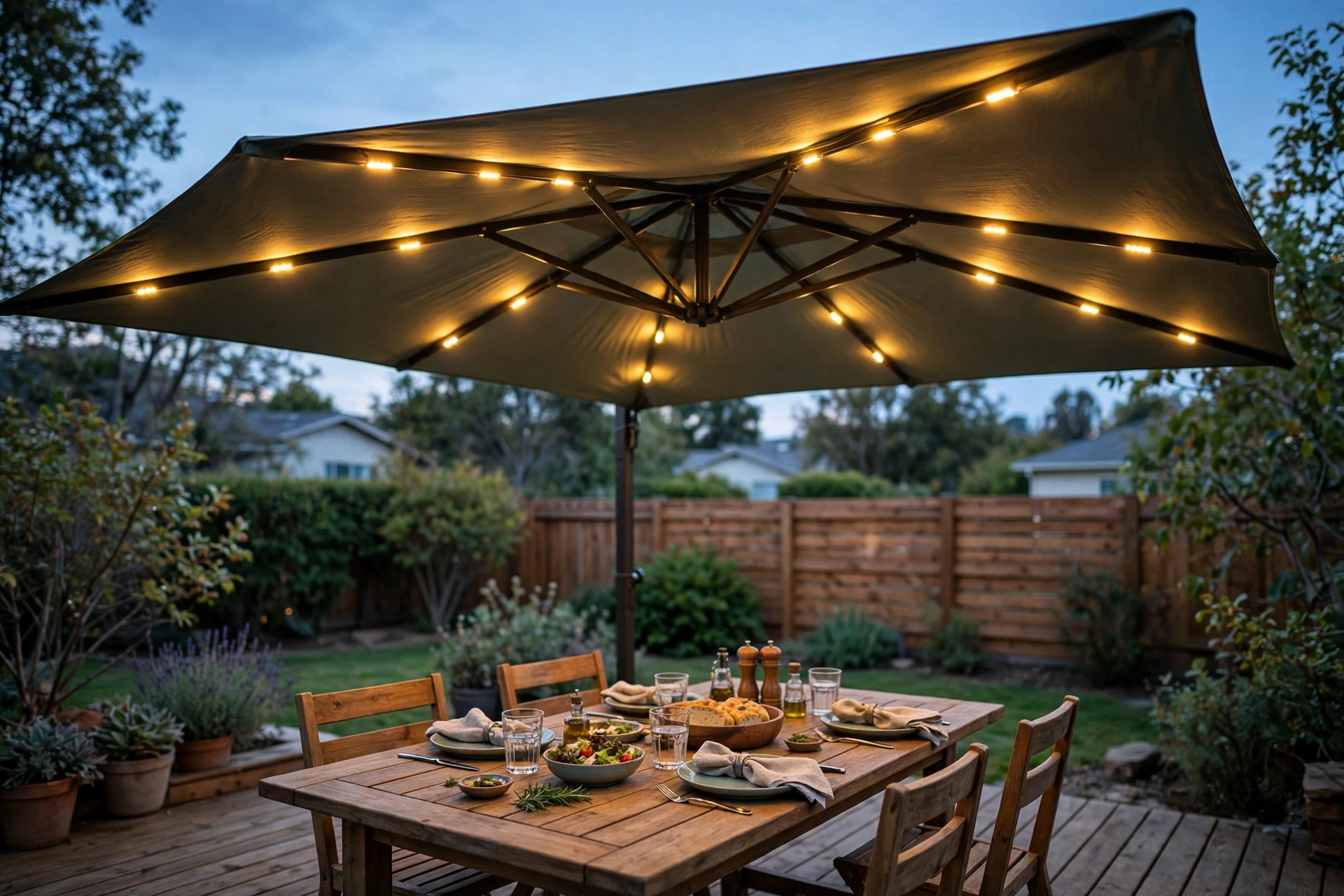
Our table seats six in a rectangle, and that decided the shape before anything else. A round umbrella shades a circle, which means the two end seats and the corners of the table spend half the afternoon frying while the middle sits in shade. A rectangular market umbrella — the category name Amazon and Target listings actually use for this shape — throws a 120-by-78-inch shadow that lands exactly where a rectangular table is. The canopy on this one measures 120 x 78 inches per the spec table, stands 98.4 inches tall, and the whole thing weighs 14 pounds, so I carried it out of the garage solo without the usual furniture-moving negotiation with my wife.
One note for the careful reader: one bullet on the product page says “6 x 9 ft,” while the title and the spec table say 10 x 6.5 ft. I put a tape measure on it — 120 by 78 inches, exactly as the spec table claims. The bullet is sloppy; the numbers in the table are right.
Solar LED lights on a rectangular patio umbrella: how they actually work
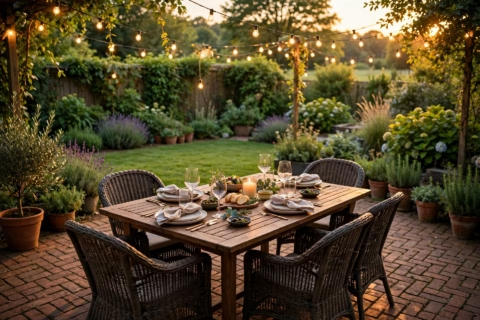
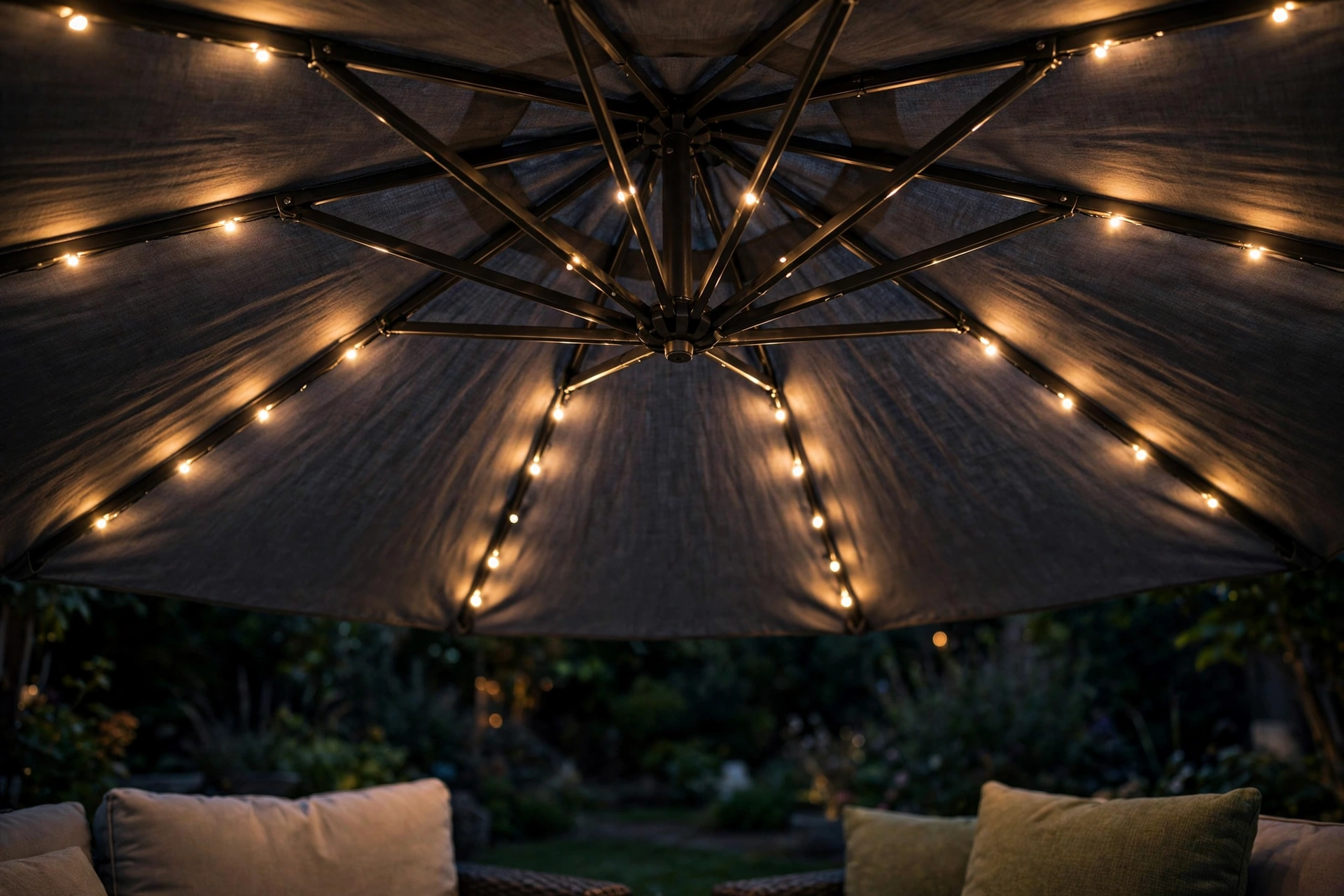
This was the part I was most skeptical about, because “solar-powered” on a product page can mean anything from a working light to a decorative rumor. The setup here is simple: a small solar panel sits on top of the canopy and charges through the day, and the LED lights run along the ribs underneath. Come dusk, the lights come on and the whole underside of the canopy glows warm. It is not reading-lamp bright — do not buy this expecting task lighting — but it turns a dark patio into a place you can eat dinner, deal cards, and find your drink without your phone flashlight.
The honest gap: the FLNORW MALL listing does not publish an LED count or a runtime figure. So here are the closest published numbers for this exact form factor, from other sellers’ listings of the same 6.5 x 10 ft solar LED format (found while researching, November 2026). A C-Hopetree Amazon listing for the same size describes 28 warm-white LED rib lights plus one central hub light, running off three rechargeable AA batteries charged by a waterproof solar panel. A Yaheetech user manual for the same format states up to four hours of illumination after a full charge. My own experience lines up with that: an ordinary sunny day gave us light well past dinner; a heavily overcast day cut it noticeably shorter. That is the physics of the category, not a defect — the panel needs direct sun to do its job, so placement matters. If your spot sits under a roof overhang all day, the lights will underperform and no umbrella at this price can fix that.
Crank and push-button tilt: the daily mechanics
Opening the canopy is a crank on the pole — one hand, about fifteen seconds, no wrestling. The push-button tilt is the feature I use most and expected to use least. Our deck gets low sun from the west around 6 p.m., and tilting the canopy toward the sun buys us another hour of shade without moving the table or the umbrella. The mechanism is a button on the pole you press while nudging the canopy; it locks into the tilted position with a solid click. The pole is steel, the 6 steel ribs feel rigid when the canopy is open, and the canopy fabric is waterproof, UV-resistant polyester in medium grey that has so far shrugged off two surprise rain showers without staining.
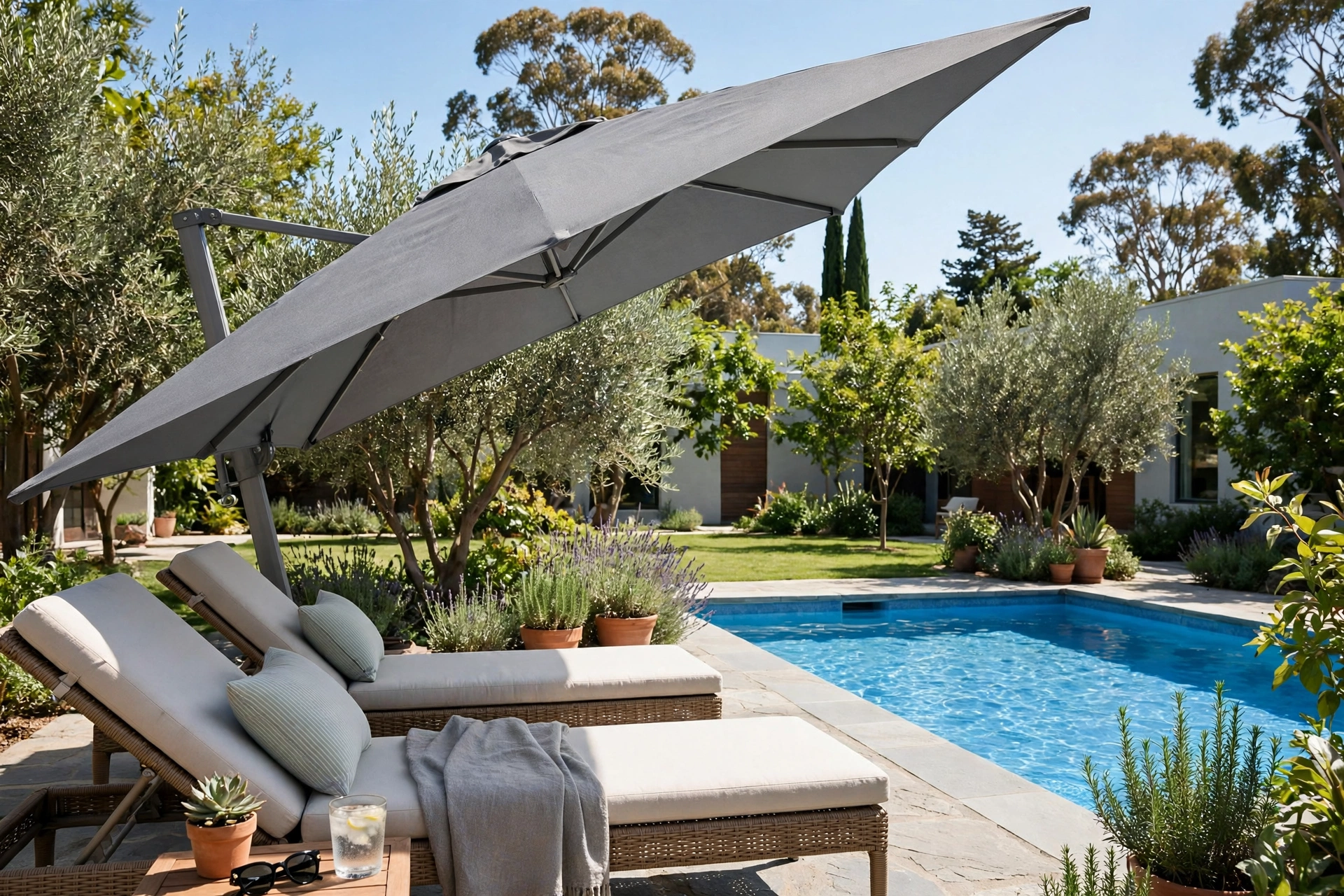
Two usage scenarios that sold the rest of the family. First, the pool: tilted over the lounge chairs, it is the only shade on that corner of the yard. Second, my daughter’s birthday cookout — twelve people, the grill going, and the lights came on mid-dessert while nobody had to touch a switch. A patio umbrella with solar lights earns its keep exactly in that moment: the party does not pause for lighting.
Wind, weight, and the vented canopy
The canopy has a vent at the top — the page says it allows airflow and reduces wind pressure, and in practice it means the umbrella does not invert itself into a sail the first time a gust rolls through. That said, let me be blunt: any 65-square-foot canopy is a sail in a real storm, and no vent changes that. The Yaheetech manual for this form factor states it plainly — not suitable for lightning storms, rainstorms, or snow — and that is the correct rule for ours too. When a thunderstorm rolled through in August, I cranked it closed in under a minute and leaned the pole against the house. Closing it is fast enough that “I will do it when the storm comes” is actually a plan you will follow.
At 14 pounds the umbrella is light enough to move around the deck but heavy enough that it does not wobble on calm days. Which brings me to the one real requirement: a base. The umbrella does not come with one — plan on buying a weighted patio umbrella base separately (a 50-pound base is the standard pairing for this size, roughly $30 to $50 at most retailers, my estimate). We threaded it through our table’s umbrella hole onto a base, which is the rock-solid way; freestanding without a base, do not.
The $129 math on a rectangular patio umbrella with LED lights
Here is the comparison I ran before buying, using live listings I found during research in November 2026. A Target listing for a same-size 10 x 6.5 ft solar LED rectangular patio umbrella was priced at $79.99 — but out of stock, so not actually purchasable. The big cantilever solar LED versions (Crestlive, 10×13 and 9×11 ft) run $346.99 to $679.99 — three to five times the money for an offset-pole form factor most decks do not need. This one was $129 and in stock, item W65690316.
The fairest comparison is the two-purchase version: a shade-only rectangular umbrella around $80 (my estimate) plus a set of solar string lights around $20 (typical) — roughly $100 for two products, two installs, two things to maintain. The integrated version is $129 for one box, one crank, one thing to close before storms. I paid about $29 extra for the integration, and the clean look was worth it: no strings to tangle, no solar panel staked in the flower bed, no second remote.
- Shade + light, one purchase: $129 vs roughly $100 piecemeal (my estimate) — a ~$29 integration premium.
- Electricity cost: zero. Solar charges the lights every day, forever, with no outlet run and no cord across the deck.
- Per-season cost: assume four summers of use (my estimate) — $129 ÷ 4 = $32.25 per summer for shade by day and light by night.
- Against the cantilever tier: $346.99 to $679.99 for fancier form factors — the $129 market umbrella is the budget tier, honestly positioned.
Two honest complaints
First: no base in the box. I keep coming back to this because it is the single most likely surprise. Budget the base at purchase time — a 50-pound weighted base, $30 to $50 (my estimate) — or plan to thread it through a table with an umbrella hole like we did.
Second: the page needs an editor. The “6 x 9 ft” bullet contradicts the spec table’s 10 x 6.5 ft, and there is no LED count or runtime figure published, which forced me to triangulate from other sellers’ listings of the same format. The tape measure says the spec table is right, but you should not need a tape measure to shop with confidence.
The maintenance outlook, honestly: the polyester is waterproof and UV-resistant, but medium grey will eventually silver out in full sun — I would plan on year two or three before it looks noticeably lighter (my estimate). The vent, the steel ribs, and the crank have no obvious wear points after ninety days, and the solar panel is a solid-state part with nothing to service.
The verdict
Ninety days in, this $129 rectangular patio umbrella with LED lights did the two jobs I hired it for: it shades the full table through the hot part of the day, and it turns the patio into a lit, usable room after dark without a single wire. The crank and tilt get used daily, the lights come on when they should, and the only real extra cost is a base you were going to need with any umbrella this size. If your deck furniture is arranged in a rectangle and your evenings run past sunset, the math works — roughly $32 a summer (my estimate) for shade and light in one motion.
Ready for a day-to-night patio? See the 10 x 6.5 ft rectangular solar LED patio umbrella at FLNORW MALL — or browse the full FLNORW MALL collection if the rest of the patio needs attention. We set ours over the wood interlocking deck tiles for the patio we laid earlier this summer, and on quiet nights the $99 Bluetooth speaker for backyard evenings keeps the soundtrack going after the lights come on.