I Ran the Sit-Stand Math for 60 Days. Here Is My Standing Desk Verdict.
Why I stopped trusting my chair
My lower back filed its formal complaint on a Tuesday. I had been sitting at my home office desk since 8 in the morning, and by 3 in the afternoon the ache had spread from my lumbar region into my shoulders. I stood up, stretched, sat back down, and felt it return within twenty minutes. That evening I did what anyone does now: I typed standing desk into a search box and fell into a two-hour rabbit hole of motorized frames, memory presets, and anti-fatigue mats.
I did not buy one that night. Instead I did something more useful: I ran a 60-day sit-stand experiment using a borrowed dual-motor desk, kept a daily log of back pain, energy, and focus, and did the honest cost math against a regular fixed-height desk. This is the full verdict — what standing actually fixed, what it did not, and who should save their money.
What a standing desk actually costs: the three price tiers
Before the health claims, the money. Standing desks cluster into three rough tiers (prices below are typical US retail ranges as of late 2026 — estimates, not quotes):
- Manual crank desks, roughly $150–$250. Height adjusts with a hand crank. Cheap, slow, and most people stop adjusting them after week three.
- Single-motor electric desks, roughly $250–$350. Push-button adjustment, decent for lighter setups under 150 lbs.
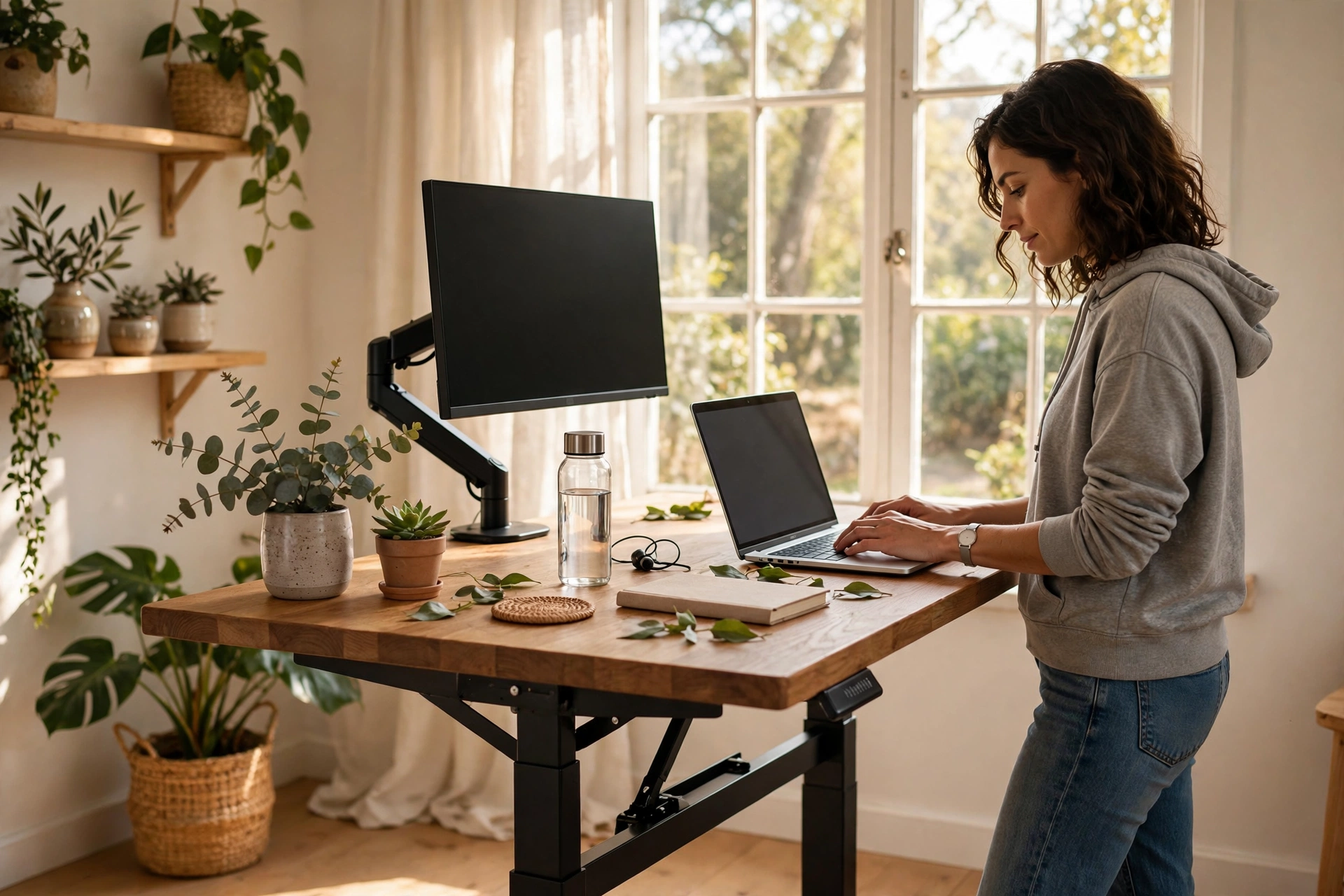
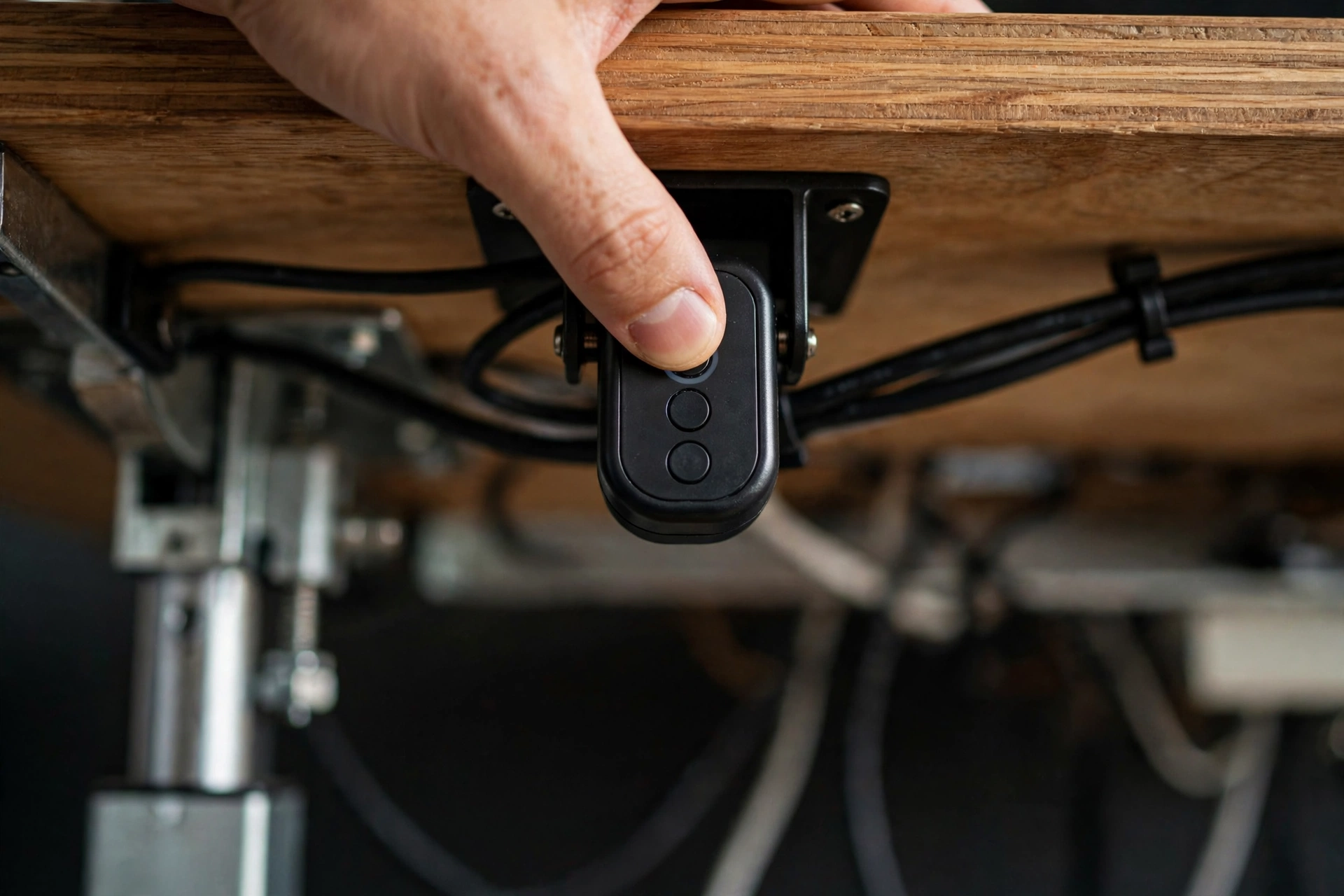
- Dual-motor electric desks with memory presets, roughly $400–$600+. Faster, quieter (usually under 50 dB), and the preset buttons are the feature that actually keeps you switching heights daily.
For context, a good regular fixed-height desk — like the $188 computer desk FLNORW MALL sells — costs less than even the cheapest crank model. So the real question is never “is a standing desk nice?” It is: what does the extra $100–$400 buy you, in measurable terms?
Standing desk benefits: what the research actually says
I went into the experiment half-expecting miracles and came out with something better: measured expectations. Here is what the published research actually supports, with names and years so you can check me.
A 2016 expert statement in the British Journal of Sports Medicine (Buckley et al.) recommends office workers accumulate 2–4 hours of standing per day, progressing toward 4, and notes that standing burns roughly 0.15 extra kilocalories per minute versus sitting. That is real but small — about 9 extra calories per hour, or roughly one apple over a full standing workday.
A 2016 Cochrane Review of sit-stand desks found they reduce sitting time by about 30 to 120 minutes per workday, while evidence for other health outcomes was limited and low-quality. In other words: the desks reliably get you upright; the long-term health payoff is still being studied.
The strongest motivation data comes from sedentary-behavior research: a 2017 study in the Annals of Internal Medicine (Diaz et al.) found that longer uninterrupted sedentary bouts were associated with higher mortality, independent of total sitting time. The enemy is not the chair — it is not moving for hours.
And the audience is big: the US Bureau of Labor Statistics reported in October 2026 that 36.9% of employed Americans can work from home at least some of the time. Millions of us now own our office ergonomics.
My 60-day sit-stand experiment: the schedule that finally stuck
Week one was a disaster. I stood for three hours straight on day one, my feet ached by noon, and by Friday I was back to sitting all day. The schedule that actually survived all 60 days looked like this:
- Start seated, 8:00–9:30. Email and planning while sitting — no need to stand for shallow work.
- Stand for 45 minutes after every 90 minutes of sitting. A kitchen timer on my phone, not willpower.
- Stand for all video calls. I talk with more energy standing up, and nobody can see my feet.
- Never stand longer than an hour at a stretch. This single rule eliminated the foot pain.
The honest results from my log: my 3 p.m. back ache dropped from a daily 6-out-of-10 to a 2, and only on days I actually followed the schedule. My step count rose about 800 steps a day (estimate, from my phone pedometer) — modest, but it came from nowhere. Focus? Slightly better during standing calls, unchanged during deep work. Weight? Unchanged. Anyone selling you a standing desk as a weight-loss tool is selling you something.
Standing desk vs sitting desk: who should buy which
After 60 days, here is my blunt sorting hat:
- Buy the standing desk if you work from home full-time, get afternoon back or neck stiffness, and will actually use the presets. The motorized adjustment is the whole product — a desk you never move is just an expensive table.
- Keep the regular desk if you work fewer than 4 hours a day at it, mostly do focused deep work, or are on a tight budget. A $188 regular desk plus a $30 kitchen timer for stretch breaks gets you most of the benefit.
- Buy the standing desk if you take lots of calls or present on video — standing energy is real and people notice.
- Keep the regular desk if your workspace doubles as a craft table, homework station, or anywhere the desk must stay put at one height for other people.
My own setup compromise, for the record: the borrowed desk went back to my friend. I now work at a regular fixed-height desk — FLNORW MALL has a solid computer desk in black and chrome for $188 — with a strict timer habit and a $25 anti-fatigue mat from a big-box store for the standing half of my day. Total spend under $220, and my back cannot tell the difference.
Three mistakes I made in month one
1. Standing too long on day one. Treat it like exercise: start with 20–30 minute blocks and add time weekly. Your feet, knees, and lower back need an adaptation period.
2. Leaving the monitor at sitting height. A standing desk with a low monitor just trades back pain for neck pain. The top of the screen should sit at or slightly below eye level in both positions — a monitor arm or a stack of books fixes this for about $30.
3. Wearing flat unsupportive shoes. Standing barefoot on hardwood for an hour is its own special misery. Supportive shoes or an anti-fatigue mat are non-negotiable, not accessories.
Specs worth checking before you buy a standing desk
If you do buy, these are the specs that separate the good from the regrettable:
- Height range. Look for roughly 28–30 inches at the low end and 46–48 at the top. Measure your elbow height standing — the desk should meet it.
- Weight capacity. A dual monitor arm plus a desktop PC can push 100+ lbs. Single-motor frames often top out around 150–175 lbs; dual-motor frames handle 220–350 lbs.
- Motor noise. Under 50 dB is the target — about the level of a quiet conversation. Cheap frames whine.
- Memory presets. Two or four one-touch buttons. This is the feature that determines whether you actually switch positions daily.
- Frame stability. Read reviews for “wobble” at full height. Crossbar-free (T-frame) designs give more legroom but can flex more.
- Warranty. Three to five years on the frame and motor is standard from reputable brands. Less than two is a red flag.

The verdict
Sixty days taught me that the standing desk is not the miracle — the routine is. Standing 2–3 hours a day in short blocks fixed my afternoon back ache, added a few hundred steps, and made my calls better. But the desk itself is just the most convenient way to build that routine. A regular desk, a timer, and the discipline to get up every 90 minutes will take you 80% of the way there for a fraction of the price.
So here is my honest math: if you will use the presets daily and work from home full-time, a $400–$600 dual-motor standing desk is worth it. If you are unsure, start with a quality regular desk — my pick is the $188 computer desk at FLNORW MALL — and prove the habit first. The desk is the easy part. Standing up is the hard part.
If a bigger workstation is more your speed, my earlier reviews of the $199 U-shaped LED desk and the $188 weathered oak desk cover the seated side of home-office life in full detail.
Ready to set up your home office? Browse the full desk and office furniture collection at FLNORW MALL — real specs, real prices, and free ideas for every corner of your workday.