I Bought a $238 Tool Cart for My Garage. Here’s the Buying Guide I Wish I’d Had.
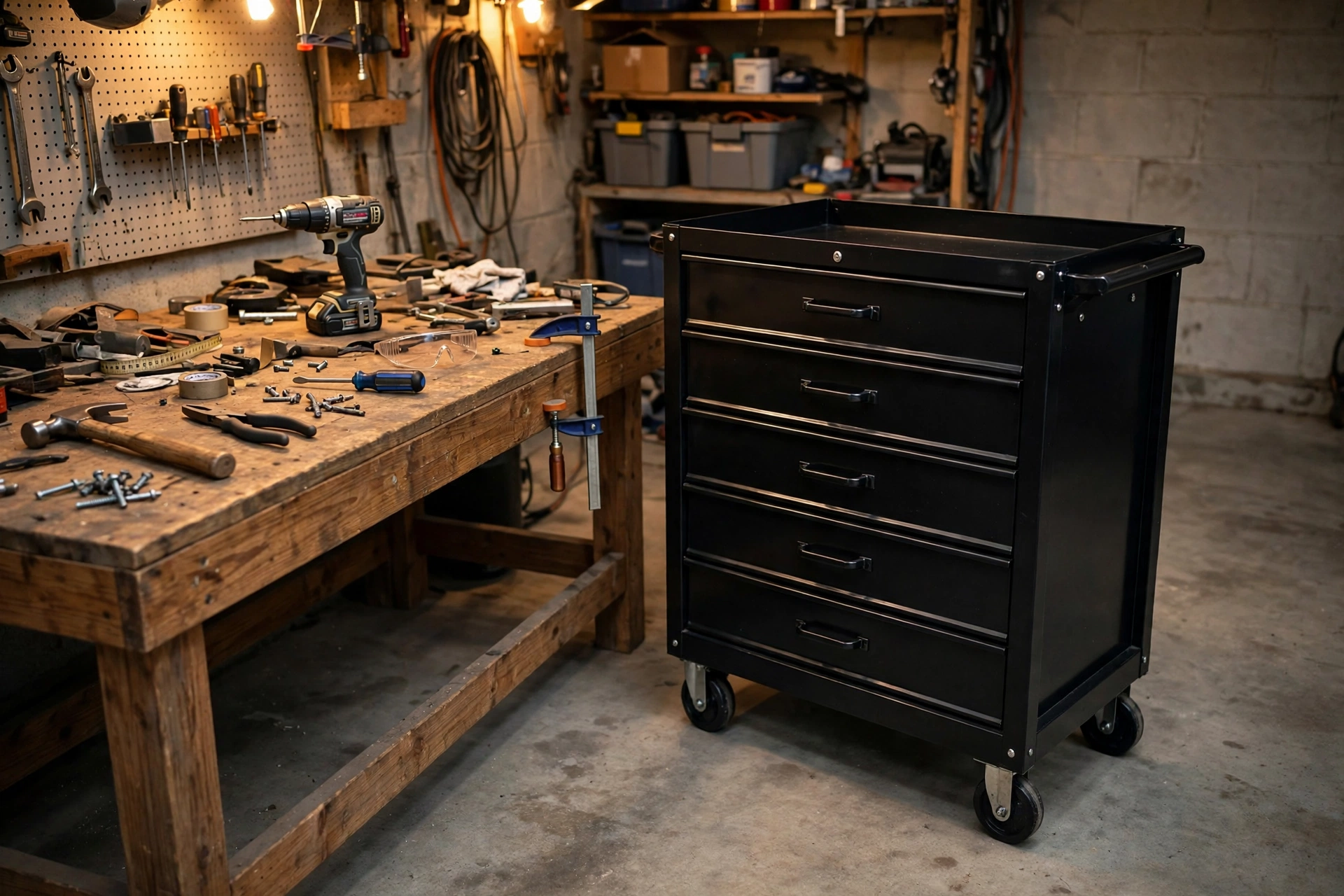
My garage didn’t have a tool shortage. It had a tool location problem. Three socket sets, two drills, a graveyard of hex keys — all of it living in milk crates and the original cardboard boxes, which meant every project started with a twenty-minute scavenger hunt. In September I finally bought the thing I’d been circling for a year: a $238 5-drawer rolling tool cart from FLNORW MALL, cold-rolled steel with a powder-coat finish, riding on four-inch casters. Sixty days later, my setup time is down to about four minutes flat, and I’ve learned exactly where a tool cart beats a tool box — and where it doesn’t.
What a Tool Cart Is (and What It Isn’t)
Shopping for one of these gets confusing fast, because the industry uses four overlapping words for what are really three different animals. A tool box is the thing you carry: handle on top, goes in the trunk, comes to the job. A tool cart is the thing that rolls: drawers on casters, parks next to your workbench, follows you to the driveway. A tool cabinet or chest is the stationary bulk-storage piece — bigger, heavier, and generally bolted to one spot for life.
The distinction matters because people buy the wrong one constantly. I almost bought another big stationary cabinet before admitting the truth: my work doesn’t happen in one spot. Sometimes I’m at the bench, sometimes I’m under the mower in the driveway, sometimes I’m fixing a bike on the patio. The cart is the only one of the three that moves with the work instead of demanding the work come to it.
And the market has noticed. Dataintelo’s 2025 report puts the global rolling tool box market at $5.15 billion in 2025, growing to $8.22 billion by 2034 — a 5.2% compound annual growth rate — with metal boxes holding a 42.3% share and residential buyers the fastest-growing segment at 6.7% a year. Translation: home garages, not just pro shops, are driving this category.
The 5-Drawer Math: What Actually Fits in a $238 Tool Cart
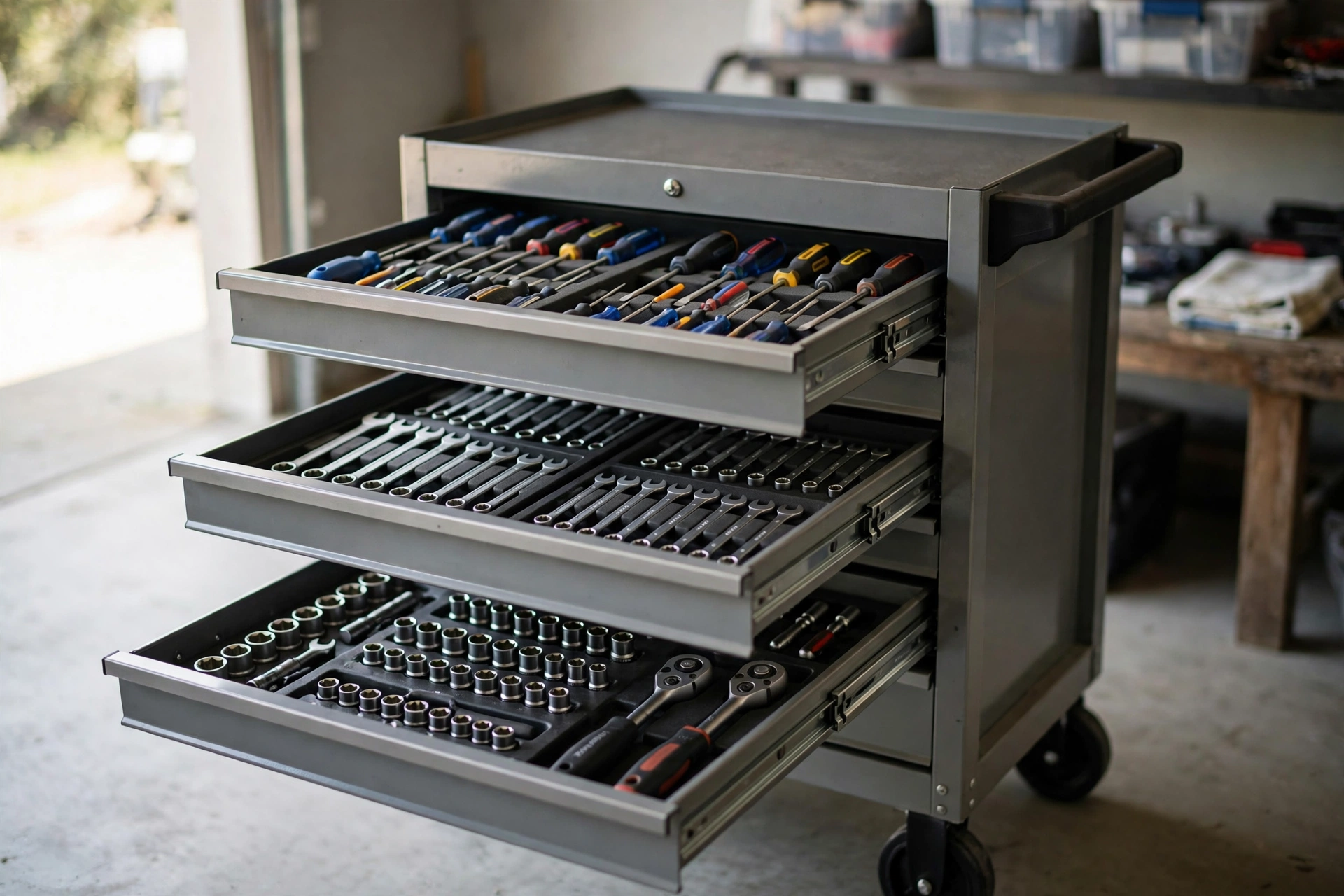
“Five drawers” tells you nothing until you know the drawer. On this cart each drawer measures 20.11 × 12 × 3.3 inches inside, riding on ball-bearing slides rated at 15 kg per pair. That 3.3-inch depth is the number that decides everything: sockets, wrenches, pliers, and drivers fit beautifully. Tall spray cans and quart oil bottles do not — they live on the cart’s flat top instead, which doubles as a staging surface.
Here’s my actual drawer-by-drawer loadout after two months of shuffling things into their final homes:
- Drawer 1 (top): the daily drivers — cordless drill, impact driver, two batteries, charger, tape measure. This drawer opens ten times a day.
- Drawer 2: three socket sets (1/4″, 3/8″, 1/2″ drive) plus extensions. The 20-inch width swallows a full socket rail with room to spare.
- Drawer 3: combination wrenches on a rail, Allen key sets, and the caliper I’m always losing.
- Drawer 4: screwdrivers, nut drivers, and a small parts organizer for the fasteners I actually reuse.
- Drawer 5 (bottom): the heavy stuff — pry bar, ball-peen hammer, a brick of shop towels, the multimeter.
The ball-bearing slides are the quiet hero here. My old tote-drawer organizer needed a hip-check to close when loaded; these drawers glide with one finger even with thirty pounds of sockets in them. The whole cart weighs 48.5 lbs empty and measures 24.25 × 12.99 × 29.33 inches assembled — narrow enough to slip between the workbench and the wall, which in my 12-by-20 garage is the difference between “stored” and “in the way.”
The Caster Test: 4-Inch Wheels, 2 Brakes, and My Sloped Driveway
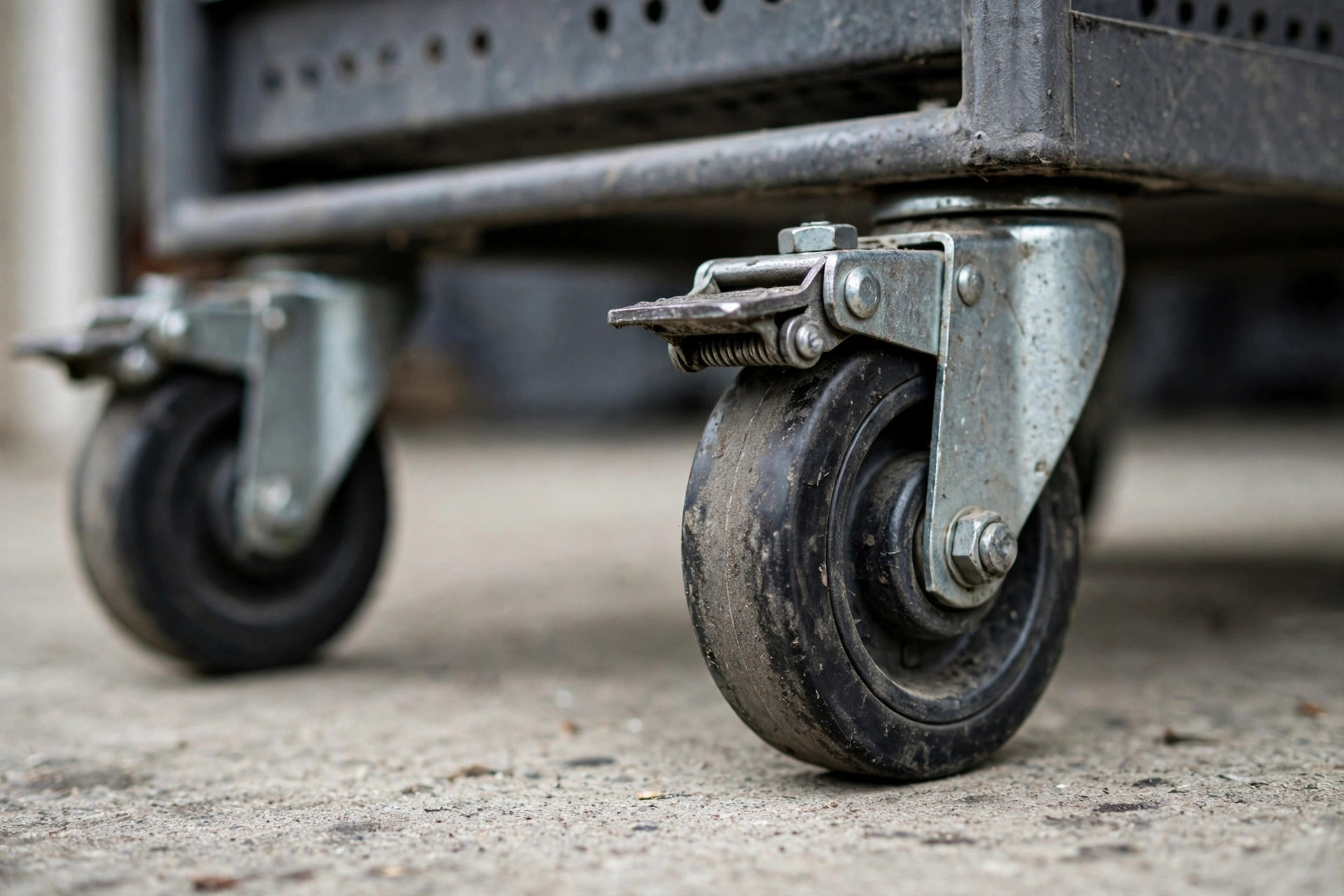
The cart rolls on four 4-inch casters, two with parking brakes and two without, plus a side pull handle for steering. Four inches sounds small until you push 150 pounds of steel and sockets across driveway expansion joints — the bigger the wheel, the less it fights you on cracks.
My driveway slopes about three degrees toward the street. First project day, I rolled the loaded cart out, got absorbed in sanding a chair rail, and watched the cart start a slow, majestic journey toward the curb. Lesson learned in one afternoon: lock the brakes before you load the top, not after. The brake pedals are the flip-down kind you can work with a boot toe, and once set, the cart doesn’t budge — even when I’m leaning into it with a breaker bar.
One honest note: two braked casters out of four is the standard configuration at this price, and it’s fine on flat concrete. If your workspace is seriously sloped, spin the cart so a braked wheel faces downhill. Free advice, learned the cinematic way.
60 Days in the Garage: The Drawer-by-Drawer Report
Assembly took me about 45 minutes solo, and I’d budget an hour if you’re methodical. The instructions are the pictogram kind — no words, just diagrams — but nothing fought me, and every bolt hole lined up, which is not something I say lightly about flat-pack anything. Wear gloves; it’s folded sheet steel.
The powder-coat finish has now survived two months of real garage life: a dropped crescent wrench, a tipped-over parts washer tub, and one memorable incident involving a bungee cord and a paint can. No chips, no rust blooms, and my garage hits swamp-level humidity in late summer. The finish wipes clean with a shop towel.
Two things surprised me. First, the cart is lockable — a small thing, but with a seven-year-old who believes every drawer is a treasure chest, locking up the utility knives and the box cutter blades is worth real peace of mind. Second, the side handle: I expected a gimmick, but steering a loaded cart one-handed while carrying a circular saw in the other is exactly the maneuver this handle exists for.
The one genuine complaint: that 3.3-inch drawer depth. My can of brake cleaner and the tall WD-40 can live on top of the cart now, which is fine, but measure your tallest must-fit item before you buy any cart, not just this one. If you own a lot of tall bottles, you want deeper drawers or a cabinet with shelves instead.
Tool Cart vs Tool Box vs Tool Cabinet: The Honest Comparison
Here’s the decision framework I wish someone had handed me, with real FLNORW MALL prices:
- The $238 5-drawer tool cart: best when your work moves around the garage and driveway. Drawers beat shelves for small hand tools — you see everything at a glance instead of digging. The mobility is the entire point.
- The $99–$228 tool boxes: best when you need tools away from home. I compared a $99 238-piece kit against a $228 3-drawer drawer set last month — the kit wins for trunk duty and helping a neighbor, the drawer set wins as a starter home base. Neither rolls to the driveway loaded.
- The $299 lockable garage tool cabinet: best for bulk storage that stays put. My four-month review of the 2-door cabinet covers it — 120 lbs per shelf, 360 lbs total, keyed lock, doubles as a work surface. If your tools mostly live in one bay and you want them behind locked doors, the cabinet wins.
The pattern: mobility versus capacity versus portability. The cart is the middle child — more organized than a box, more mobile than a cabinet. For a one-car garage where every square foot is contested, that middle is exactly the sweet spot. It’s also why the cart slots so naturally into a one-car garage workshop system: cabinet for bulk, cart for the daily drivers, shelves for the rest.
One more comparison worth making: the big-name alternative. Harbor Freight’s U.S. General 5-drawer mechanics cart advertises 15,000 cubic inches of storage and a 700-lb capacity with 75-lb-rated drawer slides — serious pro-grade numbers at a pro-grade price. The $238 cart isn’t trying to be that. It’s the home-garage answer: enough drawer, enough wheel, enough steel, at roughly the price of two tanks of gas and a pizza.
5 Rules for Buying Any Rolling Tool Cart
Whatever brand you buy, run it through these five checks before the box ships:
- Read the slide rating, not the drawer count. Five drawers on plastic friction slides will sag and jam within a year. Ball-bearing slides with a real per-pair weight rating — 15 kg here — are the line between a cart and a future garage-sale item.
- Count the braked casters. Two braked out of four is the honest minimum. All four braked is better, zero braked is a driveway accident waiting for a slope.
- Check the steel and the finish. Cold-rolled steel with powder coating is the durability baseline — it’s also why metal still holds 42.3% of the rolling tool box market (Dataintelo 2025). Painted thin sheet metal chips; powder coat shrugs.
- Measure your tallest tool against the drawer depth. My 3.3-inch drawers rejected every tall spray can I own. Know this number before you buy, not after assembly.
- Lock it if you have kids. A garage is the softest entry point in most houses, and a curious kid plus a utility knife is a combination no parent wants to discover. A lockable cart turns a casual grab into a non-event.
The Verdict: Who Should Buy This Tool Cart
Sixty days in, here’s my honest scorecard. Buy the $238 5-drawer rolling tool cart if your work moves around the garage, you’re tired of the milk-crate scavenger hunt, and you want hand tools visible and one drawer-pull away. The ball-bearing drawers, the 4-inch braked casters, and the powder-coated steel have all held up to daily use without a single wobble, chip, or jammed drawer. Skip it if you need tall-bottle storage (get a cabinet with shelves), you work exclusively at one bench (a stationary chest gives more volume per dollar), or you need pro-shop load ratings — in which case you already know you’re spending more.
The money math, because I always do it: $238 spread over a conservative 10-year life is about 7 cents a day — a rough estimate, but it frames the purchase honestly. My twenty-minute tool hunts happened roughly three times a week; at even a modest value on my Saturday time, the cart paid for itself before the second month ended. The cheapest tool storage is the kind you actually use, and I use this thing every single day.
See the exact cart I bought: the 5-drawer multifunctional tool cart with wheels ($238) comes in black, blue, green, and red. Pair it with the $778 one-car garage workshop system if you’re rebuilding the whole space, or start from the FLNORW MALL homepage and build your own setup.