I Bought a $298 Licensed Toyota Tacoma Ride-On Car for My Kid. Here’s the Honest Verdict.
My son turned four in September, and by October he had one topic of conversation: trucks. Big trucks, loud trucks, the garbage truck on Thursdays. So when Christmas list season opened, I started hunting for a ride-on car for kids that would not end up as a $300 driveway ornament by January. After two weeks of comparing specs, I bought the licensed Toyota Tacoma ride-on car from FLNORW MALL for $298. I have now watched my kid drive it almost daily for two months, and I have opinions. Here is the full, honest breakdown.
What This Ride-On Car for Kids Actually Is (and Isn’t)
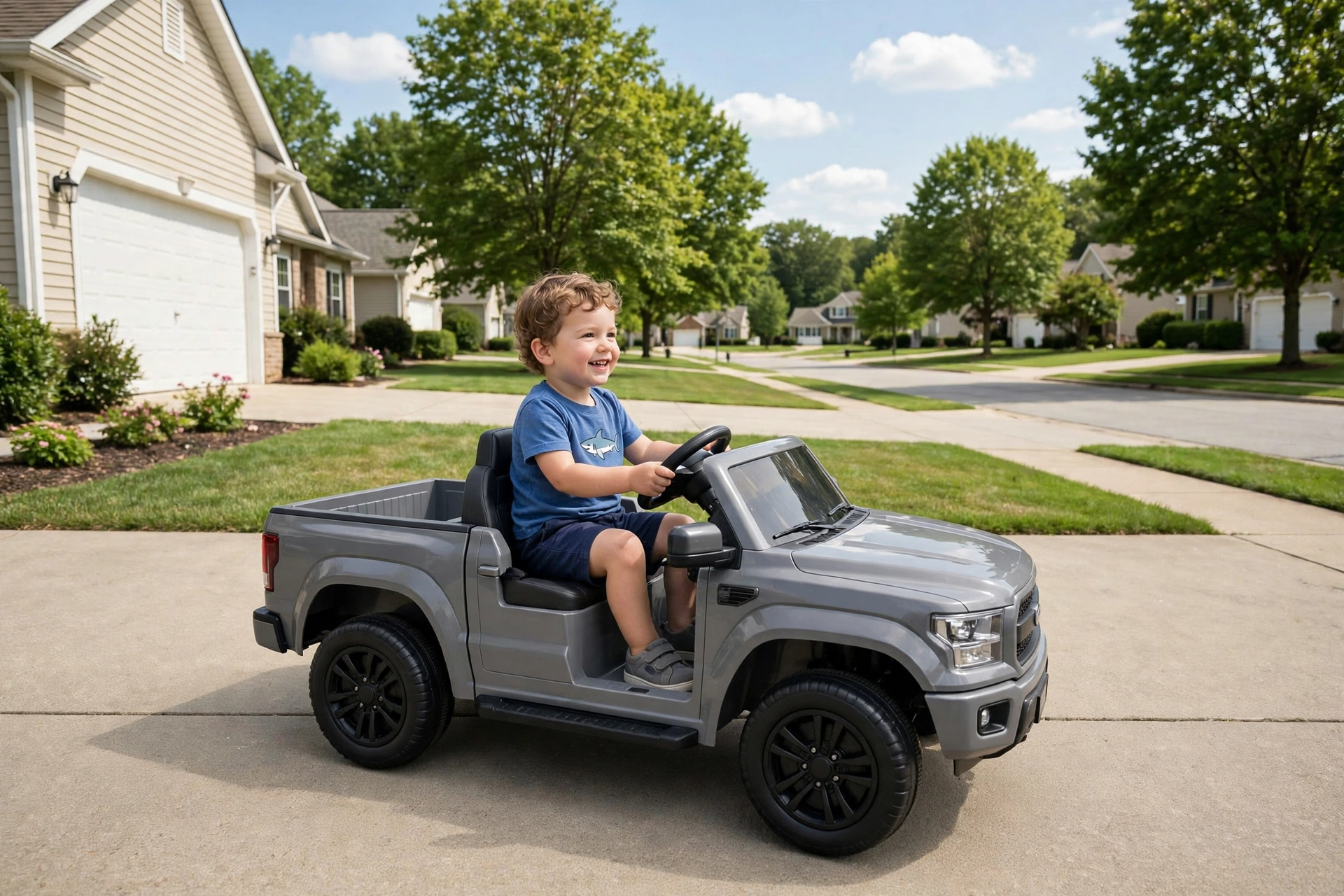
Let me be precise, because the listing packs in a lot of claims. This is an officially licensed Toyota Tacoma ride-on car made of gray polypropylene. It measures 39.76 x 21.26 x 24.29 inches and weighs 31.48 pounds — I carried the box up the driveway in one hand; the shipping weight was 40.12 pounds, so assembly does shed some bulk.
What it is: a two-motor 12V ride-on car with two 25W motors, LED lights, startup engine sounds, and doors that actually open and close. There is a built-in MP3 player with AUX input and a flash drive port, and you can pair your phone to it. My son’s first act was to blast the same three songs on loop. The seat is 15.55 inches wide and 12.2 inches tall — snug for a tall four-year-old, with real growing room.
What it isn’t: a toy you can hand to a kid and walk away. The listing is clear that it suits ages 37 to 72 months, and after two months I agree with that window. Younger than three and the steering coordination isn’t there. Older than six and the 66-pound weight capacity gets tight — and the truck starts looking small under a taller kid.
Assembly Took Me 40 Minutes and One Phillips Screwdriver
Everything arrived in one box with an instruction sheet that was, shockingly, readable. The four wheels snap on, the steering wheel clicks in, and the seat drops over the battery bay. Total time: 40 minutes, solo, with one Phillips screwdriver. The only step worth mentioning is the battery cable under the seat — make sure it seats fully into the connector. I did not, the first time, and the truck played dead until I opened the seat again and pushed the plug home.
One honest note: there is no way to make a 31-pound plastic truck look more “real” than it is. The detailing is decent — grille, headlights, the Tacoma badging — but up close it is clearly a toy. From ten feet away at golden hour, it looks fantastic. That is the distance that matters.
The Parent Remote Is the Real Product
If you only remember one section of this review, make it this one. The truck comes with a 2.4G parent remote control with forward, reverse, park, steering, and a 3-speed selection (1.5 to 2.6 MPH). This is what separates a good ride-on car with remote control from a Christmas-morning meltdown.
Here is why. My son spent the first day terrified of the startup engine sound and refused to touch the pedal. Instead of a tantrum, I drove him around the driveway by remote for twenty minutes while he played with the steering wheel and slowly got brave. By day three he was doing laps solo and honking the horn at the dog. Without the remote, day one would have been a total wash.
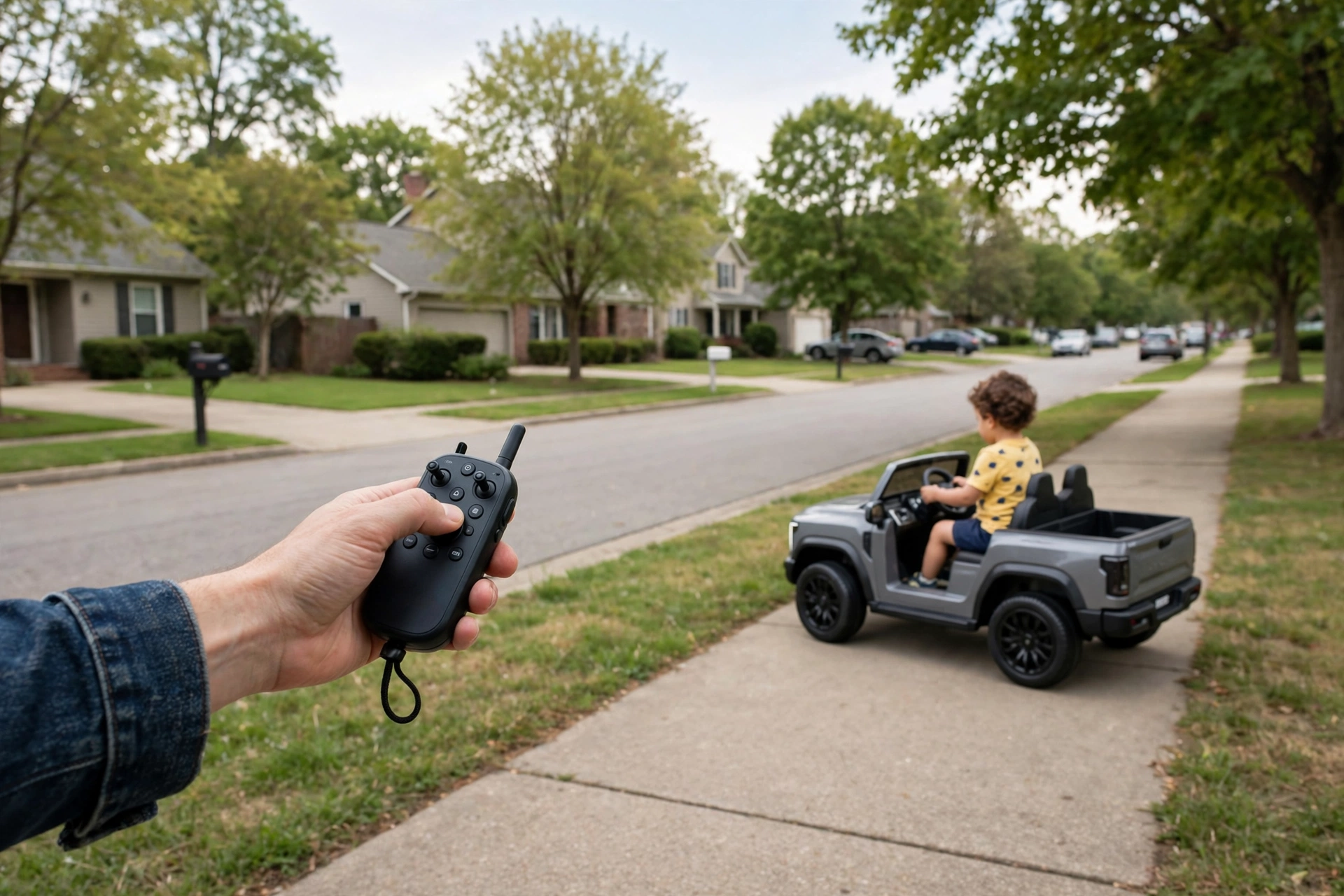
The remote is also your only real steering correction when a four-year-old aims straight at the rose bushes. The low speed setting, 1.5 MPH, is a fast walk. The high setting, 2.6 MPH, is a light jog. Both are manageable on flat ground, and the slow-start design means there is no lurching when the pedal goes down.
The Battery Math: Overnight Charging, One Good Afternoon
Specs first: a rechargeable 12V lead-acid battery, 8 to 12 hours of charging, 1 to 2 hours of playtime per full charge. That matches my experience almost exactly. I plug it in at night; it is ready by breakfast. We have never once run it dry mid-session, because 1-2 hours is honestly longer than a four-year-old’s attention span for one activity.
The practical rule is simple: treat it like a phone. Charge it overnight, every time, even after a 20-minute drive. Lead-acid batteries dislike sitting half-discharged, and the “two-hour” end of the runtime range is what you get with a full, healthy charge. The battery lifts out from under the seat, so you can charge it separately if the truck lives in a cold garage — worth doing in winter.
For the math people: at one hour of play per session, a full charge covers roughly one big afternoon. We average four or five drives a week. That is about 250 sessions a year, each one costing roughly the price of nothing — electricity for a 12V lead-acid charge is pennies.
Speed, Safety, and the Driveway Test
Our driveway is a 90-foot straight shot with a gentle slope near the sidewalk, which turned out to be the perfect test track. On the flat section, the truck is rock-solid. The shock-absorber spring tires handle our paver driveway without the rattling you get from hard plastic wheels, and the adjustable three-point seat belt actually fits a four-year-old — I tighten it like a car seat, and he cannot wriggle out.
My house rules, learned from watching a fearless preschooler: driveway only, never the street. The truck is gray and sits about two feet tall — invisible to a reversing SUV. I walk behind with the remote on low speed whenever we are anywhere near the curb. The lockable doors are a nice touch; my son figured out how to unbuckle the belt before he figured out the door lock, so it buys you a minute.
The listing notes ASTM certification, which is the toy safety standard that actually matters for electric ride-on toys sold in the US. No toy eliminates parental supervision, but certified matters to me when a product runs on a battery with real torque.
The 66-Pound Question: How Many Birthdays It Lasts
The listed range is 37 to 72 months with a 66-pound weight limit. My son is 44 inches tall, 40 pounds, and at four he fills the seat with room to spare. Realistically, this truck has about two to three birthdays in it for an average-sized kid before they outgrow it.
Run the $298 over three years: that is roughly $99 a year, or about $0.27 a day. For a toy that gets used almost daily, that is one of the better per-day numbers of anything we own. Compare it to the trampoline-park birthday party we just attended: $24 a kid for two hours. Three years of a ride-on car costs less than a dozen of those parties, and the dog gets entertainment value at no charge.
The $298 vs $299 Christmas Question: Ride-On Car or Balance Bike
Here is the decision most parents in my position are actually making. FLNORW also sells the KidRock Constructible Kit 20-in-1 balance bike for $299 — one dollar more than this truck, and a completely different kind of toy. I compared them side by side before choosing, and here is my honest breakdown:
- The ride-on car wins on instant joy. It makes noise, lights up, and a three-year-old can “drive” it with zero skill. Day-one excitement is unmatched.
- The balance bike wins on skill-building. The 20-in-1 kit builds into at least 15 different configurations, uses aerospace aluminum, and teaches balance that transfers to a real bicycle. At 13 pounds, your kid can carry it; the truck needs an adult.
- The ride-on car wins on shared play. The parent remote turns it into an activity you do together. The balance bike is a solo sport.
- The balance bike wins on longevity. Reconfigurable into new builds as the kid grows; my full review is on the toddler balance bike gift review.
- The tie-breaker is your space. A flat driveway or cul-de-sac? Get the truck. An apartment with no private outdoor space? The balance bike fits your life; the truck will not.
If I could only pick one for a four-year-old’s Christmas, I would still pick the truck — the daily-use frequency has been higher in our house. But the balance bike is the better toy for a kid who already has ride-on vehicles, or for grandparents’ houses where space is tight.
The Verdict
Two months in, this ride-on car for kids is the most-used toy we own, and the $298 has paid for itself in skipped “I’m booored” afternoons. The parent remote is the feature that makes it work for younger kids, the battery routine is painless, and the licensed Tacoma styling means my son has not found anything else he would rather drive.
Buy it if: you have a flat driveway or safe riding area, your kid is between 3 and 5, and you will commit to the remote-supervision habit.
Skip it if: you have no private outdoor space, your kid is already six and pushing the 66-pound limit, or you want a toy that builds coordination rather than delivering pure driving joy.
Christmas shopping reality check: toy budgets add up fast. The National Retail Federation’s 2024 holiday survey found the average consumer planned to spend about $902 per person on gifts, food, and decor (Prosper Insights & Analytics, October 2024). If $298 of that goes to one toy, it had better earn it. This one did — for our driveway, for our four-year-old, and honestly, a little bit for me too.
Ready to make Christmas morning? Get the licensed Toyota Tacoma ride-on car for $298, or compare the $299 KidRock balance bike for the skill-builder route. For more kid-gift ideas, see my climbing dome review — and start your holiday shopping at FLNORW MALL.