I Bought a $512 Triple Bunk Bed for My Three Kids. 90 Days Later, the Honest Verdict.
We have three kids — ten, eight, and five — and one 11-by-12-foot bedroom that has to hold all of them. For a year the arrangement was two kids sharing a hand-me-down full-size bed and the five-year-old on a twin mattress on the floor, which looked as sad as it sounds. Then my brother’s family visited for the holidays and asked where the cousins would sleep, and I ran out of answers. That was the week I started researching a triple bunk bed for kids, and the week I bought the $512 steel one from FLNORW MALL. Ninety days later, here is the honest version — the space math, the safety rules, and what the money actually bought.
Why a triple bunk bed for kids won the argument
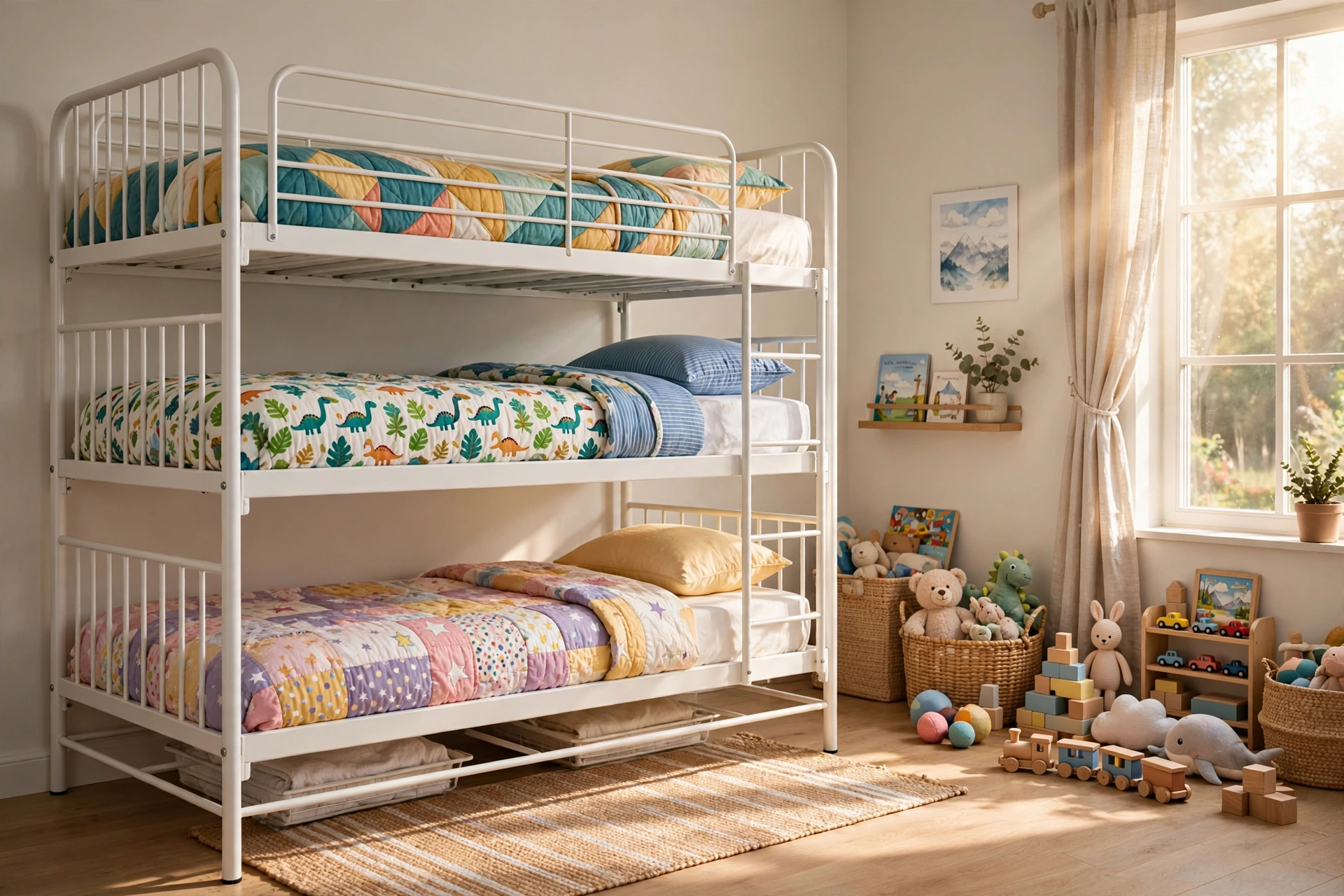
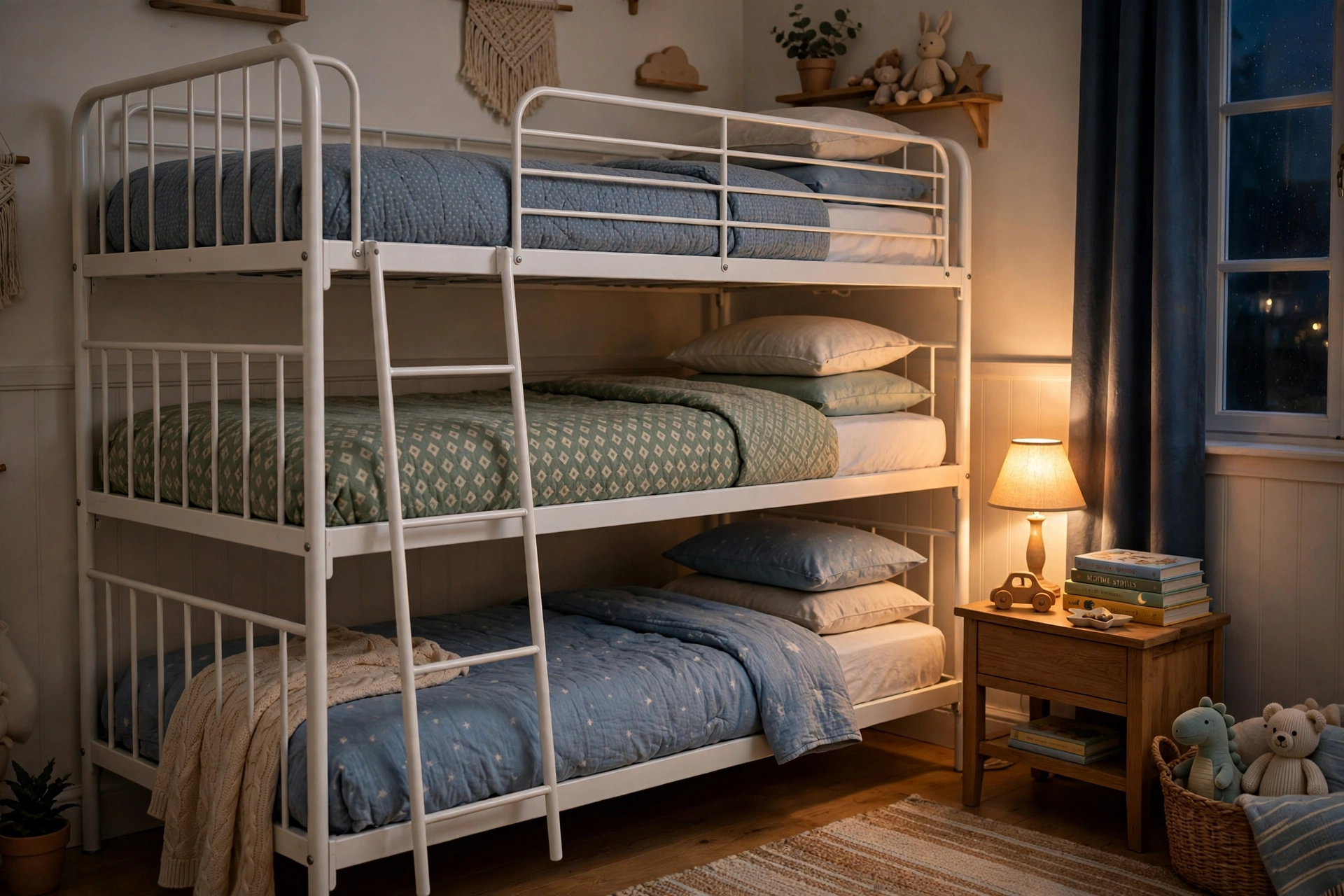
The configuration is what sold me. This is not three twins stacked to the ceiling like a submarine. It is a full-size upper bunk (96.9 by 55.9 inches) over two twin beds on the lower level, with a nightstand built into the center of the lower level between the twins. In practice that means the ten-year-old gets the top, the eight- and five-year-olds each get a twin at floor level, and each of the lower sleepers gets a real bedside surface for a lamp, a water bottle, and the current book — no clip-on caddy, no floor pile.
The alternatives all failed on geometry. Three separate beds eat roughly 60 square feet before you add walkways, and our room is 132. A twin-over-twin with a trundle sleeps three too, but the trundle lives on the floor and has to be rolled out every night — fine for guests, annoying as a permanent third bed. The triple bunks the whole problem vertically: three permanent, made-up-every-morning beds in one footprint.
The 51-square-foot math: what three sleepers actually cost in floor space
The bed’s footprint is 96.9 by 76 inches, which works out to 51.1 square feet. Three separate twin beds need about 20 square feet each — 60 square feet minimum — and that is before you leave any room to walk between them. So the triple bunk hands back roughly 9 square feet of floor compared with three twins, and closer to 25 square feet compared with three twins plus realistic walkways. In an 11-by-12 room, 9 square feet is the difference between a desk fitting and not fitting.
Per sleeper, the frame costs $512 divided by three, about $171. If the bed lasts six years — a reasonable run for kids aged five to eleven — that is roughly $85 a year, or about $28 per kid per year, before mattresses. Those are my estimates, flagged as estimates, but the direction is what matters: the per-sleeper cost of this frame is lower than any three-bed arrangement I priced.
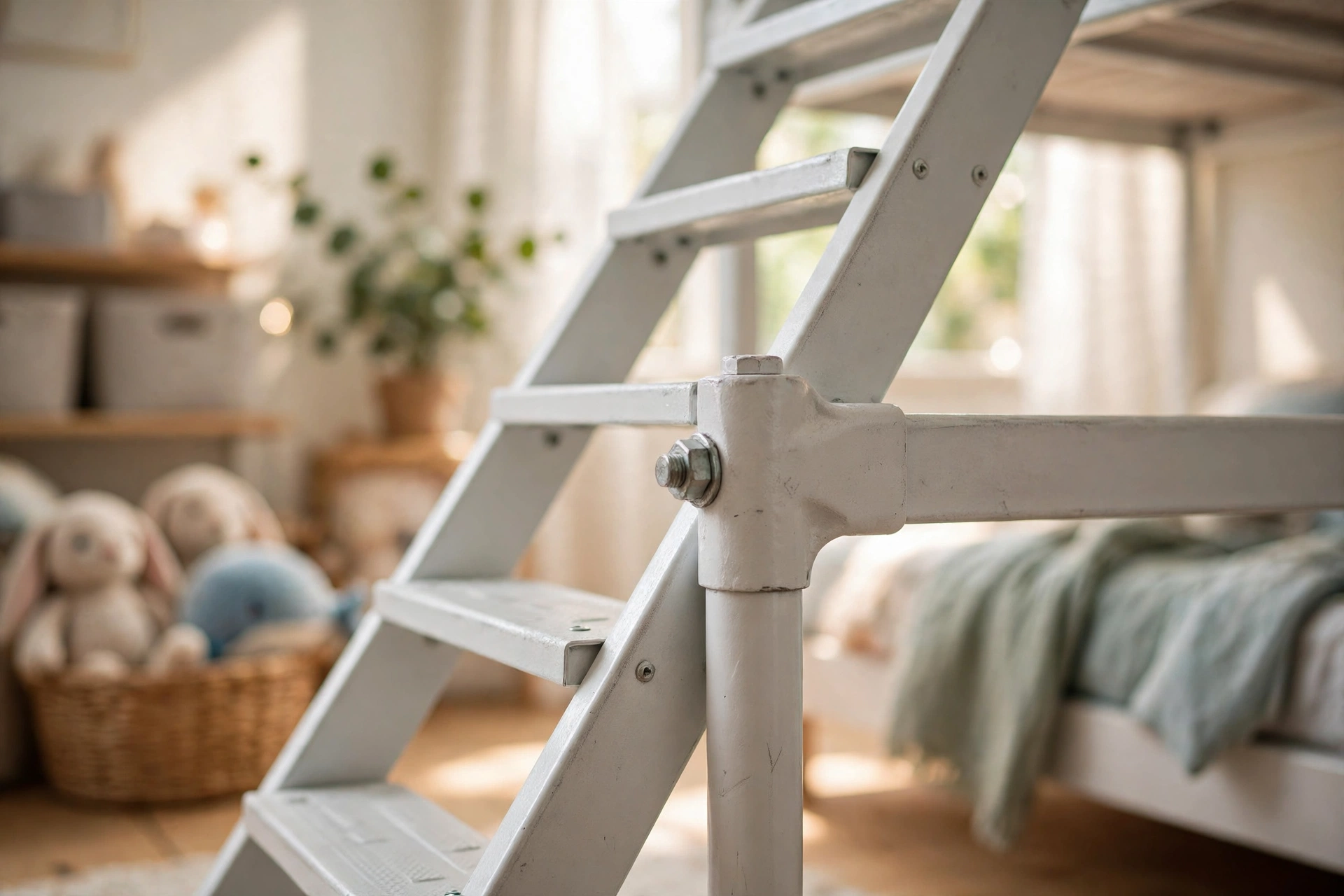
What $512 buys: the specs that mattered after 90 days
I read the spec sheet skeptically and then lived with the bed for three months. The parts that survived contact with reality:
- Steel frame, white finish, 239.36 pounds total. That weight is the whole story on stability. Lightweight frames announce every toss and turn; this one absorbs it. Ninety days in: zero creaks, zero wobble.
- 600-pound upper bunk rating, 400-pound lower rating. Absurd overkill for children, which is exactly the kind of overkill I want in a bed where someone sleeps 69 inches off the floor. It also means I can sit on any bunk for bedtime stories without doing math first.
- Full-length guardrail on the upper bunk. This was non-negotiable for me, and the page prints it plainly rather than burying it.
- Inclined ladder. Easier to climb than a vertical ladder, especially half-asleep — a meaningful difference for the ten-year-old’s 2 a.m. bathroom trips.
- Center nightstand on the lower level. Small, but it holds a lamp and a book, and it ends the nightly argument about whose stuff is on the floor.
The white powder-coat finish has taken ninety days of kid life — including one crayon incident — and everything has wiped off with a damp cloth so far. Steel does not dent the way pine does; the tradeoff is that white shows every scuff, so keep a magic eraser in the nightstand drawer.
Assembly and the two 130-pound boxes
It ships in two packages, 127.2 and 134.64 pounds. Have them left in the garage, not on the porch, and do not plan to carry either one upstairs alone. Assembly is a genuine two-adult Saturday-morning job: the frame is steel, the pieces are long, and you will want a second pair of hands holding things square while you bolt.
Five things worth knowing before the boxes arrive:
- Mattresses are not included. Budget $100 to $200 per sleeping surface for decent ones — a triple bunk that “sleeps three” really costs the frame plus three mattresses, and that is true of every bed on the market.
- Watch the upper mattress thickness. A thick mattress eats into guardrail height. Keep the top bunk mattress modest — the guardrail is a safety device, not a decoration.
- No box spring needed. The slat system is the support, which saved us another $100-plus we had mentally budgeted.
- Measure the ceiling. The bed stands 69 inches tall, so it clears standard 8-foot ceilings with room to spare — but sit-up headroom on the top bunk is the measurement I would take seriously. Tape 69 inches on the wall and have your tallest kid sit under the mark before you buy.
- Leave clearance on one long side. The inclined ladder needs approach room, and whoever makes the beds needs to reach the top bunk.
Triple bunk bed for kids safety: guardrails, ladders, and the rules I enforce
Here is the stat that reordered my priorities before I bought: a U.S. Consumer Product Safety Commission analysis estimated roughly 36,000 bunk-bed-related injuries treated in US emergency departments each year (an estimate from published CPSC analyses), mostly children under 15, and the large majority involve falls from the top bunk. Reading that made the guardrail spec the most important line on the product page.
The house rules, enforced without negotiation:
- Nobody under six on the top bunk. The American Academy of Pediatrics advises that children under six should not sleep on the upper bunk of a bunk bed. Our five-year-old is on a lower twin, full stop.
- The ladder is for climbing, not playing. The inclined ladder is easy to use, which is exactly why the rule exists — easy should not become casual.
- Bolt check on the first of the month. Thirty seconds with the included Allen key. Nothing has loosened in ninety days, and I intend to keep it that way.
- Nightlight stays on. A $5 plug-in nightlight aimed at the ladder turned the 2 a.m. bathroom trip from a worry into a non-event.
The money math: $512 versus three separate beds
Rough math, flagged as rough. Three budget bed frames run about $150 to $250 each — call it $600 for three — before you buy a single mattress, and they need three times the floor space, which our room does not have. The $512 triple bunk sleeps three in 51 square feet. Per sleeper that is $171, and the figure quietly includes the center nightstand and the inclined ladder.
For context on where the category sits: the kids’ furniture market was valued at $31.6 billion in 2024, with the beds segment alone at $10 billion and projected to reach $14 billion by 2035 (WiseGuyReports, Kids’ Furniture Market report), and North America holds about 34.7% of a $28.15 billion global market (Fortune Business Insights, 2024 data). A lot of families are solving exactly my problem, and the space-stacking corner of the market is where the growth is.
The honest caveat: if you have three bedrooms, buy three separate beds — they are nicer to sleep in and easier to make. This bed wins on space and on dollars-per-sleeper, not on luxury. We had one room and three kids, so it won on the only metrics that mattered.
The verdict
Ninety days in, the rotation argument is over who gets the top bunk, which tells you how the kids feel about it. My read as the person who paid: the $512 was not really spent on a bed. It was spent on three permanent beds in 51 square feet, a nightstand that ended the floor-pile era, an inclined ladder a sleepy ten-year-old can navigate, and weight ratings so far above what my kids weigh that I never think about them. Against three separate frames at roughly $600, it is cheaper and smaller — a combination that almost never happens in furniture. In an 11-by-12 room with three kids, I would make that trade again tomorrow.
Shop the bed: see the full specs and photos of the triple bunk bed for kids ($512) at FLNORW MALL — or compare it with the bunk bed with stairs ($699) and the twin-over-twin bunk bed comparison ($268 vs $399) if your room points elsewhere. The pirate ship bed ($599) is the fun pick for a single kid, and the FLNORW MALL homepage has the full kids’ bedroom range.