I Ditched My Rolling Office Chair for a $139 Velvet Swivel Chair. Here’s the Honest Review.
Why I bought an office chair without wheels
I started looking for a velvet swivel office chair the week my neighbor lost $220 of his security deposit to “floor restoration.” The crime: three years of caster tracks carved into the oak by a perfectly normal $120 rolling office chair. I rent in the same building, on the same oak floors, with the same deposit at risk. My own mesh task chair had already started leaving pale racing stripes across my living room. The wheels had to go.
A chair mat was the obvious answer, and I almost bought one. Then I priced it out and lived with the reality for a minute:
- A decent PVC chair mat rated for hardwood runs $40 to $60, and every one I have ever owned cracked or yellowed within two years.
- Rolling chairs drift on hard floors. Mine crept about an inch a week toward the kitchen; I was constantly dragging it back like a dog that will not stay.
- Caster rumble on calls is real. My old chair announced every lean to my team on Zoom.
So at 11 p.m. on a Tuesday I bought a $139 chair with no wheels: FLNORW MALL’s TS teddy velvet swivel chair in dark brown. It spins a full 360 degrees, sits on a carbon-steel base, and the one thing it will never do is roll across my floor. Three months and roughly 600 hours of sitting later, here is the full honest report.

What this velvet swivel office chair actually is
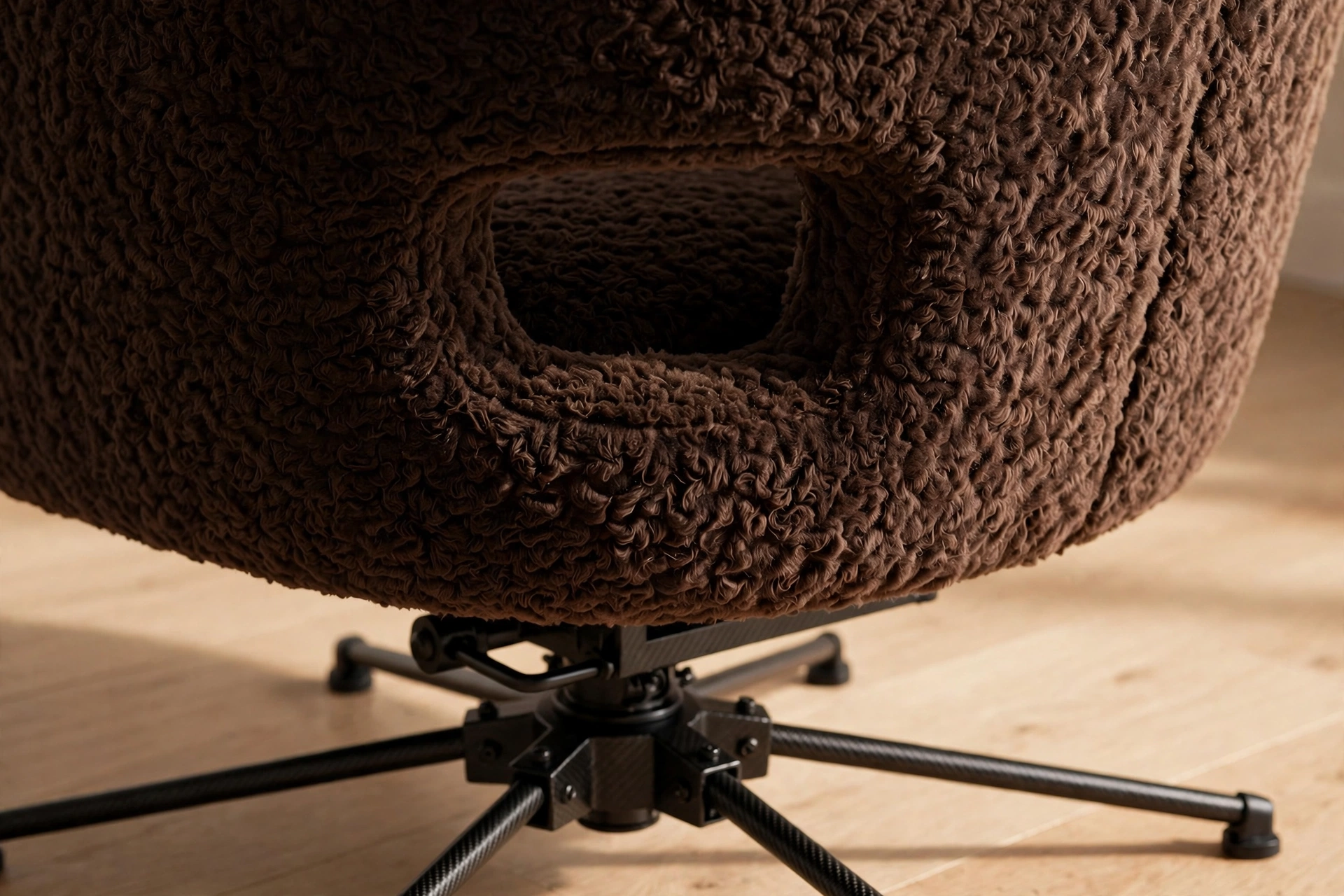
The spec sheet is refreshingly concrete. The chair measures 22.84 × 22.25 × 32.68 inches and weighs 16.53 lbs. The frame is carbon steel with extended metal legs, rated to 250 pounds. The upholstery is teddy velvet in dark brown, and the back has a hollow cut-out design that keeps it from looking like every black office slab in America. FLNORW MALL lists it at $139.00 (item code W2311P149225), with a gray version of the same chair at $139.99.
For the internal-link record, I paired mine with the weathered oak desk I reviewed last week — dark brown velvet against black metal legs and weathered oak turns out to be a combination that looks intentional rather than accidental. If you want a bolder cousin, I also covered FLNORW MALL’s navy velvet accent chair, which is bigger and softer but does not swivel.
Three months of sitting: the swivel desk chair back verdict
Let us get the expectations right first. This is not a Herman Miller, and $139 does not buy you a Herman Miller. What it bought me is an ergonomic backrest that actually follows the curve of my lower back instead of fighting it. The hollow design means the back does not press on my spine in one flat sheet; it cradles, which sounds like marketing until you sit in it for six hours.
My honest daily report: four to six hours, no complaints. I type with my elbows on the moderate-height armrests, which ended a low-grade elbow soreness my armless old chair had been giving me for months. After marathon days — nine, ten hours, deadlines, no lunch — my shoulders notice the lack of lumbar pillow by evening. That is the real limit of this chair: it is a superb daily driver, not an endurance machine. For a normal workday with a lunch break, it has never once made me think about my back, which after the old mesh chair feels like a minor miracle.
Velvet office chair durability: the cat and coffee tests
I own a cat who sheds like it is her job and a coffee habit that borders on ceremonial, so the teddy velvet got tested fast. The results, honestly, surprised me:
- Cat hair: it clings, there is no lying about that. But one pass with a lint roller takes it off clean — the weave is tight enough that hair sits on the surface instead of working in.
- Coffee: month two, a full mug tipped against the seat edge. I blotted immediately with a damp cloth and there is no stain. The dark brown hides a universe of sins.
- Wear: three months of daily sitting and the fabric is not bagging or going shiny at the pressure points. Velvet does show pressure marks where you sit; a quick run of the hand across the grain refreshes it.
Care routine is nothing: vacuum with the upholstery brush attachment every couple of weeks. That is the entire maintenance program.
Do you miss rolling? The wheelless question, answered
This is the question everyone asks, so here is the answer after three months: the swivel covers about 90% of what wheels did. Turning to grab something from the shelf behind me, pivoting toward the printer, spinning to face the window during a call — all handled. The chair weighs 16.5 lbs, so scooting it across hardwood takes one hand and zero effort.
What I genuinely do not miss: chasing the chair. My old roller would be halfway across the room by the time I stood up, and I would sit back down on air at least once a month. The wheelless base stays where you park it. What I would miss, in fairness: rolling myself across a big open office to a coworker’s desk. In a 100-square-foot spare bedroom, wheels were always overkill. One honest caveat — on thick carpet this chair will be annoying to move. It is a hard-floor specialist.
The $139 math versus a $600 ergonomic task chair
Here is the accounting, flagged as rough where it is rough. A name-brand ergonomic chair at $600, spread over three years of ~250 workdays, costs about $0.80 per workday. This chair at $139 over the same period costs about $0.19 per workday. A $90 big-box mesh chair replaced every two years lands around $0.18 per workday — technically the same math, but every one I have owned sagged into a hammock by month eighteen.
Then the wheelless bonus math: no $40–60 chair mat to buy and replace (my estimate of mat cost, based on current retail listings). And the big one for renters — my neighbor’s $220 floor-restoration deduction. I am not claiming this chair guarantees your deposit back, but a chair that cannot roll cannot carve caster tracks. One avoided floor charge pays for this chair with change left over.
The home office furniture numbers behind the switch
I wanted to know whether I was buying into a fad or a trend, so I looked at the market data. Dataintelo’s 2025 report puts the global home office furniture market at $48.3 billion in 2025, growing at a 5.2% CAGR to $72.8 billion by 2034. And per a Research and Markets report on the US market, the office-chair category alone commands 28.55% of US home office furniture spending in 2025 — the largest slice of the pie.
Translation: the chair is where the money is, which is where the competition is, which is why a genuinely comfortable seat now costs under $150 instead of $500. The value tier of home office furniture is having a moment, and this chair is riding it.
Who should skip this small home office chair
Honest drawbacks, all at once: the 250-pound rating is a hard ceiling — I am well under it and the frame is rock solid, but if you are near it, look for a 300+ lb chair. There is no height adjustment and no recline; it is a sit-upright chair, period. At 32.68 inches tall it works with standard 28–30 inch desks (I am 5’10” and the geometry is right), but check your setup. And as noted — thick carpet owners, this is not your chair. The velvet-and-swivel formula assumes hard floors.

The verdict
Three months in, the chair has done exactly what I bought it for: it swivels, it holds my back through a workday, and my floors look exactly like they did on moving day. The $139 buys a comfortable, genuinely good-looking seat that stays where you park it — and it pulls double duty as an accent chair in the living room on weekends, which no mesh task chair has ever managed. It will not replace a $600 ergonomic chair for ten-hour coders, and it is not trying to. For a renter on hardwood who works four to six hours a day at a desk, it is the right chair at the right price. I would buy it again.
Want the full spec sheet? See the velvet swivel office chair on FLNORW MALL, or browse the furniture collection for more home office picks.