I Walked 8,000 Steps a Day at My Standing Desk. Here’s My Honest $288 Walking Pad Review.
My standing desk raised and lowered beautifully for a full year before I admitted the truth: standing still is barely better than sitting. My fitness tracker said I averaged 2,800 steps a day, most of them trips to the kitchen and back. So this spring I finally did what half the remote workers I know have already done — I bought a walking pad under desk treadmill. FLNORW MALL sells one for $288: a 2.5HP motor, an LED display, and a remote control. Three months later, 8,000-step days are my boring new normal. Here is everything I wish someone had told me before I clicked buy.
Why I Stopped Just Standing at My Standing Desk
Standing desks have a dirty secret. They fix your chair problem and replace it with a standing problem: you shift your weight from foot to foot for two hours, your lower back aches by lunch, and eventually you sit back down and the $400 desk becomes an expensive footrest. A friend who works in physical therapy put it bluntly — the goal was never standing, it was movement. Walking at 1 to 2 mph under the desk keeps your blood moving without breaking your concentration, and that was the part my desk was missing.
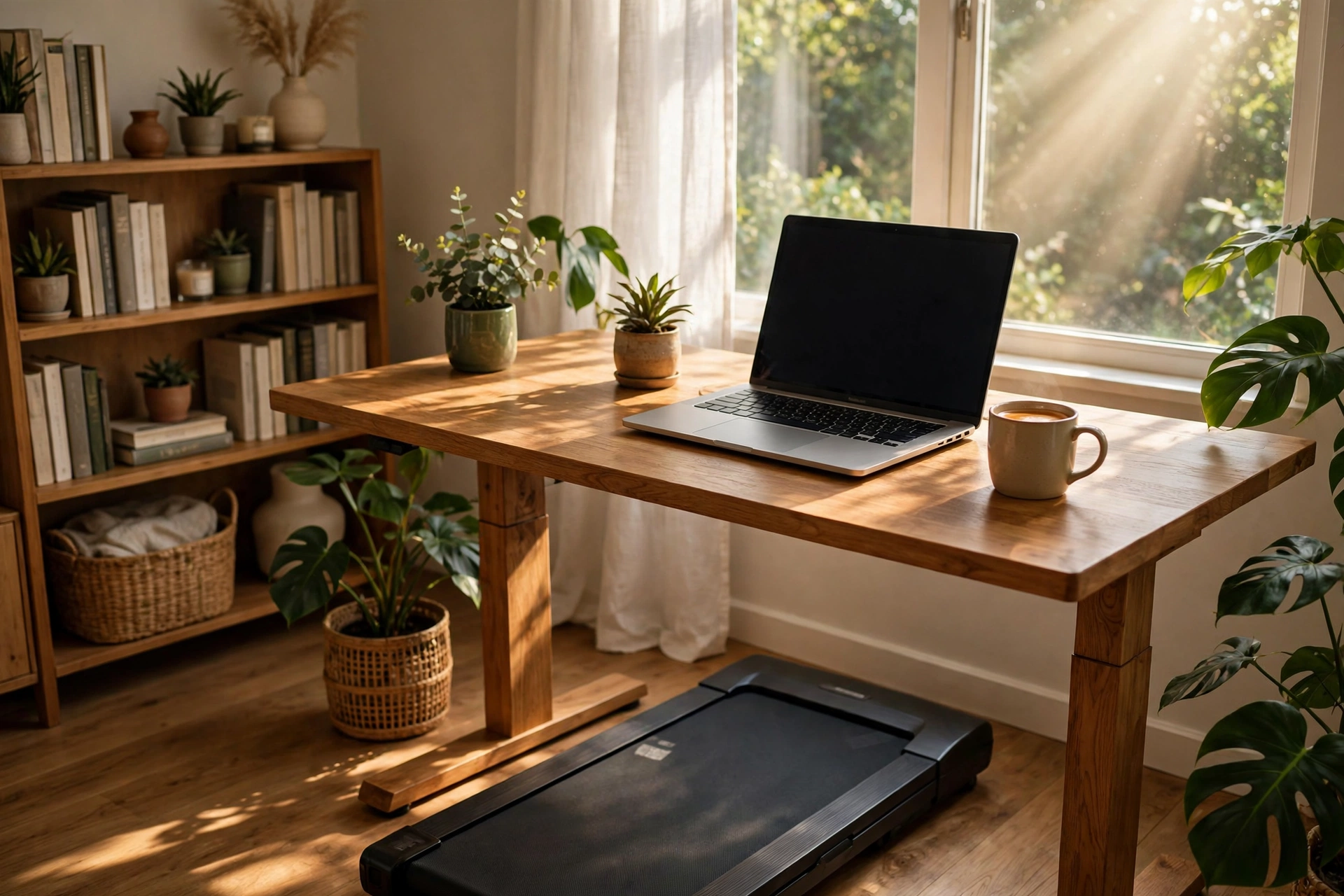
I considered a full treadmill desk, the kind with a mast and console. They run $500 to $1,000 and eat a corner of the room permanently. A walking pad treadmill — no handrails, no console, just a 4.7-inch-tall slab — slides under the desk while I work and under the sofa when I do not. For a two-bedroom apartment, that was the entire decision.
Walking Pad Under Desk Treadmill: What $288 Actually Gets You
Let me run through the spec sheet the way I wish every product page would — no marketing gloss, just the facts that mattered in practice:
- 2.5HP motor, rated for walking and light jogging. It has never sounded strained at my pace.
- Speed range 0.6–5 mph, adjusted by remote. My sweet spot for typing is 2 mph; 3 mph works for reading email.
- 5-layer shock-absorbing belt — the deck has real give underfoot, which my knees noticed within a week.
- 20.5-inch deck width. Narrower than a gym treadmill, generous for a device you walk on at desk speeds.
- Footprint 48″ × 20.5″, height 4.7″, weight 41.8 lbs. It fits under most standing desks and stores flat under a sofa.
- LED display tracking speed, time, distance, and calories. Simple, bright, readable at a glance.
- Remote control for speed changes and emergency stops without reaching for your phone.
Setup took me under ten minutes. It arrived in one box, unfolded flat, and the only “assembly” was plugging in the power cord. The item code on my invoice was W1362119975 — black, steel frame, the plainest-looking piece of fitness equipment I own, which I mean as a compliment.

The Zoom Test: Is a Walking Pad Quiet Enough for Work Calls?
This was my biggest worry, so I tested it on day one. At 2 mph the motor produces a low, steady hum — the kind of background sound a microphone’s noise suppression eats completely. In three months, nobody on a call has ever asked what that noise was. My wife works in the next room with the door open and has never complained. My cat naps under the desk while I walk, which is the most honest noise review I can give you.
At 4 mph and above the belt gets noticeably louder — fine for a podcast or a show after work, but I would not take a client call at that pace. My rule is simple: meetings get 1.5 mph or a pause, focused work gets 2 mph, and anything faster is after-hours exercise. The shock-absorbing belt also deserves credit here — there is no footfall thump traveling through the floor to the downstairs neighbor, which is the thing that would have gotten me complaints, not the motor.
The Fine Print: Weight Limit and the 20.5-Inch Deck
Honest flag first: the product name says 265 lbs max, but the safety bullet on the listing says 245 lbs. That kind of mismatch is worth calling out. I weigh 178 and the belt has never felt strained, but if you are anywhere near the top of that range, treat 245 as your working limit and do not quibble with me about it.
The 20.5-inch deck is the other thing to know going in. It is plenty for walking — I have never clipped the side rails at 2 mph — but this is not a treadmill you train for a 5K on. The whole design assumes you are moving at desk speeds. If running is your goal, you want a machine with handrails and a longer belt, not this. Know what you are buying and you will not be disappointed by it.

My Daily Walking Desk Routine, Three Months In
People ask how you actually work while walking, so here is my real schedule. Morning email triage and Slack: 2 mph. Phone calls: I slow to 1.5 or step off entirely — I gesture when I talk and walking makes me sound slightly out of breath. Deep writing: I step off. The belt hum does not bother me when reading, but when I am composing a sentence the movement pulls at my attention. After lunch I get back on for an hour or two of lighter work, and I finish most days around 8,000 steps.
Rough math, flagged as rough: at an average stride, a mile of walking is about 2,000 steps, so 2 mph for two hours lands near 8,000 steps. For calorie burn, walking at 2 mph is roughly 2.5 METs, which for someone my size (about 160–180 lbs) works out to roughly 150–200 calories an hour — do not quote me on the decimals, but the order of magnitude is right. What I can say without estimating: my knees, which complain about concrete sidewalks, do not complain about the 5-layer cushioned belt.
The $288 vs $45-a-Month Math
The gym two blocks from my apartment charges $45 a month. That is $540 a year, before the commute and the monthly ritual of not going. The walking pad cost $288 once. Simple division puts the break-even at just over six months — by month seven, mine will have paid for itself against the membership alone. Electricity is a rounding error; a small motor running at walking speeds sips power.
But the real math is not dollars, it is adherence. I used my gym membership eleven times last year. I use the walking pad five days a week because it removes every excuse: no bag to pack, no weather to check, no commute, no waiting for equipment. The cheapest treadmill is the one you actually step on, and the one under my desk has a compliance rate no gym ever got from me.
Walking Pad vs Folding Treadmill vs Pedal Exerciser
FLNORW MALL sells three machines in this lane, and they are genuinely different purchases. The folding treadmill at $499.99 is a real running machine — 12 built-in programs, 0.5–7.5 mph, 3-level incline, hand pulse sensors — but it stands 51″ × 24.5″ × 44.5″ in use and needs permanent floor space. The YSSOA pedal exercise bike at $200 fits under a sitting desk at 8.36 lbs and works arms or legs, but pedaling seated is not walking — it will not fix your step count.
My rule of thumb: if you own a standing desk, the walking pad is the answer. If you want to run at home, get the folding treadmill. If you sit all day and just want some motion, the pedal exerciser earns its $200. And if you are browsing, the whole Sporting Goods section at FLNORW MALL has the full lineup side by side.
The Industry Numbers: Walking Pads Are Having a Moment
I checked the market data to see whether I was early or just late to an obvious trend. According to QYResearch, the global walking treadmill market was valued at roughly US$2.415 billion in 2025 and is forecast to reach about US$3.538 billion by 2032, growing around 5.7% a year — with an average selling price near US$321 per unit in 2024, which puts this $288 unit below the market average. The tailwinds are real: the World Health Organization’s Global status report on physical activity (June 2024) found that 31% of adults worldwide are physically inactive, and Garmin’s 2023 Connect Fitness Report (January 2024) showed logged walking activities up 7% year-over-year.
Translation: remote workers discovered they could bank steps during meetings, and the category stopped being a niche gadget. The walking pad is where home fitness and the workday merged — and at under $300, it is the cheapest way into that merger.
The verdict. Three months in, the walking pad turned my standing desk from furniture into a habit. If you work from home at a standing desk and your step count embarrasses you, buy it — the $288 breaks even against a gym membership in half a year and gets used five times more. If you do not have a standing desk, skip it — walking while hunched over a dining table is a chiropractor bill waiting to happen. And if you want to run, buy the real treadmill instead.
Check the walking pad under desk treadmill on FLNORW MALL — $288, 2.5HP motor, LED display with remote, free shipping. My 8,000-step days are boring now. That is exactly the point.