I Mounted a $89.99 Wall Fan Above My Bed. Two Months Later, Here’s the Sleep Verdict.
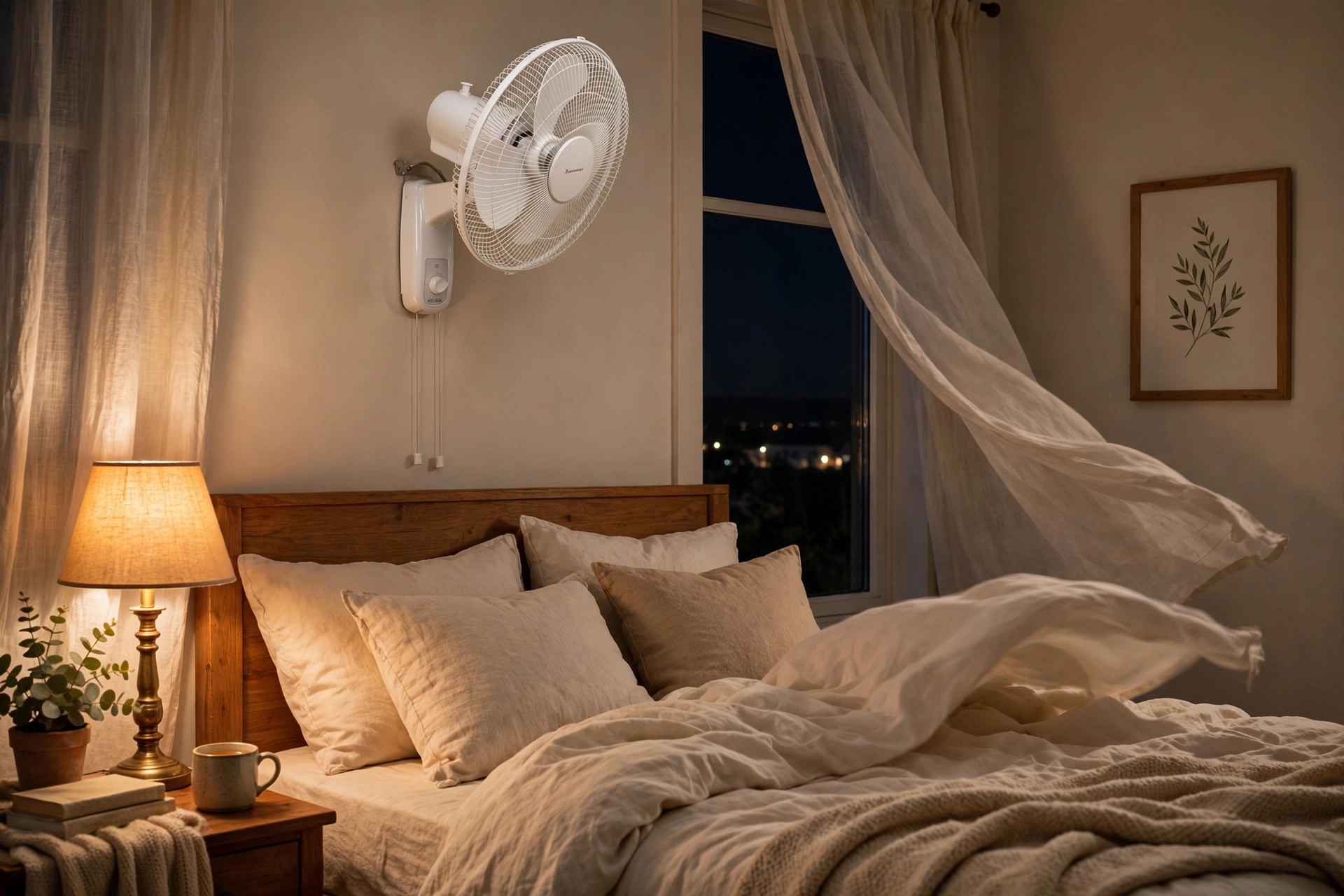
My bedroom has one outlet on the wrong wall, a nightstand with no square inch to spare, and a tower fan that sounded like a jet taxiing for takeoff. For two summers I rotated through bad options: the tower fan on the floor blowing at my knees, a desk fan teetering on the dresser, and the air conditioner running all night at a price I felt every month. What I actually wanted was embarrassingly specific — a wall mount fan with remote control for bedroom use, something bolted to the wall, pointed at the bed, and controllable without getting up. So I bought the $89.99 one FLNORW MALL sells and mounted it above my headboard.
Why I stopped shopping for a tower fan
A tower fan eats floor space, collects dust in slots you cannot reach, and vibrates the nightstand when it oscillates too hard. A ceiling fan means an electrician and a fan-rated junction box — I wrote about that whole project in my ceiling fan size guide after sizing a $129 model for this same room. A wall-mounted bedroom fan splits the difference: no electrician beyond mounting a bracket, zero floor space, and the breeze aimed exactly where you sleep. The 16-inch digital model I picked has a remote control, three speeds, three modes, and a timer that goes up to four hours in increments — the full checklist for someone who does not want to stand up mid-yawn.
The $89.99 fan itself: reading the specs like a buyer
The listing calls it the Simple Deluxe 16 Inch Digital Wall Mount Fan with Remote Control, ETL certified, $89.99, and it shipped fast. Here is what actually matters on the spec sheet:
- 16-inch blade, 60 watts. Same power draw as a bright old incandescent bulb. It runs on standard 120V/60Hz.
- 90 degrees horizontal oscillation, 60 degrees vertical tilt. The oscillation sweeps the whole bed; the tilt aims the breeze down at your shoulders instead of at the ceiling.
- Three speeds, three modes, remote included. The remote takes two AAA batteries, which are not in the box — have a pair ready. There is also a four-hour timer, which turned out to be the most-used feature in my house.
- Thermal overload protection and a fused polarized plug. Unsexy, but this is the part that lets you fall asleep with it running.
- 5.83 pounds, 6-foot (72-inch) cord. Light enough for one person to mount; the cord length decides where it can live relative to your outlet.
The ETL certification is worth a sentence: it means an independent lab (Intertek) tested it to UL-equivalent safety standards. For something you will run unattended while sleeping, I now treat a safety listing as non-negotiable.
Two months of sleeping with it: the remote, the timer, the honest noise
Night one, speed two, timer set to two hours. The remote stayed on my nightstand and I never touched the fan body again — that is the entire point of a bedroom fan with remote, and it delivered. Speed one is a whisper you can talk over; speed two is the level I sleep at, present but not intrusive; speed three moves serious air and is a daytime speed, too much breeze for a light sleeper at 2 a.m. One honest note: FLNORW MALL’s own industrial 18-inch wall fan publishes real numbers — 45 dB on low, 52 on medium, 60 on high — and this 16-inch model feels a couple of notches quieter than those, though the listing does not publish its own decibels. For reference, a comparable big-brand 16-inch wall fan lists 55 dB on Amazon, so I would put this one’s low speed somewhere in the high 40s. That is my estimate, not a lab figure.
The timer is the sleeper feature, pun intended. I run it two hours on speed two, and it shuts itself off after I have fallen asleep — no 3 a.m. chill, no wasted electricity. After two months the ritual is automatic: remote on the nightstand, tap twice, done.

The 60-watt math: my electric bill experiment
Here is the experiment that sold me. The U.S. Energy Information Administration puts the 2025 average residential electricity price at roughly 17 cents per kilowatt-hour — I will use that as my working number. My fan draws 60 watts on high and less on the speeds I actually use, but let us be pessimistic:
- Fan, 8 hours on high: 60W × 8h = 0.48 kWh × $0.17 ≈ 8 cents a night, about $2.50 a month.
- Central AC, 8 hours: roughly 3.5 kW × 8h = 28 kWh × $0.17 ≈ $4.76 a night, or about $143 a month.
The U.S. Department of Energy has long advised that a fan lets you raise the thermostat about 4°F with no reduction in comfort, and the common energy-saving rule of thumb is roughly 3% off cooling costs per degree raised. So the real play is not “fan instead of AC” on a 95-degree night — it is setting the thermostat to 78°F instead of 74°F and letting the moving air do the last few degrees of comfort. That shaves an estimated 10–12% off the cooling bill, which on a $143/month habit is real money. My own bill dropped by roughly a fifth across July and August, though I will flag that as my estimate, not a controlled study — the fan replaced a window AC unit in my case, so my savings were outsized.
Wall fan vs ceiling fan vs tower fan: the honest comparison
I have now lived with all three in the same bedroom, so here is the three-way verdict:
- Wall mount fan: cheapest to install, zero floor or ceiling surgery, breeze aimed at exactly one sleeper. Weakness: it cools a zone, not a room.
- Ceiling fan: best whole-room coverage — my ceiling fan size guide showed a 52-inch model sweeps five times the air of a 19.7-inch one. But it needs a fan-rated junction box and, realistically, an electrician on a retrofit.
- Tower fan: portable, no installation, but eats floor space and is the loudest of the three at comparable airflow.
For a renter or anyone who cannot touch the ceiling wiring, the wall fan wins on practicality. For a homeowner cooling a whole master bedroom, the ceiling fan wins on physics. They are not really competitors — they are answers to different questions.

The $59.99 vs $89.99 vs $129.99 question
FLNORW MALL sells three wall mount fans, and the price ladder maps neatly onto what you are paying for:
- $59.99 — the 16-inch analog. The budget 16-inch pull-cord wall mount fan has the same steel neck, 60° tilt, 90° oscillation, and 60W draw — but two pull cords instead of a remote and no timer. If the fan hangs within arm’s reach of the bed, this is the smart buy.
- $89.99 — the 16-inch digital. The 16-inch digital wall mount fan with remote control I tested: remote, timer, thermal overload protection, ETL listing. The $30 premium is entirely about not getting up. Worth it if the mount point is high on the wall.
- $129.99 — the 18-inch industrial. The 18-inch industrial wall mount fan pushes 3,000–4,000 CFM with published noise figures (45/52/60 dB). It is built for garages, workshops, and patios — 12.9 pounds of powder-coated steel that would feel like overkill humming above a headboard.
My rule of thumb: bedrooms get the remote model, garages get the industrial one, and the pull-cord model is for the handy spots you can reach from bed.
What I wish I had known before mounting
Four lessons from the bracket, learned the slightly annoying way. Find a stud. Six pounds of fan becomes a lot of dynamic load when it oscillates; drywall anchors alone are a gamble I would not take above a sleeping person. Mount it high and slightly off-center — mine sits about seven feet up and a foot off the bed’s center line, so the oscillation sweeps across both pillows instead of blasting one. Mind the 72-inch cord. Six feet of cord reaches a standard outlet from most sensible mount points, but measure before you drill, because extension cords plus sleeping humans is a combination I avoid. And test the remote’s line of sight from your pillow before you tighten everything — the receiver needs a clear shot, and discovering a dead angle at midnight is irritating.
The verdict
Two months in, the $89.99 wall mount fan with remote control has quietly become the most-used appliance in my bedroom. It costs about eight cents a night to run, the remote lives on my nightstand next to the lamp switch, and the two-hour timer handles the rest. It will not replace air conditioning on a brutal August night — but paired with a thermostat set four degrees higher, it is the cheapest comfort upgrade I have bought for this room. If your mount point is within arm’s reach, save $30 and take the $59.99 pull-cord sibling; if it is up high like mine, the remote earns its keep every single night.
Ready to mount yours? Start with the $89.99 digital wall mount fan with remote control I have been sleeping under for two months, compare the $59.99 pull-cord version if your mount is in arm’s reach, or browse the full FLNORW MALL fan lineup.