Wine Rack: My 32 vs 12 Bottle Buying Guide
Last spring I counted my wine bottles for the first time and got to twenty-three before I stopped looking. They were everywhere: a row along the kitchen backsplash, six more wedged on top of the pantry shelves, one brave soldier lying sideways next to the olive oil. My wife called the whole arrangement “the vineyard.” I called it a storage problem. What I needed was a wine rack — not a $2,000 climate-controlled cabinet, just a solid place to put bottles where they would stay put and stay horizontal. So I bought FLNORW MALL’s 32-bottle freestanding wine rack — natural pine with a walnut finish, $299 — and since the store also sells a 12-bottle version for $199, I ended up living with both. Six months later, here is the buying guide I wish someone had handed me before I clicked buy.
Why I stopped stacking bottles on the counter
Bottles on a counter are an accident waiting for a cat. Mine survived three near-misses before I took the hint, including one evening where a full bottle of cabernet rolled a full eighteen inches and stopped exactly at the edge of the counter. Counter storage also wastes the one thing a growing collection needs: consistency. Wine people will tell you bottles should rest on their sides so the cork stays in contact with the wine and does not dry out — Wine Enthusiast’s storage guides repeat this in nearly every piece they run. A bottle lying next to the olive oil is not resting. It is loitering.
The other problem is arithmetic. The Wine Institute’s current US consumption table puts 2024 at 2.54 gallons of wine per resident, and a 1point21interactive breakdown puts the average adult at roughly 101 glasses of wine a year. My household runs a little ahead of that average — dinner parties, Thanksgiving, the neighbor who “just stopped by” — so my twenty-three bottles were never going to shrink. They were going to grow. A wine rack stopped being a want and became a furniture problem with one correct answer.
What the 32-bottle freestanding wine rack actually is
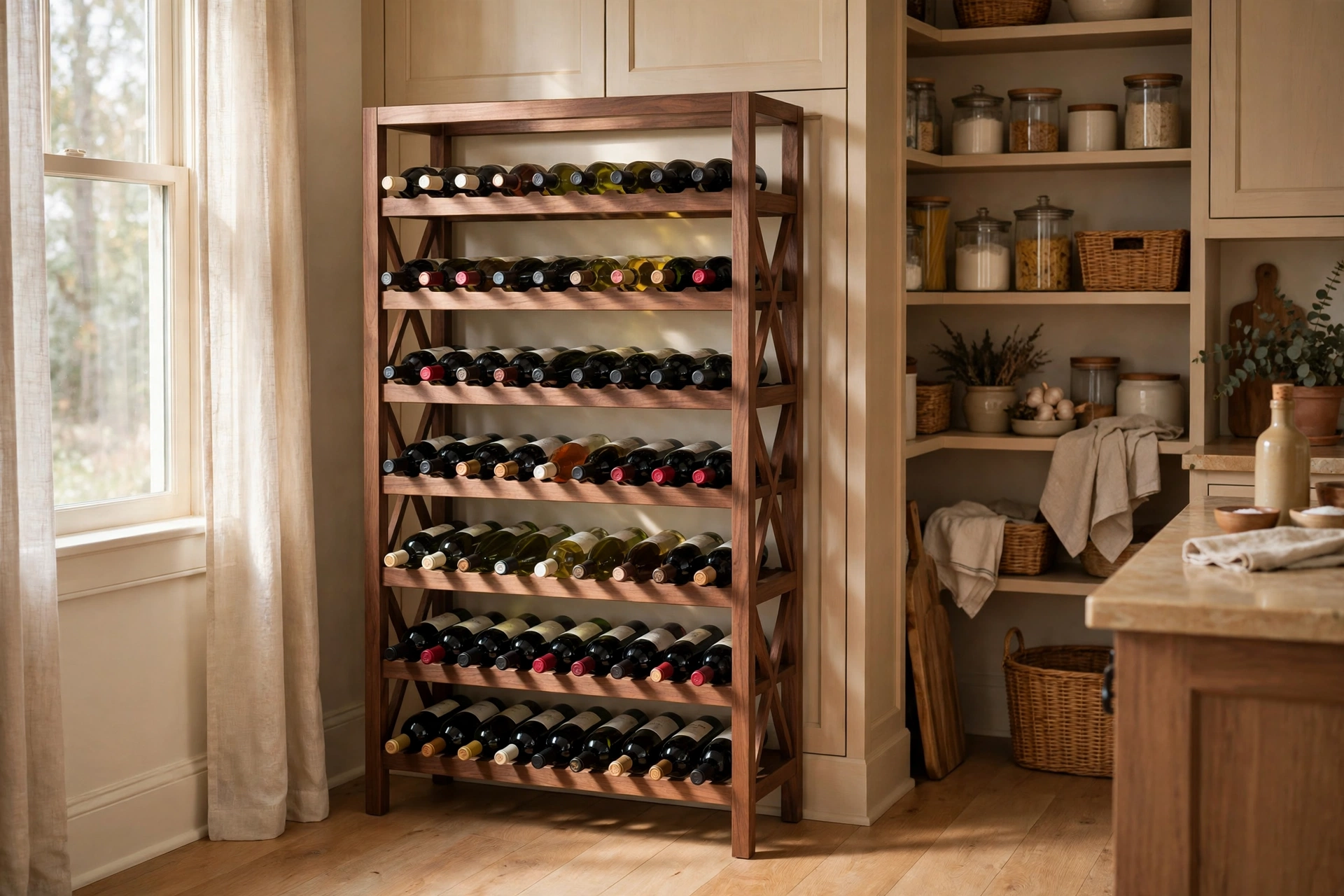
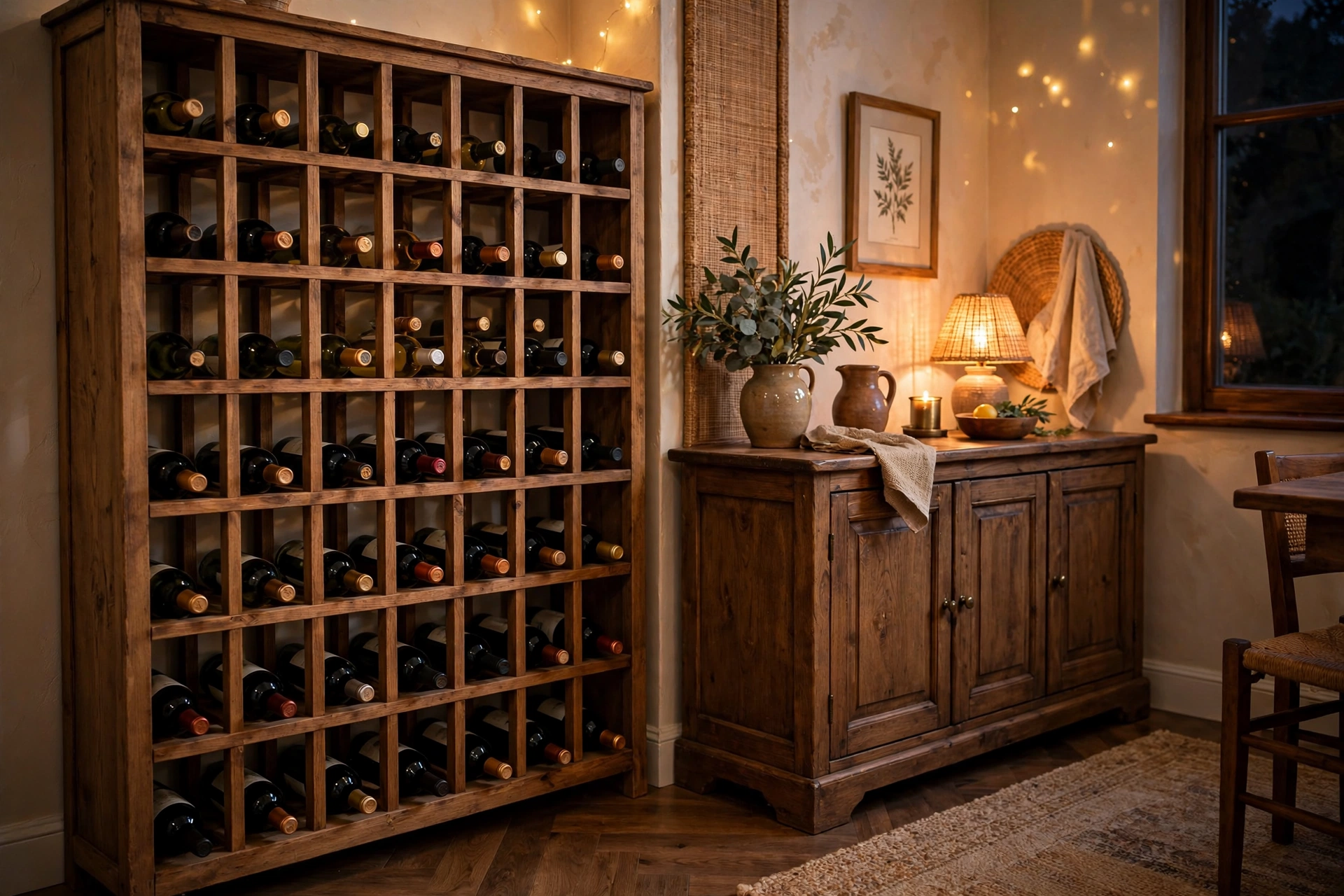
The rack I bought is the 32-bottle freestanding wine rack: solid natural pine, stained in a walnut finish, built to hold thirty-two standard 750 ml bottles horizontally. It stands on its own — no wall anchors, no brackets — and the listing positions it for the kitchen, the pantry, or the cellar. Mine lives against the pantry wall, where it replaced a small bookshelf that had been holding cookbooks I never opened.
The wood is the first thing you notice in person. Pine is a softwood, so it will pick up a nick if you bang a bottle into it, but the finish is smooth and the stain is even — no blotchy patches, no rough edges on the slots. Each bottle sits in its own cradle, neck-down, which is the right orientation for corked bottles. Assembly took me about forty minutes with the included hardware and a Phillips screwdriver; the instructions were the standard wordless-diagram type, decipherable if you have built flat-pack furniture before. It shipped in one manageable box, and I carried it in alone without incident.
One honest caveat: the slots are cut for standard Bordeaux-style bottles. My two champagne bottles — wider shoulders, fatter punt — fit, but snugly. If your collection leans heavily toward champagne or magnums, measure first. Standard 750s slide in and out with a finger’s width of clearance, which is exactly right.
The 12-bottle version: same pine, smaller footprint
The 12-bottle wine rack is the same product family — natural pine, walnut finish, same slot design — scaled down to twelve bottles at $199. It can stand freestanding or mount to a wall, which the 32-bottle cannot, and it is the obvious pick for someone whose collection genuinely stays under a dozen bottles. I bought it for my brother-in-law, whose entire wine inventory consists of “whatever Costco had” plus two bottles he is saving for no particular occasion.
Side by side, the build quality is identical. Same pine, same stain, same slot spacing. The difference is purely capacity and footprint. His twelve slots filled up within a month of delivery, which tells you something about how collections behave once they have a proper home: they expand to fill the rack.
32 vs 12: the per-bottle math that decides it
Here is the number that matters. At $299 for 32 bottles, the big rack costs about $9.34 per bottle slot. At $199 for 12 bottles, the small one costs about $16.58 per slot. The 32-bottle rack holds 2.67 times the wine for 1.5 times the money. If you think your collection will ever cross twelve bottles — and mine crossed it in a single Thanksgiving, when I bought eight bottles for one dinner and came home with four gifted ones — the bigger rack is the cheaper buy on day one and it only gets cheaper from there.
Stretch it over a decade, which is a fair lifespan for solid pine furniture kept indoors: the 32-bottle rack works out to roughly $2.49 a month, the 12-bottle to about $1.66 a month (rough estimates, flagged as rough). The small one is cheaper per month, but only if twelve slots is actually enough — and if it is not, you end up buying a second rack, at which point you have spent $398 and still have eight fewer slots than the $299 unit. I have watched this exact movie play out with bookshelves. Buy the size for the collection you will have in three years, not the one you have today.
Where a wine rack lives best in your home
I tried three spots before the pantry won. Each has a case:
- Kitchen: closest to the cooking and the corkscrew, but heat and light are the enemies of stored wine — keep it away from the oven and out of direct sun.
- Pantry: my pick. Dark, cool-ish, and the rack’s walnut finish looks like it belongs there. Thirty-two bottles take up less wall than you think.
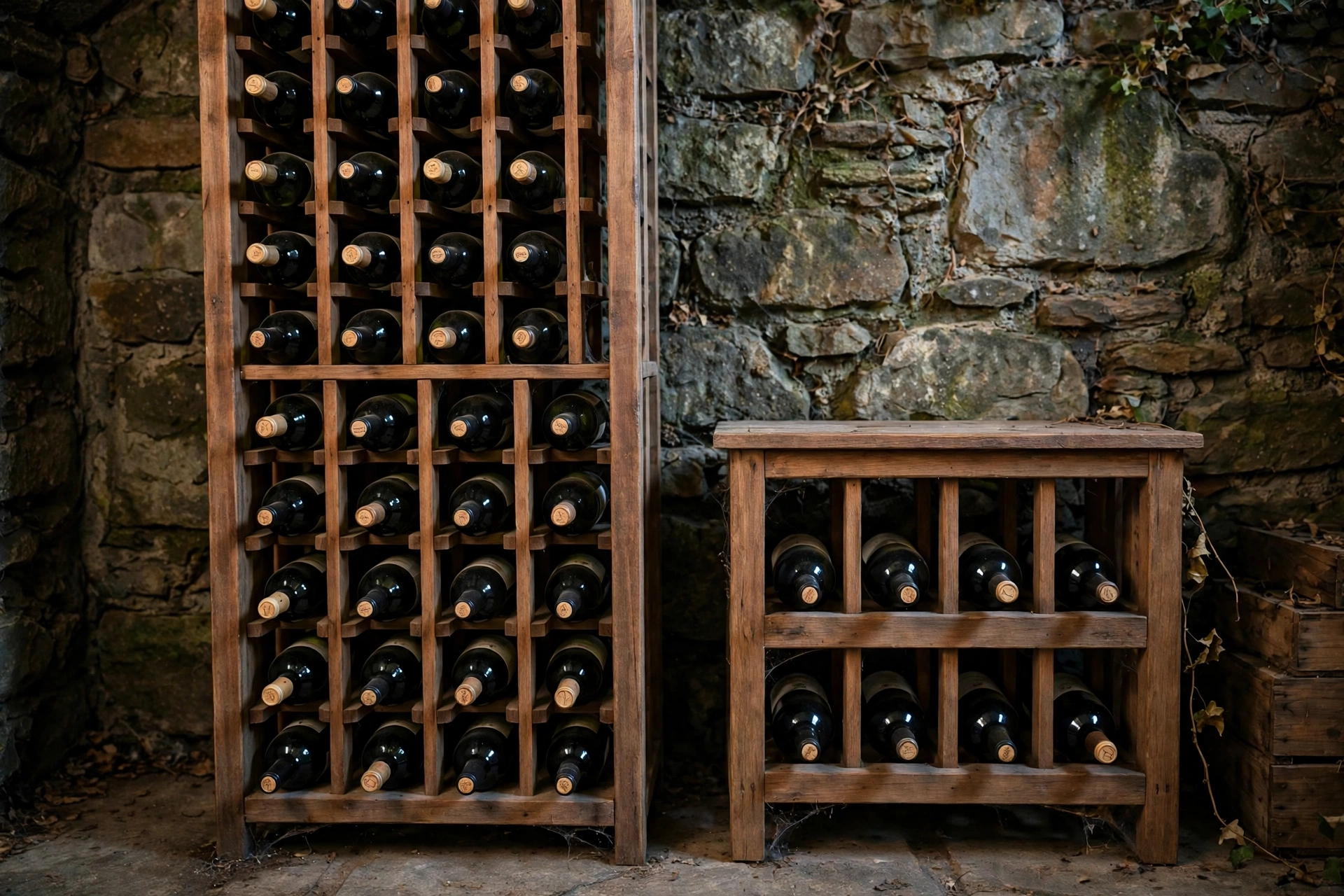
- Cellar or basement: the classic answer if you have one — stable temperature, no light, and the pine handles humidity fine as long as it is not a swamp down there.
- Dining room: doubles as display furniture. A full wine rack against a dining-room wall reads as intentional in a way a counter cluster never will.
Wherever it goes, keep it level. A freestanding rack with thirty-two full bottles is top-heavy by nature — mine sits on a rug pad so it cannot walk on the tile, and it has not budged in six months.
What the numbers say about how much wine we actually drink
I looked up the consumption data because I wanted to know whether a 32-bottle rack was overkill or just prepared. The Wine Institute’s US wine consumption table shows 2.54 gallons per resident in 2024, down from 2.65 in 2023 — wine is drinking a little less popular than it was, but it remains the country’s most common table beverage after beer and spirits. The 1point21interactive analysis breaks it down further: the average American adult drinks about 101 glasses of wine a year, roughly two bottles a month.
Two bottles a month sounds modest until you add entertaining. My Thanksgiving took eight. A dinner party takes three or four. Birthday season takes whatever is left. At my household’s pace, a 32-bottle rack holds about a year’s worth of drinking plus a party buffer — which feels exactly right. A rack that empties every two months is a chore; a rack that holds a year is furniture.
How this wine rack compares to the rest of the market
I did the comparison shopping so you do not have to. The freestanding wine rack market splits into three tiers. At the bottom are wire and stackable countertop racks — a Best Buy Canada listing I found carries a VEVOR 7-tier bamboo rack holding 42 bottles, and Amazon is full of foldable pine racks in the $30–$60 range. They work, but they look like what they cost, and the cheap ones wobble when loaded.
At the top are the powered wine coolers — Whynter’s 32-bottle dual-zone freestanding cooler is the direct capacity match to this rack, and it costs several times more while needing a power outlet and ventilation clearance. If you are aging serious bottles for years, buy the cooler. If you are storing wine you will drink within a year or two, temperature control is overkill — a dark pantry does the same job for free.
The middle tier is where this rack sits: real wood, furniture-grade finish, no electronics. Against that tier, $299 for 32 pine slots is squarely competitive — the bamboo and rubberwood racks I found in the same capacity band run $250 to $400, and most of them do not offer the walnut finish. The 12-bottle at $199 is priced for the gift market and the small-kitchen crowd, and it is fair value for what it is. Neither is the cheapest option on the internet. Both are the cheapest option that looks like furniture.
The verdict
Six months in, the vineyard is gone. Thirty-two bottles sit in their slots in the pantry, horizontal, labeled-side-out where the labels matter, and my counter holds exactly zero wine. The pine has not warped, the finish has not chipped, and the rack has not moved a millimeter. My brother-in-law’s 12-bottle rack is already full and he is eyeing my pantry with the expression of a man doing per-slot math in his head.
If your collection is twelve bottles and will stay twelve bottles — buy the 12-bottle wine rack. If there is any chance it grows, and there always is, the 32-bottle freestanding wine rack is the better buy at $9.34 a slot. Either way, stop stacking bottles next to the olive oil. Your counter will thank you.
Ready to give your bottles a real home?
See the full specs and current price for the 32-bottle freestanding wine rack, compare it with the 12-bottle version, or browse more wine storage furniture at FLNORW MALL. If you are furnishing around the bottles, our farmhouse buffet cabinet with a wine rack review covers the entertaining side.