I Laid Wood Interlocking Deck Tiles for Patio Season: My $99 Concrete Makeover
I Laid Wood Interlocking Deck Tiles for Patio Season: My $99 Concrete Makeover
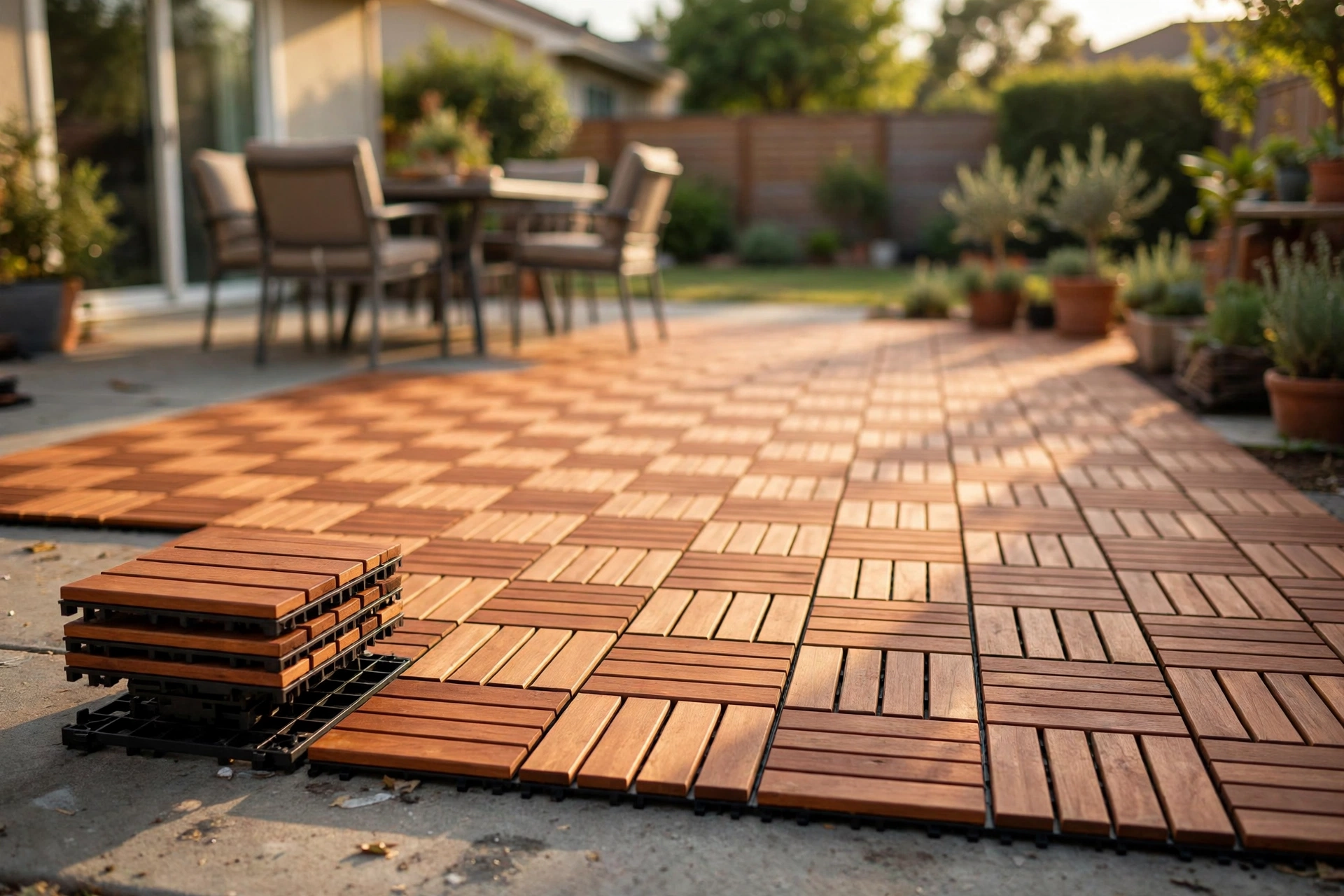
My back patio was a 12-by-10 slab of cracked concrete I had been avoiding for three summers. Two repaving quotes came in high enough that I laughed out loud on the phone, so the slab sat there, gray and oil-stained, collecting leaves and my resentment in equal measure. Then I stumbled onto wood interlocking deck tiles for patio makeovers — snap-together squares that lay straight over concrete with no tools, no glue, no contractor — and ordered one $99 pack of the Kaia 8-slat eucalyptus tiles from FLNORW MALL as a test. Forty minutes later I was standing on wood instead of concrete. This is the honest diary of that afternoon, the real cost math, and what I would tell my neighbor before he buys.
Why Wood Interlocking Deck Tiles for Patio Season Beat a Full Rebuild
I priced every alternative before I clicked buy, because $99 is cheap enough to waste but I hate wasting things. Repaving the slab: thousands. An outdoor rug big enough to matter: a couple hundred dollars, and every rug I have owned outside eventually slid around, trapped moisture underneath, and grew a smell I can only describe as pond. Painting the concrete: my brother-in-law did that, and it peeled in sheets by year two.
The tiles won on one specific promise: modular and removable. If they looked terrible, I could unsnap them and return the patio to its regularly scheduled ugliness. If they looked great, I could buy eleven more packs and finish the job. Almost nothing else in home improvement offers a $99 trial with a full refund of your dignity.
What $99 Actually Buys: The Kaia Deck Tile Specs
Facts first, all from the product page (item B093121179). You get 10 tiles of kiln-dried eucalyptus hardwood, each 11 by 11 inches and 1 inch thick, weighing 2 pounds apiece. The pattern is eight horizontal slats per tile in a reddish-brown finish, sitting on a black plastic interlocking grid base. Made in Vietnam. Price: $99, in stock at the time I ordered.
Do the coverage math with me, because the listing will not: 11 × 11 inches is 0.84 square feet per tile, so ten tiles cover 8.4 square feet. That is a test patch, not a patio — roughly a 3-by-3-foot square. I want to be blunt about this because it is the single most misunderstood number on the page. One pack tells you whether you love the product. It does not finish anything bigger than a balcony corner.
You can see the full spec sheet and current price on the Kaia 8-slat eucalyptus deck tiles product page.
The Install Diary: 10 Tiles Over Concrete in 40 Minutes
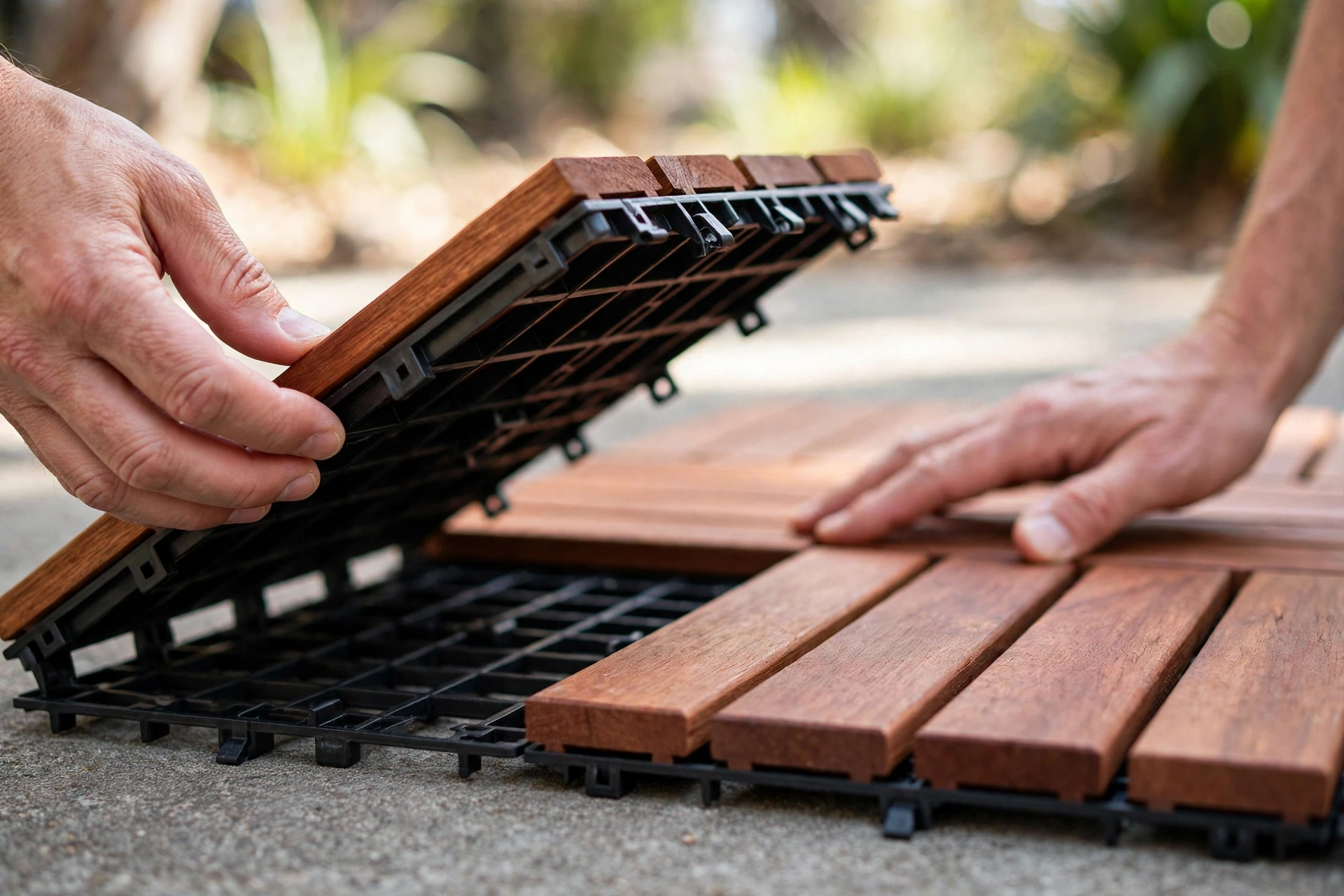
Saturday, 10 a.m. I swept the test corner of the slab — ten minutes with a push broom, the only prep the format asks for. The tiles come nested in the box; you lift one, align its connector tabs with the loops on the neighbor, and press down with your palm until you hear the click. That click is the entire quality-control department. No click, it is not seated; reseat it.
I started in the corner closest to the back door, which I recommend: you want the cleanest edge where your eye lands first. Row by row, the 3-by-3 patch plus one spare tile took shape. Elapsed time for the actual snapping: under ten minutes. The other thirty went to sweeping, stepping back to admire, re-seating two tiles I had rushed, and taking photos to send my wife, who replied “wait, that’s the same patio?”
Two install truths the product page implies but does not state plainly. First, edges and corners need trimming — around a downspout or an odd angle, you will be cutting a tile with a saw, the same way every deck-tile seller from KingsWarehouse to Greatmats describes it. Second, the surface underneath must be hard and reasonably level. This is a hard-surface product. As one guide I found while researching put it, you cannot install deck tiles directly over grass or soil; my slab qualified, a lawn would not.
Interlocking Deck Tiles Over Concrete: The Drainage Truth
Here is the engineering detail that sold me, and it is the same reason an outdoor rug was never going to work on my slab. The plastic grid base elevates the wood slightly, and the slats let water pass through — the product page says it plainly: “wood slats permit water to flow through.” Rain lands on the tile, drops through the gaps, and runs off the concrete underneath instead of pooling on top.
That raised base does three quiet jobs: drainage, airflow under the wood (which is what keeps it from rotting from below), and a small thermal break so the surface does not feel like a griddle at 3 p.m. Greatmats, which sells a lot of this category, notes you can lay these tiles directly over a concrete patio with no underlayment or adhesive — my afternoon confirmed it. I hosed the patch down afterward just to watch the water vanish through the slats, which is the kind of entertainment a 40-year-old homeowner finds deeply satisfying.
Wood Interlocking Deck Tiles for Patio: The Honest Cost Math
Let us run the numbers all the way, because the per-pack price hides the project price.
- Per square foot: $99 ÷ 8.4 sq ft = $11.79 per sq ft (my calculation).
- The market context: ECODeck, a hardwood deck-tile manufacturer, quotes $8–$12 per sq ft for hardwood deck tiles plus roughly $1–$3 per sq ft for installation labor. So these tiles sit at the top of the hardwood range on product cost — but the labor line is zero.
- A full 10×10 patio: 100 sq ft ÷ 0.84 = 119 tiles → 12 packs = $1,188, one Saturday, no contractor, no tools beyond a broom and maybe a saw for edges.
- Pro-installed equivalent: using ECODeck’s ranges, 100 sq ft runs roughly $900–$1,500 (my estimate) — but you wait weeks for a crew and you cannot take it with you.
- The cheap alternative: plastic interlocking tiles start around $4.29 per sq ft at Greatmats — but that is plastic, not wood, and it looks like it.
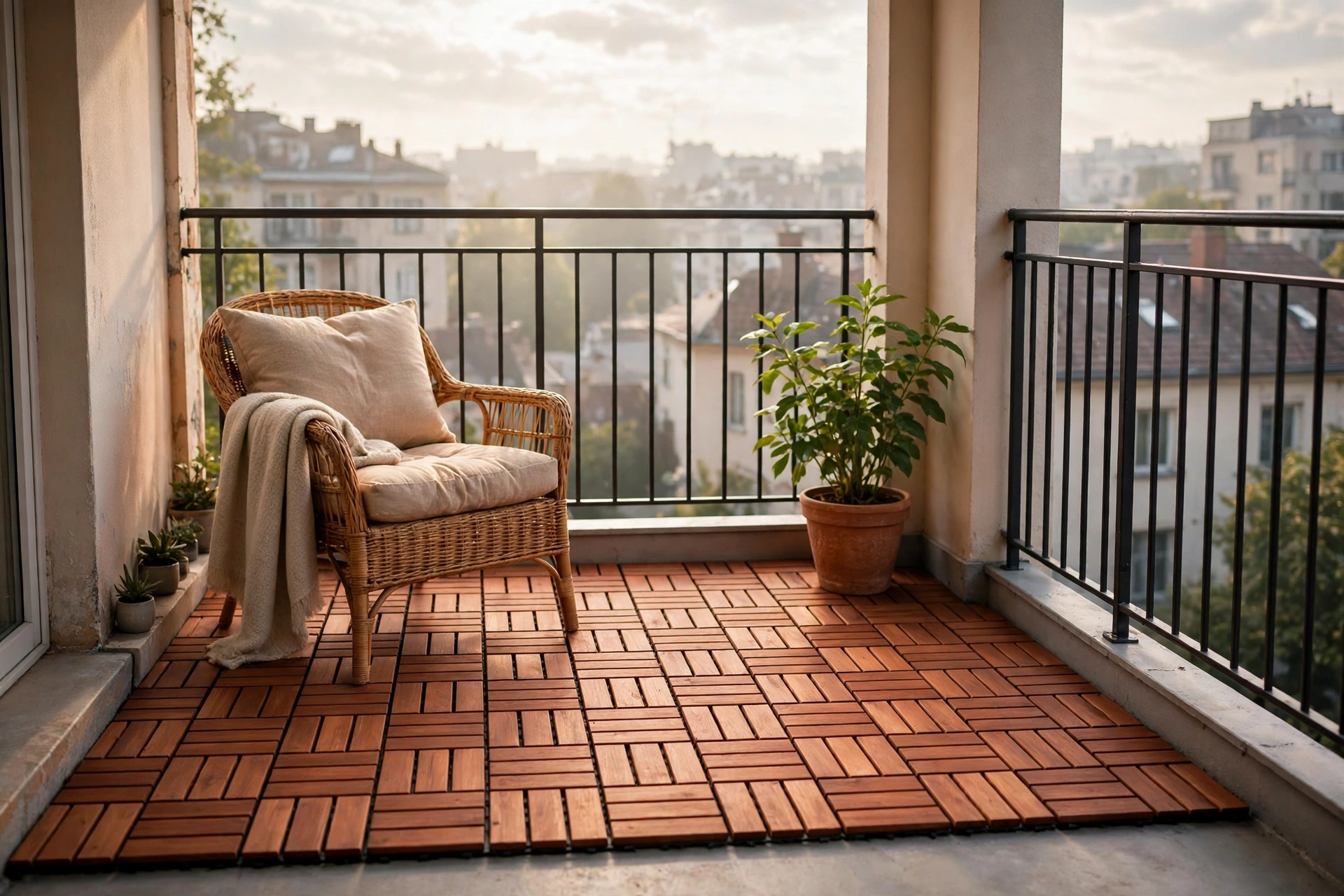
The real savings are not in the per-foot price. They are the deleted line items: no installer, no demo of the old slab, no permit conversation, and — the one I keep coming back to — a renter can unsnap the whole floor on moving day and take it along. One guide I read during research called deck tiles “an excellent option for renters who want to upgrade their space without making permanent changes,” and that is exactly right. My slab is mine, but my sister rents, and her balcony is next on my list.
Eucalyptus Deck Tiles: What the Wood Actually Does Outside
Eucalyptus is the honest middle child of deck woods: denser and more weather-resistant than pine, cheaper than teak, and — per the product specs — kiln-dried and pre-treated on these tiles. Two months in, mine look exactly like day one.
But I will not sell you the fantasy version. Natural wood changes outdoors; that is chemistry, not a defect. Victory Relax, which published a thorough “are wood deck tiles worth it” guide I found while researching, puts it plainly: the wood requires routine cleaning and may need periodic oiling if you want to preserve its original color. The reddish-brown finish on my tiles will eventually silver out in full sun if I do nothing. My plan, borrowed from how I maintain my acacia patio table: a thin coat of exterior wood oil once a season, fifteen minutes with a rag. I have already decided that is a fair trade, and I am telling you now so you decide with eyes open.
The consolation prize of the modular format: if one tile ever cups, cracks, or stains beyond saving, you pop out that single tile and snap in a spare. Try that with a poured slab. I ordered my second pack partly as spares, which felt extravagant until I remembered a single replacement paver at the garden center costs more than one of these tiles.
Three Things I Would Tell My Neighbor Before Buying
He asked over the fence last weekend, so this part is already field-tested:
- Measure twice, then count packs. Ten tiles is 8.4 square feet. A 10×10 patio needs twelve packs. Do not order one pack expecting a transformation; order one pack expecting an answer.
- You need hard and level. Concrete slab, old pavers, a balcony floor — all fine. Grass, dirt, or a heaving cracked mess with inch-high lips — fix the base first or pick a different project.
- Budget the oil and the edge cuts. Wood is not maintenance-free, corners need trimming, and the reddish-brown color is a finish you maintain, not a permanent condition. All of that is normal for real wood, and all of it is still easier than repaving.
One more honest note: at $11.79 per square foot, this is not the cheapest way to cover concrete. It is the cheapest way to cover concrete with real wood, in an afternoon, with no contractor, and take it with you when you move. That sentence is the whole product.
The Verdict
Two months in, the test patch has survived rain, a dropped grill spatula, and my dog’s enthusiastic skidding. The click-together joints have not loosened, water still vanishes through the slats, and I catch myself walking the long way around the house just to step on wood instead of concrete. I am ordering the other eleven packs this week — the $99 test did exactly what a test should do, and turned a slab I avoided into the part of the yard I am now furnishing. My solar LED patio umbrella already lives out there for evening light; the cast aluminum patio dining set I have been eyeing finally has a floor worthy of it, and it beat out the 7-piece wicker patio dining set in my head-to-head simply because I am done babysitting cushions.
Ready to stop staring at cracked concrete? Shop the Kaia 8-slat eucalyptus deck tiles at FLNORW MALL — or browse the full FLNORW MALL furniture collection if the inside of the house needs attention too.