I Bought a $99 Entryway Table. Here’s the Sizing Math I Wish I’d Done First.
My entryway ran on a system I would defend to anyone who asked: keys in the left jacket pocket, mail on top of the microwave, the dog leash draped over the stair newel, sunglasses wherever they landed last. It worked right up until the morning I grabbed my wife’s keys instead of mine, discovered it in a double-parked car, and stood in the rain rethinking my life. That afternoon I measured the one usable wall in our foyer — 60 inches of bare plaster between the door casing and the coat closet — and started shopping for an entryway table with a tape measure instead of a mood board.
Sixty days later I can tell you exactly what matters when you buy one, because I got two of the three big decisions right on the first try and had to learn the third the annoying way. This is the buying guide I wish someone had handed me: the sizing math, the storage reality, and the cost breakdown on the $99 narrow console table I ended up with.
Why an Entryway Table Earns Its Floor Space
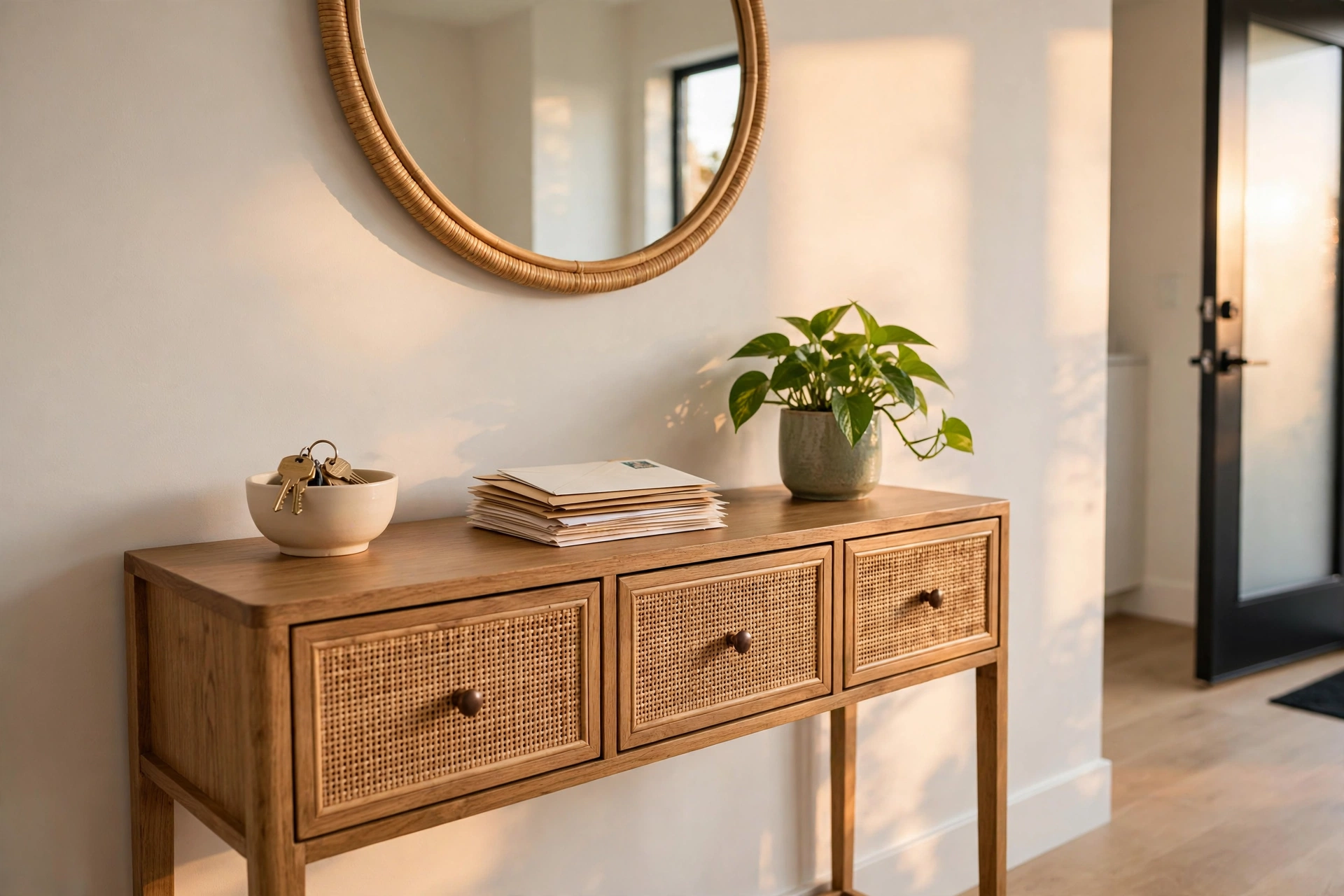
An entryway table is the smallest piece of furniture with the biggest daily job. It is a landing pad, not a display shelf: everything you carry in your hands when you walk through the door needs a home within arm’s reach, or it migrates to the kitchen counter, the stairs, and eventually the floor. Keys, wallet, sunglasses, mail, the leash. Five categories. That is the whole inventory, and the table only has to hold those five things to change your mornings.
It is also the first thing guests see. Mine went from a radiator-top mail pile to a finished-looking corner in one afternoon, and I did not buy a single decoration to do it — the table, a bowl I already owned, and a plant that had been dying on the windowsill. The National Association of Home Builders has tracked buyer wish lists for years, and organized entry zones keep landing near the top of “must-have” features. The market figured out what I learned in the rain: the doorway sets the tone for the whole house.
Entryway Table Sizing: The Depth Rule I Learned the Hard Way
Here is the part I almost got wrong. I fell for a beautiful 15-inch-deep console table first — solid-looking, great reviews, the works — and only caught the problem because I measured the corridor before I clicked buy. Our hallway is 38 inches wide. I set myself one rule: keep at least 24 inches of clear walkway, because anything less turns into a nightly shin-bruise obstacle course.
The math: 38 minus 15 leaves 23 inches of clearance. Fail. The table I bought instead is 11.81 inches deep: 38 minus 11.81 leaves 26.2 inches of clearance. Pass, with room to spare for a door that swings inward. Depth is the number that matters most on an entryway table — more than length, more than style. Measure your walkway first, subtract, and do not talk yourself into the deeper table. You will curse it every time you carry groceries in.
Length is the easy number. My wall is 60 inches; the table is 39.37 inches long, which leaves about 10 inches on each side — enough for the door trim and a wall hook rail I added later for the leash. A good rule of thumb: the table should cover roughly two-thirds of the wall it sits against. Shorter looks lost; longer starts fighting the door swing.
The 11.8-Inch Test: What Actually Fits on a Narrow Console Table
A narrow console table gives you one row of objects, not two. Plan for it and it looks intentional; fight it and it looks cluttered. On my 39-inch top, the working arrangement is a shallow catch-all tray for the day’s keys and mail before it gets sorted, a small lamp with a narrow base, and one framed photo. That is a full load.
What does not work: books stacked in two rows (the back row becomes a dust museum), a lamp with a wide drum shade plus anything else, or anything round that rolls. Go vertical instead of horizontal — a tall thin vase, a stack of two books with a candle on top. The drawers on this table have flush handles, which matters more than it sounds: passing coats and backpacks do not snag.
Entryway Table Storage: Drawers vs Open Shelves
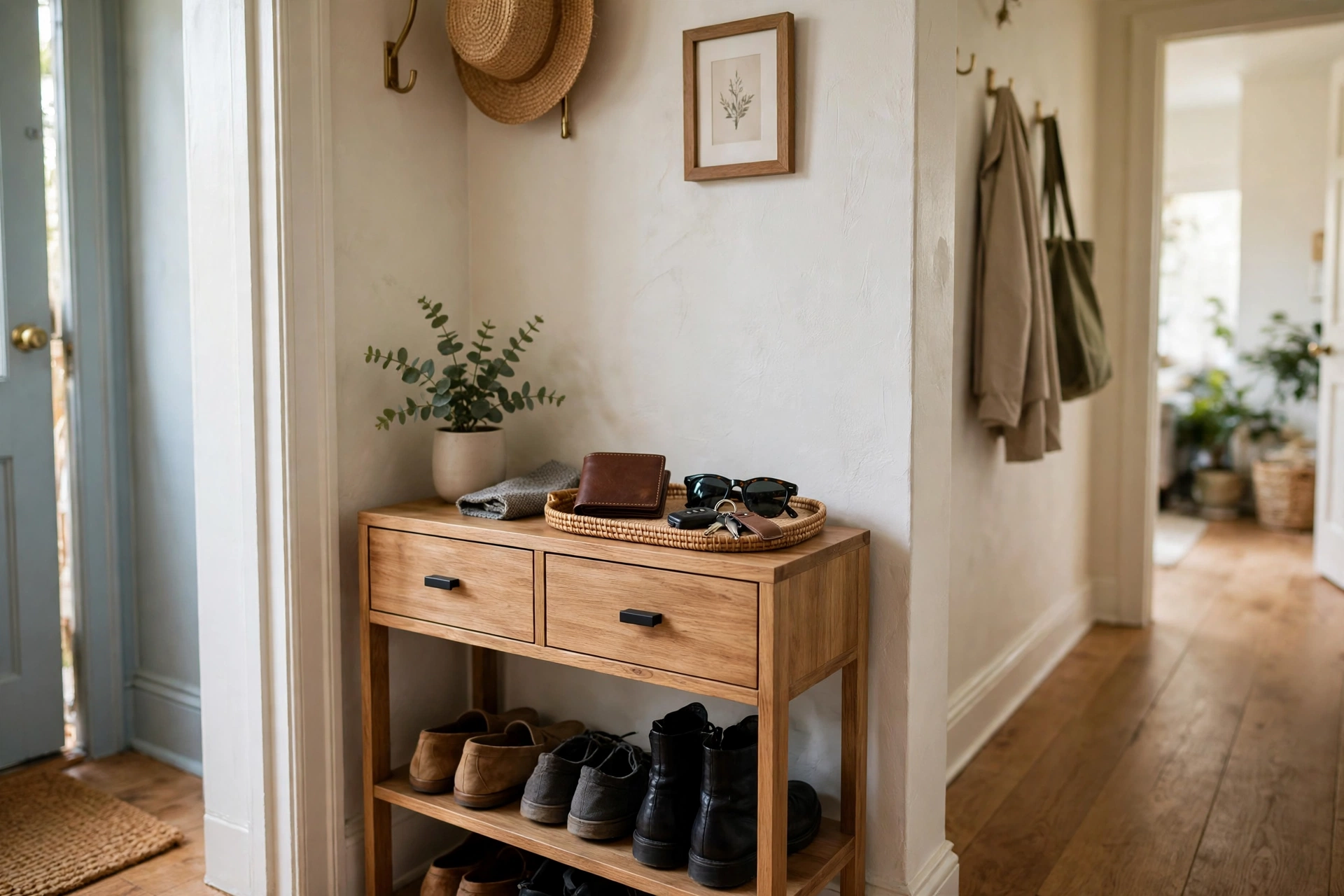
This is the real fork in the road, and it comes down to what kind of clutter you generate. Drawers hide things. Open shelves display things and ventilate shoes. I wanted both, which is why the $99 entryway table with storage won: two drawers up top, one open shelf at the bottom.
The drawer inventory after sixty days, honestly logged:
- Drawer 1: two sets of car keys, sunglasses, a garage remote, and a roll of dog waste bags. The drawer box is 15.94 × 9.45 × 2.56 inches — shallow, which turns out to be a feature. Deep drawers become junk voids; 2.56 inches forces the flat stuff.
- Drawer 2: mail opener, stamps, spare earbuds, and the takeout menus I keep meaning to throw away. Every house gets exactly one drawer like this. Containment is victory.
- Bottom shelf: four pairs of shoes. The shelf is 36.61 inches long; at roughly 7 inches per pair heel-to-toe, five pairs is the honest maximum and four is comfortable. My size-11 sneakers and my wife’s flats coexist without stacking.
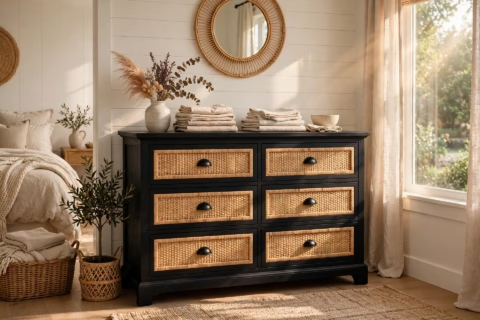
The imitation rattan drawer fronts deserve a note: up close it is a printed finish, not woven cane, but at arm’s length it reads as texture, and it hides fingerprints the way a flat white drawer never would.
Entryway Console Table Height: Why 30 Inches Is the Sweet Spot
This entryway console table is 29.92 inches high — call it 30 — which sits right in the standard console range of 28 to 32 inches. Height matters for two pairings. First, the mirror: mine hangs with its center at 62 inches, and a 30-inch table leaves about 32 inches of wall between the tabletop and the mirror’s center, which is the comfortable viewing band rather than a craned neck. Second, the lamp: on a 30-inch table, a 14-inch lamp puts the light right at standing eye level when you walk in, instead of blasting up from below.
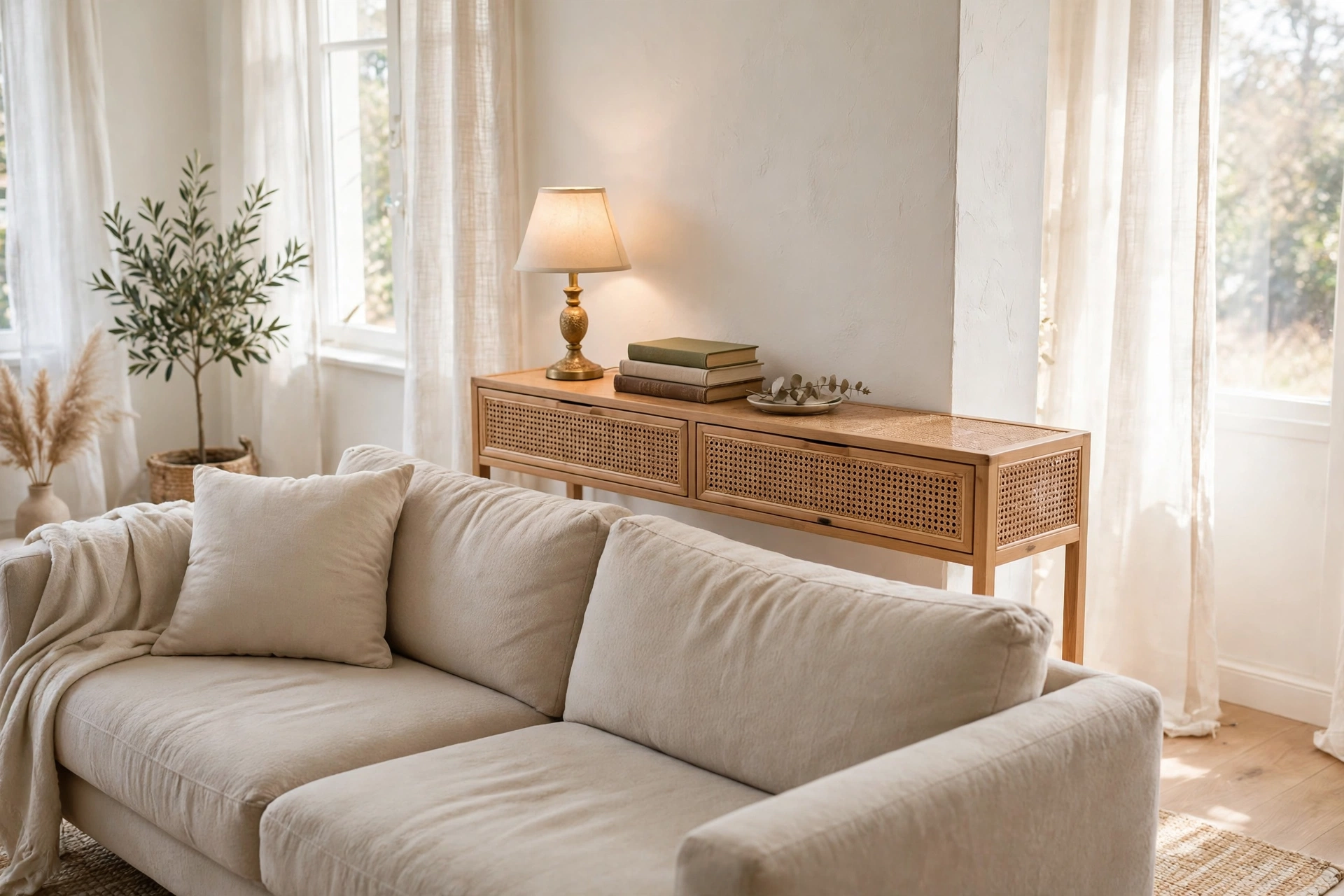
If you plan to tuck the table behind a sofa instead of in a foyer — and this one is explicitly sold as a sofa table too — 30 inches clears the standard 28-inch sofa back by a couple of inches, so a lamp or vase on top reads as styled, not swallowed. I tested ours behind our loveseat for a weekend before committing it to the foyer. It worked in both rooms, which is more than I can say for most single-purpose furniture.
The $99 Cost Math: Console Table vs Today’s Market
I price-checked the category on Target and Wayfair in November 2026 before buying, because “$99” means nothing without a ladder. Here is what the market actually looks like, cheapest to priciest:
- $55.99: basic 2-tier industrial console, no drawers (Target)
- $67.99–$69.99: narrow console with open shelves (Target)
- $91.14–$92.66: 4-tier entryway console, open storage (Target)
- $99: this table — 2 drawers plus open shelf, rattan-look fronts
- $114.99: console with 3 drawers and open shelf (Target)
- $159.99–$179.99: 63-inch farmhouse consoles with tiered shelves (Target)
- $369.99: 63-inch console with drawers and bottom shelf, solid-wood look (Wayfair)
- $899: designer 78-inch console (Wayfair)
The $99 price sits at the bottom of the drawer-model range — the next drawer table up the ladder costs about 16 percent more, and the solid-wood-look options start at nearly four times the price. Run the ownership math: $99 spread over five years is $19.80 a year, about five cents a day (my estimate). The $369.99 table is $74 a year over the same span. Both will hold your keys. The question is whether the extra $270 buys you anything your doorway actually needs, and for a 38-inch hallway, my answer was no.
For calibration, I also looked hard at FLNORW MALL’s bigger $388 entryway console table — 62.2 inches long, 13.8 deep, four drawers. It is the better buy if your wall is 70-plus inches and your hallway can spare the depth. For my 60-inch wall it would have meant 23 inches of overhang past the closet. The tape measure said no.
Honest Caveats: What the Listing Will Not Tell You
Three things, because nothing at $99 is perfect. First, the body is E1 particleboard with PVC veneer, not solid wood. It looks like rustic oak and wipes clean with a damp cloth, but the edges will chip if you slam a suitcase into them — treat it like furniture, not a workbench. Second, the top is rated for 44.1 lbs. That is plenty for keys, mail, a lamp, and a plant; it is not a seat, and it is not where the toolbox lives. Third, assembly took me about 45 minutes solo with the included Allen key and a Phillips screwdriver — every panel was labeled, but the drawer slides want patience. Get the carcass square before you seat the drawers, or they will close crooked.
One more: the 2.56-inch drawer depth is honest about what it is. Keys, sunglasses, mail, a checkbook. If your entryway chaos includes a hair dryer and a camera bag, you want the deeper four-drawer unit, not this one.
The Verdict
Sixty days in, the sizing math was the whole story. The 11.81-inch depth kept a 38-inch hallway walkable, the 39.37-inch length fit a 60-inch wall with room to spare, the two drawers swallowed exactly the five categories of doorway clutter, and the $99 price works out to about a nickel a day. My old system — keys in the jacket pocket, mail on the microwave — is officially retired. The new system is a table, a bowl, and sixty seconds of sorting when I walk in.
If your entryway runs wider and needs the full coat-boot-bag treatment, I also reviewed the $499 4-in-1 hall tree with bench — the same idea at apartment-hallway scale, with seating. And if shoes are the main problem, the $99 acacia shoe rack bench sits at the same price and earns its keep in 11 inches of depth. But if you have a bare wall, a tape measure, and a key problem, start here: measure the walkway, do the subtraction, and buy the narrow one.
See the Console Table with 2 Drawers — $99 with free shipping at FLNORW MALL
More honest furniture tests at FLNORW MALL.