Bunk Bed with Stairs: I Compared the $699 House Bunk Bed Against a $268 Ladder Model
The problem a bunk bed with stairs was supposed to solve
We have three kids — nine, seven, and five — and one shared bedroom that measures ten by twelve feet. For two years that room worked because the oldest two shared a regular twin bed and the youngest slept in a hand-me-down crib mattress on the floor, which looked exactly as sad as it sounds. When my sister came over last spring and asked why our five-year-old was sleeping at floor level like a camping trip, I decided the arrangement had officially expired.
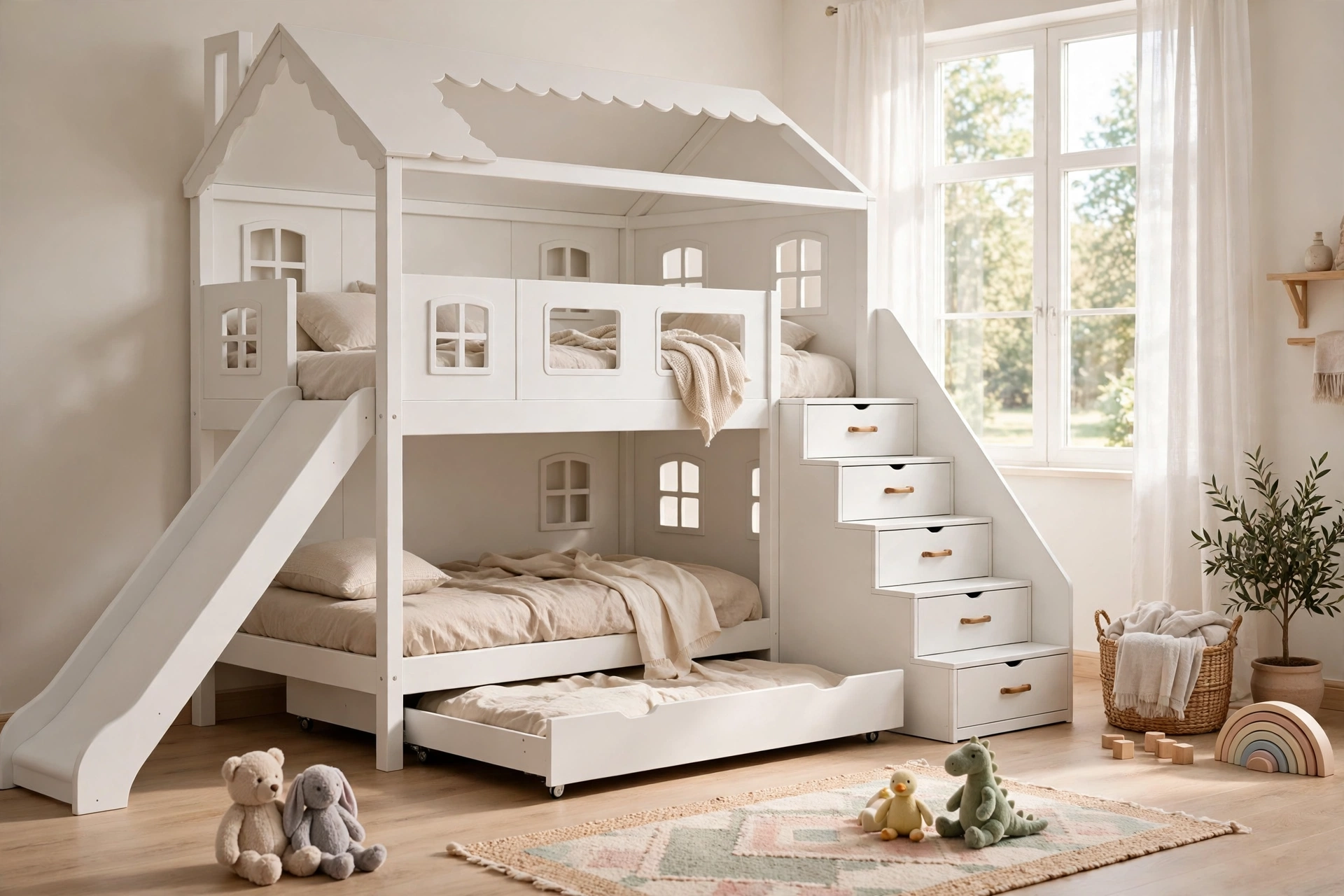
The math was obvious before anything else was: three sleepers, one small room. A bunk bed with stairs kept coming up in my late-night research, and I finally bought the Twin over Twin House Bunk Bed with Trundle and Slide from FLNORW MALL for $699. It has a storage staircase instead of a ladder, a pull-out trundle underneath, full-length guardrails, and a pitched roof that makes it look like a tiny house. Eight weeks later, here is the honest version.
What the storage staircase replaces (it is more than a way up)
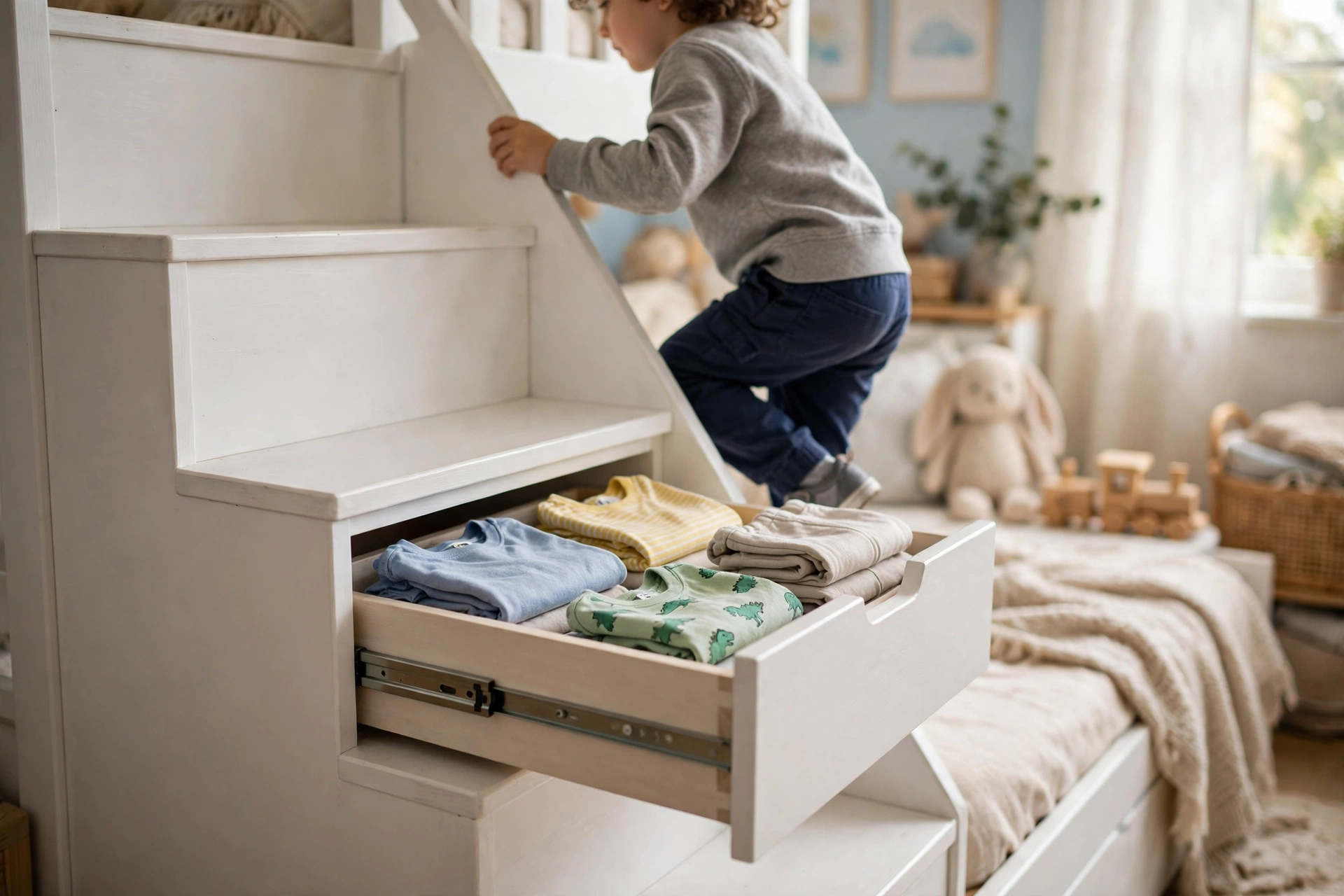
A ladder does one job: get the kid up. The staircase on this bed does four. Each deep step is a drawer, and in our house those drawers hold exactly the category of kid stuff that otherwise migrates to the floor: pajamas in step one, the seven-year-old’s book collection in step two, spare sheets and the allergy pillowcase in step three, and — I found this out during assembly — the five-year-old’s entire rock collection in step four. Rocks. In a drawer. I am choosing my battles.
Counting dollars the way a parent in a small house has to: a standalone three-drawer kids’ dresser runs $80 to $150 and eats about four square feet of floor. The staircase drawers hold roughly the same load and eat zero, because the stairs were going to occupy that footprint anyway. On our balance sheet that is effectively $100 of dresser value folded into the price of the climb.
The $699 house bunk bed: specs that actually matter
I read the spec sheet the way I read a used-car listing — skeptically, and twice. The parts that survived contact with reality: the frame is pine wood plus MDF, the assembled footprint is 79.6 inches deep by 41.8 wide by 94 high, and the whole thing weighs 316.5 pounds. That weight told me something before the boxes even opened: this is not the 90-pound metal frame that rattles every time someone rolls over. Each bunk is rated to 300 pounds, the trundle to 300 pounds as well, and the slat counts are generous — 14 slats on the upper bunk, 14 below, 7 on the trundle.
It ships in three boxes and comes in white or gray; we took white because the room is already starved for light. The product page says assembly takes under an hour with a friend’s help. It took me and my brother-in-law about fifty minutes on a Saturday morning, and the only tool we reached for that was not in the box was a rubber mallet for seating two dowels. I will not pretend there were zero moments of staring at the diagram — there were — but nothing had to be undone, which in flat-pack terms is a five-star outcome.
Stairs versus ladder: the 2 a.m. bathroom test
Here is the test no spec sheet includes. A kid wakes up at 2 a.m. needing the bathroom. On a ladder, that kid descends rungs in the dark, half asleep, barefoot. On wide staircase steps with a handrail on the house wall side, that same kid walks down like stairs — because they are stairs. Our seven-year-old has made that trip roughly a hundred times now without a single incident, and as the parent who lies awake listening, that is the feature I would pay double for.
There is a daylight version of the same test: the five-year-old going up to the top bunk with a book under one arm. Ladder plus book equals a negotiation I never want to referee. Stairs plus book equals a non-event. The full-length guardrails on the upper bunk mean the only real argument left in this house is who gets the top, which my wife resolves with a rotation calendar on the fridge.
Three sleepers for $699: the real math
Rough math, flagged as rough, because this is where the purchase stops looking expensive. Three separate twin bed frames at the budget end run about $150 each — that is $450 before a single mattress, and they need three times the floor space, which our room does not have. The $699 house bunk bed sleeps three (twin over twin plus the trundle) in a 79.6 by 41.8 inch footprint. Per sleeper, that is $233 — and that figure quietly includes the staircase drawers and the slide, which my kids treat as core infrastructure.
For context, FLNORW MALL sells a $268 twin-over-twin metal bunk bed with trundle — also three sleepers, which works out to under $90 a sleeper, the cheapest bed money in the catalog. It converts into three separate beds, which is genuinely clever, and its built-in ladders sit on both sides. But it is a ladder bed: no storage in the climb, steel frame at 65.2 inches tall versus the house bed’s 94, and the whole thing weighs under 100 pounds. For a small kid doing the midnight bathroom run, that difference is not cosmetic.
Between them sits the $399 twin over pull-out bunk bed with trundle — solid New Zealand pine, 400-pound capacity per sleeping surface, meets US and EU safety standards. An excellent bed. But it stacks with a ladder, has no staircase storage, and no trundle-and-slide play value for the under-ten crowd. So the honest comparison is this: $268 buys you three beds; $699 buys you three beds plus a dresser, a playhouse, and stairs a sleepy kid can navigate. If you only need the beds, take the $268 and smile. We needed the rest.
What it looks like after the kids actually move in
Durability with kids is not about weight ratings, it is about whether the thing survives being used as furniture and as a fort. Two months in, the honest report: the pine frame has picked up two small dings (one from a launched toy car, one unexplained — the nine-year-old pleaded ignorance with suspicious speed). Nothing creaks, nothing wobbles, and the staircase drawers still glide smoothly despite the rock collection. The slide gets used every single morning, including, I have observed, by one adult who was “just testing it.”
The 316.5-pound total weight shows up here in a good way. Lightweight frames announce every toss and turn; this one just absorbs it. I sat on the lower bunk edge (180 pounds) while reading bedtime stories and felt zero flex. The upper bunk’s 300-pound rating is honestly overkill for a seven-year-old, which is exactly the kind of overkill I want in a bed that is seven feet off the ground.
The industry numbers: why the kids’ bed aisle keeps growing
I wanted to know whether I was buying into a trend or just furnishing a bedroom. The kids’ furniture market was valued at $31.6 billion in 2024, with the beds segment alone at $10 billion and projected to reach $14 billion by 2035 (WiseGuyReports, Kids’ Furniture Market report). North America holds the biggest regional share — about 34.7% of a $28.15 billion global market in 2024, per Fortune Business Insights data. Translation: a lot of families are solving exactly my problem, and the beds-with-storage corner of that market is where the growth is.
It tracks with what I saw shopping. The plain ladder bunks are getting cheaper while the models with stairs, trundles, and storage keep their prices — because the storage is doing real economic work in small bedrooms. Rough estimate on my part, but the direction is not subtle: square footage is expensive, and furniture that stacks functions is how small rooms win.
Assembly, mattresses, and the fine print
Things worth knowing before the boxes arrive:
- Mattresses are not included, and thickness matters more than usual: the page recommends 6 inches for the upper bunk, 8 to 10 inches for the lower, and 6 inches for the trundle. The 6-inch upper limit is a safety number, not a suggestion — a thicker mattress eats into guardrail height.
- No box spring needed. The slats are the support, which saved us another $100-plus we had mentally budgeted.
- Three packages, one 114-pound box. Have them left at the garage, not the front porch, unless your delivery driver does deadlifts.
- The slide is removable. We kept it; the five-year-old’s morning routine now involves it. When the kids outgrow it, four bolts and it is gone.
- 94 inches tall. Measure your ceiling before you buy. Standard eight-foot ceilings clear it with about two inches to spare — we measured twice and it fit with room to breathe.
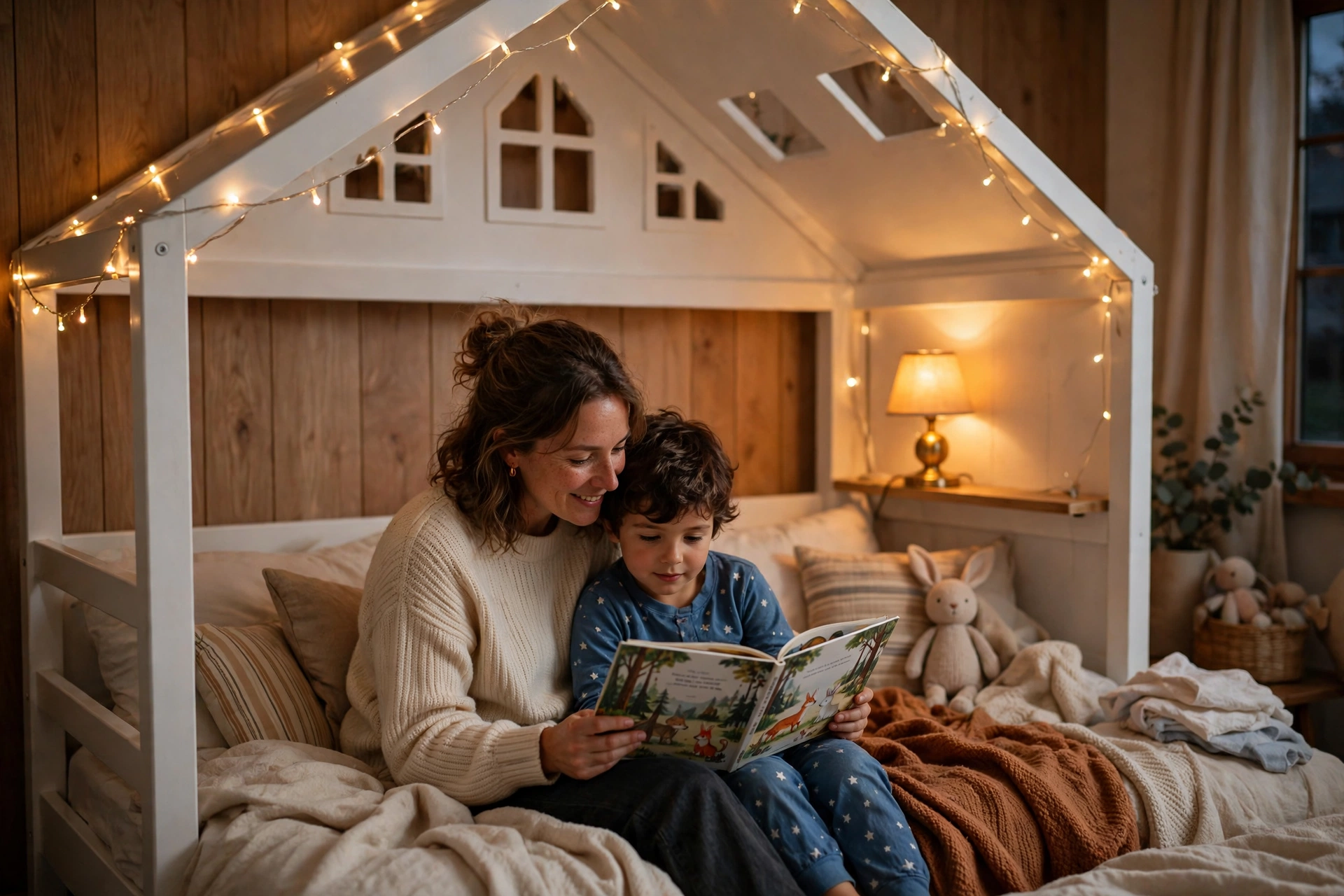
The verdict. Eight weeks in, the rotation calendar on the fridge is the most contested document in our house, which tells you how the kids feel. My read as the person who paid: the $699 was not really spent on a bed. It was spent on three beds in 23 square feet, a dresser’s worth of drawer space, stairs a half-asleep seven-year-old can walk down, and a playhouse roof that turned bedtime from a negotiation into a destination. Against the $268 ladder model, that is a $431 premium for the staircase, the storage, and the sleep-through-the-night confidence. In a ten-by-twelve room with three kids, I would make that trade again tomorrow.
Shop the bed: see the full specs and photos of the bunk bed with stairs at FLNORW MALL — or compare it with the ladder-style metal bunk bed ($268) and the twin over pull-out bunk bed ($399) if your room and budget point elsewhere. The full furniture collection and the FLNORW MALL homepage have the rest of the kids’ bedroom range.