I Bought a $289 Portable Generator Before Storm Season. Three Outages Later, Here’s the Honest Math.
The power went out on a Tuesday afternoon in August, right as a storm front turned the sky the color of a bruise. My phone buzzed with the utility ’s cheerful estimate: eleven hours. By nine that night I was standing in my kitchen with the fridge door cracked two inches, doing the mental arithmetic every parent does in the dark — a full week of groceries, roughly $300 worth by my estimate, sitting in a box that was slowly warming up. Two weeks later I bought the portable generator for home use I had been ignoring for years. Three outages later, I have opinions and receipts.
This is the $289 one from FLNORW MALL — item code W46540523, a 71cc 2-stroke gas unit rated at 800 watts with a 900-watt peak. I bought it for the fridge. It has since run my camping lights, a tailgate TV, and one miserable January night of furnace-blower diplomacy. Here is the honest accounting.
What this $289 portable generator actually is
Let us be clear about what you are getting, because this category is full of inflated claims. This is a small gas powered portable generator: a 71cc air-cooled 2-stroke engine, 2.2 horsepower, putting out 800 rated watts and 900 peak watts at 120 volts. It is not a whole-house backup system. It will not run your central AC. What it is — and what it is honestly good at — is keeping the essentials alive: the fridge, the freezer, phones, lights, and small electronics.
The headline specs, all from the product page, so you know exactly what is on the table:
- 1.1-gallon tank, ~5 hours at half load — about $3.75 of gas per tank at my local prices
- 50:1 gas-to-oil mix — like a chainsaw; a mixing bottle makes it painless
- 34 lbs with a molded handle — genuinely one-person portable
- 12V DC output plus 120V outlets — handy for charging batteries directly
- EPA III and CARB compliant — legal for sale and use in all 50 states
- Ships with spark plug wrench, DC charging cable, and manual — recoil start, built-in reset breaker against overheating
The three outages that paid for it
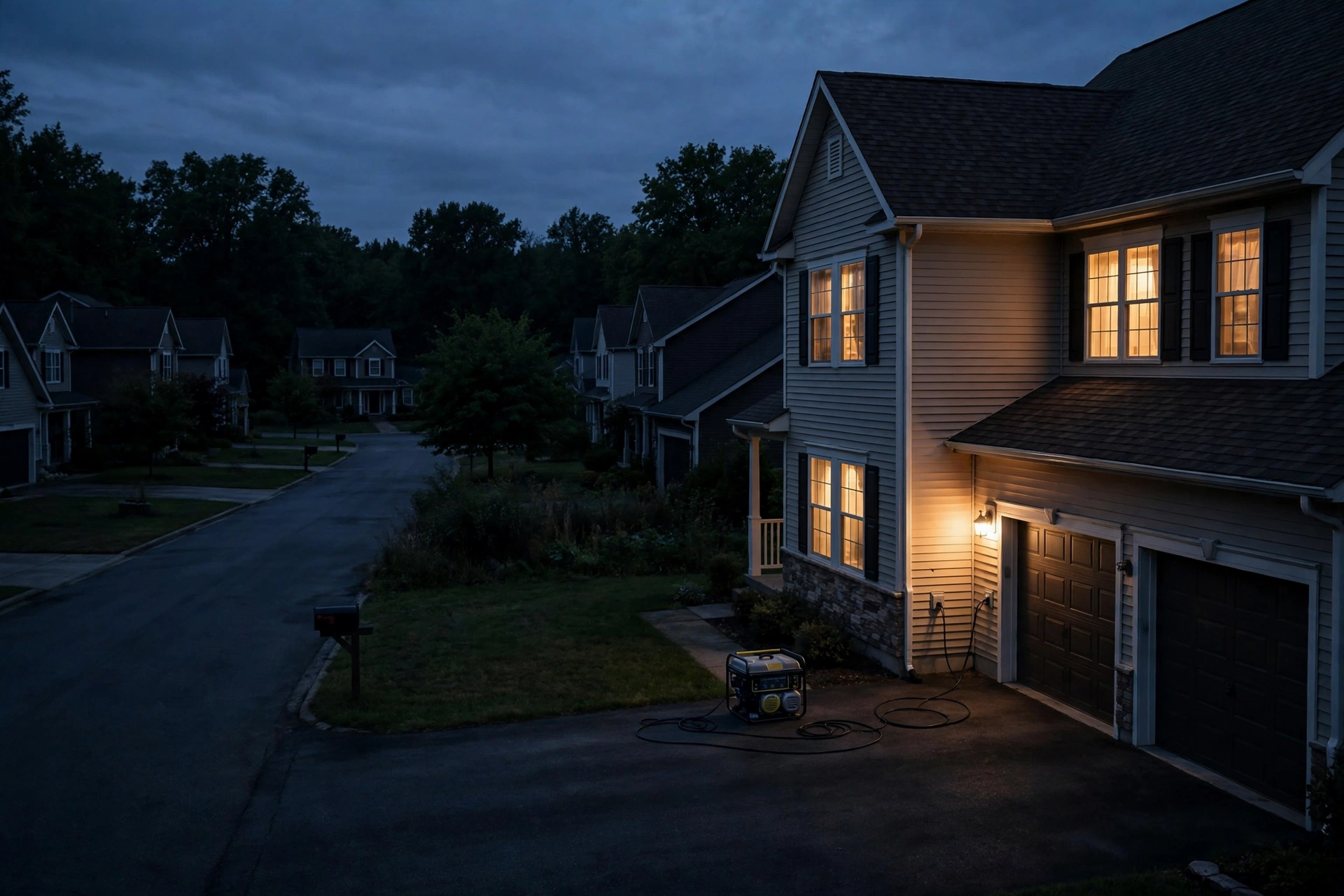
Outage one was the August storm — eleven hours, $300 of groceries lost (my estimate, and it stung). Outage two came in January: an ice event snapped a branch through a feeder line, and we lost power at 2 a.m. I had the generator by then. I dragged it out to the driveway, pulled the recoil cord twice, and ran an extension cord to the fridge, the chest freezer, and a power strip with our phones and the router. The gas furnace has an electric blower, and on its low stage the generator carried it along with the fridge without tripping the breaker. When the utility texted “restored” at 6:40 a.m., nothing in the freezer had thawed and both kids ’ phones were at 100 percent.
Outage three was a spring windstorm, six hours on a Saturday. This one felt almost routine: generator out, fridge plugged in, coffee maker plugged in. A standard drip machine pulls 800 to 1,000 watts, so mine sat right at the edge — I unplugged the freezer for the ten minutes the pot brewed, then swapped back. That is the reality of an 800 watt portable generator: you play load Tetris, and you win every time if you are paying attention.
What 800 watts actually runs: my real load list
The number that matters is not the 900-watt peak — peaks exist for the half-second a compressor kicks on. What matters is the steady-state budget. Here is what I have personally run on this unit at the same time, checked against the wattage printed on each appliance label:
- Fridge (150W running): the big win, cycling on and off
- Chest freezer (100W): alternated with the fridge during long outages
- Four phone chargers plus a laptop (~60W total): the family ’s sanity preserved
- Wi-Fi router (15W): if the ISP node has power, you have internet
- Three LED lamps (~30W total): light for the whole downstairs
- Box fan (75W): worth its weight in a summer outage
That stack sits around 400 to 450 watts steady — comfortably under the rating, right in the zone where the tank delivers its promised five hours. What I do not run: the microwave (1,000W+), any space heater (1,500W — forget it), or the dryer. Know the watts on your appliances before the storm, not during it.
The fuel math: about 75 cents an hour
Here is the part I should have calculated before buying. Gas near me runs about $3.40 a gallon (an estimate — yours will vary). A full 1.1-gallon tank costs roughly $3.75 and buys about five hours at half load. That works out to about 75 cents an hour of insurance for your freezer.
One evening outage — five hours — costs you under four dollars in fuel plus the oil mix. Compare that to the alternative. FoodSafety.gov says a fridge keeps food safe for up to 4 hours with the door closed; a full freezer buys you about 48. After that, everything perishable goes in the trash. My estimate: a well-stocked fridge plus a chest freezer holds $250 to $400 of groceries. One bad outage and the generator has nearly paid for itself — before you count the hotel room you did not have to book.
The honest competitor here is not a bigger gas generator — it is a portable power station, the big lithium battery boxes. A battery unit with roughly 800 watt-hours of usable capacity costs about $500 to $900 (a market estimate; prices move fast). It is silent and indoor-safe, and it is wonderful for two hours. Then it is dead, and it needs four to six hours of wall power — which you do not have — to come back. The gas generator ’s answer is a gas station: a five-gallon jerry can is 22 hours of runtime at half load. When the outage stretches past a day, fuel beats batteries every time.
The noise question, honestly rated
The product page says “low noise,” and I want to be straight with you: the spec sheet also lists 95 dB. That is not whisper-quiet. That is lawn-mower territory at close range. What the “low noise” claim actually means, in my experience, is that it runs quieter than the contractor-grade open-frame generators that rattle windows — this one settles down under light load and does not scream. But it is audible through closed windows, and your neighbors will know it is running.
How I handle it: the generator sits at least 20 feet from the house, exhaust pointed away, tucked behind the garage where the building absorbs some of the sound. I do not run it past 10 p.m. If you need library-quiet, you need an inverter generator at three times the price. At $289, this is the honest middle: loud enough to notice, not loud enough to hate.
The safety rules I do not bend
This section is not optional reading. A power outage generator makes carbon monoxide — odorless, invisible, lethal in minutes. The rules below are the non-negotiable version:
- Never indoors, never in the garage. Not with the door open. Every fire department on earth agrees on this one.
- 20 feet from the house minimum, exhaust pointed away from windows and doors.
- Dry location, dry hands. A pop-up canopy over the unit (not touching it) is cheap insurance.
- Let it cool before refueling. Spilled gas on a hot muffler is how fires start.
- Test it twice a year. I run mine fifteen minutes every spring and fall. A generator that will not start is a paperweight.
Where else it earns its keep: camping, tailgating, tools
Here is what surprised me. I accidentally bought a camping generator. At 34 pounds with a handle, this thing rides in the back of the SUV without complaint. On a fall camping trip it ran a string of LED lights, a phone charging station, and a small tent fan — and at a campsite I parked it fifty feet out and nobody complained.
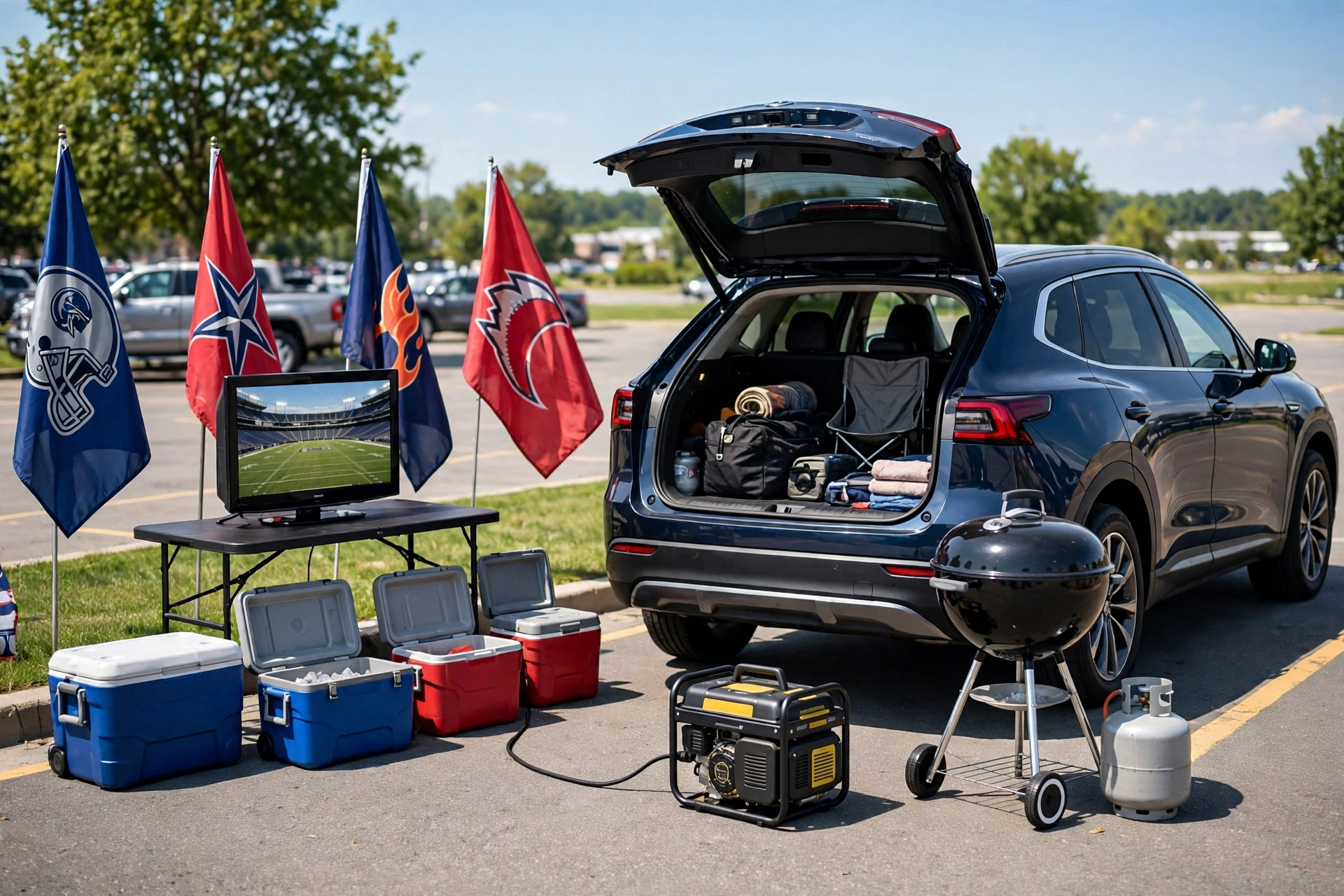
Tailgating is the other life. A buddy ’s crew runs a portable TV off theirs for the pregame show — a 40-inch LED TV pulls under 100 watts, so the generator is barely awake. The TV plus a speaker plus a charging strip is exactly the kind of light load this unit was built for. Around the house, I have used it to run a drill charger and a work light on a fence repair in the far corner of the yard where no outlet reaches. The product page lists household appliances, electric tools, camping, and tailgating as the intended uses, and after a year I would say that list is accurate, not marketing.

The verdict: my $289 power-outage math
I looked up the outage data to see whether my three blackouts were bad luck or the new normal. According to the U.S. Energy Information Administration ’s December 2025 reliability report, American electricity customers averaged 11 hours of power interruptions in 2024 — nearly double the annual average of the previous decade. Hurricanes Beryl, Helene, and Milton accounted for 80% of all outage hours that year. The routine blips average about two hours; the tail events are getting fatter.
That is exactly the risk profile a small portable generator insures against. Three outages, one camping trip, one tailgate, and about forty dollars of gas later, here is the accounting. The generator cost $289. One spoiled fridge and freezer would have cost me $250 to $400 in groceries (my estimate). One January night, it kept a furnace blower, a fridge, and four phones alive until the utility showed up. At 75 cents an hour in fuel, the operating cost is a rounding error next to the cost of the thing it protects.
The honest downsides: it is not quiet, it will not run your whole house, and the carbon monoxide rules deserve your full respect. But as a targeted insurance policy for the essentials, this is the cheapest peace of mind I have bought in years. One bad night pays for it. I have had three.
If you want the full spec sheet, it is on the portable generator for home use product page at FLNORW MALL. If you are kitting out the yard end of your emergency setup, their cordless leaf blower is the $98 cleanup tool I reach for after the storm passes. The full FLNORW MALL store has the rest of the outdoor and home lineup.