I Bought a $268 Hanging Chaise Lounger. My Nap Quality Has Opinions Now.
Two months ago I bought a hanging chaise lounger from FLNORW MALL — the $268 one with the removable canopy — because I had developed a very specific summer problem. My living-room recliner faces the wrong direction for afternoon sun, the old porch swing I owned was built for two teenagers and one hip, and my bedroom blackout curtains apparently also block out the concept of Saturday. I wanted exactly one thing: a place outside where I could lie down, sway a little, and fall asleep without a sunburn. This chair promised all three. Two months in, here is the honest accounting.
What a hanging chaise lounger actually is
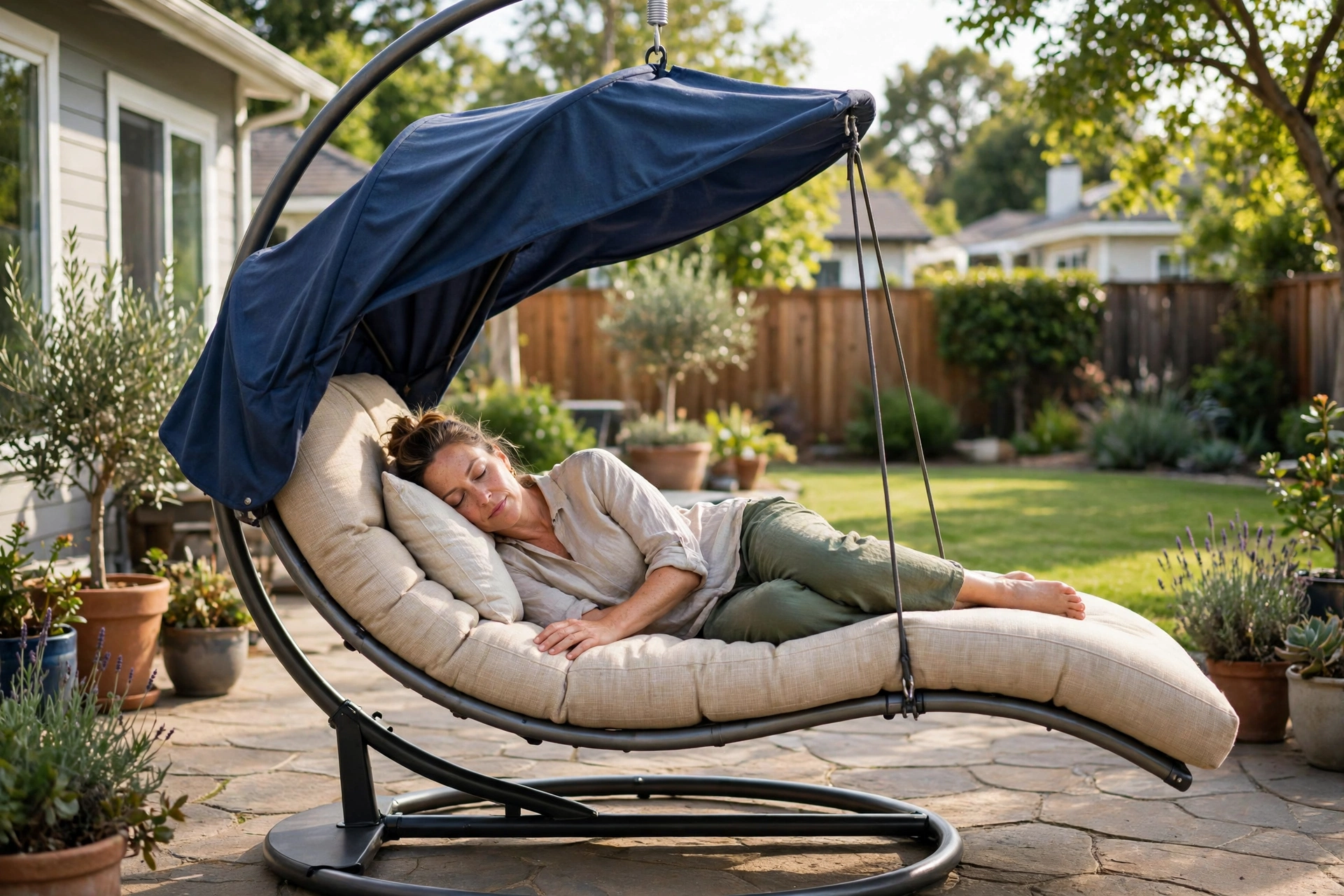
It is not a hammock and it is not a porch swing — it sits somewhere in between, and that in-between-ness is the whole point. A curved chaise seat hangs from a wide metal stand by chains or straps, so you recline back into it the way you would a lounger, but with a gentle floating bounce a fixed chaise cannot give you. FLNORW MALL lists it as the Hanging Chaise Lounger with Removable Canopy: a 73-pound steel stand, a thick seat cushion with a built-in pillow, and a canopy you can adjust or take off entirely.
Real numbers from the product page, since I checked them against the box in my garage: assembled it is 42.52 inches long, 72.83 inches wide, and 82.68 inches tall. The tall number is the stand, not the seat — the seat itself hangs low enough that getting in feels like sinking into a good hammock. It comes in blue, navy, and orange. I took navy, because navy forgives pollen. Orange is cheerful but would show every lawn-clipping incident I planned to have.
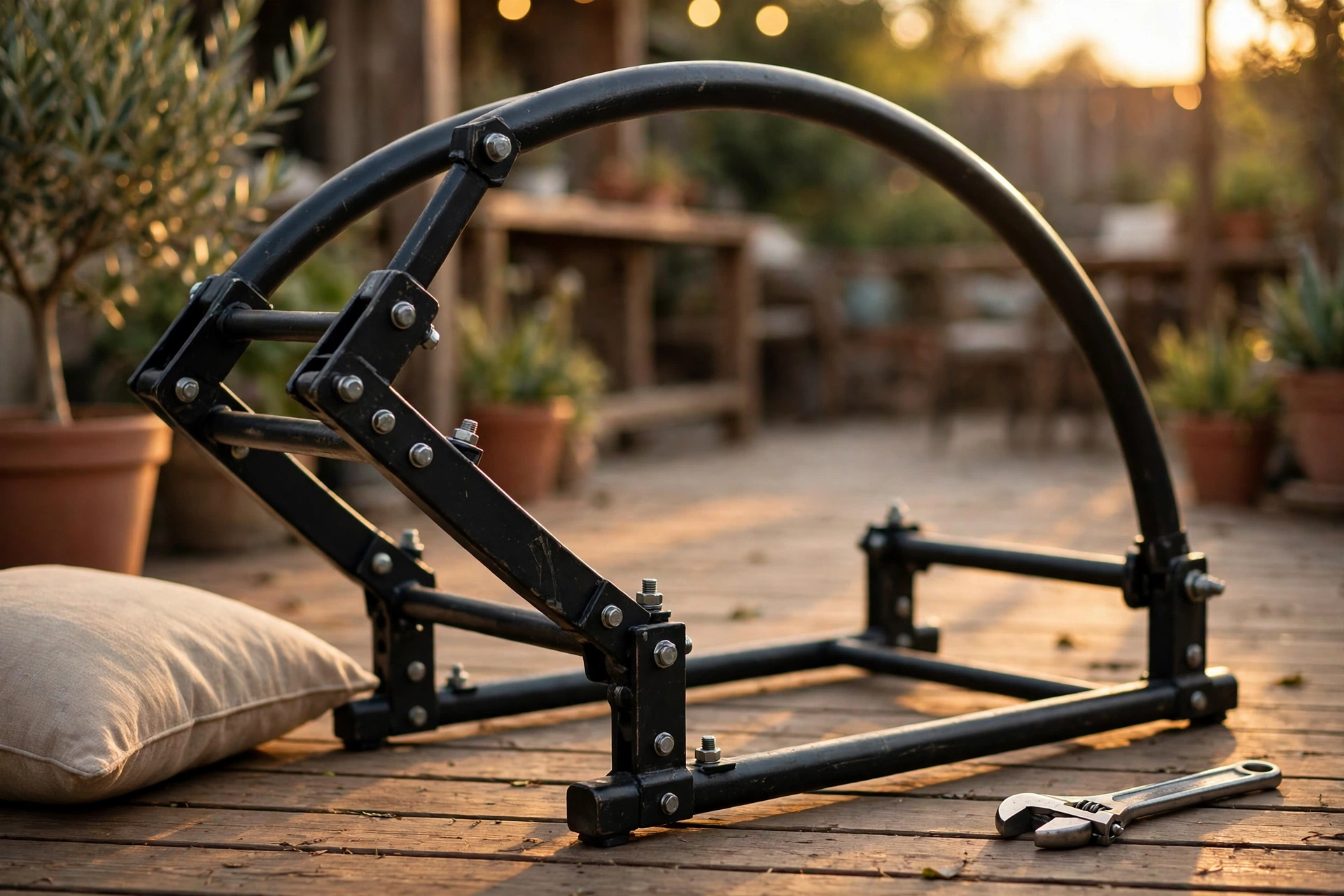
Assembly was bolts and the included wrench, exactly like the product page says. One person, about forty-five minutes, and the instructions were actual instructions rather than interpretive poetry. The cushion cover slips off for washing, which I did not expect at this price and appreciated immediately.
Why I bought this outdoor swing chair: the nap problem
I have a confession: I am bad at naps. My brain treats a Saturday afternoon like an inbox with unfinished items, and lying still indoors just gives it a quiet room to reorganize my worries. But something about being outside — moving air, leaves making that particular summer noise — short-circuits the whole thing. The problem was that I had no outdoor furniture built for lying down. The old porch swing creaked like a haunted house and sat two people only if both of them were eight.
I considered three options. A regular chaise lounge ($150–$400 at the big-box stores) lies flat but does nothing for the drowsy part of napping. A two-person porch swing ($200+) rocks beautifully but needs ceiling joists or an A-frame and eats my whole porch. This outdoor swing chair was the third option: the rock of a swing, the full-body lie-down of a chaise, freestanding on a steel base, $268. I bought it on a Tuesday night at 11 p.m., which is when I make my best and worst decisions.

The nap math: what $268 buys you in sleep
Let us do the honest arithmetic, with estimates flagged as estimates. I have used this chair for roughly eight weeks and averaged four naps or long reading sessions a week. That is about 32 sessions in two months. Extrapolated conservatively — say three sessions a week over a five-month warm season — that is around 60 sessions a year, rough estimate. $268 divided by 60 comes out to about $4.50 per session in year one. By year two, if it survives, that number halves.
Compare that against doing nothing: the cost of me lying awake rehearsing the workweek is not measured in dollars, but it is measured in the Saturday I did not get back. And there is actual science on why this works. A 1995 NASA study with the University of Texas found that a 26-minute cockpit nap improved pilot performance by 34% and alertness by 54%. The Sleep Foundation generally recommends 20-minute power naps for the same reason: short sleep, big recovery.
A flat lounger asks your body to hold still; the hanging chaise keeps swaying a little, and that motion does the quieting for you.
The rock and the canopy: two features doing the heavy lifting
The product page calls it a “gentle rocking/bouncing motion,” and that undersells it slightly. The seat hangs with enough give that shifting your weight restarts the sway without effort, but not so much that it feels unstable. The wide, heavy base is doing real work here: at 73 pounds of steel with a footprint over six feet wide on one axis, the whole thing planted itself on my patio and has not moved since, through two thunderstorms. I checked for wobble every time I got in for the first week. There is none.
The removable canopy is the other half of the nap equation. It is adjustable, so you can tilt it toward the afternoon sun instead of rotating the whole chair — a small thing that turns out to matter at 4 p.m., when the sun comes sideways. And it removes completely. I took mine off for the first week of October because the light was low and lovely, then put it back on for an unseasonably bright weekend. Ten minutes either way, no tools. Shade is not a luxury feature on a nap chair; it is the feature. The canopy alone is what turned “chair on the patio” into “the spot.”
Three spots I tested the canopy hammock chair in
One advantage of a freestanding piece is that you can audition it around the yard. I tried three locations, and each one taught me something:
1. The back patio (concrete slab). This is where it lives now. Full sun exposure, so the canopy earns its keep daily. The wide base sits perfectly on flat concrete, and the chaise faces the one corner of the yard with actual trees. Nap success rate here: nearly 100%.
2. The screened porch, canopy off. During a rainy week I moved it under cover — two people to carry it, because 73 pounds of steel is not a one-person lift despite what my confidence told me. With the canopy removed it feels like an indoor reading chair that happens to sway. I finished a whole novel there over four evenings. It works indoors or in a sunroom just as well as outside, and the product page says so plainly.
3. The garden corner (uneven grass). This was the stability test. The base is wide enough that a slightly lumpy lawn did not bother it, though I would shim a leg if it sat permanently on a slope.
Care and maintenance: the cushion-cover trick
Two months of outdoor life in summer is where cheap furniture starts confessing. Here is the honest wear report: the steel frame shows nothing — no rust, no paint chips, and it has been rained on twice. The canopy fabric looks new; I take it off in actual storms because I am not testing fate. The cushion cover is the star here: it unzips for washing, and after one wash cycle it went back on snugly with no sagging. One honest footnote — the cover is machine-washable but not magic, so treat sunscreen smears before they set.
For winter, the product page describes indoor-outdoor use, and my plan is to move the whole thing into the garage and bring the cushion and pillow inside. Five minutes of work, and it avoids the slow fade that kills outdoor fabric. Total maintenance effort so far: one cushion wash and one canopy wipe-down. That is about as low-maintenance as outdoor furniture gets.
The industry numbers: outdoor seating is having a moment
I looked up the market data because I wanted to know whether a hanging nap chair was a quirky purchase or part of something bigger. It is something bigger. Expert Market Research, via Research and Markets, put the United States outdoor furniture market at nearly $6.15 billion in 2024, growing at 5.6% a year toward about $10.61 billion by 2034. The International Casual Furnishings Association reported that US consumers spent nearly $8.5 billion on outdoor furniture and accessories in 2023 — up 12% from the year before. The same research flags outdoor seating as the fastest-growing segment, at 6.2% a year through 2032.
Translation: the backyard has become the second living room. Remote work scattered people out of office buildings and into their own homes, and the money followed them into patios, porches, and gardens. A $268 swinging chaise is not an indulgence in that context; it is one of the cheapest ways to furnish a whole new “room.” My patio went from a concrete slab with a dead plant to the room I use most on weekends.
Specs worth knowing before you buy
- $268, one price. No tier games, no “pro” version. What you see is the whole product.
- Footprint: 42.52″ long × 72.83″ wide. Measure first — the stand is wider than it looks in photos. It needs a solid 4-by-7-foot patch.
- 73 pounds of steel. This is stability, not portability. Plan a two-person carry to its spot, then never move it again.
- Three colors: blue, navy, orange. Fabric, with a removable, washable cushion cover.
- Thick cushion plus built-in pillow included. No separate pad to buy.
- Canopy adjusts and removes tool-free. Ten minutes either way.
- Assembly: bolts plus the included wrench, about 45 minutes solo. Genuinely one-person work — the carry is the only two-person part.
- Indoor-outdoor rated. It spent a rainy week on my screened porch and was perfectly happy there.
The verdict
Two months ago I bought a chair to fix a nap problem, and the problem is fixed. I fall asleep outside four times a week, in the shade, swaying gently, for roughly $4.50 a session in year one — dropping every year the steel frame holds up, and steel holds up. The canopy is the feature I would pay for twice, the cushion cover is the detail I did not know I needed, and the rock is the reason naps finally work for a person who is bad at naps.
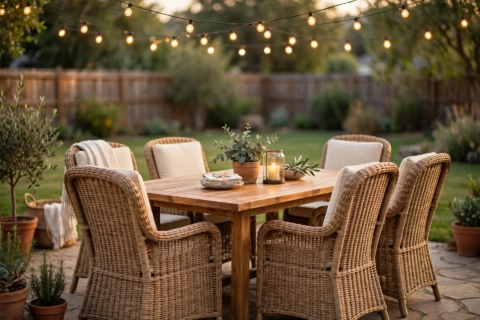
The hanging chaise lounger is the best $268 I have spent on the backyard. If your patio is currently a concrete slab with ambitions, pair it with a cast aluminum outdoor dining set for the eating half of the evening and the seven-piece wicker set I reviewed earlier if you need seats for a crowd. The full FLNORW MALL collection has the rest of the second living room.