Hand Truck: My $99 Folding Dolly Honest Review
I bought a hand truck the week my back filed a formal complaint. Two trips up the driveway with a 50-pound bag of water-softener salt, and I was standing in the garage doing that slow straighten-up routine that men my age pretend is stretching. My neighbor watched, laughed, and said the four words that ended my stubbornness: borrow mine, he said. I did, once. Then I ordered my own — a 440-lb folding hand truck for $99 — because borrowing a tool twice means you need one. I have been writing about practical home gear on the FLNORW MALL blog for a while now, and this is the review I wish I had read first.
Two months later, it has moved salt, soil, a portable generator I refuse to lift alone, half a garage cleanout, and one very heavy sleeper-sofa mattress. Here is what a $99 hand truck actually does, where it surprised me, and the one thing I would change.
Why I Finally Bought a Hand Truck
Every house has a hauling bottleneck: the driveway-to-garage trip, the curb-to-porch trip, the trunk-to-basement trip. Mine is a 60-foot gravel driveway with a slope that turns every heavy box into a negotiation. The Bureau of Labor Statistics has listed overexertion from lifting among the top causes of workplace injuries for years — and my garage is not a workplace, it is where my common sense goes to rest. A hand truck turns those trips from lifting into rolling, and rolling is what wheels are for.
The math that sold me: I paid $99. A single chiropractor visit in my town runs $60 to $80, and I was clearly headed there. I have now made roughly forty loaded trips with this cart. That is about $2.50 per trip so far, falling every week. My back has not filed another complaint.
For comparison, renting a hand truck from a moving company runs about $10 to $15 per day around here, and they want it back the same day. Two rentals and I would have spent a third of the purchase price on a tool I did not get to keep. The cheap non-folding dollies at the hardware store sell for $40 to $60, but they live in your garage forever because they collapse into nothing. I paid for the fold.
Folding Hand Truck vs the Classic Dolly
When you search for a hand truck, you meet two families. The classic L-shaped two-wheel dolly — the kind delivery drivers tilt and stack boxes on — and the platform style: four wheels, a flat deck, a push handle. Hand Truck Expert’s buying guide, updated in 2026, lists both, plus convertibles that switch between the two.
I chose the platform hand truck style, and here is why: most of my loads are wide and low — generator, salt bags, storage totes — not tall stacks of boxes. A platform deck of 27.6 by 19.7 inches swallows those loads without the balancing act a two-wheeler demands. The trade-off is real, though: a classic dolly climbs curbs with a tilt-and-pull motion that a platform cart cannot copy. If your life is stacked boxes up porch steps, buy the L-shape. If your life is heavy, awkward stuff across flat ground, buy the platform.
And the folding part matters more than I expected. The Harbor Freight bestseller in this category is a 150-lb folding truck at a similar price; this one is rated 440 lbs — nearly triple the capacity — for the same $99. That number is what closed the deal for me.
The 440-Pound Test
I have not loaded the full 440 pounds, because I am honest and slightly chicken. The heaviest single load I ran was about 280 pounds: the generator at roughly 60 lbs, two 50-lb salt bags, and a tote of tools. The steel frame did not flex, the handle did not wobble, and the wheels rolled like the load was half that.
Here is what I learned about capacity numbers: the rating describes the frame, but your real limit is you. A 280-pound load on flat concrete is easy. The same load on my sloped gravel driveway required planning — low stance, straight line, no turns mid-slope. Never stand downhill of the cart. The manufacturer’s 440-lb rating is honest engineering; treat 250 to 300 lbs as the practical human limit unless your ground is flat and smooth.
Five Inches Flat: Where It Actually Lives
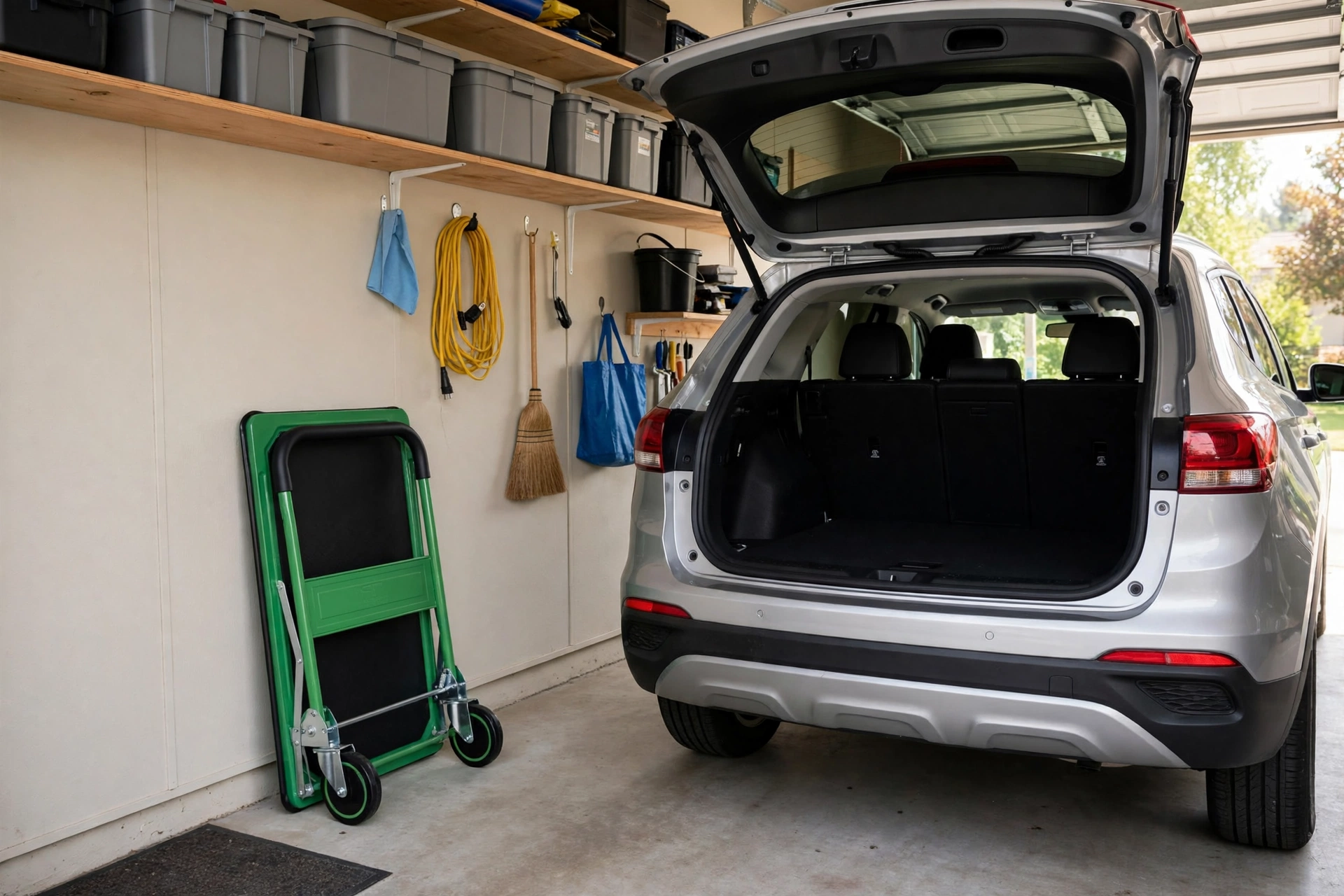
This is the section that justifies the purchase for small-garage people. Folded, the cart is 5 inches thick — it ships in a box 29.6 × 21.7 × 5 inches and folds to about the same. It leans against my garage wall in the gap between the lockable garage tool cabinet and the water heater, occupying roughly one square foot of floor.
Weight: 22 pounds. Light enough to hang on a wall hook, heavy enough to feel solid. I carry it one-handed to the trunk; my wife carries it with two hands and no complaint. Compare that to non-folding steel dollies, which live permanently in the middle of the garage because they fold into nothing.
Gravel, Grass, and Curbs: The Wheel Test

Wheels are where cheap carts die. This one ships with what the listing calls precision-engineered wheels — marketing words, but the performance is real. It rolls over my gravel driveway without the death rattle of small hard casters, crosses dry lawn without sinking, and the curb at the street is manageable with a tilt and pull.
The honest limits: wet grass is the enemy. The wheels dig in, and a 200-pound load becomes a plow. Thick mulch is worse. On those surfaces I lay two plywood scraps as a runway, a trick I learned from a mover years ago. Pavement, concrete, packed dirt, dry lawn — all fine. Sand — do not bother.
Two Months of Real Jobs
- Garage cleanout: fourteen trips of totes and old paint cans to the curb. Zero back pain. This job alone paid for the cart.
- Generator maintenance: wheeled the generator to the driveway for its oil change instead of carrying it. Twenty feet, one hand on the handle.
- Garden season: eight 40-lb bags of soil from the trunk to the raised bed. Two bags per trip, four trips, done before lunch.
- The mattress: a queen sleeper-sofa mattress down to the basement. Awkward, floppy, terrible to carry — the platform deck made it a non-event.
What I Would Buy Differently
Almost nothing, which is rare for me. Two small notes. First, the handle height is fixed at 32.9 inches — fine for me at 5-foot-10, but my 5-foot-4 wife finds it slightly tall for long pushes. An adjustable handle would be a genuine upgrade. Second, the green paint scratches. It is a work tool; the first scratch hurt, the twentieth did not register.
What I would not change: the fold-flat design, the 440-lb rating, the wheel size. And I would not buy the classic L-shaped dolly instead — the platform deck has proven itself on every load I actually own.
Verdict: two months and roughly forty trips in, my $99 folding hand truck is the most-used tool in my garage that is not a screwdriver. It folds to 5 inches, hauls anything I can load onto it, and has quietly ended the era of me carrying 50-pound bags like a stubborn mule. If you own a house, a garage, or a bad back, this is $99 well spent. If you rent a third-floor walkup, buy the classic two-wheel dolly instead — stairs are its home turf.
See the one I bought: 440-lb folding platform hand truck, collapsible dolly cart — green