One Piece Toilet for Small Bathroom: My $300 Fit-and-Flush Verdict
Last spring my plumber dragged our old two-piece toilet out to the driveway, and lying on its side the thing looked bigger than the crate our new dishwasher came in. The tank was a separate 30-pound slab of porcelain bolted to the bowl, and the two halves had spent a decade collecting dust in the seam between them. That was the moment I started shopping for a one piece toilet for small bathroom duty — our hall bath is forty square feet, five feet wide and eight feet long, with a tub-shower combo eating one entire wall.
I taped, I measured, and I bought FLNORW MALL’s 1.1/1.6 GPF dual-flush one-piece elongated toilet for $300. Three months of daily use later, here is the fit math, the water math, and the honest answer to the question Google keeps asking: one piece or two piece?
A One Piece Toilet for Small Bathroom: the Tape-Measure Test
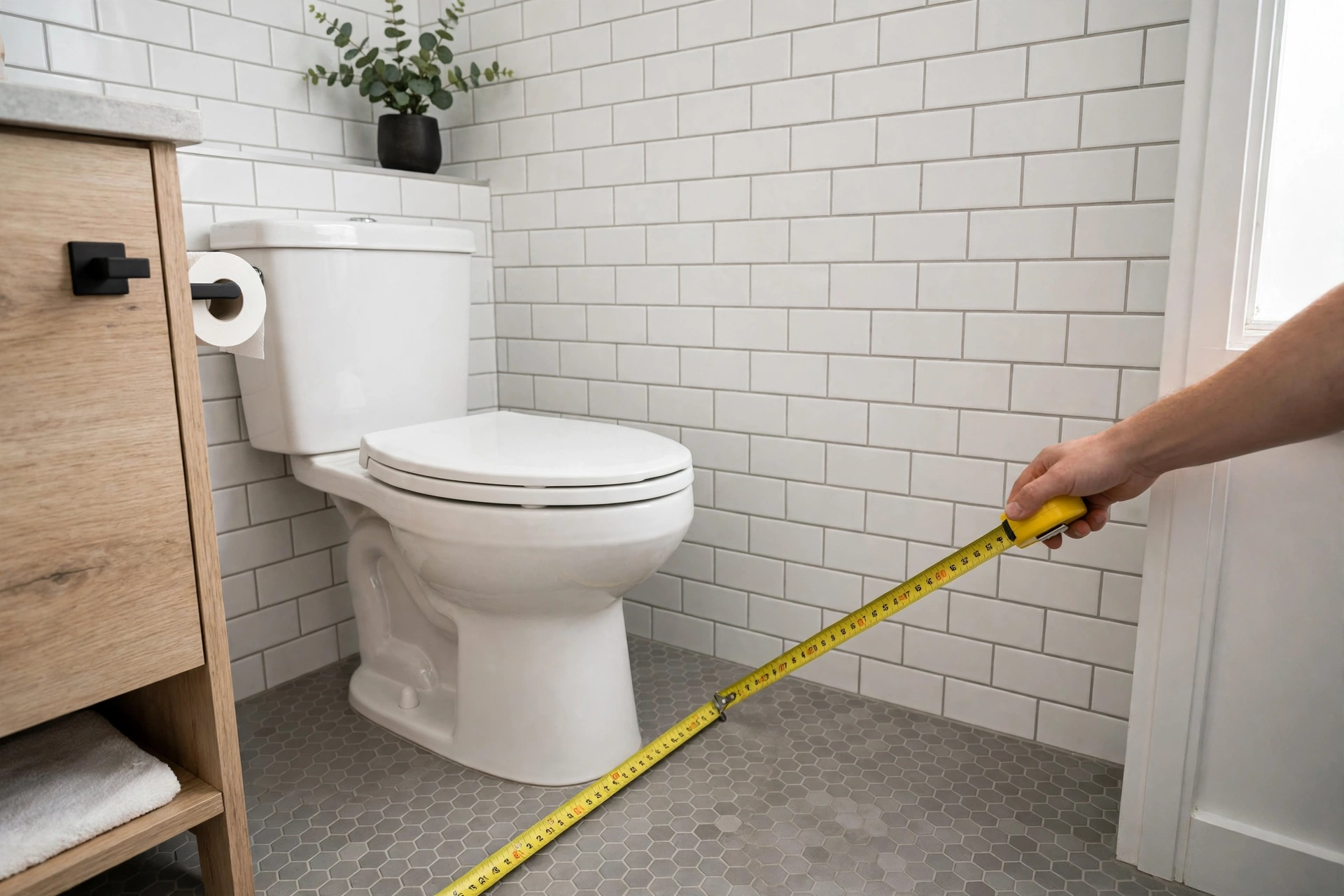
The unit I bought is 27.17 inches long, 15.55 inches wide, and 30.71 inches tall. Here is why that first number matters. Building code — IRC R307, the rule every plumber quotes — requires at least 15 inches from the toilet centerline to any side wall or obstruction, and at least 21 inches of clear space in front of the bowl. My bath is 60 inches wide. Sixty minus 27.17 leaves 32.83 inches of clear floor in front of the bowl — nearly a foot more than code demands.
The old two-piece measured just under 29 inches long, so switching to the one-piece gave me about 1.8 inches of floor back. In a five-foot bathroom, 1.8 inches is the difference between my knees grazing the vanity and sitting comfortably. It is also the difference the door makes: my taped 27.17-by-15.55-inch rectangle cleared the inward-swinging door by four inches, where the old footprint nearly clipped it.
Before you order any toilet, measure three things: your rough-in (the distance from the finished wall to the center of the flange bolts — 12 inches is the standard, and this unit is built for it), the door swing, and the distance from the flange to the nearest obstruction. I painter’s-taped the footprint on the floor and lived with it for a day. Tape costs four dollars. A toilet that clips the door costs a return label on 106 pounds of porcelain.
One Piece vs Two Piece Toilet: 4 Differences That Actually Matter
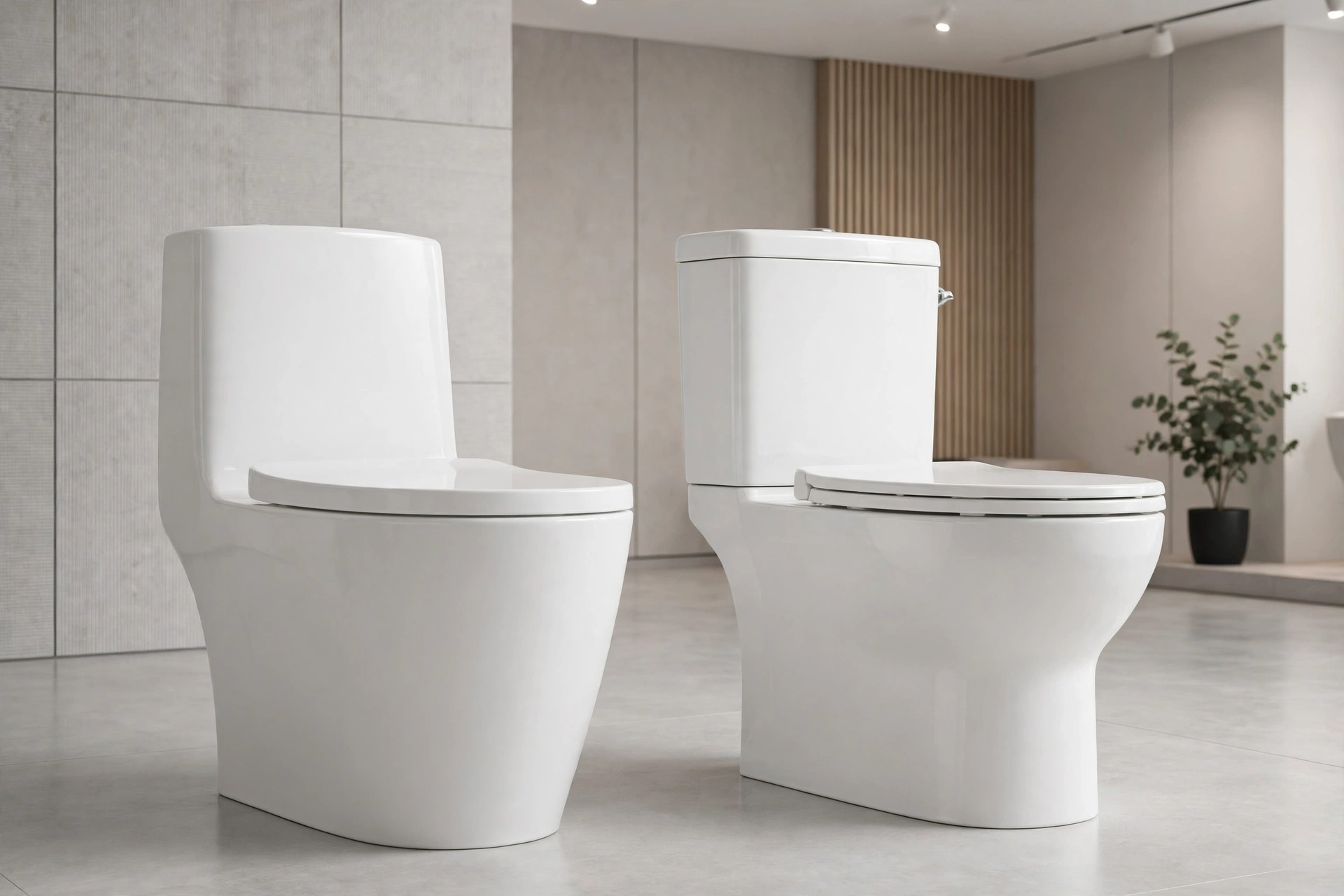
Google’s most-asked question on this topic — which is better, a 1 piece or 2 piece toilet? — deserves a better answer than the spec sheets give. After living with a one-piece and hauling a two-piece to the curb, here are the four differences I can actually feel:
- The seam is gone. A two-piece has a tank bolted to the bowl, and the seam between them is a dust trap you clean with a toothbrush. The one-piece is cast as a single unit — you wipe it down like a countertop.
- Fewer leak points. The tank-to-bowl connection on a two-piece is a gasket plus two or three bolts, and that is exactly where leaks start. The one-piece eliminates the joint entirely.
- Shorter footprint. With no separate tank overhanging the wall, a one-piece typically runs 1–2 inches shorter front-to-back than a comparable two-piece. In a small bathroom, that is usable floor space.
- Heavier to carry. My one-piece weighs 106 pounds in one solid slab. A two-piece splits into a roughly 30-pound tank and a 60-pound bowl. Carrying it up a flight of stairs solo, you will notice.
Price side: this one-piece runs $300; a basic big-box two-piece goes for $150–200. So the one-piece costs roughly a hundred more — money that buys the shorter footprint and the seam-free cleaning. In forty square feet, I would pay it twice. I learned a few of these measurement habits the hard way during our remodel, and I wrote up the full damage report in my 7 bathroom remodel mistakes I paid to learn — the door-swing mistake alone nearly cost me a vanity.
The Dual-Flush Water Math: 1.1/1.6 GPF Explained
Toilets are the biggest water user inside the house — the EPA’s WaterSense program puts them at roughly 30 percent of indoor residential water use. Toilets built before 1994 can flush up to 3.5 gallons per flush. The 1992 Energy Policy Act capped new toilets at 1.6 gallons, and WaterSense now labels models at 1.28 gallons or less.
This unit is a dual-flush toilet: a 1.1-gallon partial flush for liquids, a 1.6-gallon full flush for solids. If about half your flushes are partial — roughly right for a two-person household — the effective rate lands near 1.35 gallons per flush (my estimate; your mix will differ). Against our old 1990s 3.5-GPF unit, that saves about 2.15 gallons per flush. At five flushes a day per person for two people, that is roughly 7,800 gallons a year.
At typical U.S. water and sewer rates, 7,800 gallons works out to something like $50–75 a year back in your pocket — again my estimate, and it swings a lot by city. On that math the $300 toilet pays for itself in water savings alone in about four to five years, before you count the part where our old toilet ran phantom-flushes at 2 a.m. twice a month.
Elongated vs Round: the 2-Inch Question for Small Bathrooms
An elongated toilet bowl adds roughly two inches of front-to-back length compared to a round bowl. In a small bathroom that sounds like a dealbreaker, but the totals matter more than the category: this elongated one-piece is 27.17 inches long overall, which is shorter than plenty of round-bowl two-piece toilets I measured at the showroom. Elongated bowls seat more comfortably, and for older knees and hips the extra couple of inches of bowl make sitting and standing noticeably easier — which answers another of Google’s popular questions: for seniors, elongated is the better pick.
My tape test one more time: 60 inches of room, 27.17 inches of toilet, 32.83 inches clear. Code asks for 21. The elongated bowl costs me nothing in this room and buys real comfort. If your bathroom is narrower than about 56 inches, run the numbers before choosing elongated over round — but for most hall baths, it clears with room to spare.
Install Day: What 106 Pounds of Porcelain Taught Me
One-piece toilets ship as a single unit, which means one box, one trip up the stairs, and one very solid 106-pound lift onto the flange. Two delivery people carried mine. The plumber’s visit ran about $200 — my cost, for a straightforward swap: pull the old unit, scrape the old wax ring, set a new wax ring, drop the new toilet, torque the bolts, connect the supply line. Roughly an hour of work, most of it spent on his back under the tank area of the old unit.
Two things to check before install day. First, the rough-in: 12 inches is the standard and what this unit expects. If your house was built with a 10-inch or 14-inch rough-in, this toilet will not sit flush against the wall — measure the flange bolts before you order, not after. Second, the flange condition: if it is cracked or sits below floor level, the plumber fixes it for roughly $50–100 in parts and time. Ask for a flange check when you book the visit, so it is one trip instead of two.
If the whole bathroom is getting attention at the same time, I also wrote up my bathroom vanity buying guide after we put in the 54-inch solid wood unit — the 21-inch clearance rule in that piece applies to the toilet zone too.
Cleaning a One-Piece Toilet: Where the Design Pays Off Weekly
The cleaning difference is the thing I underestimated before buying. The old two-piece had a horizontal seam where tank met bowl, and that seam held a gray line of dust no brush could quite reach. The one-piece has no seam. The gloss-white ceramic wipes down with a damp cloth, the soft-close seat lifts off its quick-release hinges for a full wipe underneath, and the whole routine takes five minutes on a Sunday.
Three months in, the gloss finish shows no staining, and the soft-close hinges have not loosened a millimeter. The lid closes with a quiet tap instead of a slam — at 6 a.m., when someone is still sleeping down the hall, that matters more than it sounds on paper.
The Honest Downsides of a One-Piece Toilet
Google’s other popular question — is there a downside to one-piece toilets? — deserves an honest answer, because there are two real ones. First, the weight: 106 pounds in one slab is awkward. A two-piece splits the load into manageable halves. If you plan to DIY the install up a flight of stairs, budget a second pair of hands. Second, the price: $300 against $150–200 for a basic two-piece. You are paying for the seamless casting and the shorter footprint.
A third, rarer one: if a two-piece tank cracks, you replace the tank. If the tank section of a one-piece cracks, you replace the whole toilet. Ceramic almost never cracks without a dropped wrench, so I filed this under “unlikely but true.” None of these would change my answer for this bathroom. In a small bath, the shorter footprint and the no-seam cleaning are worth the hundred-dollar premium and the heavy box.
The Verdict on This One Piece Toilet for a Small Bathroom
Three months in, the scorecard is short. The 27.17-inch one-piece cleared my 60-inch room with 32.83 inches of floor to spare — code needs 21. The dual flush is saving roughly 21 gallons a day against our old 3.5-GPF unit (my estimate). The seam-free body wipes clean in five minutes. The soft-close seat has ended the 6 a.m. slam. Total installed cost: $300 for the toilet, $200 for the plumber, one Saturday morning.
Would I buy it again for a one piece toilet for small bathroom project? Yes — and I would measure the rough-in before ordering, which is the only part of this project that could have gone wrong. If your budget stretches another $500 and you want the heated seat, the auto open-and-close, and the warm-water bidet, FLNORW’s smart toilet with heated bidet seat is the one-piece upgrade at $800. Otherwise, the $300 dual-flush one-piece is the right amount of toilet for forty square feet.
The $300 verdict, in one line: in a small bathroom, inches are money — and this 1.1/1.6 GPF dual-flush one-piece elongated toilet ($300, in stock) spends fewer of them. Browse the rest of the house at FLNORW MALL.