7 Bathroom Remodel Mistakes I Made (and What Each One Cost Me)
Last year I remodeled our hall bathroom. Forty square feet, one small window, a tub-shower combo, and a 1998 vanity whose toe kick had swollen into something with the texture of wet cardboard. I went in with a spreadsheet, a tape measure, and complete confidence. I came out with seven bathroom remodel mistakes I paid actual money to learn. Here they are in the order they bit me, with the dollar amounts attached, so your bathroom remodel cost stays on the spreadsheet and off the credit card.
Mistake 1: I Measured the Wall and Forgot the Door
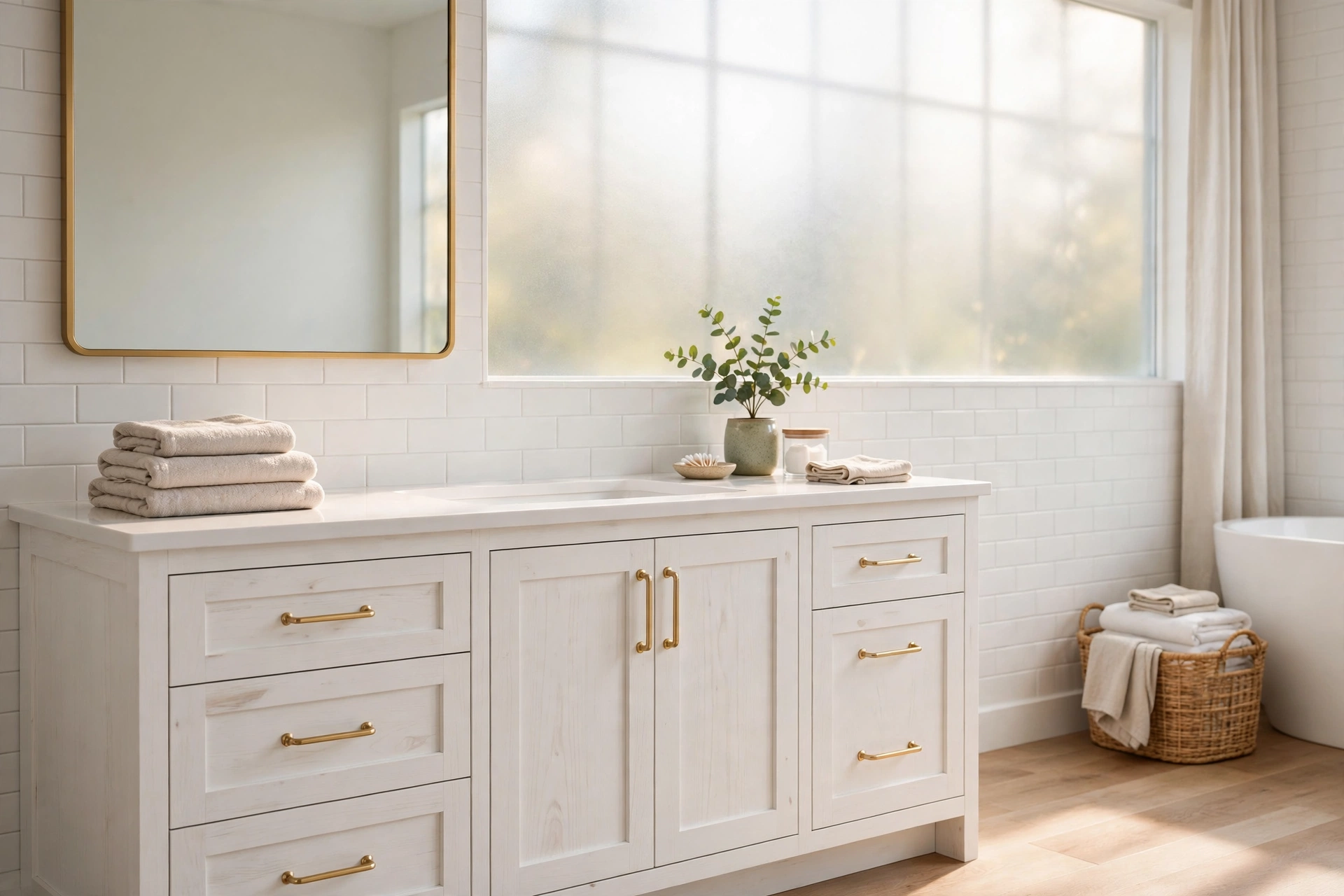
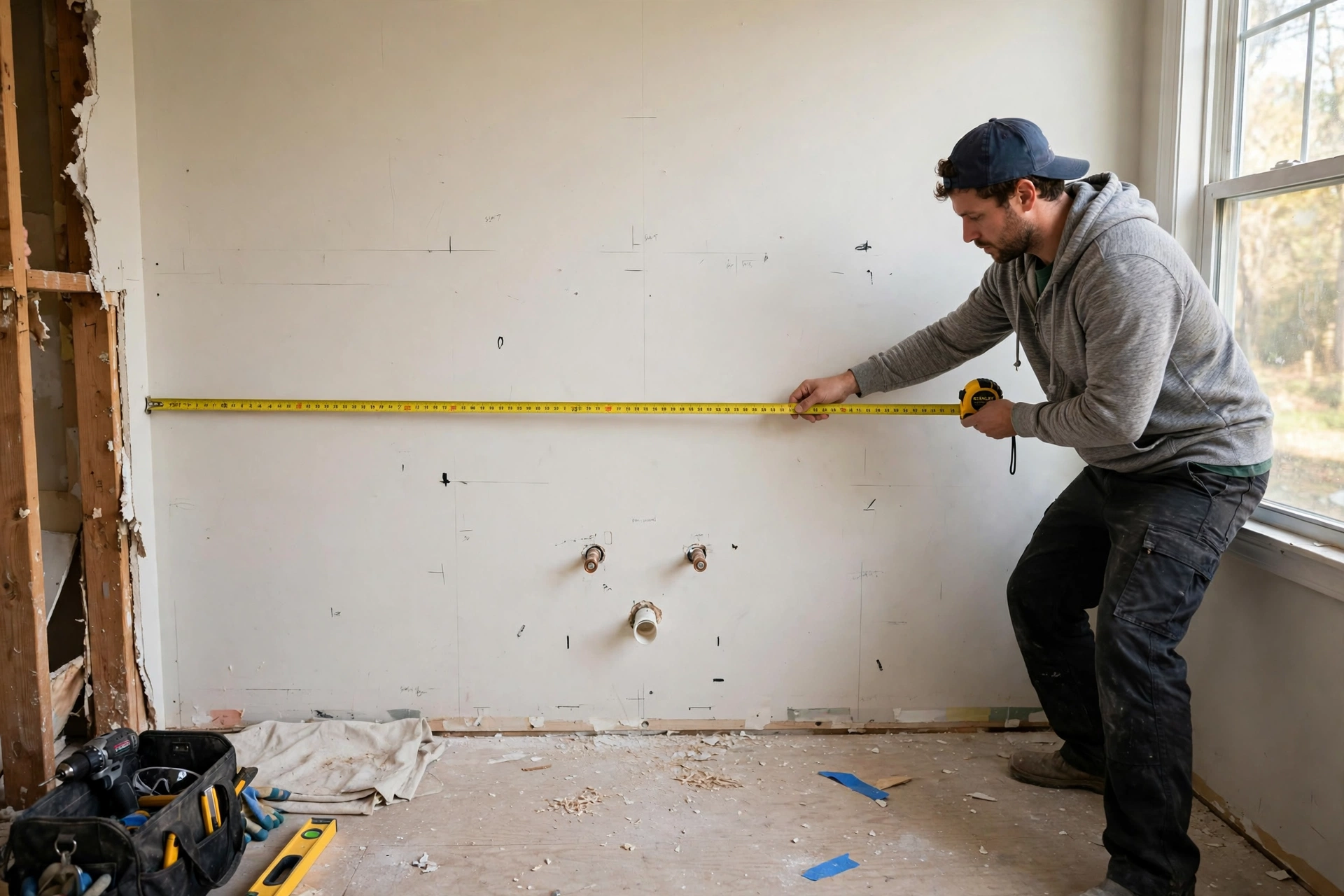
The wall was 60 inches wide. The vanity I wanted — a 54-inch bathroom vanity with sink — was 54 inches wide. Sixty minus fifty-four is six, and I did the arithmetic standing in the aisle of my own confidence. It fit on paper. What I never measured was the door swing. The hall bathroom door opened inward and clipped the vanity’s left drawer bank by a full three inches.
I discovered this on delivery day, standing in a 40-square-foot room with a 281.6-pound crate I could not return without a fight. The fix was cheap — I re-hung the door to swing outward, about $20 in hinges and an afternoon — but it was a fix I could have made two weeks earlier for zero stress. The rule I tape to my forehead now: painter’s tape the vanity footprint on the floor, then open and close every door in the room. Tape costs four dollars. Delivery-day surprises cost your Saturday.
Mistake 2: I Bought “Standard” Vanity Height Without Measuring the People
The vanity I replaced was 32 inches tall — the old standard. I am 5’11″ and spent a decade washing my hands hunched over like I was apologizing to the sink. When I ordered the new one I almost clicked “standard height” again out of pure habit, because standard sounds like someone smarter already decided. The unit I ended up with is 36 inches tall — comfort height — and it is the single most noticeable upgrade in the whole room. My wife is 5’4″ and reaches it fine; my back no longer files a complaint at 6:45 a.m.
Heights come in four flavors — 30, 32, 34, and 36 — and there is no wrong answer, only the wrong answer for your household. I wrote up the full sizing logic in my bathroom vanity buying guide afterward, but the mistake version is shorter: measure the people, not the brochure. If I had ordered another 32-inch unit, I would have paid $2,999 to keep my old backache.
Mistake 3: I Never Read the “What’s Included” Line
The product page for the $2,999 vanity lists exactly what ships: cabinets, countertop, sink pre-installed, hardware, backsplash. It also says, in plain text I scrolled right past, that faucets and mirrors are not included. I found this out the morning the plumber arrived, when he asked where the faucet was and I said “in the box” with a confidence that evaporated in about four seconds.
That cost me a panicked hardware-store run, a $230 faucet I had not budgeted (my estimate — a decent widespread faucet runs $150 to $400), and a plumber standing around at $85 an hour while I drove. Total damage: roughly $300 and a red face. The lesson is boring and permanent: read the “What’s included” section like a contract, because it is one. Budget the faucet, the mirror, and the plumber’s visit as separate line items from day one.
Mistake 4: The Mirror Needed Power I Did Not Have
I wanted an LED bathroom mirror with anti-fog — $199, dimmable, three color temperatures, the fog-clearing feature that shuts itself off after an hour. What I did not think about, until the electrician asked, is that an LED mirror is an appliance. It needs power. My old mirror was a piece of glass with two clips. There was no outlet behind it, no switch leg, nothing.
Running a new circuit to that wall cost me a $180 electrician visit (my estimate for a short run in an accessible wall) and two days of schedule slip, because electricians do not appear on demand. The mirror itself is excellent — the anti-fog alone ended the post-shower wipe-down ritual — but the mistake was treating it like a decoration instead of a fixture. If your mirror plugs in, lights up, or defogs, plan the electrical before you plan the hanging.
Mistake 5: Doors Instead of Drawers, and Two Years of Kneeling
My first vanity order — yes, there was a first order — had two big cabinet doors and one sad little drawer. It was cheaper by $400 and I congratulated myself on the savings. Then I lived with it for exactly eleven days, during which I knelt on a cold tile floor every single morning, digging past the contact-lens case to reach the sunscreen behind it. Doors force you to excavate. Drawers bring the contents to you.
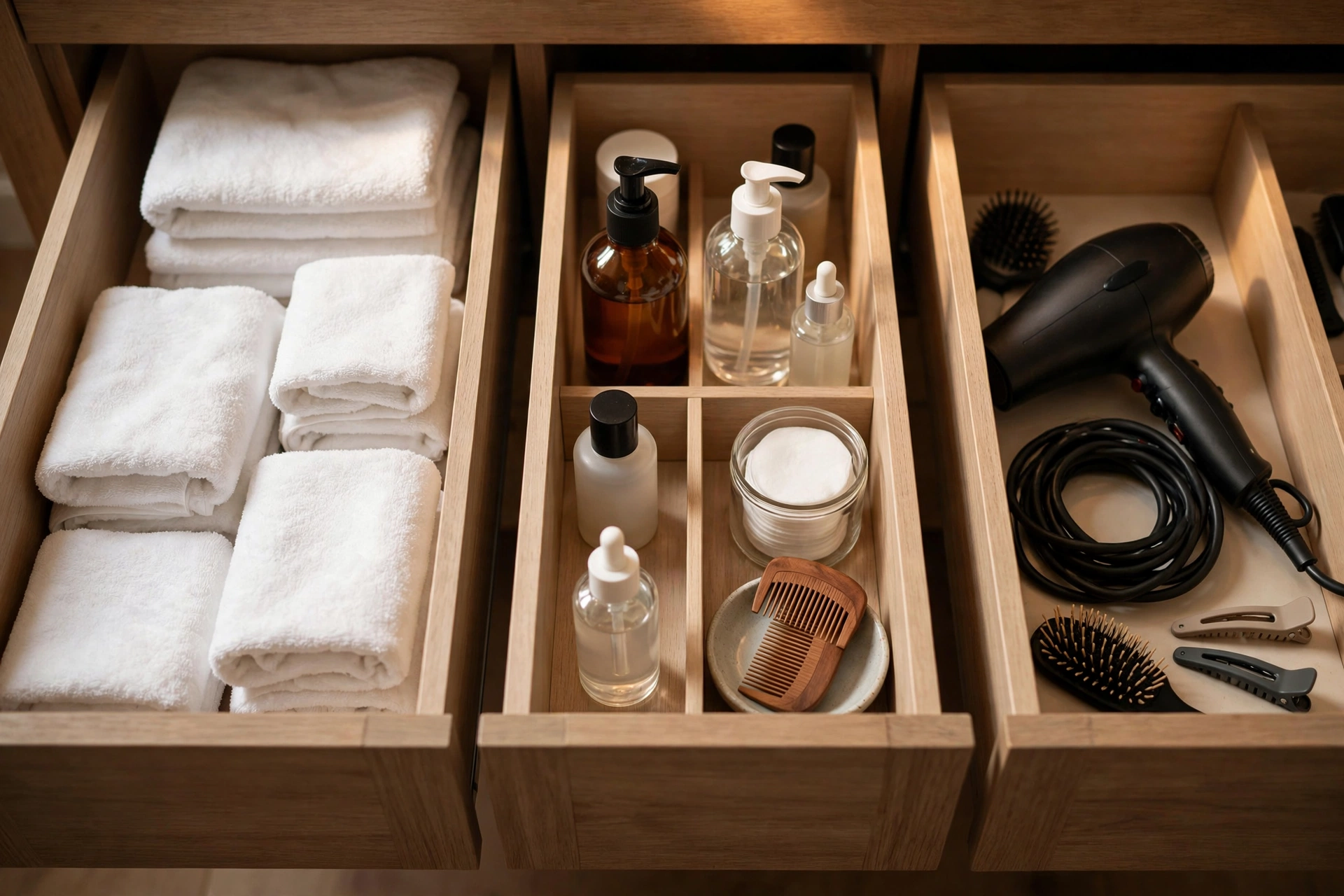
I swapped to the six soft-close drawer layout, and small bathroom storage stopped being a daily negotiation. Top drawer: my toothbrush, floss, contacts. Second: my wife’s six-bottle skincare rotation, all standing upright. Third: the hair dryer, docked in the built-in power station box so the cord never drapes across a wet counter. The rest swallow towels, the first-aid kit, and the cleaning supplies that used to live under the kitchen sink. The $400 I “saved” on the door-only unit would have bought me years of kneeling. I paid a restocking fee to fix it — about $150, and I have never been happier to lose money.
Mistake 6: Lighting Was My Last Thought
For the first month, the finished bathroom had exactly one light source: a ceiling fixture that turned my face into a topographical map every morning. I had spent weeks choosing a vanity and approximately four minutes thinking about light. The fix came from the mirror: the LED bathroom mirror offers 3000K warm white, 4500K neutral, and 6000K daylight at up to full brightness, with a CRI of 90 — which means colors look honest instead of morgue-green.
Here is what I know now: bathroom lighting is a two-source minimum. One overhead for the room, one at face level for the mirror. If I could redo the remodel, the mirror would have been line item number two, right after the vanity, not a decoration I added when the room felt wrong. The $199 mirror did more for how the bathroom feels than the paint color I agonized over for a week.
Mistake 7: I Ignored Steam Until It Ate the Cabinet
The old vanity did not die of age. It died of steam. The carcass was particleboard, and ten years of shower humidity turned the toe kick into wet cardboard — the texture I mentioned at the top. The replacement is a solid wood frame with plywood panels, which is the combination the industry keeps betting on: wood is the largest material segment in bathroom vanities, more than a third of the money in a very large market.
But here is the mistake inside the mistake: even good materials need a habit. I ran the exhaust fan for exactly zero minutes after showers in the old bathroom because the fan was loud and I was lazy. Now the fan runs for twenty minutes after every shower — a $30 timer switch solved the laziness — and that habit is worth more than any material upgrade. Steam is patient. It outwaits particleboard, MDF edges, and eventually even laziness. Respect it early and it never shows up on your spreadsheet.
The Industry Numbers: What a Bathroom Remodel Really Costs
I needed context for my own bill, so I looked up the market. A 2026 survey by This Old House of 1,000 homeowners put the average bathroom remodel at $15,586 — which made my ~$3,600 all-in (vanity $2,999, mirror $199, faucet ~$230, electrician ~$180, misc) feel like the budget tier it was. The broader market agrees that people keep spending: the U.S. Bureau of Economic Analysis reported continued expansion in residential improvement spending during 2024, and Harvard’s Joint Center for Housing Studies reported that spending on home improvement and repair stayed above historical averages entering 2025.
The vanity category itself is enormous — Grand View Research’s 2025 report put the global bathroom vanities market at $46.1 billion in 2025, growing toward $83.6 billion by 2033 — which explains why there are fifty options for every slot and why the measuring tape matters more than the marketing. My seven mistakes are not exotic. They are the standard-issue errors of a big, fast-growing category meeting a small room and an overconfident homeowner.
- The pre-order checklist I wish I had: tape the footprint on the floor and swing every door
- Measure the tallest and shortest daily users before choosing vanity height
- Read “What’s included” like a contract — faucet and mirror are separate budgets
- If the mirror has a plug, a light, or a defogger, plan the electrical first
- Count drawers, not doors, for daily-use storage
- Two light sources minimum: overhead plus face-level at the mirror
- Exhaust fan on a timer, twenty minutes after every shower, no exceptions
The verdict.
A year later, the bathroom works. The 36-inch vanity fixed my back, the six drawers ended the morning excavation, the anti-fog mirror killed the wipe-down ritual, and the door now swings the right way. Total tuition for these seven lessons: roughly $650 in avoidable costs — the restocking fee, the panicked faucet, the electrician’s extra visit, the hinges — plus one lost Saturday I will never get back. Against a $15,586 average remodel, that is cheap tuition. Against my spreadsheet, it was entirely avoidable.
Starting your own bathroom? Read the checklist twice, tape the floor once, and look at the 54-inch solid wood bathroom vanity with sink ($2,999, pre-assembled, six soft-close drawers) and the $199 LED anti-fog bathroom mirror that survived my mistakes — or browse the rest of the house at FLNORW MALL.