I Have Built 30+ Flat-Pack Pieces. These 9 Assembly Rules Are Everything I Know.
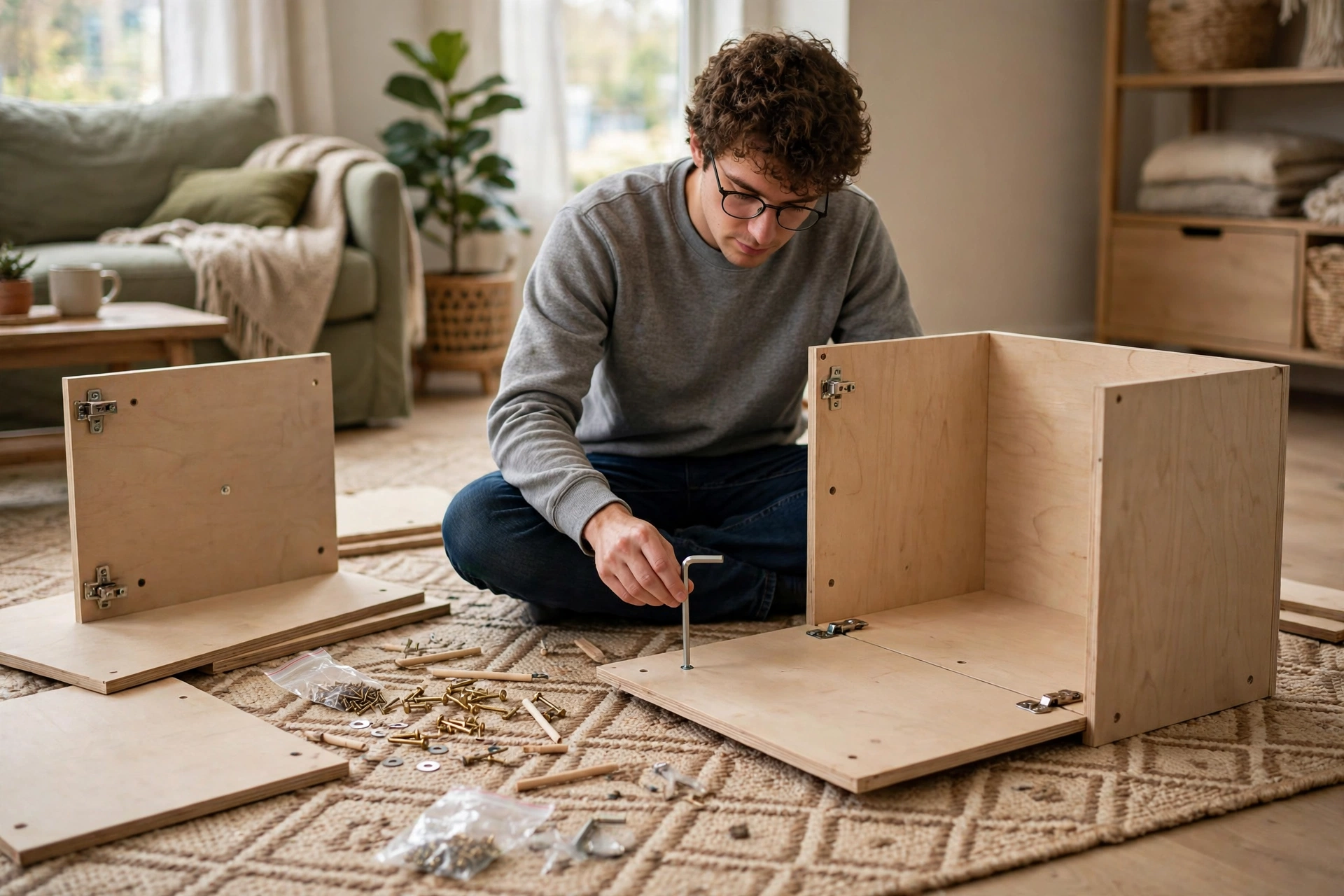
The box said twenty minutes. It always says twenty minutes. I was sitting cross-legged on my living room rug at 9 p.m., surrounded by two dozen pale wooden panels, a bag of cam locks, and an instruction sheet drawn by someone who believes pictures are a universal language. This was flat pack furniture assembly at its most honest: me, a 4mm Allen key, and a nightstand set that was supposed to take twenty minutes. Forty-seven minutes later I had two rattan-front nightstands beside my bed, plus one wobbly drawer I had to rebuild from scratch. That night was build number thirty-something for me. After that many builds, you stop fighting the process and start following rules. These are mine.
Rule 1: Count every part before you touch a screwdriver
This is the most skipped step in all of flat pack assembly tips, and the one that saves the most time. Open the box, lay every panel, dowel, screw, and cam lock out on the floor, and check them against the parts list. I do this on a blanket so nothing scratches and nothing rolls under the couch. Twice now — twice — I have found a missing drawer slide screw halfway through a build and had to stop everything to order a replacement. Both times were miserable, and both were avoidable in six minutes of counting.
Count the dowels too. Dowels are the part everyone assumes is interchangeable and it mostly is, but a build that calls for twelve and ships eleven will ruin your evening at step nine.
Rule 2: The free Allen key is a suggestion, not a plan
Every flat-pack box includes an L-shaped Allen key, and it will build the piece. It will also chew up your palm and triple the time. After build number ten I bought a small build-day kit and I have never looked back. Here is exactly what lives in mine:
- A ratcheting screwdriver with hex bits — the single biggest upgrade, roughly $15. The 4mm and 5mm bits cover nearly every cam bolt and Allen screw in home furniture.
- A drill/driver with an adjustable clutch, set LOW — for driving screws, not for final tightening. Low torque, always. You finish every screw by hand.
- A rubber mallet — for seating dowels. Never hammer a panel directly; if a joint needs force, tap a scrap block of wood against it instead.
- A tape measure and a small level — you will use both before you are done.
The Allen key stays in the box as backup. Total kit cost: about $30 to $40, and it pays for itself the first time you assemble a piece without a blister. For comparison, hiring a furniture assembly service runs roughly $60 to $120 per piece in most US cities — an estimate based on typical listings, not a quote, but it frames the math: your time plus a $35 kit is the cheapest professional-grade result you can get.
Rule 3: Cam locks are a quarter-turn — sorry, a half-turn religion
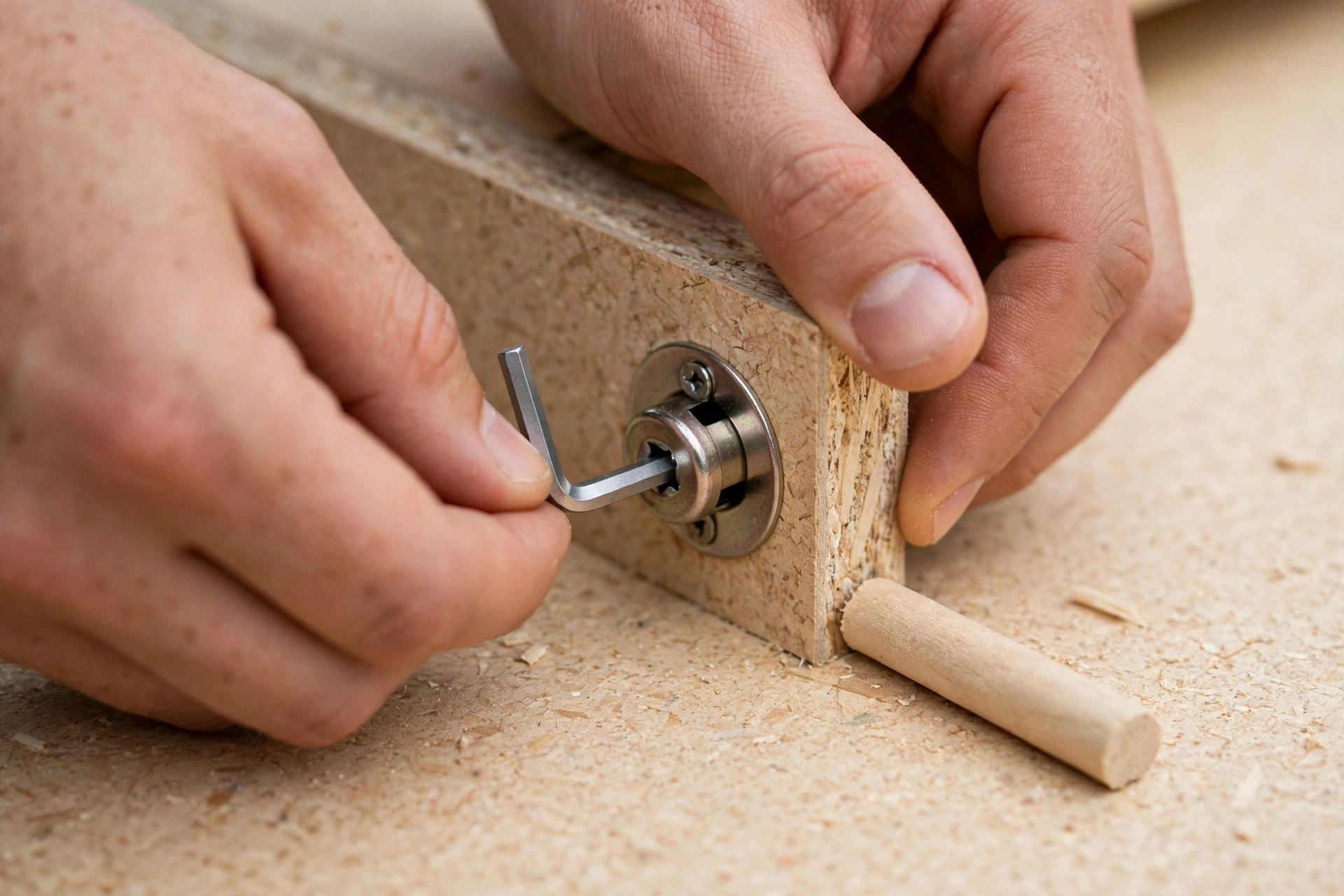
Here is the entire secret of modern flat-pack hardware: the cam lock. A bolt goes into one panel, the cam sits in a pre-drilled pocket in the other, and you turn the cam about a half turn — 180 degrees — with your Allen key or hex bit. The slot on the cam should end up pointing toward the bolt. That is the locked position.
Two mistakes ruin cam locks. The first is turning them before the panels are fully seated — the cam grabs, the joint closes with a gap, and the panel sits crooked. Push the joint fully together first, then turn the cam. The second mistake is over-turning: when the cam hits its stop, stop. Forcing it past the stop shears the little locking tab inside, and now you own a cam that spins freely and holds nothing.
One more detail nobody tells you: cam locks are designed for one assembly. If you disassemble and reassemble a cam-locked joint, it will hold, but it will never grip quite as hard as the first time. So if a build ever has to be moved, treat that as a vote for disassembling only what the manual says to move.
Rule 4: Snug now, tight later — square everything before the final pass
This rule alone separates sturdy furniture from the wobbly kind. When you are joining the main frame, tighten every bolt and cam to about 80 percent — firm, but with a whisper of give. Then square the frame: measure diagonally from corner to corner, both ways. Equal diagonals mean square. Unequal diagonals mean you rack it gently until they match. Only then do the final tightening pass.
Why does this matter? Particle board frames lock in whatever shape they are in when you crank the hardware down. My first bookshelf went up with a 3mm diagonal difference. It looked fine, but every shelf sat at a barely visible tilt and the doors never closed evenly, and I lived with that for six years. Measure the diagonals.
Rule 5: Particle board forgives nothing
Almost every flat-pack piece in an American home is particle board with a laminate or veneer skin, and particle board has exactly one structural rule: a screw hole gets one chance. Drive a screw, back it out, drive it again — and the hole strips. The fix I wish I had known at build one: put a drop of wood glue (plain PVA) on every wooden dowel before tapping it in. The dowels stop walking out, the joints stiffen noticeably, and the whole piece feels like it cost twice as much. The glue adds maybe five minutes and costs nothing from a bottle you probably own.
And if you do strip a screw hole — it happens to everyone — the repair is a toothpick and wood glue: coat the toothpick, press it into the hole, let it dry, trim flush, re-drive. It holds better than the original. I keep a jar of toothpicks in my build-day kit next to the mallet. No shame in it.
Rule 6: Build it where it will live
The single most expensive mistake in flat pack furniture assembly is building a 59-inch-wide cabinet in the garage and then discovering it does not fit through the bedroom doorway assembled. Ask me how I know. (I carried a fully assembled dresser up a stairwell once, twisted it slightly on the landing, and listened to a dowel joint pop. It never sat flush again.)
New rule: if the piece is taller than your doorway or heavier than you can carry low and level, assemble it in the room where it will stand. Remove the drawers and shelves before any move — that cuts a third of the weight and removes the parts most likely to slide out and gouge a wall. And once a tall piece is standing, anchor it. Tall furniture plus kids, pets, or earthquakes is a tip-over risk, and the ten-minute fix is worth doing — I wrote a whole guide on furniture anchoring after learning that one the loud way.
Rule 7: My two real builds — the $99 nightstands and the $168 cabinet

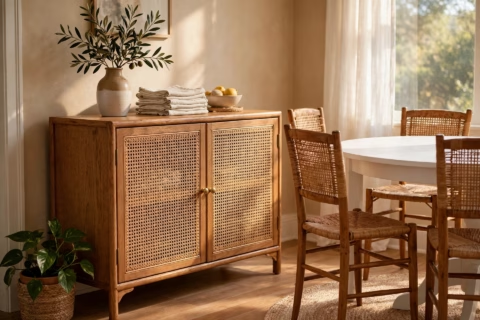
The specs: 15.75 by 15.75 by 18.90 inches each, particle board, natural rattan-look fronts, item W167382609. The product page says all tools included and 20-minute installation. My honest number: 47 minutes for the pair on my first attempt, working carefully, counting parts first. The 20-minute claim is achievable if you skip the counting step — which Rule 1 says you should not do. The drawers glide fine, the rattan fronts look far more expensive than $49.50 a nightstand, and neither piece has wobbled since — because I squared the frames before the final pass.
Second, the 59-Inch Rustic Farmhouse Storage Cabinet, $168 — same rattan design language, 59.10 inches wide, 59.50 pounds, item W167382615. This is the piece where Rule 6 earns its keep: at nearly five feet wide and sixty pounds, it is a two-person lift and a build-it-in-the-room piece. I glued every dowel, measured my diagonals (off by 4mm, racked it square), and the doors close evenly to this day. Total build time: about an hour and a half — budget two hours if it is your first cabinet this size.
The honest math on both: $267 for three finished pieces of furniture plus one evening of work, versus a few hundred dollars more for the same storage in pre-assembled form — or $60 to $120 per piece for a hired assembler. The labor is the discount. These rules are how you collect it without the wobble.
Rule 8: The industry numbers behind the flat-pack boom
I looked up the market data because I wanted to know whether I was an outlier or just average. Turns out I am extremely average. Mordor Intelligence puts the global ready-to-assemble furniture market at $16.48 billion in 2025, growing to $25.24 billion by 2031 at a 7.36% compound annual growth rate — and home furniture leads the category with a 62.65% share in 2025. Different analysts land in different places (estimates range from roughly $16 billion to over $50 billion depending on definitions), but every one of them points the same direction: more and more of the furniture in American homes arrives in a flat box.
That growth is not an accident. Flat-pack cuts shipping volume, which cuts the price, which puts real-wood looks in apartments that could never afford solid-wood prices. The trade-off was never the furniture — it was the assembly. And the assembly, it turns out, is a learnable skill with about nine rules.
The verdict. Flat-pack furniture is the best value in home furnishing if — and only if — you assemble it like you mean it. Count the parts. Bring real tools. Respect the cam lock: seat the joint, half turn, stop. Square the frame before the final pass. Glue the dowels. Build it where it will live. Do those things and a $99 nightstand set or a $168 cabinet will stand square and silent for years; skip them and you get the wobble, the tilted shelf, the drawer that never quite closes. I have built both kinds. Trust the rules.
Start with pieces worth building right. The $99 rattan nightstand set is the perfect first build — small, forgiving, and genuinely useful when it is done. Ready for a bigger Saturday? The $168 farmhouse storage cabinet is the one I would hand a confident beginner. Browse FLNORW MALL →