I Have a Dog and a Cat. Here Is the Pet-Friendly Furniture That Actually Survived.
My beagle mix Biscuit has been on the couch since roughly the second day we brought her home. My cat Milo — eleven pounds of orange tabby with the moral compass of a raccoon — joined the household two years later and treated every upholstered surface like a quality-control station for his claws. I spent the first year of combined-pet ownership googling pet-friendly furniture at midnight and buying cheap throws that I washed every three days. Six years in, here is everything I actually know: which fabrics survive, which ones are marketing, and the two pieces I would buy again tomorrow without blinking.
Pet-Friendly Furniture Has Two Enemies: Hair and Claws
Here is the thing nobody tells you: hair and claws are two completely different problems, and furniture that handles one can fail spectacularly at the other. Hair is a cleaning problem — annoying, relentless, but solvable with a lint roller and ten minutes. Claw damage is permanent. You cannot un-pick a knit. So the first question to ask about any piece of pet-friendly furniture is not “is it washable” but “what happens when the cat runs at it sideways at 3 a.m.”
The industry clearly knows there is money in answering that question. The American Pet Products Association’s 2023-2024 survey found 66% of U.S. households — 86.9 million homes — own a pet, with 59.1 million dog-owning households and 46.5 million cat-owning ones, and Americans spent $147 billion on their pets in 2023. When two-thirds of the country has an animal in the house, pet gear stops being garage equipment and becomes furniture. The marketing has caught up; my job is to tell you which of it actually works.
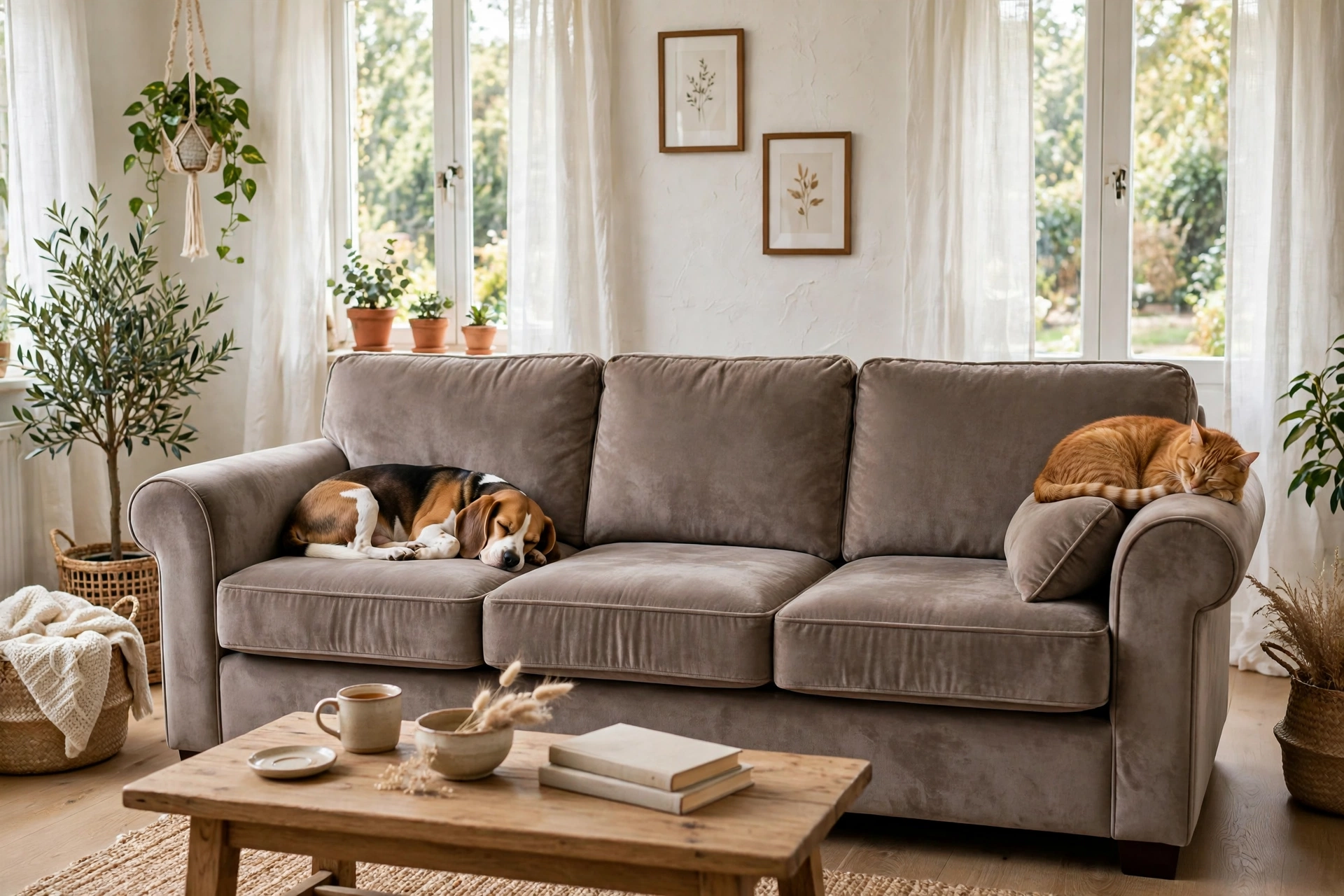
My Velvet Sofa Survived Both Animals ($468)
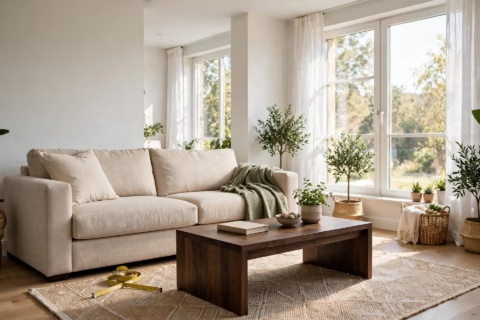
My main test subject is a taupe velvet three-seat sofa, $468 — 74 inches long, solid rubberwood frame, 18-inch seat height, and the detail that sold me: removable seat cushions. Two years of a beagle who believes the armrest is her personal pillow plus a cat who kneads like he is auditioning for a bread commercial, and it still looks close to new. Here is why velvet earned my trust, with the honesty clause: not all velvet is equal, and I got lucky with the weave.
Velvet’s secret against hair is the nap — those short, dense fibers do not give loose fur much to grab onto, and what does land vacuums up in one pass instead of being woven in. Against claws, a tight-woven velvet like mine matters more than the word “velvet” itself; Milo’s rear claws have slid off the arms more than once without leaving a mark. The removable cushions turned out to be half the battle: I rotate them left-to-right, front-to-back every month, so no single cushion takes all the wear, and the covers can be lifted off for a proper clean underneath — the crumb-and-fur burial ground every sofa has. And the solid rubberwood frame has absorbed years of a 34-pound dog launching herself at it sideways without a wobble, which is more than I can say for the $180 particleboard loveseat this sofa replaced.
If you want the full cleaning playbook I use on it — the stain routine, the cleaning-code decoder, the $12 protector-spray verdict — I wrote that up separately in my fabric sofa care guide. The short version: vacuum weekly, blot never rub, read the tag.
The Chenille Chair vs. the Cat: An Honest Draw ($398)
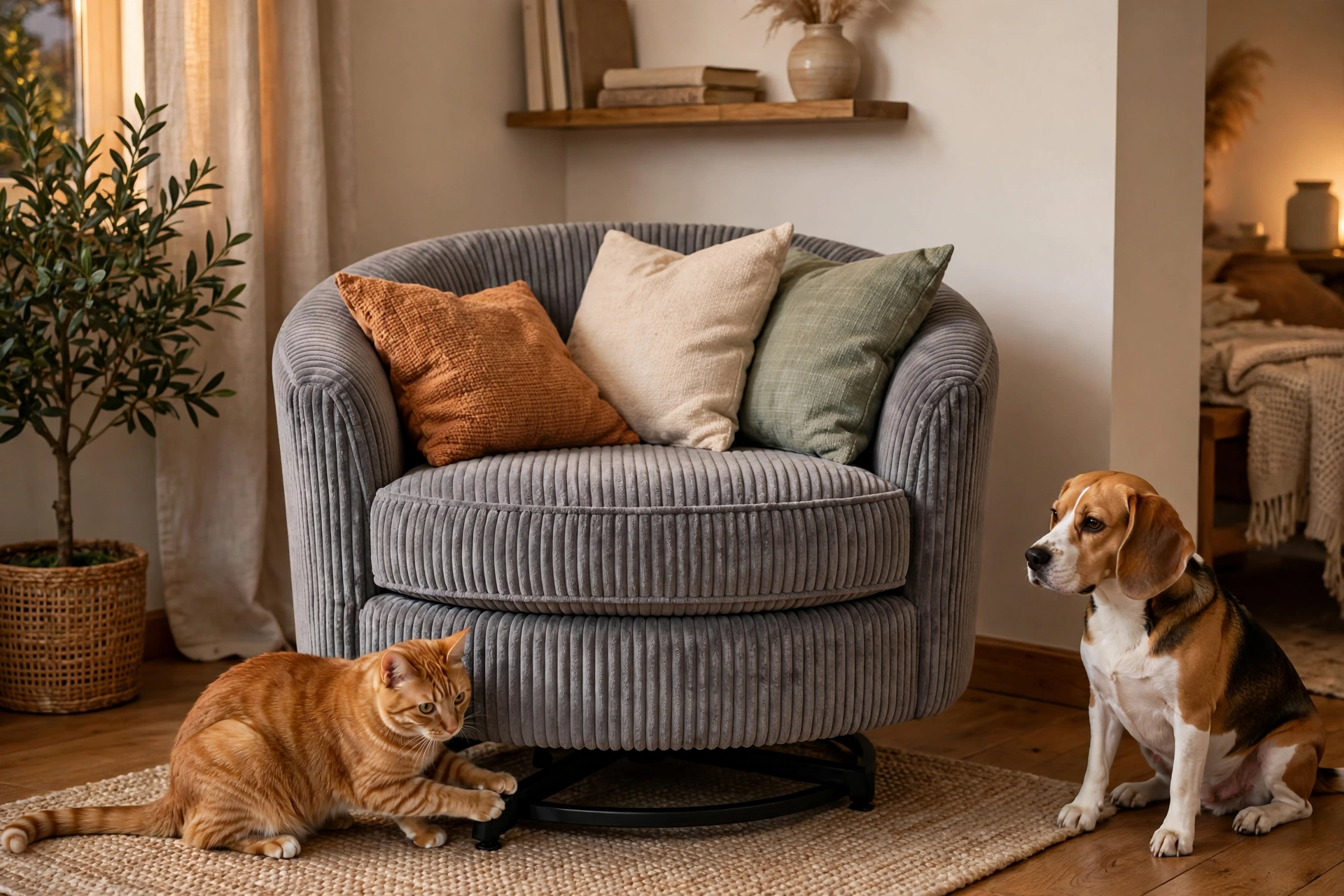
Not every test has a clean winner. My $398 gray chenille oversize round swivel chair — 360-degree swivel, 40.2 inches wide, plywood frame, three loose pillows — is the comfiest seat in the house and the piece Biscuit chose as her second-favorite nap spot. It is also where I learned the one honest drawback of chenille for cat scratch furniture situations: chenille is a woven-and-cut pile, and a determined cat can pull individual tufts. Milo put two small picks in the back panel in month one, when the chair was new and everything was a scratching post.
Here is the honest part, though: after I got him a proper scratching tree (different purchase, different story), the damage stopped entirely. Sixteen months later, those two picks are still barely visible if you do not know where to look, and the three loose pillows rotate so his favorite one never flattens. The swivel base has also survived two years of a dog bumping it with her nose and a cat leaping off it at full speed — the plywood frame earns its keep. So my verdict is a qualified pass: chenille is fine for dogs and fine for cats with outlets, but if your cat is still in the scratch-everything phase, start elsewhere. The chair’s link above is the exact one I bought, in gray — gray was strategic, which brings me to the ranking.
The Fabric Ranking for Pet Homes, From Two Animals’ Worth of Evidence
Every fabric guide online gives you a star rating. Here is mine, earned in the field:
- Tightly woven microfiber and performance fabrics: the boring champion. Hair brushes off, claws find no loops to catch. If I were furnishing a house from zero with these two animals, this is the default for a pet-proof sofa.
- Tight-woven velvet: my personal winner. Nap hides fur, slides off most claw passes, and looks like furniture instead of a compromise. Watch for cheap velvets with loose backing — the keyword is the weave, not the name.
- Real leather: the scratch paradox. Dog claws leave small marks that blend into patina; cat claws can do real damage. It cleans with a wipe, which is glorious. It also costs real money — which is why I have not tested it in my own living room.
- Chenille and other textured weaves: great for dogs, risky for unbroken cats. Comfort is top-tier, but buy the scratching tree the same week.
- Linen and loose canvas: the hair magnet tier. Beautiful in a no-pets house. In mine, it would be a felted monument to Biscuit within a season.
One more rule that costs nothing: pick colors that match your animals. My sofa is taupe because Biscuit is tan-and-white; hair is practically camouflaged. The gray chair matches Milo’s litter-box-adjacent reality. This is not a style compromise — it is the cheapest insurance you will ever buy.
Covers, Throws, and the Tricks That Actually Work
No fabric wins without maintenance, and no maintenance routine should be exhausting. Here is my honest short list, tested over years:
- A machine-washable throw on the dog’s spot. Biscuit always lands on the left cushion. A $25 washable throw lives there; it goes in the laundry every Friday. That is 80% of my hair management in one move. It is my estimate, but a confident one.
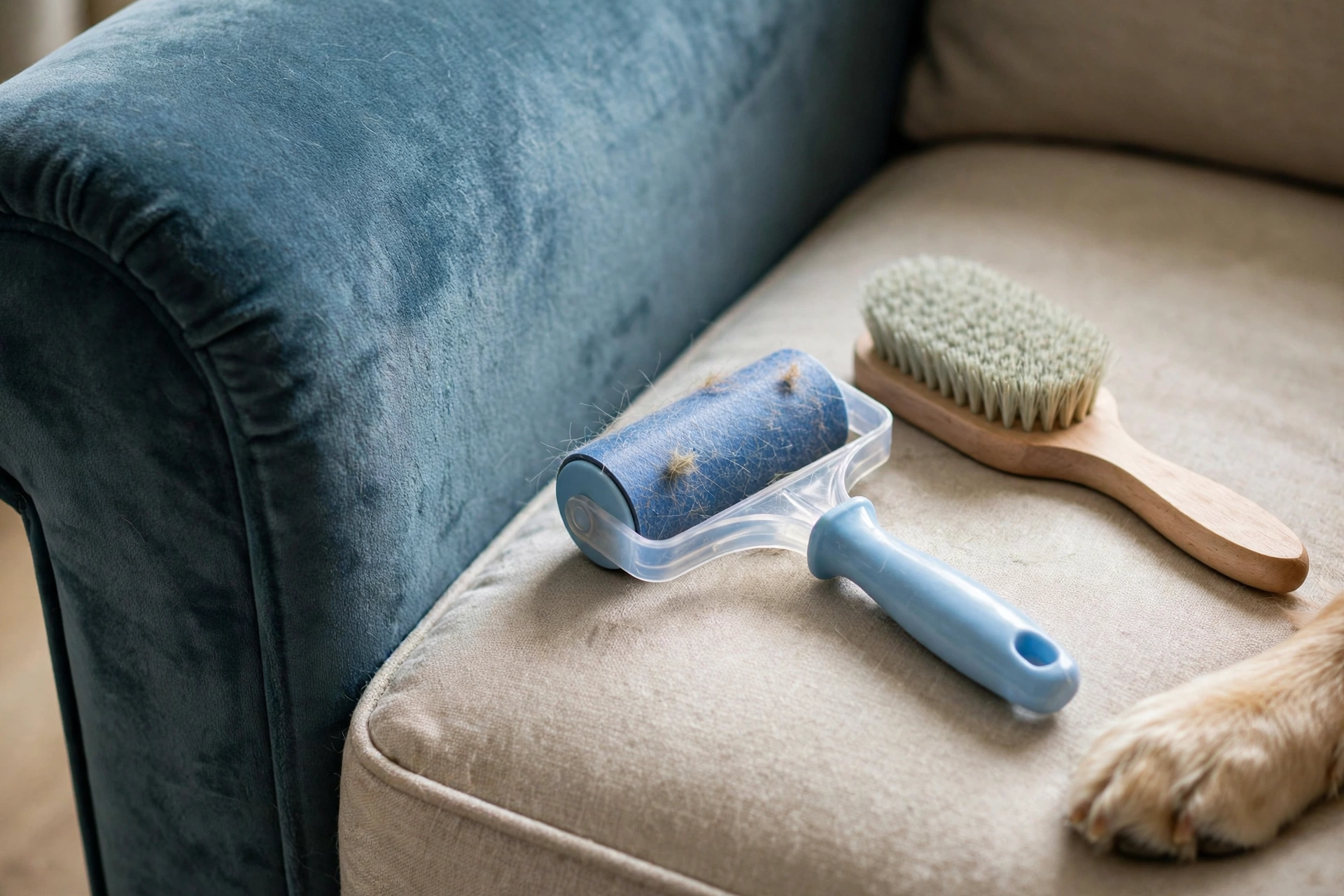
- A lint-roller station. One roller by the door, one on the coffee table. Guests never see the before picture.
- Nail trims every two to three weeks. Milo’s claws go from fabric-safe to fabric-shredding in about a month. A $12 pair of clippers has saved this furniture more than any fabric choice.
- Ten-minute weekly vacuuming with the upholstery attachment. Dust and grit are sandpaper on upholstery; the crumbs work deeper every time someone sits. The sofa I vacuum looks two years old. The never-vacuumed back panel does not, relatively speaking.
- Fabric protector spray, the $12 can. I treated one armrest and left the other — the treated side beaded water for months. It buys you time to blot a spill, not immunity. Reapply yearly.
Make the Crate Part of the Furniture
The biggest visual upgrade in my pet home was not a sofa at all — it was evicting the black wire dog crate from the corner and replacing it with a furniture-style crate disguised as an end table. Two years on, guests set their coffee on it before noticing Biscuit sleeping inside, the lamp on top has never wobbled, and the sliding iron door opens flush against the wall. I wrote the full accounting of that $288 purchase — the good, the particle-board honesty, the thin included mat — in my dog crate furniture review. If your crate lives anywhere guests can see it, this is the upgrade I recommend first, before any sofa shopping.
The Real Cost Math: $866 Once vs. Replacing Cheap Furniture Twice
Let me do the arithmetic out loud. My sofa was $468, my chair $398 — $866 total, purchased two years ago, both still going strong with the routine above. The alternative I actually lived: a $180 loveseat and a $150 chair that Biscuit destroyed in under two years — sun-faded one side, claw-picked everywhere Milo went, frame creaking by month fourteen. Replacing that tier of furniture twice in five years runs $660 to $1,000, and you sit on compromised furniture half the time.
So the honest math: spending $866 once on tight weaves and real frames ran me about $86 per year so far, trending down as the pieces keep going, versus roughly $150 to $200 a year on the buy-cheap-replace route — my rough estimate, but the wreckage in my garage backs it up. Pet-friendly is not a premium you pay for the animals’ benefit. It is the cheaper choice if the animals are staying.
The Verdict
The verdict: pet-friendly furniture is not a category, it is a checklist — tight weaves, removable covers, frames that survive a sideways dog, colors that forgive your animals, and a maintenance routine measured in minutes, not hours. My $468 velvet sofa earned its keep against both animals, the $398 chenille chair survived the cat’s adolescence with two nearly invisible picks, and the $288 furniture crate quietly became the most complimented piece in the room. Buy the fabric your animals cannot destroy, then spend the saved money on the two things that matter more than any upholstery: a good lint roller and a standing nail-trim appointment.
Ready to make your living room pet-proof? Shop the two pieces I tested — the taupe velvet three-seat sofa ($468, removable cushions) and the gray chenille oversize swivel chair ($398, 3 pillows) — or browse the full range at FLNORW MALL.