Fabric Sofa Care: 7 Rules That Keep Mine Looking New
I bought my first fabric sofa this spring — a taupe velvet three-seater from FLNORW MALL. $468, 74 inches long, solid rubberwood frame, and — the detail that sold me — removable cushions. It looked like a showroom piece for exactly nine days. Then my daughter’s chocolate milk happened.
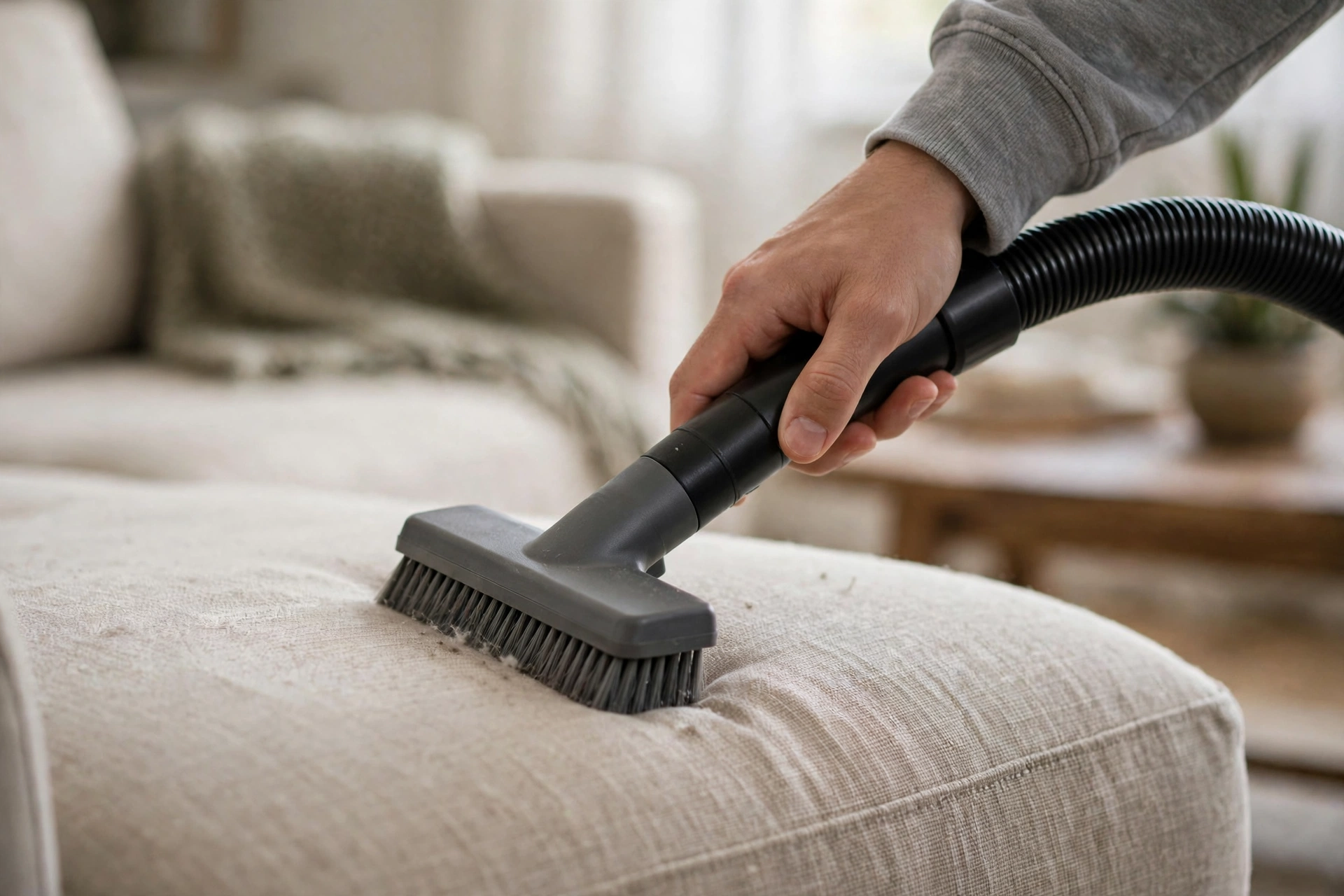
Two years, two coffee incidents, one dog who believes the armrest is his personal pillow, and more trial and error than I care to admit later, that sofa still looks close to new. Fabric sofa care is not complicated, but almost everything I assumed about it was wrong. Here are the seven rules I actually live by.

1. Read the Cleaning Code Before You Touch Anything
Every upholstered piece I own has a tag tucked under the seat cushion with a letter code. For two years I ignored it. Then I sprayed a water-based cleaner on a side chair coded X — solvent-only — and learned what a water ring looks like. Here is the decoder ring:
- W: water-based cleaners are fine.
- S: solvent-based cleaners only, no water.
- W/S or SW: both are fine — the most forgiving code.
- X: vacuum only, no liquids at all.
My velvet sofa is tagged W/S, which is why the chocolate milk did not end me. Find your tag, photograph it with your phone, and keep the photo. When a stain happens at 9 p.m., you will not feel like crawling under the cushions.
2. Vacuum Your Fabric Sofa Weekly — With the Right Attachment
Dust and grit are sandpaper on upholstery fibers. Every crumb grinds a little deeper the next time someone sits down. My rule: ten minutes every Sunday, with the upholstery attachment — the wide brush head, not the bare hose, which can snag loose weaves.
Get under the cushions, run the crevice tool along the seams, and do the back and arms where skin oils collect. It feels like nothing is happening until you empty the canister and realize a small mammal’s worth of dust lived in your couch. This one habit alone probably adds a year or two to the fabric’s life — my estimate, but the wear pattern on my vacuumed seat cushions versus the never-vacuumed back panel backs it up.
3. My 5-Minute Stain Routine (Tested on Coffee, Twice)
The first coffee incident: month two, a full mug, tipped during a movie. I panicked, grabbed the nearest spray bottle, and rubbed. The stain got bigger. The second coffee incident went differently, because by then I had a routine:
- Blot, never rub. Press a clean white cloth straight down. Rubbing pushes the spill sideways into clean fibers.
- Scrape off solids first with a spoon edge — ketchup, mud, the works.
- Mix a teaspoon of clear dish soap in a cup of lukewarm water (for W or SW coded fabrics). Dab from the outside of the stain inward so it does not spread.
- Rinse by blotting with a damp cloth, then press a dry towel over the spot and stand on it — your body weight pulls out more moisture than your hands can.
- Let it air-dry fully before sitting there again. A fan speeds it up.
Two things I wish someone had told me earlier: always test in a hidden spot first — the back of the sofa, near the floor — and use white cloths only. I learned about dye transfer from a blue towel the hard way.
4. Velvet Sofa Maintenance Is Its Own Game
Velvet is the drama queen of fabrics. The nap — the direction the fibers lie — shows every touch as a lighter or darker patch. That is not damage, just the light. A soft clothes brush or a clean dry sponge, stroked in one direction, resets it in about a minute.
For the flattened spot where I sit every night, a handheld steamer held six inches away lifts the pile right back up. No steamer? A steam iron works if you hold it above the spot without touching. I would never press an iron onto velvet — that crushes the pile for good.
The real gift of my sofa: removable cushions. I rotate them monthly — left to right, front to back — so no single cushion takes all the wear. Honestly, that is half of why a two-year-old velvet sofa still photographs well. When I was shopping, this taupe velvet three-seater ($468) won on exactly that detail, and it has paid off every month since.
5. Is Fabric Protector Spray Worth $12? My Honest Answer
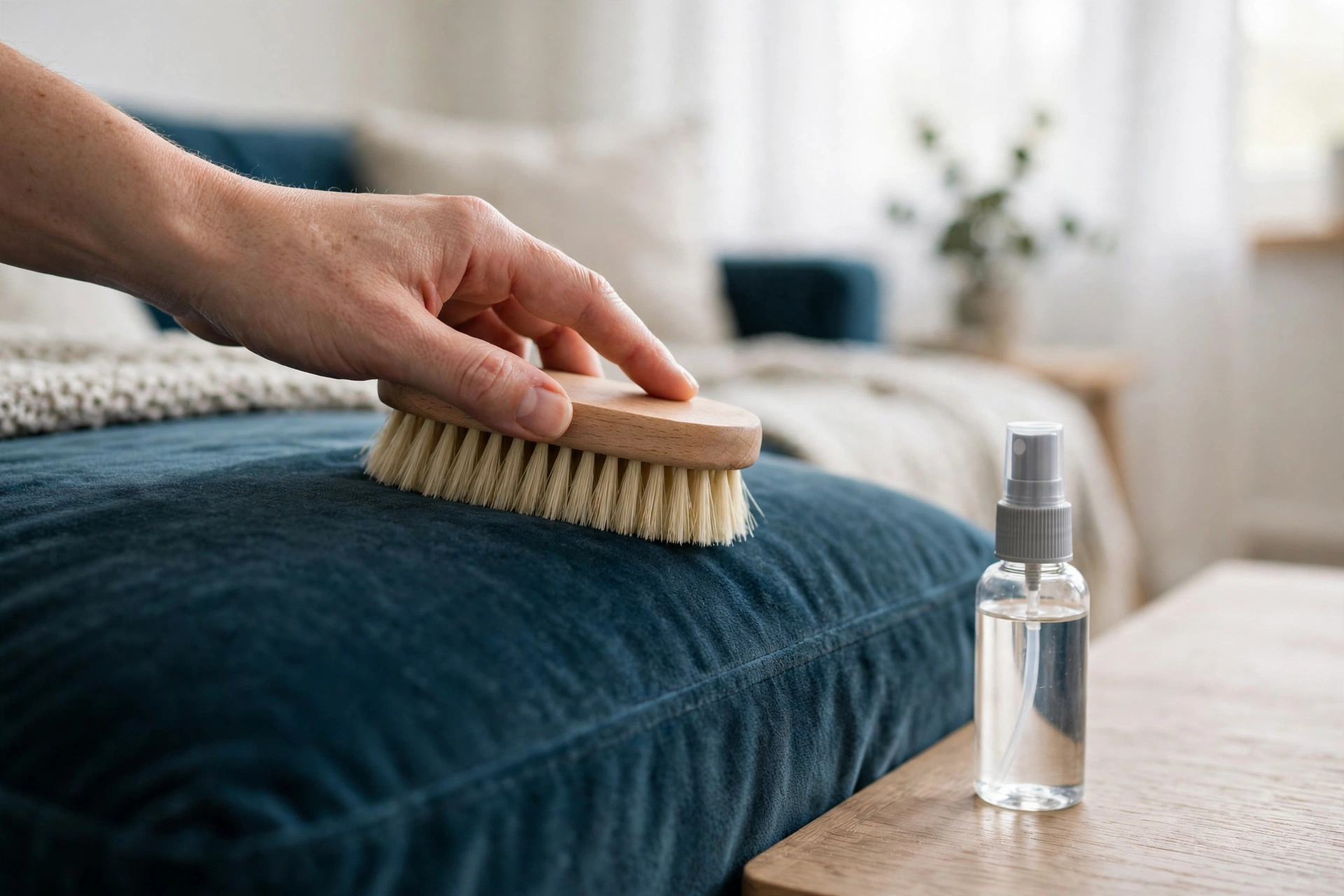
Last year I bought a $12 can of fabric protector spray and did one armrest as an experiment, leaving the other alone. Six months later I flicked a few drops of water on both. The treated side beaded up. The untreated side drank it in. The spray is real.
But it is not armor. It buys you time — maybe fifteen minutes of beading before a spill soaks through — not immunity. My verdict: yes, worth it, especially with kids, pets, or red wine in the house. Reapply every 12 months or after a deep clean, spray in a ventilated room, and test a hidden patch first. What I would skip: the $60 “professional-grade” versions. The $12 can did the job fine.
6. Flip, Rotate, Fluff — the Free Habit Nobody Does
Sunlight fades one side of a sofa the way it fades one side of a rug. Mine sits near a window, and the arm closest to the glass was getting lighter. Two free fixes: rotate the whole sofa 180 degrees once a year if the room allows it, and fluff the back cushions every week or two — karate-chop the top for the designer dent, or just shake them out and put them back.
The same trick works on accent chairs. My friend’s cozy barrel chair — a 360-degree swivel in gray chenille a lot like this oversize round swivel chair ($398) — has three loose pillows she swaps around so the dog’s favorite one does not flatten into a pancake. Same principle, five seconds of work.
7. When to Pay a Pro (and What It Should Cost)
DIY covers maintenance, but every few years a sofa earns a professional deep clean. I am far from alone in paying for one: U.S. carpet and upholstery cleaning services brought in $4.9 billion in 2022, up from $3.5 billion in 2018, according to the U.S. Census Bureau’s Service Annual Survey (cited in ServiceTitan’s 2026 industry data roundup). People spend real money on this because a pro’s hot-water extraction reaches grime no vacuum can touch.
Quotes in my area for a standard three-seat sofa ran $150 to $300 — that is my experience, so get your own quotes. Now the math: my DIY routine costs about $12 for the spray plus roughly $10 a year for a bottle of upholstery cleaner, and twenty minutes a week. Three professional cleanings over five years would run $450 to $900, my estimate. My sofa cost $468. The routine has paid for itself many times over — and the sofa is the thing that looks new, not just smells clean.
Call a pro when: the tag says X and something spilled anyway, a stain survived your five-minute routine twice, or it has been three-plus years since the last deep clean.
My Verdict After Two Years
The verdict: fabric sofa care is 80 percent boring routine and 20 percent knowing what not to do. Vacuum weekly, blot don’t rub, read the tag, rotate the cushions, and spend the $12 on protector spray. My $468 velvet sofa still turns heads at two years old, and I have spent maybe $50 total keeping it that way. There is no secret — just the routine.
Ready to put these rules to the test? Browse the furniture collection at FLNORW MALL — including the taupe velvet three-seat sofa ($468) I have been testing these rules on — or start from the homepage and more furniture care guides.