How to Choose an Artificial Christmas Tree: 7 Rules That Saved Me $300
I have bought two artificial Christmas trees in my life, and the difference between them taught me everything I know about how to choose an artificial Christmas tree. The first was a $120 box-store special I grabbed on a Saturday morning in 2019. It leaned like it had been drinking, shed PVC tips onto the rug until February, and took an hour of my life every December just to string lights on its thin, gappy branches. The second — the $199 prelit 6-foot tree I will mention by name later — goes up in under an hour and looks better now than it did out of the box.
That gap between the two trees is not luck. It is seven decisions I made wrong the first time and right the second. With November here and holiday shelves already filling up, here is the full artificial Christmas tree buying guide I wish someone had handed me in 2019.
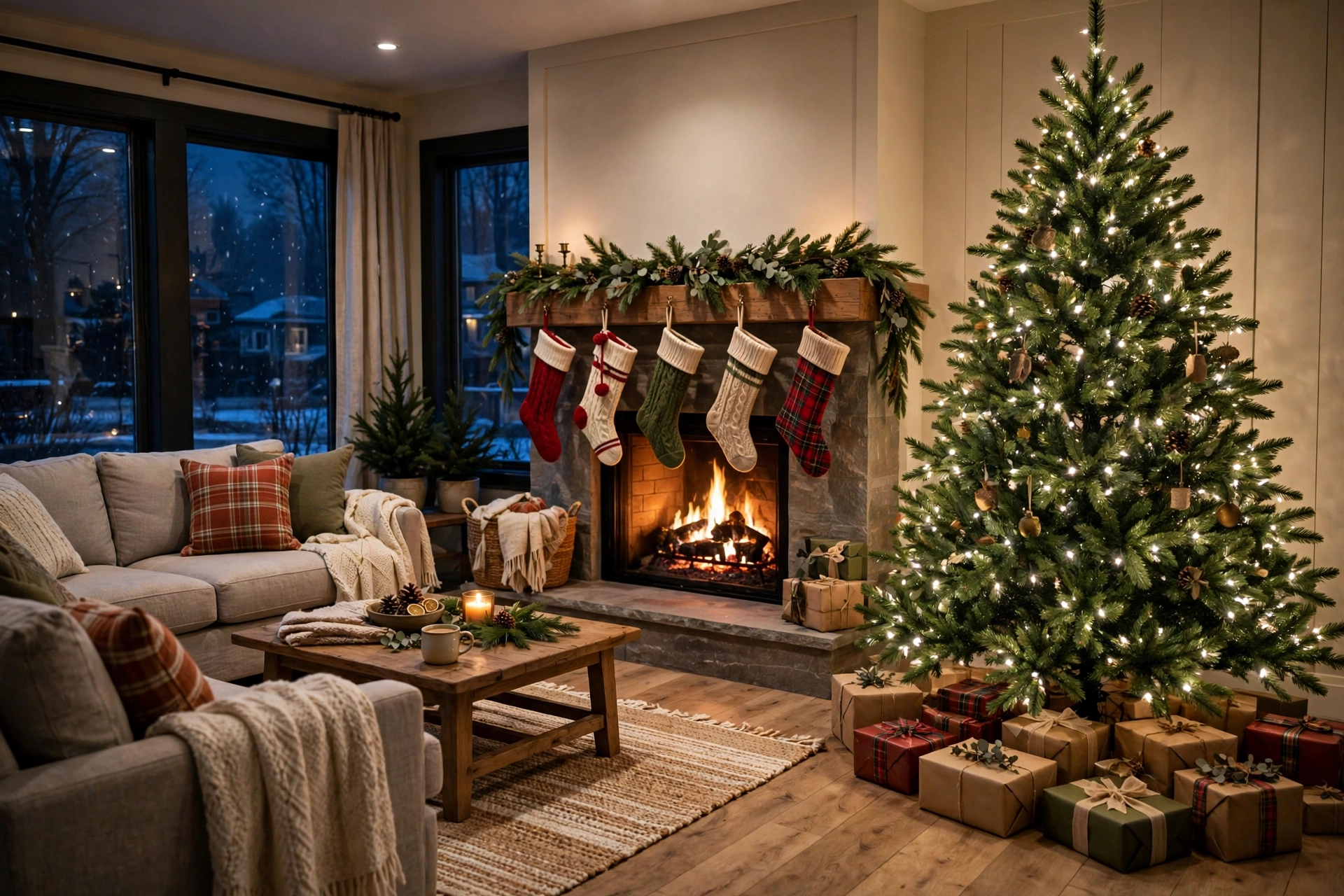
Rule 1: Measure the Room First, Then Shop
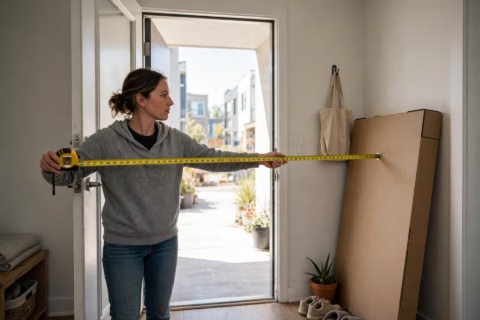
This is the mistake nearly everyone makes, and I made it twice. We shop by the tree we want instead of the tree our room fits. Grab a tape measure before you open a single product page.
For height, take your ceiling height and subtract about 12 inches — that leaves room for a tree topper plus the star or angel you will eventually buy. Our ceilings are 8 feet, so a 6-foot tree at 72 inches is the sweet spot. A 7-foot tree in our room would have scraped the crown molding, and I only figured that out because I measured before ordering this time.
For width, check the base diameter against your floor space. A 6-foot tree typically spreads 36 to 40 inches wide. The tree I bought runs a 36-inch base, which tucks neatly beside our fireplace with the couch still three feet away. If your tree has to live in a corner, a slim-profile tree buys you back almost a foot of floor.
Rule 2: Count the Branch Tips, Not Just the Height
Here is the single most useful spec on any product page: the artificial Christmas tree branch tips count. Height tells you how tall it is. Tip count tells you whether it looks like a tree or a green traffic cone.
My cheap first tree never published a tip count, which should have been my warning. The good one lists 1,250 branch tips on a 6-foot frame — roughly 208 tips per foot. That density is what lets you fluff it full enough that you cannot see the center pole, which is the fastest quality check I know. Stand back six feet: if you can spot the trunk through the branches, it needed more tips.
My rule of thumb after comparing a lot of product pages: for a 6-foot artificial Christmas tree, look for at least 1,000 tips. Under that, you are decorating the gaps. The extra tips also hold ornaments better — heavy glass balls need branch structure to sit in, not dangle from.
Rule 3: Hinged Beats Hooked, Every Time
Branch construction comes in two flavors, and the difference matters every year you own the tree. Hooked branches have to be pulled off individually and re-hung branch by branch — on my first tree that was roughly 200 separate pieces and forty-five minutes of assembly before a single ornament went up.
Hinged branches are permanently attached. The sections stack together and the branches drop down into place like an umbrella. The $199 tree assembles in 4 sections that slot onto the metal stand, and setup takes about ten minutes before fluffing.
Hinged also wins on durability. Every hook you yank off and jam back on stresses the socket; after five seasons my old tree had a graveyard of loose branches I could never reseat properly. Hinged branches fold flat for storage, so nothing gets bent or broken in the box. If the spec sheet does not say “hinged,” keep scrolling.
Rule 4: Go Prelit Unless You Genuinely Love Stringing Lights
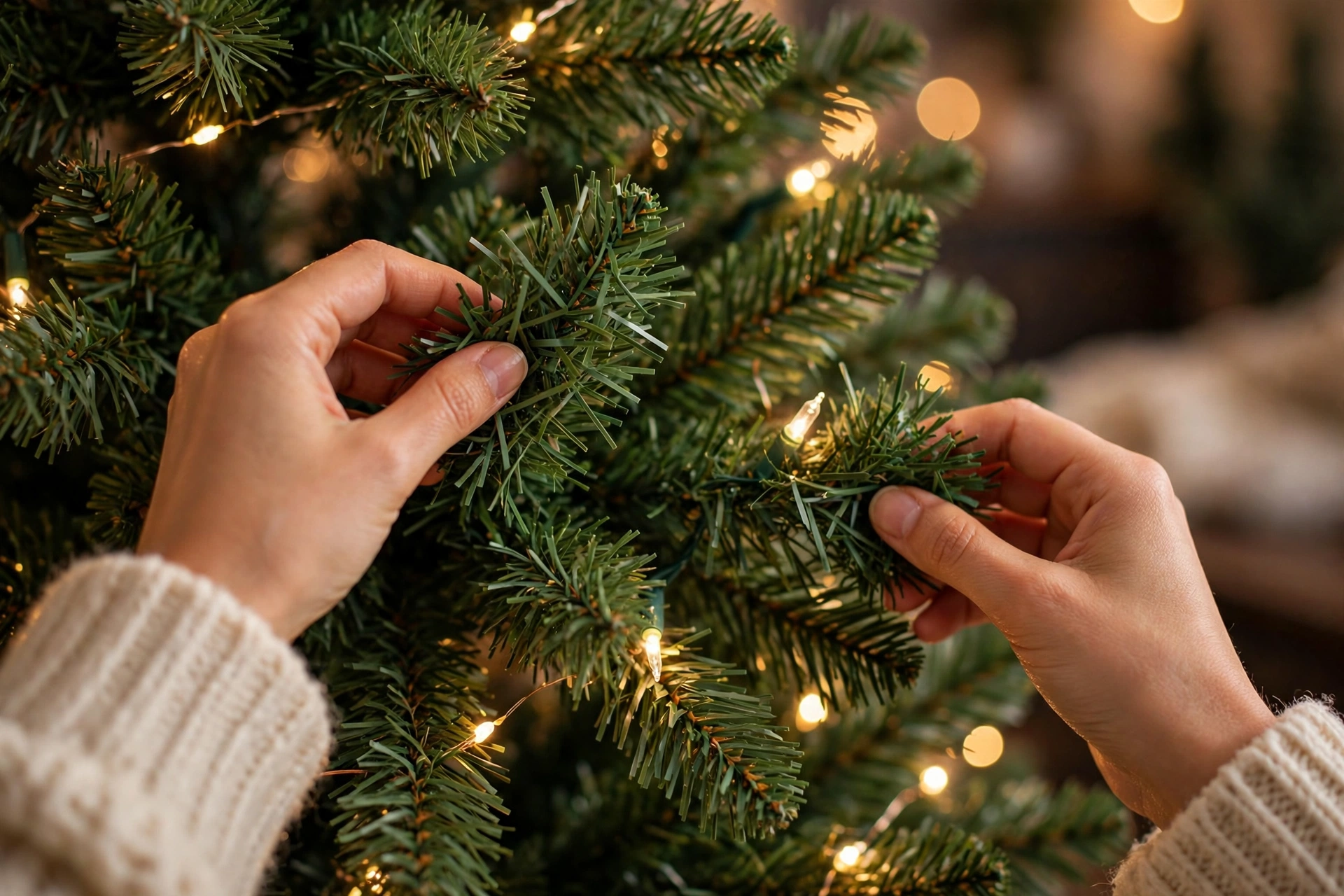
The industry already settled this one. The American Christmas Tree Association reports that about 80% of artificial trees sold each year come prelit (via the Associated Press, 2025), and I understand why. Stringing lights on my first tree took 45 minutes and two strings of lights I had to buy separately. On the prelit tree, I plug in one cord.
What to check on a prelit Christmas tree before you buy:
- Light count — this tree carries 300 LED lights, which is bright enough that I do not add extra strings.
- Stay-lit bulbs — if one bulb dies, the rest keep burning. This is non-negotiable on a prelit tree; rewiring a prelit string is a special kind of misery.
- Bulb type — LEDs run cool and last tens of thousands of hours. Incandescents on a prelit tree are a maintenance hobby.
- Light tone — mine is clear white (cold light), crisp rather than amber. Know your preference before it arrives, because you will live with it for a decade.
The trade-off is real: if the light string ever fails out of warranty, a prelit tree becomes a decorating project. Mine has survived three seasons with every LED still burning, and LED lifespans make me comfortable calling that a ten-year bet.
Rule 5: Read the Needle Material Like an Ingredient Label
Tree branches are mostly PVC (polyvinyl chloride), sometimes PE (polyethylene), sometimes a mix. PVC is the workhorse — flat needle tips, fire-resistant, and practically immortal if kept dry. PE looks more realistic because the needles are molded in 3D, but it costs significantly more.
The $199 tree I bought is fire-resistant PVC, and I chose that deliberately with two small kids and a string of heat-generating lights running for six weeks. The safety math is concrete: the National Fire Protection Association reported an average of 160 home fires starting with Christmas trees per year from 2016 to 2020, nearly all involving real trees that had dried out. A PVC artificial tree that never needs watering simply does not carry that risk.
If you want the most realistic look and can spend more, PE tips on the outer branches with PVC inside (a common “PE/PVC mix” construction) give you realism where the eye lands it and durability underneath. For my money, dense PVC at $199 is the sweet spot — nobody has ever guessed mine is not real from across the room.
Rule 6: Measure Your Storage, Not Just Your Room
Nobody tells you this one, and it is the rule I broke worst. The tree lives in your living room for six weeks and in a box for forty-six. Measure the storage before you buy.
The box my 6-foot tree arrived in measures 41.34 x 9.06 x 8.66 inches. That fits flat under a bed, against a garage wall, or in the back of a standard closet. A 7.5-foot tree’s box runs closer to five feet long and weighs twice as much — fine if you have a basement, miserable if you have an apartment closet.
Storage quality is also what determines artificial Christmas tree lifespan. Dry, off the floor, with nothing stacked on the box: that is the entire maintenance program. My tree is entering its fourth season with zero tip shedding beyond a handful in year one, and my working estimate — marking this clearly as an estimate — is 8 to 10 years of service. A tree you replace in four years because the box lived in a damp garage was not actually cheaper.
Rule 7: Price It Against Real Trees Before You Wince
$199 can feel like a lot for something that comes in a box. Run the comparison and it stops feeling that way fast.
The National Christmas Tree Association has reported average real-tree prices in the $75–$90 range in recent seasons. Add the tree stand you replace every few years, the two strings of lights, and the Saturday morning at the lot, and a real tree runs most families around $95 a year — my rough estimate, and I think a conservative one.
At $199, an artificial tree breaks even after about two and a half seasons. Over my estimated 8-year lifespan, the effective cost drops to about $25 a year — roughly $700+ less than buying real trees for the same span. And there is a market tailwind: a 2026 Ipsos survey for the American Christmas Tree Association found 83% of U.S. households planning to display a tree intend to include an artificial one (78% artificial only, 5% both), and the association notes prices rose 10–15% in 2025 on tariff pressure. Buy before December and you buy before the seasonal markup.
My Verdict: The Checklist I Hand Every Friend
If you want the short version of this whole artificial Christmas tree buying guide, here is the checklist I send friends now:
- Ceiling minus 12 inches for height; base diameter fits your floor plan
- At least 1,000 branch tips on a 6-foot tree (more is better)
- Hinged branch construction, never hooked
- Prelit with LEDs, stay-lit bulbs, a tone you actually like
- Fire-resistant PVC (or PE/PVC mix if the budget allows)
- The box fits your actual storage — measure it
- Total cost beats the real-tree math within three seasons
The tree that passes all seven of those for me is the 6FT Hinged Fir Artificial Bent Top Christmas Tree at FLNORW MALL — 6 feet, 1,250 hinged branch tips, 300 pre-strung LED lights, fire-resistant PVC, $199, InStock. If you want the longer story on what three seasons with it actually look like, my full review of the tree has the cost math and the honest caveats. And once the tree is up, the mantel behind it deserves the same treatment — seven rules, $129 of decor, about two hours on a Saturday.
Ready to pick yours? Browse the full FLNORW MALL holiday collection before the December price creep, and measure twice. Your January self will thank you.