I Bought a $380 Outdoor Metal Storage Shed. Here’s the Winter-Storage Math That Sold Me.
I Bought a $380 Outdoor Metal Storage Shed. Here’s the Winter-Storage Math That Sold Me.
The October that broke me started with a garage door that would not close. I did not own an outdoor metal storage shed yet, so my patio chairs, the lawn mower, and four garden-tool totes all lived in a two-car garage that had quietly turned into a storage unit with a roof. The garage door hung half-open on a leaf blower handle. I spent $380 on a 6-by-4 metal shed, gave it a Saturday afternoon, and it paid for itself before the first frost. This is the honest review.
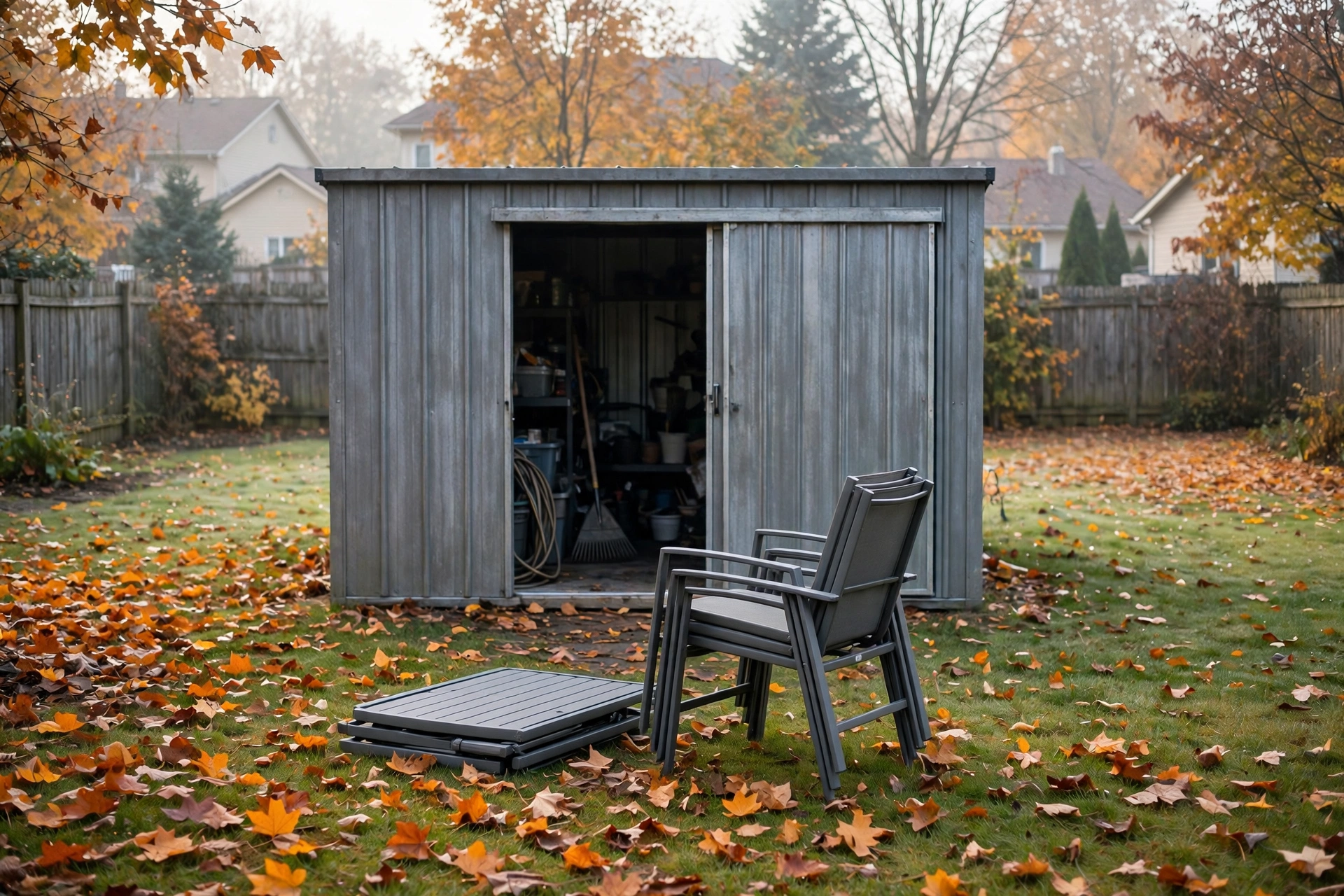
Why I started shopping for an outdoor metal storage shed
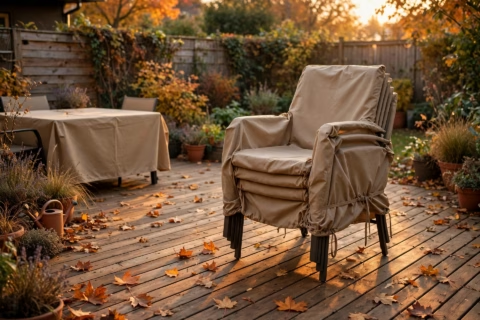
My garage had a filing system: lawn tools in the front, patio furniture in the middle, and everything I actually needed buried in the back. The cast aluminum patio set I reviewed this spring survived two seasons of rain and pollen, but it was never going to survive a winter of ice sitting uncovered — the dark bronze finish chips when you drag it, and I had already proven that once. Four chairs and a round table occupied roughly 25 square feet of my garage floor, which is the entire walking lane.
The trigger was the mower. I winterized it — drained the tank, fogged the cylinder, the whole ritual — and then had nowhere to put it except leaning against my wife’s car. That night I did what every tired homeowner does: typed metal garden shed into a search bar and started comparing square footage against prices. The 6-by-4 from FLNORW MALL came in at $380, grey, with specs that read like someone had actually thought about drainage and break-ins. I ordered it on a Tuesday. It shipped free and arrived the following week.
What $380 buys: galvanized steel, sliding doors, and a real padlock
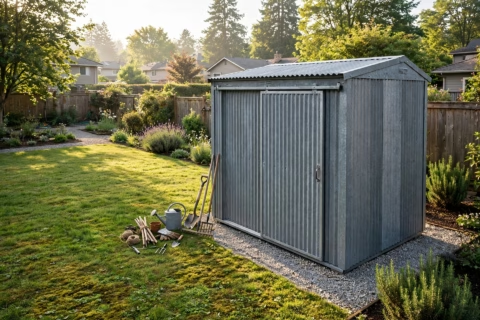
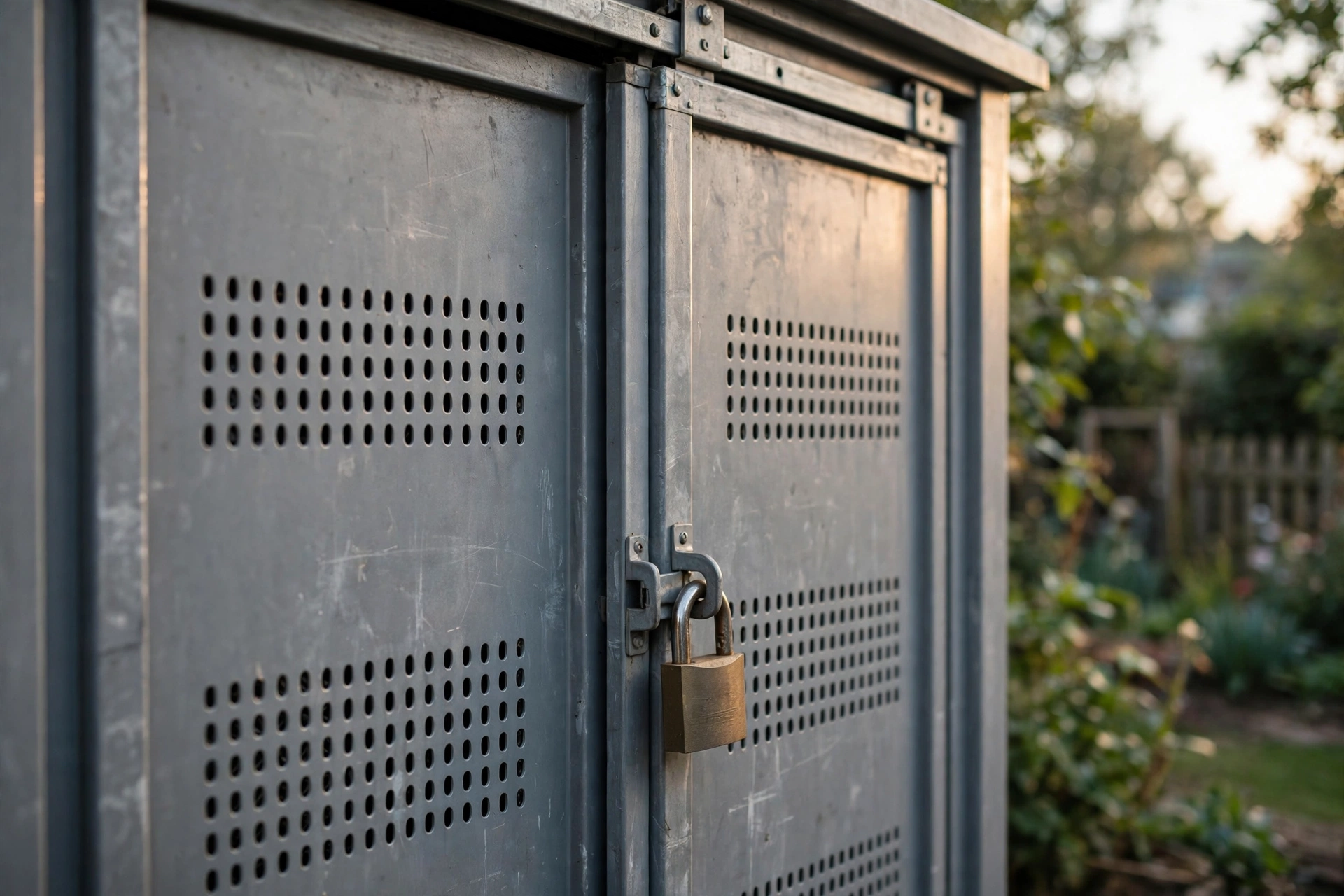
Here is the spec sheet, minus the marketing adjectives. The shed is a 6 ft × 4 ft outdoor metal storage shed (item code W54057424) with galvanized steel panels over aluminum frames, coated in an eco-friendly paint the listing claims will endure harsh weather for at least six years. You get four punched metal vents instead of plastic ones, pad-lockable sliding doors, and the padlock itself ships in the box — a small thing, but every shed I priced at a big-box store wanted another $25 for that. Also included: a metal foundation, ground anchors, hooks, one shelf, and work gloves.
The box weighed 100.31 lbs and measured about 64 × 22 × 5 inches — flat-packed steel, which means two adults can move it but one determined person can drag it across a driveway. Everything arrives pre-cut and pre-drilled. That sentence does not sound impressive until you have built flat-pack furniture with hand-drilled holes that miss by a quarter inch. Every bolt on this shed lined up on the first try.
One design detail won me over before I ever lifted a wrench: the sliding doors. Swing doors need clear ground in front of them, which is exactly where snow piles up and where you will be parking the mower anyway. The sliding doors glide sideways, so a foot of snow against the front does not lock you out of your own shed.
The $380 winter-storage math vs renting a storage unit
I ran the numbers the way I always do — against the laziest alternative, which was renting space. A basic 5×5 storage unit near me rents for roughly $60 to $75 a month (my local figure, an estimate; your metro will vary). That is $720 to $900 a year for 25 square feet of rented floor.
The shed is 6×4 feet: 24 square feet, essentially the same footprint, bought once for $380. The math is not close. Even at the cheap end of storage-unit pricing, the shed breaks even in about five months — and after that it stores things for free, forever, forty feet from my back door instead of a fifteen-minute drive away.
Cost per square foot, purchased: $380 ÷ 24 = $15.83 per sq ft, owned outright. The equivalent rented space costs roughly $2.40 to $3.00 per sq ft per month. I also considered the “do nothing” option — leave the patio furniture under a tarp and let the garage stay unusable. A decent tarp is $40, the garage stays a cave, and one gust of winter wind rips the tarp off anyway. The shed won on every row of the spreadsheet.
Assembly: one afternoon and two blister-free rules
Total build time for two adults with a cordless driver: about three hours, including the part where we argued about which wall gets the shelf. One person could do it — the manual claims no experience needed, and I believe that — but the long roof panels are unwieldy solo, and gravity is not your friend at head height.
Two rules I would give anyone building a backyard storage shed like this:
- Wear the included gloves. Folded sheet steel has edges that are technically finished but practically unforgiving. I learned this on the lockable garage cabinet I built last spring and have never forgotten it. The gloves ship in the box; use them.
- Do not fully tighten anything until the doors hang. Assemble the frame, fit the sliding doors, check they glide and meet in the middle, then snug every bolt. I tightened the door track early and had to back off six bolts to get the doors aligned. Ten minutes of patience saves thirty minutes of rework.
Anchor the shed. The kit includes ground anchors, and a 100-pound steel box on four feet is a sail in a November windstorm. I set mine on a gravel pad — the included metal foundation sits on top — and drove all four anchors. Level matters more than the manual admits: a crooked frame is why sliding doors stick, and most “the doors don’t fit” complaints are really “the ground wasn’t level.”
What actually fits in a 6×4 outdoor metal storage shed
This is the question every listing dodges, so here is my actual winter inventory, loaded in October:
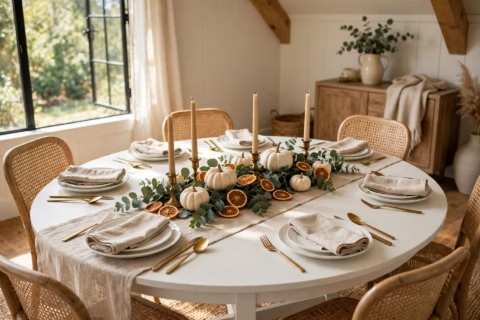
- My full patio furniture winter storage load: four cast aluminum chairs (stacked in pairs) plus the round table, tabletop down
- A push mower, winterized, tipped back against the left wall
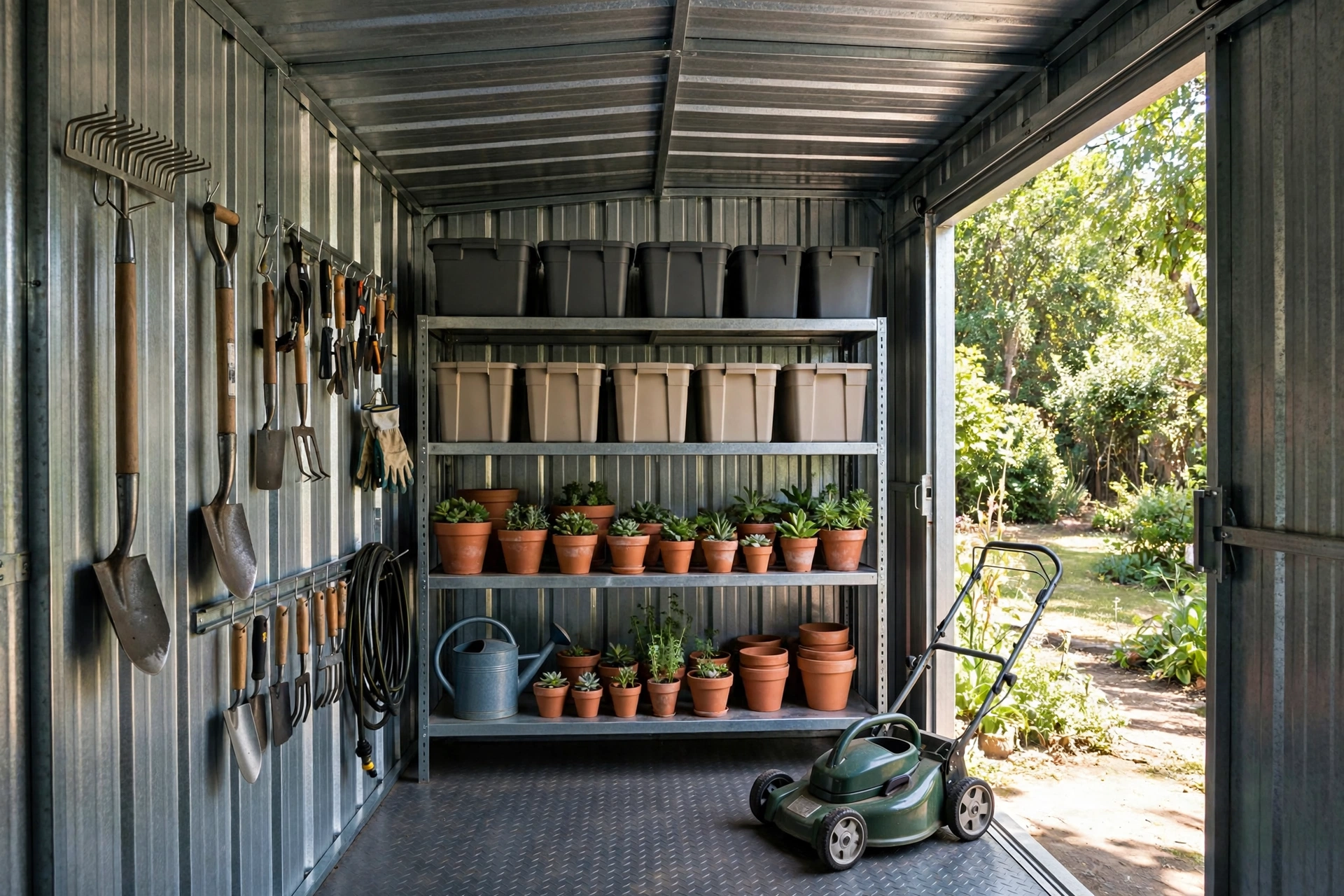
- The leaf blower, two rakes, a shovel, and a bag of fertilizer — all on the included shelf or hanging from the included hooks
- Four garden-tool totes and the patio cushions in sealed bins (rodents treat a shed like a hotel)
- My metal raised garden bed hardware — I reviewed that bed last year — plus the drip-line coils and a spare bag of compost
It is snug, but everything has a place, and the mower goes in last so it comes out first in spring. A 6×4 shed will not hold a riding mower or a canoe. It will hold everything a normal suburban yard actually needs to winterize. If you are debating between this size and the 8×6, measure your mower first — the mower is always the constraint.
Rain, wind, and rust: one season on galvanized steel
We have had one full season of weather on this small outdoor storage shed: three heavy rainstorms, one windstorm that took a fence panel, and the first freeze. Inside, everything stayed dry. The four punched vents do their job quietly — no condensation on the steel walls, which is the thing that rusts a shed from the inside out. Plastic vents crack in sun; these are punched into the steel itself and will outlast the panels.
The galvanized steel treatment is the whole durability bet. The panels are electro-galvanized steel with a corrosion-resistant coating, and the listing claims six years of harsh-weather endurance. I can verify one season: no rust bloom at the screw holes, which is where it always starts, and the sliding-door track still glides clean. The padlock and latch are the only rust risk I am watching — they are the one part I would oil in spring, the same maintenance I give my lockable garage cabinet’s casters.
One honest limitation: this shed has no floor beyond the metal foundation rails, so ground moisture wicks up. I put mine on gravel and keep everything on the shelf or hanging. Store nothing directly on bare dirt — a $20 pallet solves it if your pad is soil.
Metal vs wood vs resin: which backyard storage shed wins
Three materials own the shed market, and they trade off differently than the listings admit:
- Wood: the prettiest option and the only one that looks good in a garden. Also the most expensive for the size — a comparable 6×4 wood shed runs $800 to $1,500 as a kit (my estimate from browsing), it needs staining every few years, and it rots from the ground line up. If curb appeal matters more than money, wood wins.
- Resin: zero rust, lighter panels, snap-together assembly. But resin bows in summer heat, goes brittle in deep cold, and a comparable size typically costs $500 to $700 — more than this metal shed for less weather resistance in my climate.
- Metal: the cheapest per square foot, the most weatherproof per dollar, and the least charming. A grey metal box is a tool, not a garden feature. Plant a shrub in front of it and move on.
The market agrees with the metal case. Dataintelo puts the global storage sheds market at $11.4 billion in 2025, growing to $18.7 billion by 2034 at a 5.6% CAGR, with North America alone at $4.1 billion and residential buyers driving 54.7% of revenue. Their residential-outdoor-shed data puts that segment at $9.8 billion in 2025, rising to $16.4 billion by 2034 at 5.9% CAGR. People keep buying sheds because the alternative — renting space at $60-plus a month forever — never gets cheaper.
The verdict
A $380 outdoor metal storage shed is the rare purchase where the cheapest serious option is also the most sensible one. It freed my garage, it swallowed the patio set and the mower for winter, the galvanized steel survived its first season dry, and the math — $15.83 per owned square foot against $2.40-plus per rented square foot per month — is not a contest. My complaints are cosmetic: it is grey, it is plain, and it will never be a garden feature. It is, however, the reason my garage door closes.
Ready to take your garage back? Shop the 6×4 outdoor metal storage shed at FLNORW MALL — or browse the full FLNORW MALL collection to see how it fits alongside the rest of the backyard lineup.