Headboard Height Guide: How Tall Should a Headboard Be?
Nobody told me headboard height was a thing you had to measure. I bought a queen bed, bolted it together in my 11-by-12 bedroom, stood back — and the headboard barely cleared the mattress. It looked like the bed was apologizing. A friend’s bed, same price range, had a headboard that rose like a backrest you could actually lean on while reading. Same room size, same budget, completely different bedroom. That is when I learned the first rule of headboards: the height number matters more than the price number.

I have since measured four headboards across two houses and talked my sister through buying one last month. This is the headboard height guide I wish someone had handed me before I clicked buy — with the actual numbers, the math that connects them, and the one product whose specs finally made it all click.
The three numbers every headboard listing hides
A headboard has three heights, and most listings only give you one. The one you usually get is total height — the distance from the floor to the top of the headboard. On the queen upholstered bed I eventually bought, that number is 47.5 inches, out of an overall frame that runs 64 by 84 inches on the floor. Useful, but incomplete.
The second number is above-mattress height — how much headboard rises past the top of your mattress. It is the number you actually live with: whether the bed looks finished and whether you can lean against it. Almost nobody prints it, because it depends on your mattress thickness.
The third is leg or mounting height — how far below the mattress the headboard starts, which decides whether it hides behind the mattress or floats. On a frame-mounted headboard, the legs typically extend a few inches below the side rails. If the headboard panel starts too high, you get a visible gap between mattress and headboard that collects dust and looks unfinished.
The math that matters: above-mattress height equals total height minus (frame base height plus mattress thickness). I will walk you through it with real numbers below.
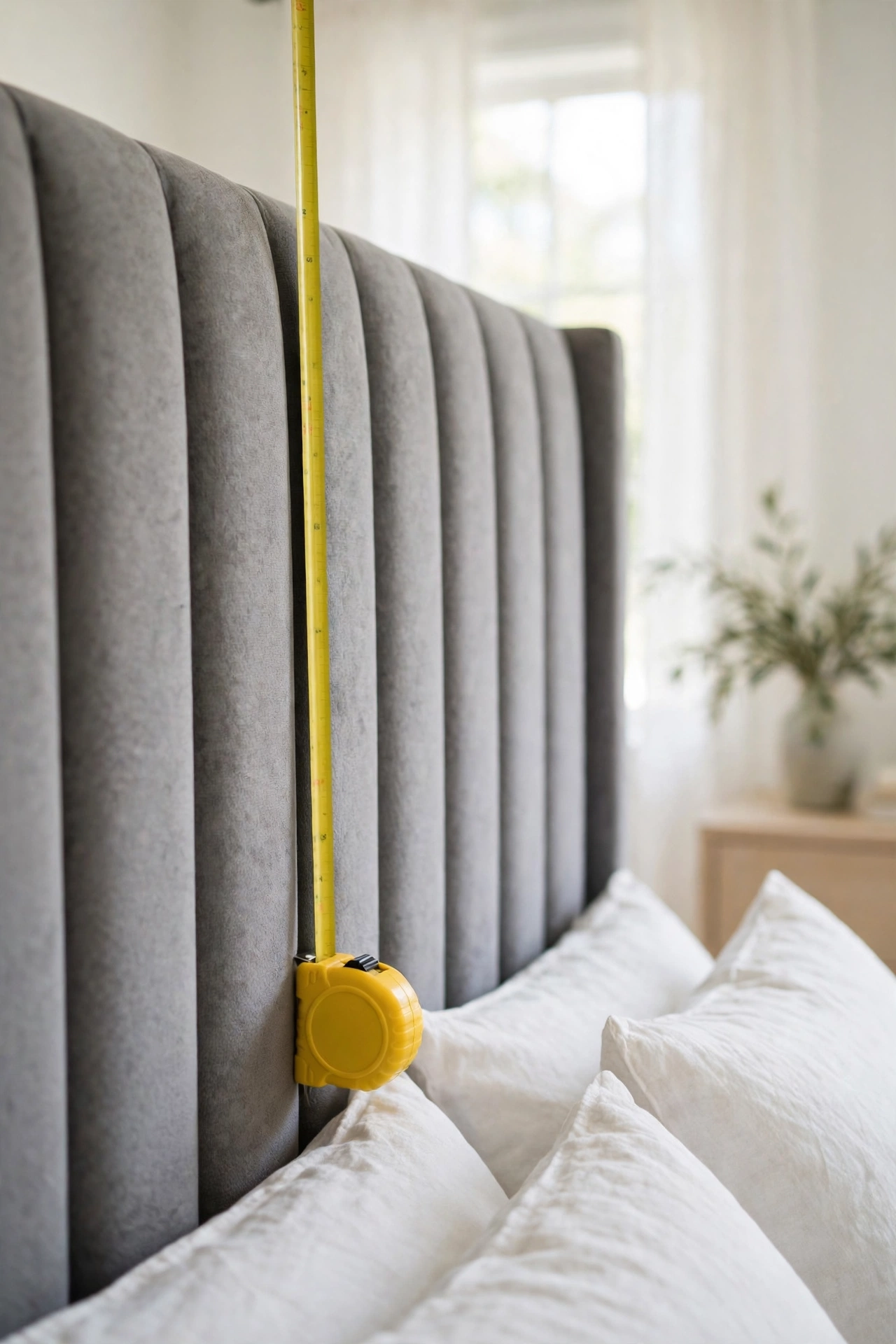
Headboard height above the mattress: the 24-to-36-inch rule
Here is the rule furniture salespeople use but rarely say out loud: a headboard should rise roughly 24 to 36 inches above the top of the mattress. Below 24 inches, the headboard reads as decoration rather than furniture — that was my first bed’s problem. Above 36 inches on a standard bed, it starts to dominate the wall and can make a small bedroom feel crowded.
Run the math on the bed I bought. The headboard stands 47.5 inches tall. The frame’s slat platform sits at roughly 14 inches off the floor (my measurement, by estimate — the spec sheet does not print this one), and I put a 10-inch mattress on it, comfortably inside the recommended 8-to-14-inch range. So the mattress top sits around 24 inches off the floor, and the headboard rises about 23.5 inches above the mattress — right at the bottom edge of the 24-to-36-inch sweet spot.
That half inch short of the rule? I do not notice it, because the panel is wide and padded. But if I had bought the 14-inch pillow-top instead of my 10-inch mattress, the above-mattress height would have dropped to roughly 19.5 inches — below the comfort zone, and I would have been leaning against a panel that ends at my shoulder blades. This is the part of the purchase nobody calculates until it is too late.
Queen headboard dimensions: the width and height math
Width has a rule too, and it is simpler: a queen headboard should be about as wide as the queen mattress — 60 inches — or a touch wider. The bed I bought measures 64 inches wide overall, which leaves two inches of headboard panel visible on each side of the 60-inch mattress — enough to frame the bed visually.
Height by bed size follows a pattern you can trust. Twin and full headboards typically run 36 to 48 inches total height; queens land in the 48-to-60-inch range (mine, at 47.5, sits at the low end and compensates with padding and width); kings go 54 to 72 inches. If you are shopping headboard-only rather than a full frame, measure your existing frame first — the headboard’s mounting holes need to line up with your frame’s bolt pattern, and the panel width should land within two inches of the mattress width, never more than four inches wider.
One more measurement people skip: doorway and stairwell clearance for the headboard panel itself. A 60-inch-wide panel will not turn some corners. Measure the path from your front door to the bedroom, not just the bedroom.
Mattress thickness changes everything
Here is where headboard math goes sideways for most buyers: the headboard does not change, but the mattress does. Switch from a 10-inch to a 14-inch mattress — both inside this bed’s recommended range — and you have eaten four inches of above-mattress height. That is the difference between a headboard you lean on and a headboard you look over.
This matters more than ever because mattress thicknesses keep growing. Pillow-tops and hybrids routinely hit 13 or 14 inches, and my earlier mattress sizes chart with the dimensions that fit shows how thickness decisions ripple through sheet fit and frame compatibility. If you are buying a headboard and a mattress at the same time, pick the mattress first, write down its thickness, then solve the headboard equation with that number.
The fix if you already own a short headboard: a thicker mattress is never the answer to a too-short headboard, because it shrinks the above-mattress height further. The real fixes are an adjustable-height headboard, a taller replacement panel, or accepting the look and leaning against pillows instead.
Tall sleepers and the sit-up test
My brother-in-law is 6-foot-4, and he broke this problem down for me the practical way. Sit up in bed the way you actually read — back against the headboard, pillow behind you — and notice where the top of the headboard lands on your back. If it hits below your shoulder blades, you will hunch. If it lands between your shoulder blades and the base of your neck, you are in the zone. My 47.5-inch headboard with my 10-inch mattress lands about mid-back on me at 5-foot-10, and it works. For him, I would have steered him toward a panel in the 55-to-60-inch range.

The sitting math, roughly: a seated adult’s back rises about 28 to 34 inches above the mattress surface, and you want the headboard to meet at least the lower two-thirds of that. Add a thick pillow behind your back and the effective sitting height grows another two or three inches — another reason the above-mattress number deserves margin.
If two partners have very different heights, do not try to solve it with one headboard measurement. Solve it with pillows: the headboard sets the wall look, and a firm euro pillow stacked on a sleeping pillow gives the taller reader a backrest that reaches higher than any panel reasonably would.
Adjustable headboards: when they earn their price
The feature that finally sold me on my bed was not the LED strip (though I use it every night) — it was the adjustable-height headboard. The frame lets the mattress sit at different levels to accept 8-to-14-inch mattresses, which means the above-mattress height is tunable. Swap mattresses later, re-level the platform, and the headboard geometry stays in your sweet spot. For a household that will replace its mattress at least once in the bed’s lifetime, that adjustability is not a gimmick. It is insurance against the thickness math.
Adjustability also matters for the household with changing needs: a guest room that doubles as an office, kids whose beds get handed down, or anyone whose back decides five years from now that a firmer, thicker mattress is in the cards. My full review of the $288 queen upholstered bed with LED headboard goes deeper on how the adjustment works in practice — it is a simple bolt-and-slot system, not hydraulics, which is exactly why I trust it to still work in a decade.
The industry numbers: bedrooms are where the money goes
I looked up the market data out of curiosity, because headboards feel like a category everyone replaces but nobody talks about. Custom Market Insights’ 2025 U.S. furniture market report puts the total U.S. market at roughly $173.27 billion, with bedroom furniture accounting for about 37% — the largest product category, ahead of living room and office. Grand View Research’s 2026 U.S. furniture analysis lands in the same place: bedroom furniture held a 35.16% share of the U.S. furniture industry in 2025.
That share is why the headboard aisle keeps growing: beds, headboards, nightstands, dressers, and wardrobes are the category where American households spend first and replace most often. When more than a third of furniture spending goes to the bedroom, the difference between a headboard you measured and one you guessed is the difference between furniture you keep for a decade and furniture you list on the local marketplace in eighteen months.
My headboard verdict: measure twice, buy once
After all the measuring tape and all the math, here is the headboard height guide distilled to one checklist:
- Pick your mattress thickness before you pick the headboard.
- Solve the above-mattress equation and land in the 24-to-36-inch zone.
- Keep the panel width within two inches of the mattress width on either side.
- Run the sit-up test against your own height and your tallest regular reader.
- If your mattress may change thickness later, buy the adjustable-height frame — it adapts instead of aging.
My own setup — a 47.5-inch upholstered headboard over a 10-inch mattress, roughly 23.5 inches of rise — lands at the bottom edge of the rule and works because the panel is padded and wide. I measured it, did the math, and bought it once. The tape measure is the cheapest furniture upgrade there is.
Start with the bed I measured against: the $288 queen upholstered bed with a 47.5-inch adjustable headboard, LED strip, and footboard drawers is the one whose spec sheet taught me all of this — see the queen upholstered bed with adjustable headboard — and if your room is short on closet space, my bedroom storage for renters guide pairs well with it. Planning the whole room? The mattress sizes chart and the full FLNORW MALL bedroom collection are worth the read.