Sell Old Furniture First: How I Got $250 Back Before Buying Anything New
Why I sell old furniture first and buy second
Two months ago I did something I should have started doing years earlier: I learned to sell old furniture before buying new. The plan was a $599 grey velvet Chesterfield sofa and a $225 white six-drawer dresser from FLNORW MALL — $824 out the door. My old couch, a saggy three-seater with five good years on it, went on Facebook Marketplace for $180. The old dresser, particleboard and a little wobbly, sold for $70 to a college kid furnishing his first apartment. Net outlay: $574 instead of $824.
That $250 changed how I think about every furniture purchase. Learning to sell old furniture well is not about squeezing pennies out of strangers. It is about knowing, before you click buy, what your current stuff is actually worth — and which of the three exits (sell it, donate it, haul it away) leaves you with the most money and the least guilt.
Every furniture purchase I make now starts with a resale audit. I walk through the room with my phone and ask one question per piece: if I listed this tomorrow, what would it fetch? The answer becomes part of the budget. My $599 Chesterfield was not a $599 decision. It was a $599 minus $180 decision — and that is a very different number to argue with yourself about.
The math works because furniture holds value longer than we assume, but depreciates unevenly. A solid wood frame and a timeless silhouette hold up. A five-year-old particleboard bookcase does not. Knowing the difference before you list saves you the disappointment of a $400 listing that gets zero messages for three weeks.
There is a second reason: space. In my case the new sofa was 81.8 inches wide — two inches wider than the old one — and the new dresser stood 48 inches tall against a wall that needed measuring twice. Selling first forced me to measure, photograph, and clear the old pieces. No “I will deal with it later” pile in the garage.

Where to sell used furniture: the honest tier list
Not every exit is worth your time. Here is how I rank them, from most money back to least:
- Local marketplaces (Facebook Marketplace, OfferUp, Craigslist). Best prices — usually 15 to 25 percent of retail for upholstered pieces in good shape, more for solid wood. You handle the listing, the messages, and the pickup. Cash or a payment app on the spot.
- Consignment stores. They sell it for you and take roughly 30 to 50 percent of the sale price (my estimate, varies by shop). Good if you hate negotiating with strangers. Bad if you need the money soon — payouts can take 60 to 90 days.
- Donation (Salvation Army, Goodwill, Habitat ReStore). Zero cash, but many offer free pickup for large pieces. If you donate furniture for a tax deduction, the deduction equals fair market value — but only if you itemize (IRS Publication 561 covers the valuation rules). The honest truth: most filers take the standard deduction, so the write-off is worth $0 to most of us. Donate because it is the right thing, not for the math.
- Bulk trash / haul-away. Last resort. Many cities offer free bulk pickup once or twice a year; private junk haulers run roughly $100 to $150 for a couple of pieces (my estimate, varies by city). This is where furniture goes to become landfill.
Furniture resale value: the depreciation math nobody tells you
Here is the part that stings. Furniture depreciates like a car — the moment it leaves the store, the “new” premium evaporates. These are my observed ranges, flagged as rough estimates from years of buying and listing:
- Solid wood furniture (real oak, walnut, maple): 30 to 50 percent of retail. Holds value best. A $800 solid wood dresser at $300 to $400 sells in days.
- Upholstered sofas and chairs: 15 to 25 percent of retail. Buyers discount for other people’s wear, no matter how clean it is. My $180 couch had retailed around $900 five years earlier — almost exactly 20 percent.
- Flat-pack and particleboard (MDF) pieces: 10 to 20 percent of retail. Functional, but everyone knows what it cost new and everyone knows it does not survive a third move.
- Mattresses: do not bother. Most marketplaces restrict or ban used mattress listings for hygiene reasons, and buyers will not touch them. Donate or haul.
The pattern is simple: the sturdier and more timeless the piece, the higher the recovery. Trendy, fragile, or flat-pack recovers almost nothing — which, honestly, should factor into what you buy new.
How to sell old furniture in 10 minutes: my listing formula
My couch sold in four days. My dresser in six. Same formula both times, and it takes about ten minutes:
- Daylight photos, pulled from the wall. Eight to ten shots: front, both sides, back, close-ups of fabric and legs, and one honest photo of any flaw. Buyers trust listings with flaws shown.
- Measurements in the title and first line. “81-inch sofa, 29 deep” beats “nice couch” every time. People are measuring their doorways.
- Price at 80 percent of what you hope for. My couch was listed at $200 and sold at $180. Listings priced to move get the algorithm’s favor and the buyer’s first message. A listing sitting at an optimistic price for a month sells for less in the end than one priced right on day one.
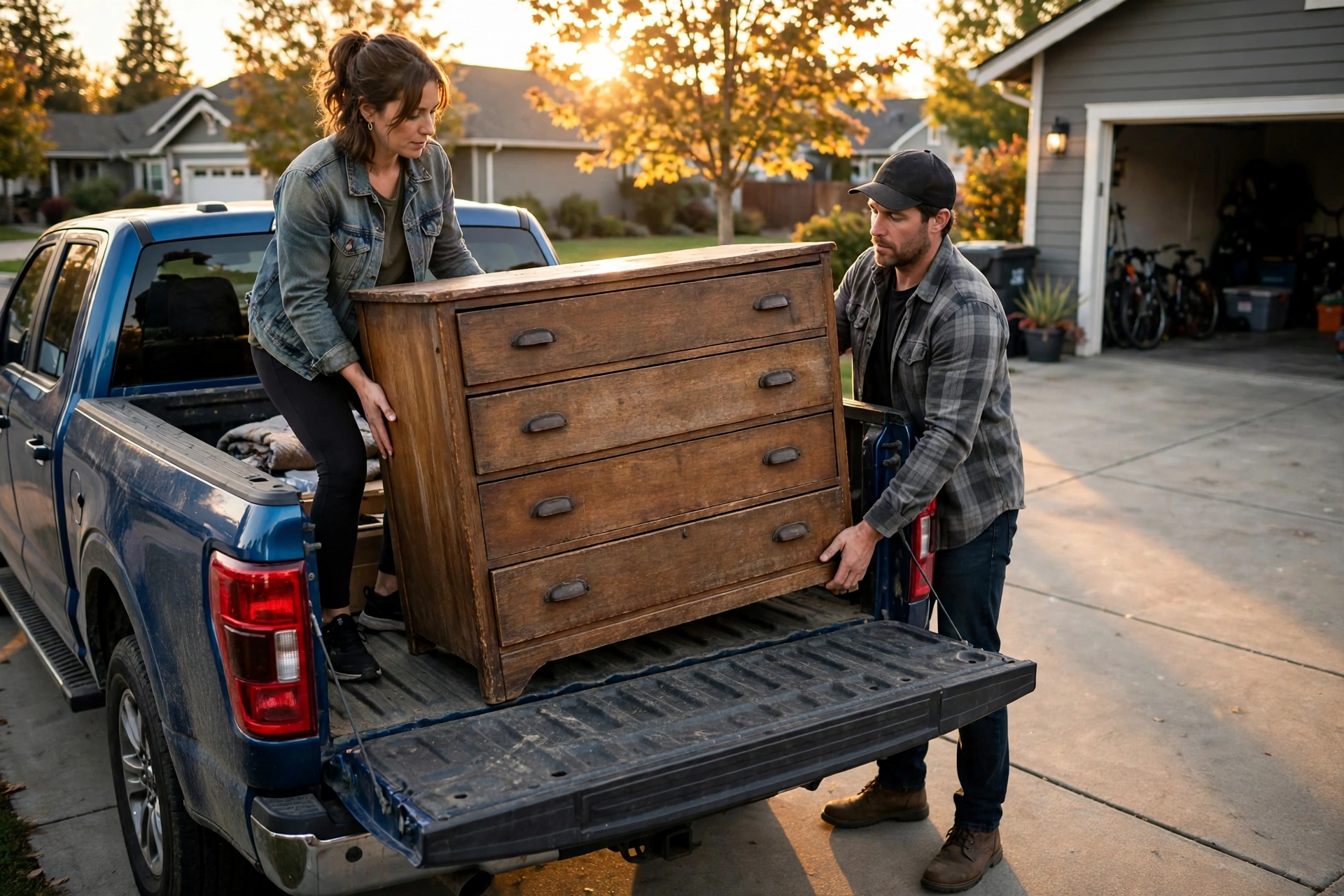
- “First with a truck takes it.” Put pickup terms in the description. I require buyers to bring help for anything over 50 pounds. My Chesterfield weighs 104.6 pounds — I was not carrying that down the stairs for anyone.
Sell furniture on Facebook Marketplace: 3 rules I learned the hard way
Three small lessons from my listings this year:
- Never hold a piece without a deposit. Two buyers flaked on my dresser before the college kid showed up with cash and a friend. “I will come Saturday” means nothing until it is in your driveway.
- Meet strangers smartly. I only do pickups in daylight, with someone else home. No exceptions, even for a $70 dresser.
- Write the flaw into the ad. My couch had a faint coffee stain on the back cushion. I photographed it and wrote “faint coffee stain, back cushion, invisible when against a wall.” The buyer never mentioned it again. Hidden flaws come back as angry messages and refund demands.
The industry numbers: used furniture is a real economy now
This is not just me being thrifty in my living room. The second-hand furniture market was valued at USD 38.32 billion in 2024 and is projected to reach USD 59.76 billion by 2030, growing about 7.69 percent a year, according to Research and Markets — driven by sustainability-minded younger buyers and plain affordability. Separate numbers from Renub Research put it at USD 36.5 billion in 2024 rising to USD 74.19 billion by 2033.
The other side of the coin is uglier. The US EPA’s 2018 waste data — still the latest comprehensive national numbers — found that 80.1 percent of furniture and furnishings thrown out were landfilled. Only a small fraction was recycled. Every couch that finds a second owner through a marketplace listing is one that does not join that pile.
So the resale math is not just personal finance. It is the difference between your old dresser furnishing a student’s first apartment and your old dresser sitting in a landfill for the next century.

The verdict
Run the resale audit before you buy, not after. Price your old pieces at 80 percent of hope, photograph them in daylight, and put “first with a truck takes it” in every listing. The money you recover is real — $250 in my case — and it turns a $824 purchase into a $574 one. Sell what holds value, donate what still has life in it, and save the landfill for things that are truly done.
When the old pieces are gone and the room is empty, that is the fun part: choosing what goes in. My replacements came from the FLNORW MALL furniture collection — the $225 white six-drawer dresser (29.53 by 15.75 by 48.03 inches, InStock when I ordered) and the $599 grey velvet Chesterfield sofa. Both are pieces I would buy again — this time with the resale math already done. For more guides like this one, the FLNORW MALL blog has the full shelf, and everything starts at FLNORW MALL itself.