Sofa Slipcover vs Reupholstery: the $180 Math That Saved My Couch
Sofa Slipcover vs Reupholstery: the $180 Math That Saved My Couch
My grey velvet Chesterfield turned five this fall, and it shows its age in exactly two places: the arms. The frame is still rock solid — solid wood, no wobble, passes every test in my couch lifespan checklist. The cushions still bounce back because I swapped in new foam inserts at year four, $135 for the set, a trick I wrote up in my sofa cushion fillings guide. But the velvet on both arms has worn to a pale, shiny patch exactly where my elbows land every evening. The couch sits fine. It just looks tired in the two spots I touch most. So I priced the three real options honestly, down to the yard: a sofa slipcover, professional reupholstery, or a brand-new couch.
I want to be straight about what I found, because the furniture industry has a quiet incentive to never show you this math side by side. A sofa slipcover is the cheapest fix and the shortest-lived one. Reupholstery is the longest fix and often the most expensive one. And buying new — specifically the $1,288 sleeper sectional I had been eyeing — sits in the middle on cost and wins on function. Here is the full breakdown, with the real numbers from my quotes.

The Three-Way Price Math, Side by Side
Before any opinions, here are the numbers I actually collected this month for my 81.8-inch grey velvet Chesterfield 3-seater:
- Option 1 — sofa slipcover: $60 to $150 off the rack for a fitted cover in my size (the SureFit-style stretch brands), or $300 to $500-plus for a custom-measured one. My fitted pick landed at $180 with a steamer rental for the fitting afternoon.
- Option 2 — reupholstery: Angi’s October 2026 guide puts couch reupholstery at $600 to $4,000, with a national average of $1,800; a standard 3-seat sofa typically lands between $1,000 and $2,500. My local shop quoted $1,650 for my Chesterfield in a performance velvet.
- Option 3 — replace: a brand-new 95-inch sleeper sectional with a pull-out bed and storage ottoman from FLNORW MALL for $1,288, InStock, eucalyptus frame. New sofa, new warranty, no fitting afternoon.
Same couch, three prices, three very different clocks. The rest of this guide is about which clock you are actually buying.
What a $180 Sofa Slipcover Actually Buys You
I bought the $180 fitted cover, and I measured the arms twice before ordering — a habit left over from my 9-drawer dresser sizing guide days. It arrived in a box the size of a throw pillow, which should tell you something about expectations: a sofa slipcover is fabric engineering, not furniture.
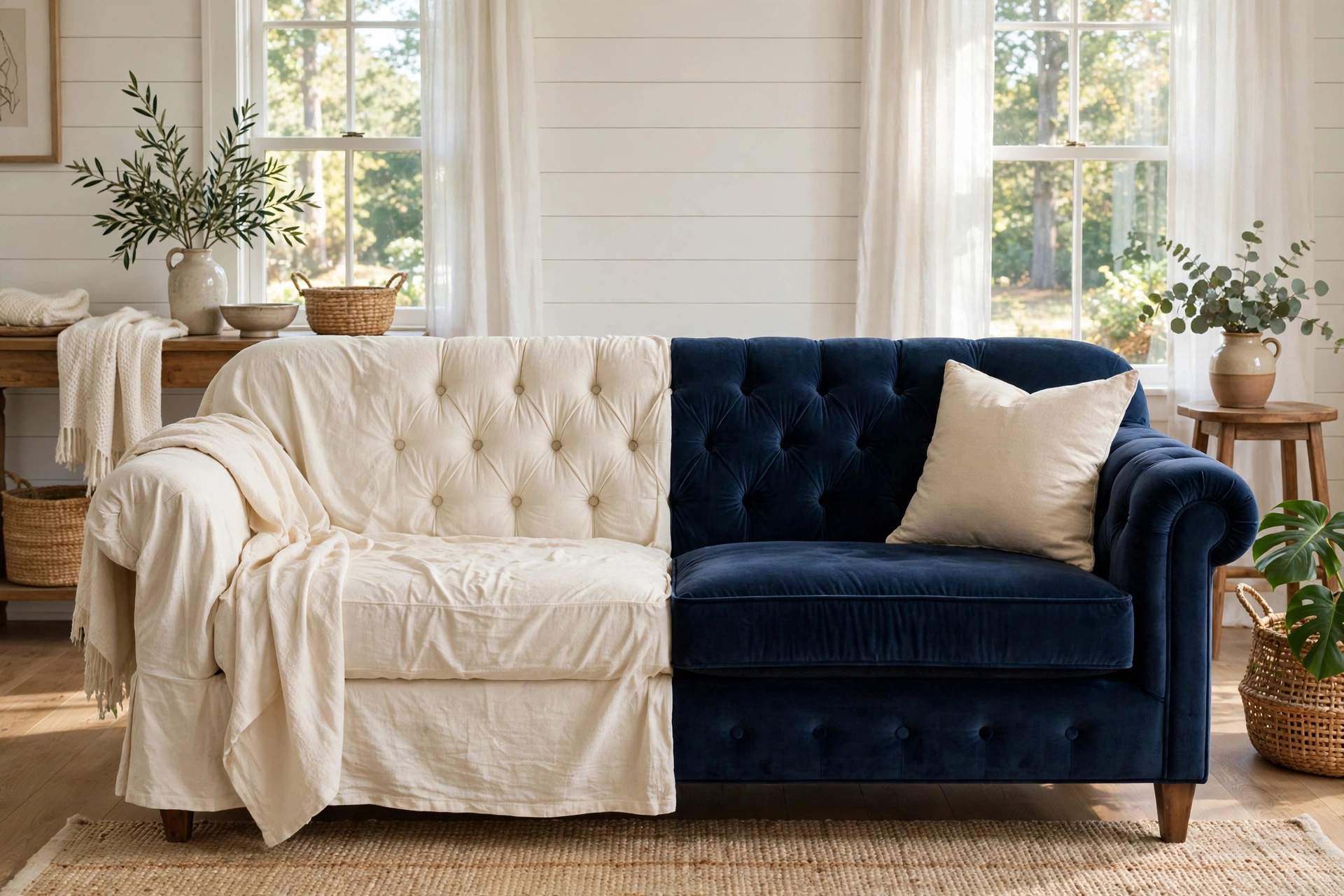
Here is the honest part nobody puts in the product photos. Slipcovers look fantastic on simple, straight-armed sofas. On a deep-buttoned Chesterfield, they fight you. The tufting shows through as soft lumps unless you add a thin batting layer underneath, and the rolled arms eat fabric — my cover needed every inch of its stated 81-inch capacity. The tricks that actually worked: a wooden spoon as a tucking tool for the crevices, pinning the excess behind the back cushions, and steaming the whole thing once it was on so the wrinkles relaxed into place.
Washed every six to eight weeks, a good cover lasts 2 to 4 years in my estimate before the elastic gives up and the seat starts sliding. That is not a flaw; it is the deal. A sofa slipcover hides wear, it does not fix it. Flat cushions stay flat underneath. A creaking frame keeps creaking. But for $180, my couch stopped looking tired, the cat lost interest in the arms (a win my wooden cat tower could not deliver), and guests stopped asking what happened to the velvet.
A couch slipcover makes sense in exactly three situations: the frame and cushions are genuinely fine and only the fabric is ugly; you rent and cannot justify big furniture spending (my renter-friendly furniture guide says the same); or you need a color change for a season of life — new baby, new dog, new roommate — without committing to new upholstery.
Reupholstery Cost: the $1,800 Average Nobody Warns You About
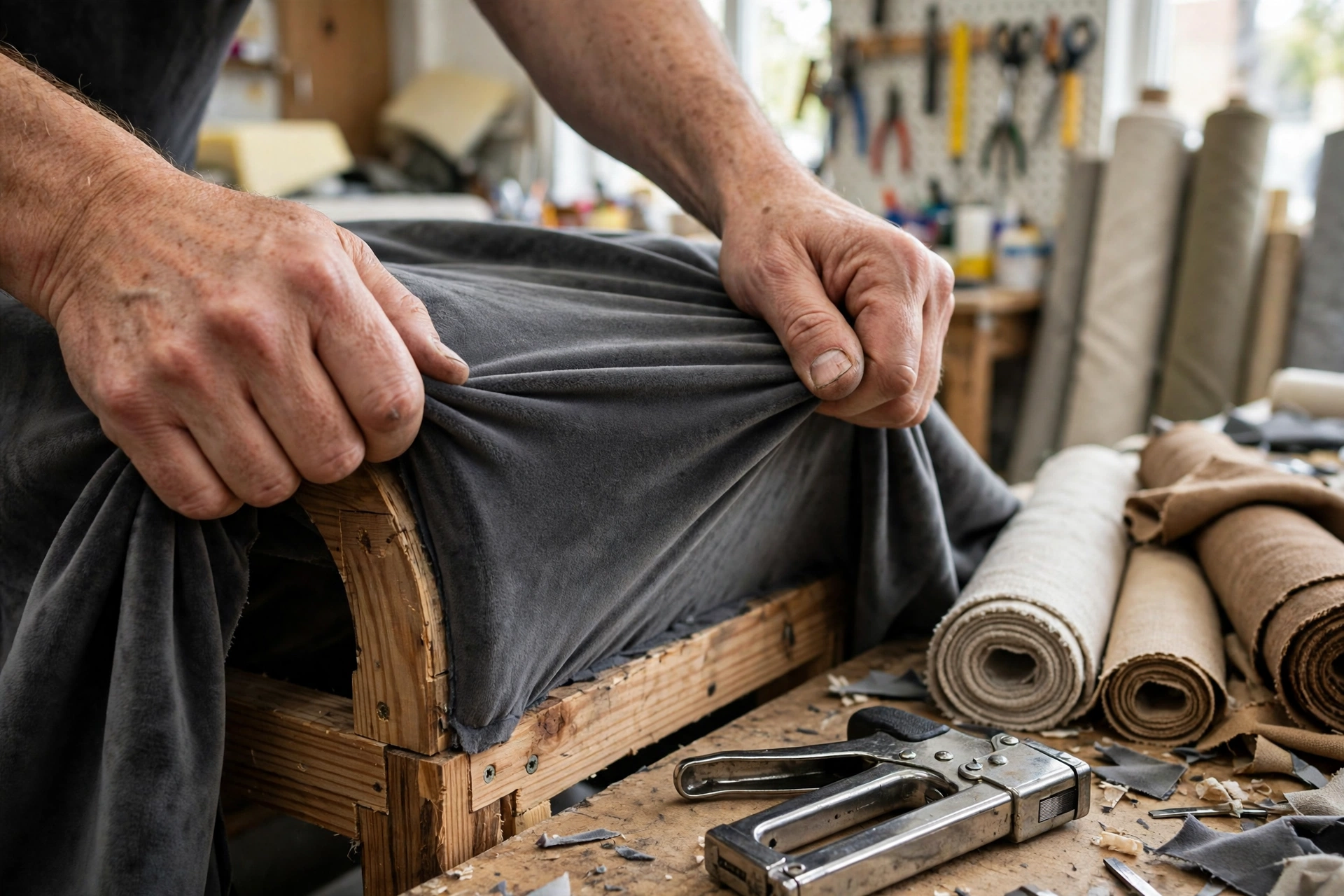
Now the number that surprises everyone: why does recovering a $599 couch cost $1,650? Because you are not buying fabric. You are buying 16 to 28 hours of skilled labor — stripping the old cover, minor frame repair, cutting, sewing, and reassembly — at $50 to $100 an hour, per engineerfix’s cost breakdown. Labor alone is 55 to 60 percent of the total project price.
Then the fabric. HomeAdvisor puts a three-seat sofa at 14 to 18 yards, and Angi lists performance velvet at $60 to $200 a yard. Do the middle of that math — 16 yards at $90 — and you get $1,440 in fabric before anyone picks up a staple gun. Add labor and you land exactly where my $1,650 quote landed, and where Angi’s $1,800 national average lives. The reupholstery cost is not a markup story. It is a labor-and-yardage story.
This is why HomeGuide’s standing observation matters: reupholstery tends to cost more than buying new furniture outright, with new sofas running $400 to $4,000 (cited via houseaiapp, October 2026). If your couch was a $599 purchase, spending triple that to recover it feels absurd — until you remember you are paying for a craftsperson’s week, not a warehouse’s container.
Reupholster a Couch Only If It Passes These 4 Checks
So when is it worth it to reupholster a couch? I made myself a four-check gauntlet before I would even consider the $1,650 quote. My Chesterfield passed three of the four — which is exactly why I did not reupholster it.
- The twist test. Lift one front corner about six inches. If the opposite front leg stays planted on the floor, the frame is twisting and the piece is dying. Mine passed — both front feet lifted together, frame rigid.
- The deck test. Pull the seat cushions off and sit directly on the deck. The springs should feel even with no pokes or dead spots. This is the same check from my cushion fillings guide, and it tells you whether the suspension has another decade in it. Mine did.
- The fabric-first math. Multiply your yardage by your fabric price before you call the shop. If the fabric alone costs more than the new couch you would actually buy, stop. Sixteen yards of the velvet I wanted was $1,440 — more than the $1,288 sleeper sectional.
- The 50 percent rule (my estimate). If the all-in quote exceeds half the price of the new couch you would buy instead, replace. At $1,650 against $1,288, my Chesterfield failed this one cleanly.
Reupholstery earns its money on three kinds of pieces: genuinely well-built frames (solid hardwood, hand-tied springs) that will outlive any replacement; antiques or heirlooms with sentimental value no store can sell you; and odd dimensions that fit your room perfectly — a 72-inch apartment sofa or a 40-inch-deep reading couch you simply cannot buy off the rack anymore.
The Cost-Per-Year Math That Settled It
Here is the comparison the industry never prints, because it makes two of the three options look ordinary. All figures are my estimates, built on the quotes and sources above:
- Sofa slipcover: $180 ÷ 3 years ≈ $60 a year. Cheapest per year, shortest life. You will buy another one.
- Reupholstery: $1,650 ÷ 12 years ≈ $138 a year. The longest clock on a good frame — a properly reupholstered hardwood-frame couch can run 12 to 15 years — but the highest entry ticket.
- New $1,288 sectional: $1,288 ÷ 10 years ≈ $129 a year. Middle price, middle clock, plus a pull-out guest bed my Chesterfield will never have.
Context helps here: Dataintelo’s 2025 sofas report puts the global sofa market at $23.4 billion in 2025, growing to $38.7 billion by 2034 at a 5.8% CAGR. That flood of new supply is exactly why reupholstery economics keep getting harder — every year, the new couch you are comparing against gets a little cheaper and a little better, while the craftsperson’s hourly rate only goes one direction.
When Replacing Beats Fixing: My $1,288 Line in the Sand
Let me say the quiet part: the $1,288 sleeper sectional almost won. Ninety-five inches, ultra-soft cushions, a pull-out bed for guests, and a storage ottoman that swallows the throw blankets currently colonizing my closet. I reviewed it back in the spring and the math has only gotten better since.
Replacing wins over any sofa slipcover or reupholstery quote in four cases. One: you want a different function — a sleeper, a sectional, a chaise — because no cover or new fabric adds a pull-out bed. Two: the frame fails the twist test, which means you are dressing a corpse. Three: the reupholstery quote crosses my 50 percent rule. Four: you have moved five times in ten years like I have (see my furniture packing guide), and you have learned not to bet $1,650 on forever furniture.
One cost people forget in the replace column: delivery. My white-glove delivery guide puts full-service delivery with assembly at $150 to $400. The sleeper sectional ships in three boxes at 238 pounds total, so I would assemble it myself and pocket the difference — forty minutes with an Allen key, based on my last two FLNORW MALL builds.
The Verdict
I kept the Chesterfield and bought the $180 sofa slipcover. The frame passed every test, the cushions are year-four foam with years left, and $60 a year buys me three more years to decide what this living room becomes. If the frame had failed the twist test, I would have ordered the $1,288 sleeper sectional that same night and never looked back. And the $1,650 reupholstery quote? It only makes sense for a piece I would keep twelve-plus years — and I do not buy forever furniture anymore.
So here is the rule I am keeping, taped inside my measuring-tape case: slipcover the structure you trust, reupholster the heirloom you would never replace, and replace everything else. Run the four checks, do the fabric-first math, and let the cost-per-year number — not the sticker price — make the call.
Shop the pieces from this guide: the grey velvet Chesterfield 3-seater that started this whole experiment, the $1,288 sleeper sectional with storage ottoman that nearly replaced it, the cushion fillings guide that saved my cushions at year four, and my fabric vs leather 4-year durability test — or browse the full FLNORW MALL furniture collection to find your next couch.