I Rented a 450-Sq-Ft Studio for Three Years. These 7 Pieces of Renter Friendly Furniture Survived Two Moves.
For three years I lived in a 450-square-foot studio with beige carpet, a radiator that clanked, and a lease that banned wall anchors in bold print. Then I moved to a one-bedroom across town. Two years later I moved again. Everything I own has been carried up and down two stairwells by either hired movers or friends I paid in pizza and gas money.
That experience taught me what renter friendly furniture actually means. Not “looks good in a rental.” It means furniture that survives 30-inch doorways, skinny staircases, and strict lease clauses without eating your security deposit — and that you will not dread hauling the next time the landlord raises the rent.

The three rules of renter friendly furniture
Every piece on this list passed the same three tests, which I worked out the hard way across two leases and one lost argument about drywall patches.
Rule one: nothing that needs a drill. My first studio banned anchors outright; the one-bedroom allowed them “with written approval,” which I never requested because I never wanted it badly enough. A typical handyman charges around $50 to $150 per patch-and-paint spot when you move out — my own estimate from calling three of them, not a published price list. Two shelves and a curtain rod and your deposit is bleeding.
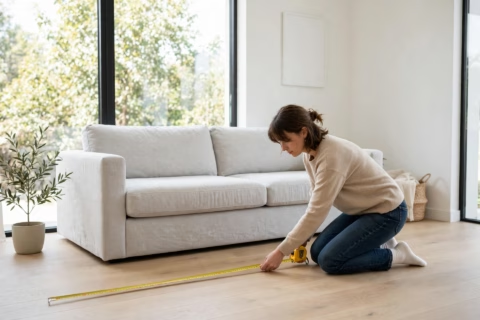
Rule two: it has to fit through a 30-inch doorway. Most older rental apartments have 30 to 32-inch interior doors, and stairwells are worse. If a piece cannot be carried in a box or folded flat, it does not belong in a rental, period. I learned this the afternoon a lovely solid-wood bookcase met my hallway corner and lost.
Rule three: weight is a moving cost. The three quotes I got for a local one-bedroom move ran $480 to $750 — estimates from my own calls, not a national average — and every one of them priced by how long the truck is loaded. Heavy, awkward pieces stretch the clock. A 126-pound dresser costs you real money on move day in a way a 40-pound table never does.
The $128 room divider that gave my studio a second room
The cheapest idea on this list is also the one I would buy first again: a 3-panel room divider for $128. Six feet tall (70.87 inches), 44.49 inches long unfolded, and all of 20 pounds. No drilling, no brackets, no landlord negotiation — it stands on its own accordion footprint.
It went from box to standing in about thirty seconds, and it solved three studio problems at once: the unmade bed kept photobombing my video calls, the desk lamp kept me awake at night, and dinner guests ate facing my pillows. The Bureau of Labor Statistics reported in October 2026 that 36.9% of wage and salary workers could work from home in 2024-25, with about 51 million Americans working at home at least occasionally — so I was not the only person solving the “bed on Zoom” problem with a folding screen. When friends came over, I folded it flat against the hallway wall in ten seconds and the room opened back up. If the experiment had failed, it would have slid behind a door.

The $188 bar table set that solved my 8-by-7 kitchen
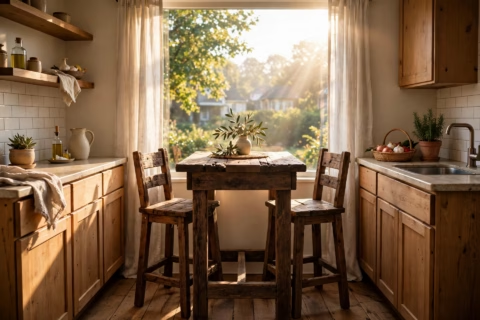
My first kitchen measured eight feet by seven, and the fridge ate one wall. My partner and I ate dinner standing up for nine days before I bought the bar table set with 2 stools from FLNORW MALL for $188.
The numbers that matter: the tabletop is 23.62 inches square — about 3.9 square feet of floor — and both stools slide completely underneath when you are done, so stored footprint and in-use footprint are the same number. The table is rated for 300 pounds, each stool 350 pounds, and the whole assembled set weighs about 37.62 pounds. I carried the box up two flights of stairs myself. Assembly took me 50 minutes with the included Allen key and one mug of coffee.
This is the piece that taught me rule two. In-use footprint and stored footprint being equal is the difference between a kitchen that works at midnight and one that feels like a storage unit with a stove. Per-seat math: $188 divided by two seats is $94 a seat, table included. A single decent bar stool from a big-box store runs $60 to $100 alone.
The $168 pantry cabinet, no wall drilling required
Rentals love to give you a kitchen with nowhere to put food. Mine had one 24-inch cabinet, original to the 1950s, where groceries went to be forgotten. The farmhouse pantry cabinet at $168 is 59.1 inches tall, 27.6 wide, and only 12.6 deep — slim enough for a rental kitchen wall and fully freestanding, so no anchors, no rule-one violations.
Sixty days in, I had inventoried the load: 34 standard cans, 12 boxes of pasta and rice, 9 glass jars, 23 spice bottles. It cleared roughly four linear feet of countertop that had been occupied by grocery clutter — my own estimate, but the before-and-after photos do not lie. The rattan-look door fronts made the whole corner look intentional instead of panic-bought, and the wide countertop slab on top became my coffee station within a week. Kettle steam, twice a day, for sixty days: no warping, no bubbling.
The $388 hydraulic storage bed that ate my dresser
The biggest renter cheat code I know is a hydraulic storage bed. The queen model I bought for $388 lifts its entire platform on gas struts, and the whole area under the bed — roughly 25 to 30 cubic feet, my own estimate after packing it — becomes one giant enclosed trunk. Two guest quilts, a vacuum bag of winter sweaters, a suitcase of textbooks, spare sheets, and the duffle bag that used to trip people in the hallway. The hallway is walkable again.
Here is the rent math. RentCafe’s 2024 rental data puts the average US apartment at about 887 square feet and average rent near $1,600 a month — roughly $1.80 per square foot. A regular bed renders its 39-square-foot footprint useless; this one gives it back. A mid-size dresser costs $150 to $300 and eats floor space permanently, and a 5×5 storage unit runs $100 to $180 a month. The $388 bed pays for its storage function against a rented unit in about three months.
The honest warnings: the box totals 175 pounds in two deliveries, the product page wants a 6-to-8-inch mattress so the struts are not fighting a 12-inch pillow-top, and white upholstery shows scuffs from luggage wheels. Assemble it with a friend and measure your stairwell first.

Three quick wins: the $99 nightstand pair, the $288 dresser, and the nesting coffee table
Not everything needs a full review. These three cleared the same three rules and earned their spots:
- The nightstand set of 2 for $99. That is $49.50 a table, each one 15.75 inches square and 18.9 tall, with two drawers and two open shelves. One beside my bed, one in the guest room, and the second one later pulled duty as a sofa side table. At this price you will not cry over a crayon incident or a move-day scuff.
- The 9 drawer dresser for $288. One person’s full folded wardrobe — socks, tees, jeans, sweaters, sheets — in 47.56 inches of wall. The rule-three caveat: it assembles to 126 pounds, so you move it once, with a second person, and you are done. Measure the wall, the window sill, and the drawer swing with painter’s tape before you order.
- The $399 nesting coffee table. Two round tables that nest into 5.4 square feet of floor and pull apart when company comes. When your living room is also your dining room, furniture that changes size is the whole strategy.
The move-day math: the hidden costs of not buying renter friendly furniture
People price furniture; renters should price furniture plus moving plus move-out. My estimates, from my own quotes and calls:
- Local one-bedroom move: $480–$750 for the truck and two movers, priced on time. Every piece that needs disassembly, a doorway squeeze, or a second carry adds minutes.
- Wall repair per anchor spot: roughly $50–$150 at typical handyman rates, patch and paint. Three shelves and a wall-mounted desk can eat a third of a deposit.
- Junk removal for the piece you cannot move: haulers quoted me $150–$250 to take a single sofa. The abandoned bookcase that “wasn’t worth moving” just cost you more than some of the furniture on this list.
- The free-standing premium: a piece you can carry out yourself, folded flat, is a piece you keep. Everything on this list went through two moves. The one bookcase that needed three people and a saw did not make it to lease three.
The broader backdrop backs the strategy. The National Apartment Association’s 2025 analysis of RentCafe data found the average US studio reached 457 square feet in 2024 — up slightly, but still a single room — while rents per square foot keep climbing. Square footage gets more expensive, furniture has to do two jobs, and nothing you own should need a drill to do its job.
The verdict
Seven pieces, two moves, one studio and one one-bedroom: the room divider gave me privacy, the bar table set gave me a dining room in 3.9 square feet, the pantry cabinet gave me a pantry without a single wall anchor, the storage bed gave me a closet, and the nightstands, dresser, and nesting tables filled in the rest for under $800 combined. Every one of them fit through a 30-inch door, and every one of them is in my current apartment right now.
Renting does not mean settling for bad furniture. It means buying furniture like you are going to move it — because you are.
See all of it in one place: FLNORW MALL — the 3-panel room divider, bar table set with 2 stools, farmhouse pantry cabinet, hydraulic storage bed, and the rest of the small-space lineup, all factory-direct.