Solid Wood vs MDF Furniture: Is It Worth It?
Five years ago I bought two pieces of furniture in the same week: a solid wood dresser from a local furniture store and a cheap bookcase from a big-box retailer that said “wood” on the box. The dresser has moved with me twice and still opens like a bank vault. The bookcase started wobbling after the second move, and the shelves now bow in the middle like a tired hammock. That $90 difference in what I paid taught me more about solid wood vs MDF furniture than any showroom ever could. This is the guide I wish someone had handed me before I clicked “add to cart” that week.

The four labels you’ll actually see, decoded
Shopping for furniture, you will run into four material labels, and they are not interchangeable. Solid wood means every visible board is one species of lumber — oak, pine, rubberwood, walnut. Wood veneer is a thin slice of real wood glued over a substrate, which is often MDF or particleboard; you get the look of solid wood at a lower price, and the quality depends entirely on what is underneath. MDF (medium-density fiberboard) is wood fibers broken down in a defibrator, mixed with resin, and pressed into smooth, dense panels. Particleboard is the coarser cousin — wood chips and sawdust pressed with resin, cheaper and weaker than MDF.
The honest part nobody puts on the box: MDF is a genuinely good material for the right jobs. It takes paint better than real wood, it does not warp with humidity the way solid boards can, and its perfectly smooth surface makes it ideal for flat, painted cabinet doors. The problems start when it is used for jobs it is not suited to — shelf spans that need stiffness, joints that need screw-holding strength, pieces that need to survive three apartment moves.
Why the industry can’t quit MDF: a $44.9 billion habit
Here is the scale of what we are talking about. Grand View Research puts the global MDF market at $44.9 billion in 2025, growing at a 8.2% compound annual rate through 2033. That is a staggering amount of fiberboard. And furniture is its biggest appetite: Dataintelo estimates furniture applications held 42.3% of MDF demand in 2025, worth roughly $13 billion, driven by ready-to-assemble furniture, e-commerce, and modular design trends.
The broader backdrop: Market Research Future estimated the global wooden furniture market — split by material into solid wood, engineered wood, reclaimed, and composite — at about $546.5 billion in 2025. Engineered panels are not a niche budget trick; they are the backbone of the modern furniture economy. That consistency is why your flat-pack dresser costs a third of the solid-wood version — and why knowing where that consistency stops mattering is the whole game.
My dresser and my bookcase: a five-year field test
Let me be specific about my own two pieces, because this is where theory becomes grocery money. The solid-wood dresser cost me $320 back in 2021. Solid pine, dovetail drawers — the kind of drawers that stay shut when you slam them. Five years, two moves, one toddler who uses the bottom drawer as a step stool. It has one scratch, which I fixed with a $9 furniture marker in four minutes.
The bookcase cost $75. Particleboard with a printed “walnut finish” — which is to say, a photograph of wood wrapped around sawdust. It looked great in the listing. After the first move, one cam-lock hole had wallowed out so the side panel leaned. After the second, two shelves sagged under paperbacks. I reinforced it with $12 of brackets and it now lives in the garage holding paint cans, which is honestly a fair retirement for it.
Rough math, flagged as rough: the dresser cost about $64 a year over five years and is on track for fifteen more. The bookcase cost $75 plus $12 in brackets for roughly two years of real service. Cheapest upfront was not cheapest.
What real listings tell you: $248 vs $389
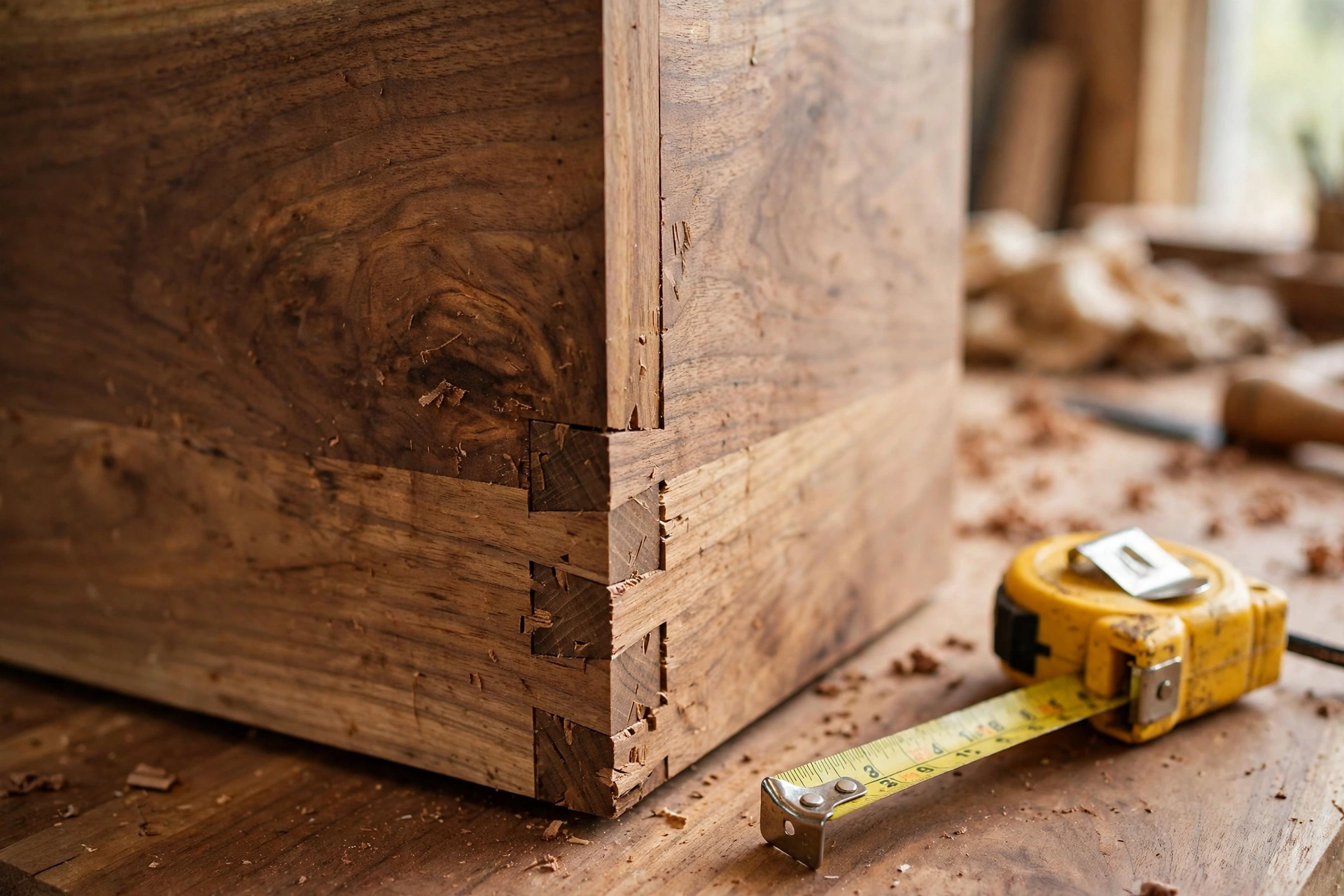
This is where reading the spec sheet like a skeptic pays off. Take a real example from the FLNORW MALL furniture collection: a Louis Philippe nightstand listed at $248, spec’d as solid wood — rubberwood, per the product details — with English dovetail drawer construction, two drawers, and a 21.6″ x 15.75″ footprint. Dovetail joints are the detail that matters: they mechanically lock instead of relying on glue and staples, which is why a dovetailed drawer still glides after a decade.
Compare that with the store’s MDF dining table set at $389 — table plus four chairs, 55″ wide table, rated to hold up to 300 lbs, assembles in about 30 minutes. The spec sheet names MDF as the main material. For a dining set at that price, MDF is a defensible engineering choice: a smooth painted finish, consistent panels, and a price that gets a whole family seated. Neither product is “better” in the abstract. The nightstand is built to outlive you; the dining set is built to seat six people for the price of two nice restaurant dinners.
The takeaway from both listings: the price premium on solid wood buys lifespan and repairability, not looks. On day one, a well-made MDF piece can look every bit as good — sometimes better, because the finish is factory-perfect. The difference shows up in years three through ten.
Where MDF dies early: moisture, moves, and kids
Three failure modes kill engineered-wood furniture, and knowing them changes what you buy. Moisture is the big one. MDF swells irreversibly when soaked — a slow drip under a bathroom vanity, a spilled plant saucer, one flooded dishwasher away from the bookshelf. Solid wood also dislikes standing water, but it dries, and you can sand and refinish it. MDF that has swelled looks like a soggy cracker and stays that way.
Moves are the second killer. Particleboard and MDF hold screws in end grain poorly — each disassembly of a flat-pack piece chews the cam-lock and dowel holes a little more. Industry wisdom, and my bookcase agrees: plan on one, maybe two successful moves from flat-pack engineered pieces before the joints get sloppy. Solid wood joints — dowels, dovetails, mortise and tenon — reassemble cleanly because the wood fibers grip hardware the way they did on day one.
Kids and pets are the stress test. A toddler climbing dresser drawers, a dog’s claws on a chair leg, a cat treating a bookcase corner as a scratching post. Solid wood takes abuse and shows it as patina; you can sand it out. On veneer or printed finishes, one deep scratch reveals the substrate underneath, and there is no fixing it invisibly.
One safety footnote worth knowing: the U.S. EPA finalized formaldehyde emission standards for composite wood products under TSCA Title VI in 2016, which covers the resins in MDF and particleboard. Reputable retailers source compliant panels. If a listing cannot tell you its composite panels meet current standards, that is a signal — buy from sellers that can.
The care gap: what you can fix and what you cannot
Here is the part that sealed it for me as a buyer: solid wood is repairable; MDF mostly is not. Scratched solid wood? Sand, stain, done. Water ring? A little mayonnaise and patience, then refinish if you are ambitious. Loose joint? Wood glue and a clamp make it stronger than new — glue joints in real wood are famously stronger than the wood around them.
MDF and veneer give you fewer second chances. A chipped edge on MDF exposes the raw fiber core, and while you can fill and paint it, the repair never quite matches. Delaminating veneer can sometimes be re-glued, but bubbling across a large panel is effectively terminal. My rule of thumb now: if I plan to keep it for a decade, I buy material I can fix.
That said, solid wood asks something of you. It moves with the seasons — small gaps in winter, tight drawers in August — and it wants an occasional polish or wax. None of this is hard. I do a once-a-season wipe-down of our pine bookshelf with a soft cloth and furniture wax, maybe twenty minutes, and the wood looks better every year. MDF asks for almost nothing until the day it asks for everything.

So which should you buy? My honest rules
After five years of living with both materials, here is the decision framework I actually use — not in a showroom, in my head while scrolling listings:
- Buy solid wood for anything you will move more than twice — dressers, nightstands, dining tables. The joints survive the truck; engineered joints often do not.
- Buy MDF for painted, stationary pieces you will replace in five to seven years — kids’ room desks, media consoles, the entryway bench that might not survive the next apartment’s layout anyway.
- Check the joinery, not just the material. A solid-wood piece held together with staples loses its advantage; an MDF piece with proper metal hardware and through-bolts can surprise you. Dovetails and dowels beat cam locks.
- Never put engineered panels where standing water is plausible — bathrooms, under sinks, mudrooms, directly under big plants. This is the single most expensive mistake in the material game.
- Read the spec sheet for what is NOT said. “Solid wood construction” with no species named, or a listing that says “wood” without saying which kind — ask before buying. The Louis Philippe nightstand I mentioned names rubberwood and dovetail construction; that specificity is the sign of a listing you can trust.
- Budget by cost-per-year, not sticker price. A $248 nightstand that lasts twenty years costs about $12 a year. A $75 bookcase that lasts two costs $37.50. The math is not close.
The verdict
Solid wood vs MDF furniture is not a moral question — it is a lifespan question with a price tag attached. MDF is the right answer when you need something affordable, smooth-finished, and stationary for a few years; the $44.9 billion market and the 42.3% furniture share (Grand View Research and Dataintelo, both 2025) did not happen by accident. But if a piece is going to move with you, hold your clothes, or survive your kids, solid wood’s repairability and joinery make the higher price the cheaper choice over time. My dresser knew something my bookcase never did.
Browse the FLNORW MALL furniture collection — compare the $248 solid-wood Louis Philippe nightstand with dovetail drawers against the $389 MDF dining table set, or the store’s farmhouse wood coffee table with hidden storage. Read the spec sheets like a skeptic — and buy the material that matches your timeline, not your mood.