I Tested a $200 Under Desk Pedal Exerciser for 30 Days. Here Is the Honest Verdict.
My fitness tracker ended my week of denial. Friday night, scrolling through the numbers: 3,112 steps a day, average. I work from home, my desk is eleven steps from the fridge, and my “exercise” for the month was carrying groceries in from the car. The standing desk had not saved me — and I had read enough honest reviews to know that standing still is barely an upgrade over sitting.
So I did what I always do when a problem is my own fault: I researched it to death. That was how I landed on the under desk pedal exerciser — a compact crank unit you pedal from your office chair — and specifically the YSSOA pedal exercise bike at FLNORW MALL for $200. It arrived on a Tuesday. Thirty days later, here is everything the spec sheet did not tell me.
What a $200 Under Desk Pedal Exerciser Actually Gets You
The product page is light on poetry, which I appreciate. Here is the factual inventory, item code W113446689:
- $200, black steel frame. Assembled size 16.14″ × 7.68″ × 12.80″, weight 8.36 lbs — roughly the footprint of a shoebox, lighter than most dumbbells.
- Adjustable resistance. A tension knob regulates intensity from barely-there to genuinely sweaty. No plug, no batteries, no subscription app.
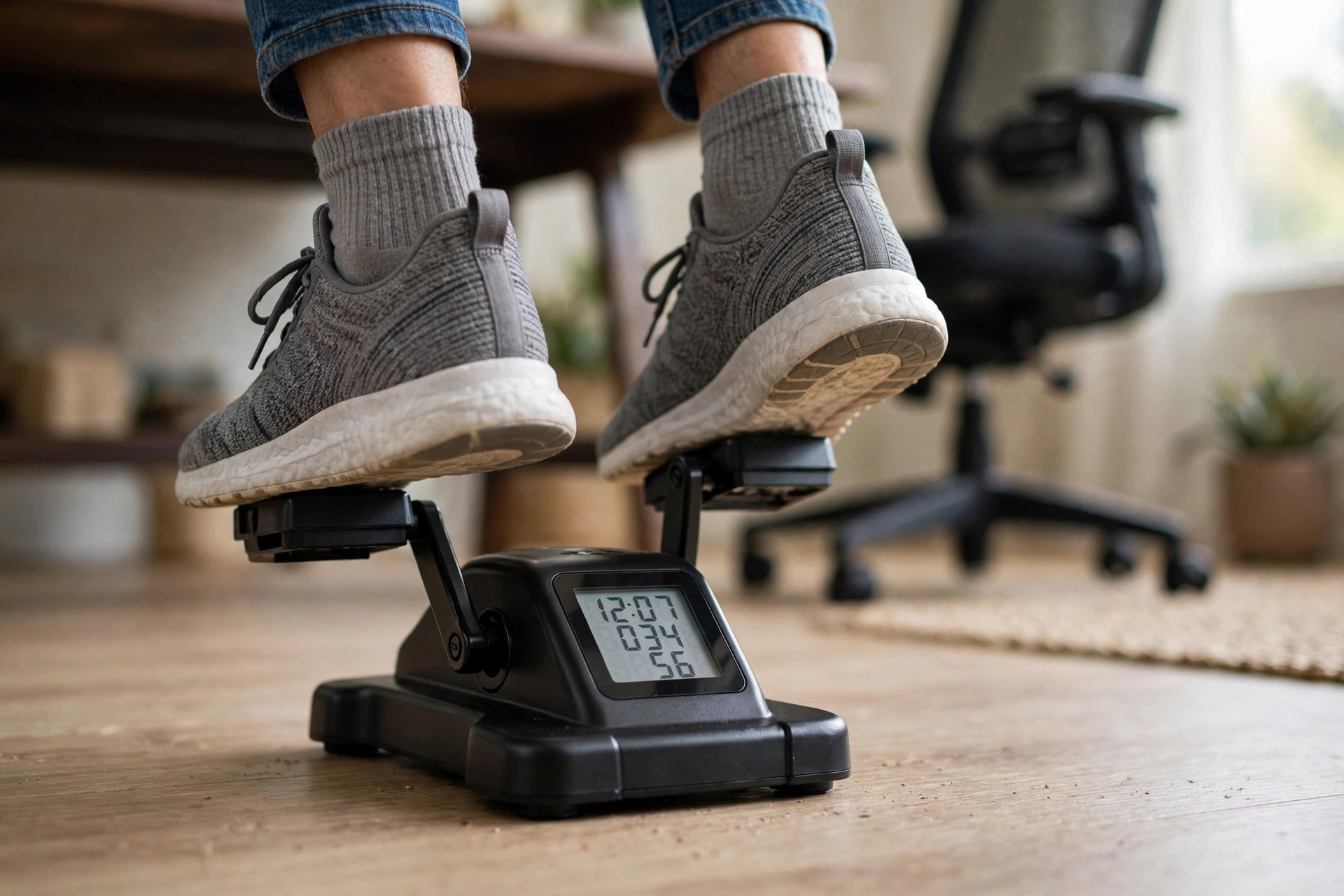
- Multifunction LCD display tracking time, pedal count, distance, and calories. (An LED display with touch control is listed as an option.)
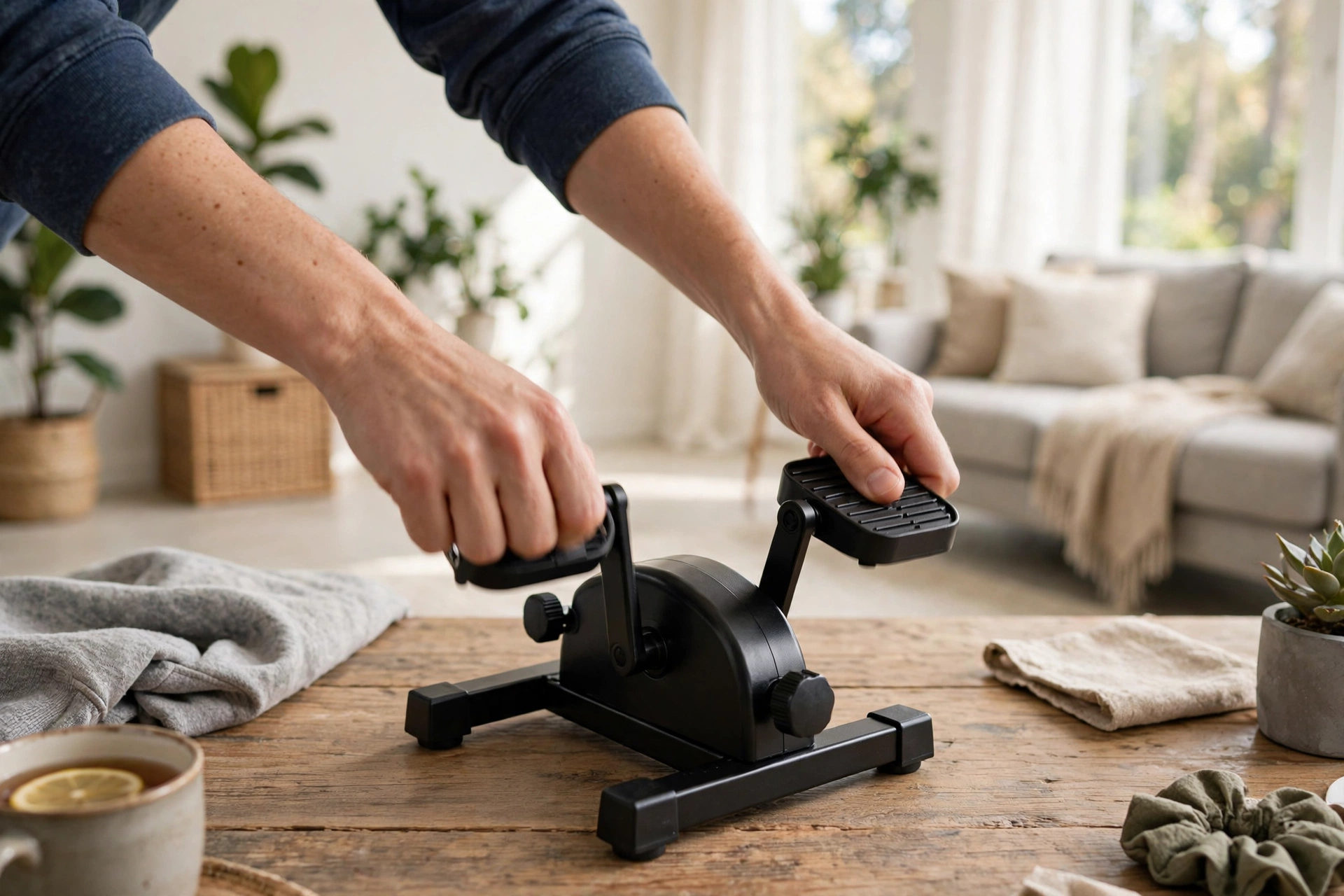
- Arms and legs. The same unit pedals under the desk for leg work or sits on a table for upper-body cranking.
- Adjustable toe loops and non-slip feet for stability on hard floors.
There is no motor, which matters more than it sounds: it cannot break the way a treadmill motor can, and it cannot make treadmill noise. The silence part I can confirm personally.
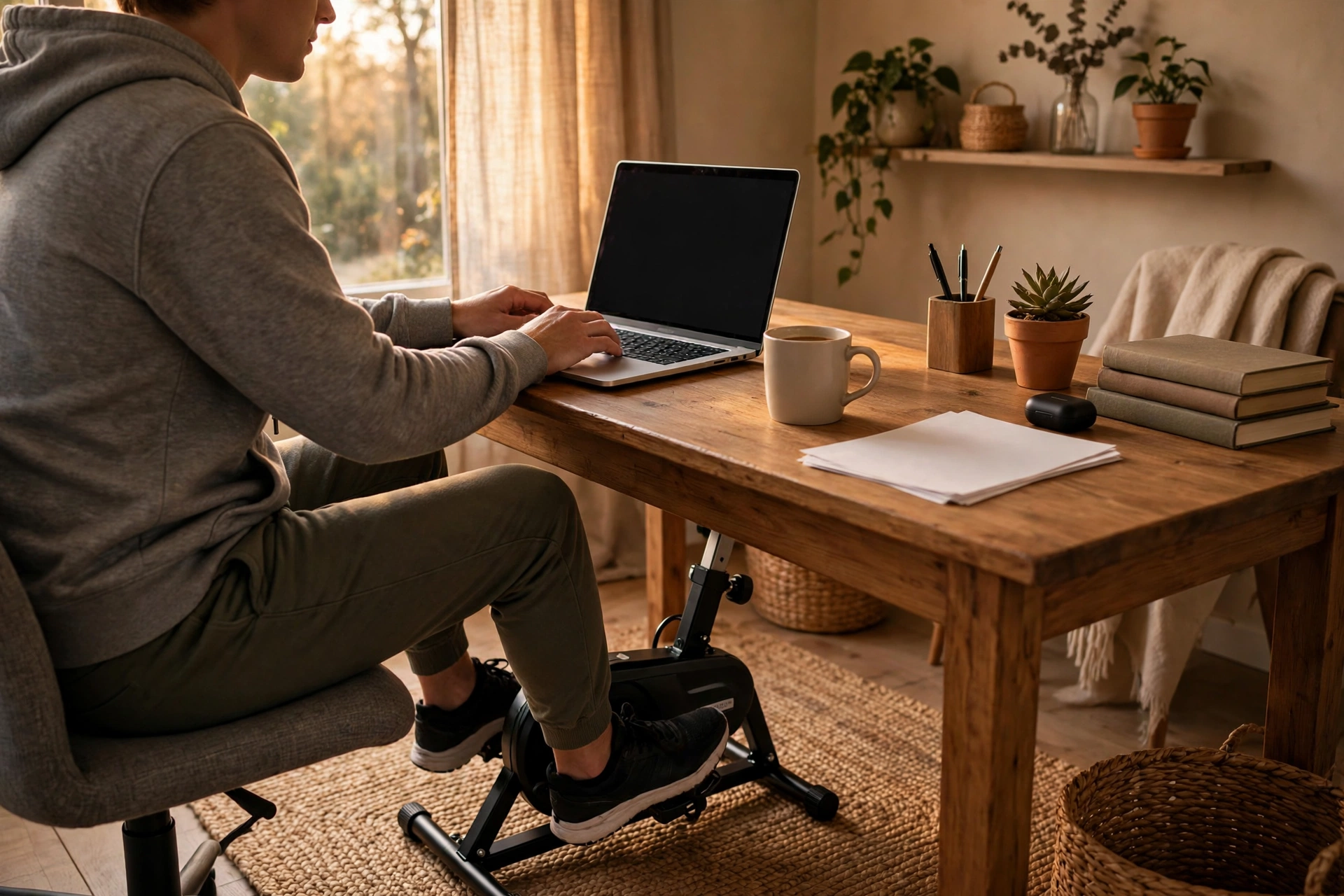
First Week: The Knee-Clearance Question
The one thing I measured before buying: my desk clearance. My home office desk is a 28.5-inch writing-height slab, and the unit stands 12.8 inches tall — meaning my knees do the pedaling underneath. I wear 34-inch-inseam pants and a regular task chair, and I can report it works, but the geometry is worth thinking through: with shoes on, the top of my pedal stroke clears the desk underside by about two inches. If your desk is 25 inches or lower, or you are taller than about 6′2″, measure first. (My wife, at 5′6″ on her own desk, has four inches to spare and finds it comfier than I do.)
The toe loops took one session to figure out — snug enough that my heels do not slip, loose enough to slide out when the phone rings. The non-slip feet genuinely grip: on our hardwood floor the unit has never walked across the room on me, which was my unspoken fear.
Portability was the honest surprise. At 8.36 pounds I carry it to the living room one-handed when the workday ends. It lives under the sofa now — the footprint is smaller than my vacuum.
The Honest Question: Does Seated Pedaling Actually Count?
I went in skeptical, so let me be the skeptic on the record. This is not cardio training. It will not give you cyclist legs. It is NEAT — non-exercise activity thermogenesis — the background burn of staying in motion instead of parked. Researchers who study sedentary behavior keep making the same point: the problem was never your desk, it is the eight unbroken hours of stillness.
Seated cycling at easy effort runs roughly 2 to 4 METs versus about 1.5 for sitting still — my estimate from standard exercise-intensity tables, not a lab. On my wrist tracker, an hour of light pedaling registers like an hour of slow walking. I am not going to pretend it feels like a workout. But the afternoons stopped dragging in a way I could not ignore: the 3 p.m. stiffness in my lower back, the one that used to make me stand up and do a doorway stretch, is mostly gone.
My Calorie Math, 30 Days In
Rough math, flagged as rough. My pattern settled into 2 to 3 hours a day, 5 days a week, mostly during email and status meetings, tension knob about a third of the way up. At my weight — call it 170 pounds — light seated pedaling burns roughly 100 to 160 calories an hour (standard MET estimates; your numbers will differ).
Over four weeks that is about 80 hours of pedaling, or somewhere around 10,000 to 12,000 extra calories — the theoretical equivalent of three-plus pounds. My scale moved about two pounds over the month, and I will happily admit diet and everything else confounds that. But the arithmetic direction is not subtle: two hundred dollars bought me a calorie deficit I did not have to schedule, commute to, or think about.
The money math is just as plain. A mid-range gym membership near me is $45 a month — the pedal bike breaks even in under five months and has no membership to cancel. Against name-brand desk bikes like DeskCycle, which run in the same $200-plus territory for comparable manual units, the price is unremarkable in the best way: exactly what this category costs, no premium, no gimmick discount.
The Arm Mode I Did Not Buy It For
On day nine, bored during a long webinar, I set the unit on my desk and started cranking with my hands. This is the feature I had dismissed as marketing filler, and it turned out to be my favorite thing about it. Ten minutes of arm pedaling loosens shoulders that have been hunched over a keyboard all morning — the only part of my workday where my upper body does anything at all.
Two honest notes: keep the resistance low in arm mode (your shoulders will tell you, loudly, if you do not), and do not try to type while doing it. This is a phone-call activity, not a typing activity.
Where $200 Lands: Pedal Bike vs Walking Pad vs the Gym
FLNORW MALL sells several machines in this lane, and they are genuinely different purchases. I tested the comparison seriously, because I almost bought the other one first: the walking pad under desk treadmill at $288 — 2.5HP motor, LED display, remote — walks you at 1 to 2 mph while you work and genuinely rebuilds a step count. But it needs a standing desk, makes motor hum, and weighs 41.8 pounds. The pedal exerciser needs nothing but a chair.
My rule of thumb after thirty days: if you own a standing desk and want your step count back, the walking pad wins. If you sit at a regular desk — like most of us — and want motion without rebuilding your workspace, the $200 pedal bike is the lazier, smarter answer. The gym beats both on paper and loses to both in practice: my last membership lapsed in early 2025 after four months of good intentions and eleven actual visits.
The Industry Numbers: Desk Bikes Are Having a Moment
I checked the market data to see whether I was early or late to an obvious trend. According to Dataintelo’s 2025 report on the category, the global under desk bike pedal exerciser market was valued at $0.74 billion in 2025 and is projected to reach $1.62 billion by 2034, growing about 9.1% a year, with North America holding 35.4% of revenue. The World Health Organization’s Global status report on physical activity (June 2024) found that 31% of adults worldwide are physically inactive.
Translation: remote work made sitting the default setting for millions of people, and the category that fits inside that setting is growing fast. A market nearly doubling in under a decade is not a fad statistic — it is what happens when the problem is structural.
Specs Worth Understanding Before You Buy
- 12.8-inch height. You need roughly 27 inches of desk clearance, more if you are tall. Measure the desk, not the chair.
- 8.36 lbs. One-hand portable; store it flat under a sofa or against a wall.
- Tension knob, no power cord. Silent and unbreakable-ish — resistance is mechanical, so there is no motor to fail and nothing to trip over.
- Toe loops + non-slip feet. Snug the loops and the unit stays put on hardwood.
- LCD tracks time, count, distance, calories. The calorie number is a rough estimate — treat it like a step counter treats steps: directionally right, decimally fiction.
- Arms mode exists. Put it on a table. Your shoulders will thank you on long-call days.
The verdict. Thirty days in, the under desk pedal exerciser has become furniture I forget I own — and that is the highest compliment I can give it. It asked for nothing: no standing desk, no power outlet, no schedule change, no noise tolerance from the rest of the house. In return it erased the afternoon stiffness and quietly banked a five-figure calorie deficit I never would have scheduled. (And if your evenings are for lounging instead of motion, my power lift massage recliner review covers the opposite end of the comfort spectrum.)
Who should buy it: anyone chained to a regular desk, anyone whose step count embarrasses them, anyone rehabbing the habit of moving. Who should skip it: anyone shopping for a cardio machine — this is motion, not training. For $200, the laziest exercise machine ever made turns out to be the one I actually use.
Check the under desk pedal exerciser on FLNORW MALL — $200, adjustable resistance, LCD tracking, free shipping. My afternoons no longer drag. That is exactly the point.