I Bought a $228 Industrial Wine Bar Cabinet. Two Months Later, My Dining Room Finally Feels Like a Home Bar.
I Bought a $228 Industrial Wine Bar Cabinet. Two Months Later, My Dining Room Finally Feels Like a Home Bar.
Our dining room had a drinking problem — or more accurately, a storage problem. A dozen wine bottles crowded the kitchen counter every weekend because the pantry shelf sat too high for guests to reach. The good stemware lived in a cardboard box on the dining table, wrapped in the bubble mailers they shipped in, and my wife had started hiding the corkscrew because I kept losing it. It was not a crisis. It was a slow, weekly annoyance that made entertaining feel like setup instead of fun.
So in early September, I ordered the Industrial Wine Bar Cabinet from FLNORW MALL for $228. It showed up in October, all 69 pounds of it, in one long box. Two months and two dinner parties later, here is everything I learned — including how it stacks up against the taller farmhouse bar cabinet I almost bought instead.
What $228 actually buys you
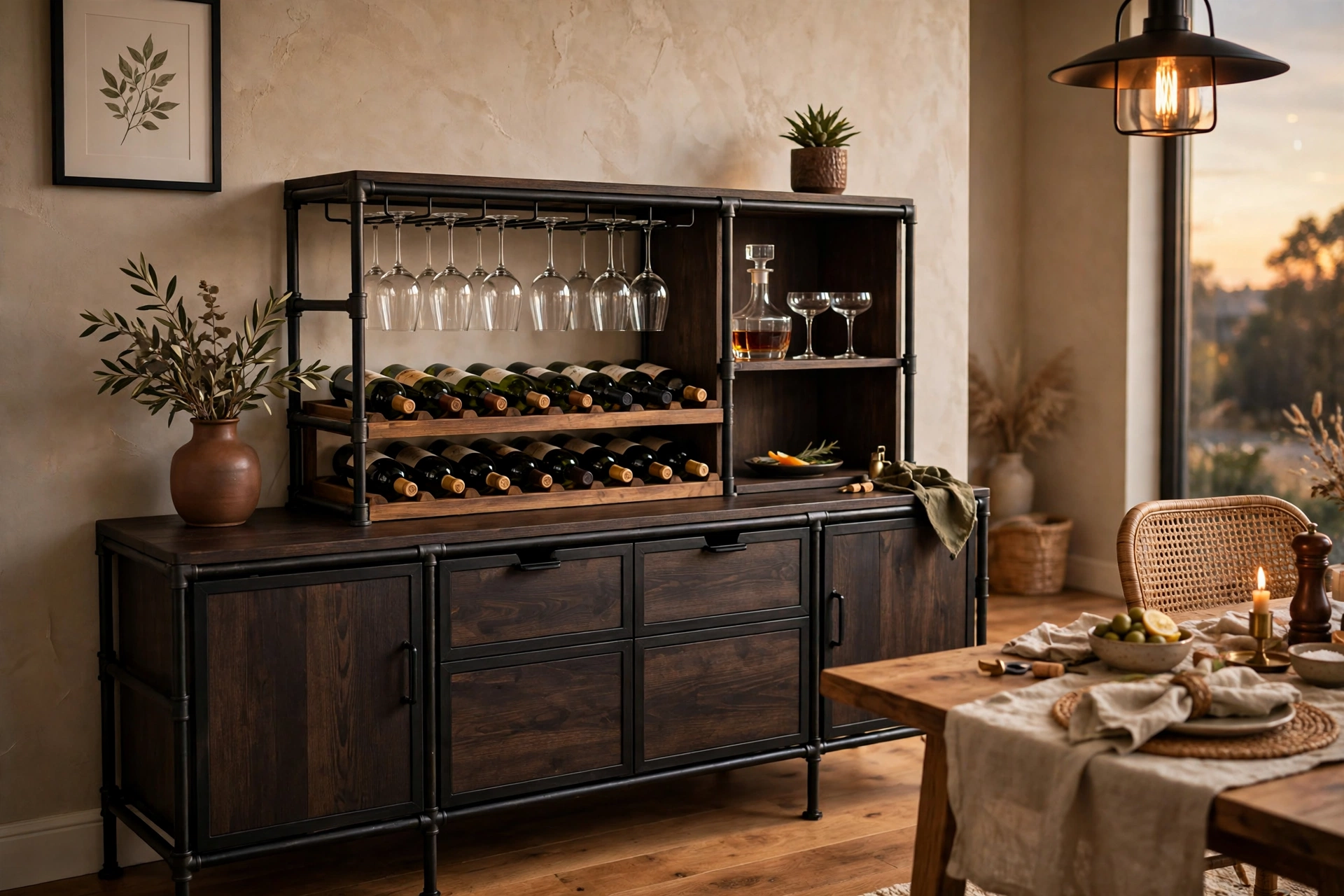
This is a credenza-style cabinet, not a tower. It measures 55.12 inches wide, 13.78 inches deep, and 30.31 inches tall — wide and low, which turned out to be the whole point. At roughly counter height it doubles as a serving surface, and because it is only 13.78 inches deep it hugs the wall instead of eating the room.
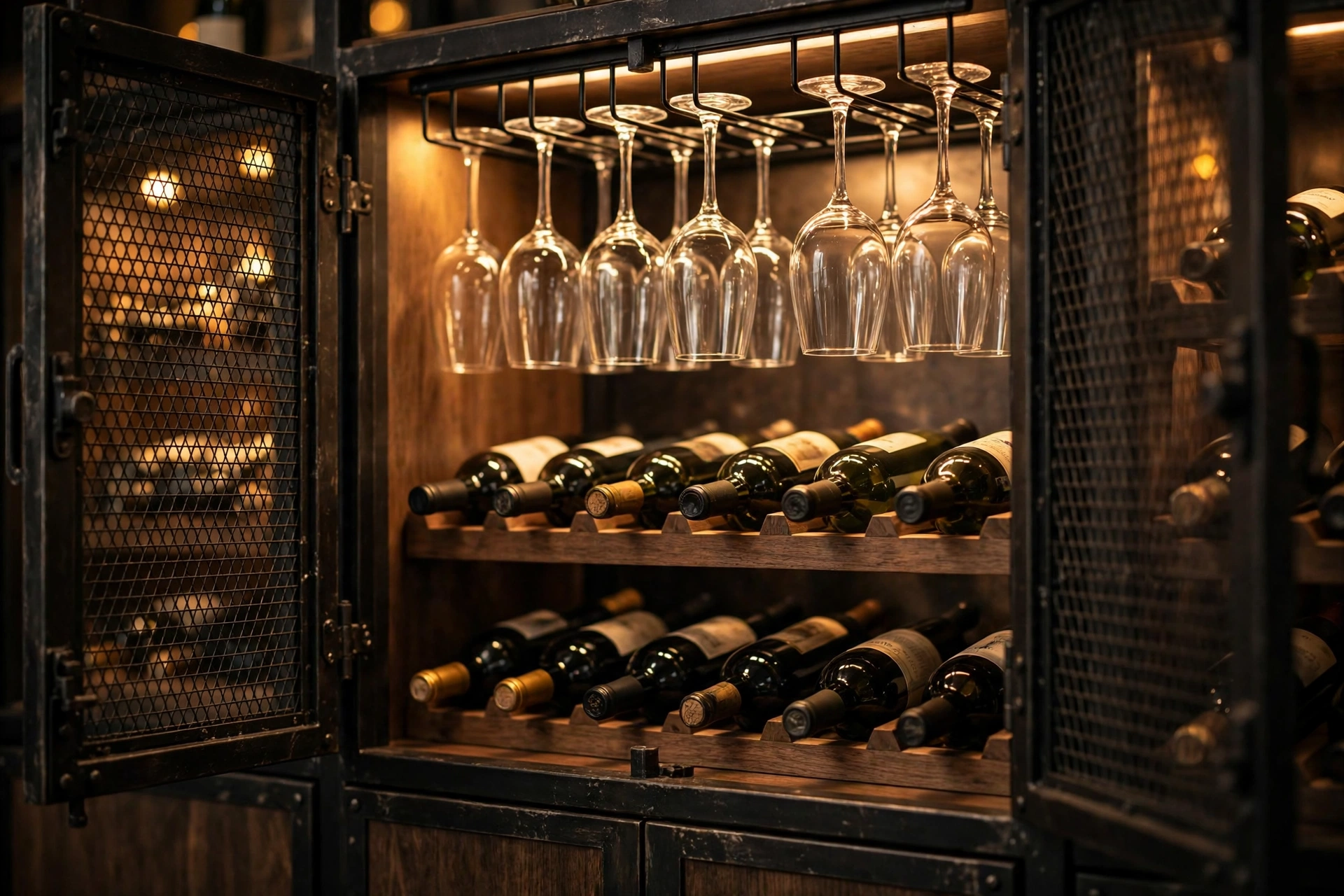
The look is honest industrial: a black metal frame with wood-grain engineered wood panels, mesh-paneled double doors on the enclosed section, and an open bay with the wine racks on one side. It comes in two finishes, Brown Oak and Dark Gray. I picked Brown Oak, which reads as a warm mid-brown in our evening light — closer to furniture-store wood than the grayish product-photo version suggests.
The layout has two zones. The open bay holds up to 12 bottles laid horizontally plus open shelving above for a decanter, a couple of nice bottles, or whatever you want guests to see. Behind the mesh doors sits the enclosed cupboard: a stemware hanger for up to 9 glasses, more shelving, and a small interior light that switches on when you open the doors. The wood-grain top is your serving station — drinks, a cheese board, the stack of cocktail napkins that used to live in the junk drawer.
The 12-bottle wine rack: tested with real bottles
I was suspicious of the rack. “Up to 12 bottles” sounds great until your wide-bottomed champagne bottles refuse to fit slots designed for slim Rieslings. So I loaded it up: six standard 750ml bottles (a Cabernet, two Pinots, a Malbec, a Chardonnay, a Tempranillo), two champagne bottles with the fat bottoms, a squat Aperol-style bottle, and two tall Pinot Grigios. All twelve fit. The slots are square-grid, not X-divided, which is exactly why the champagne bottles squeezed in — they lay flat without rocking.
Twelve bottles equals 9 liters, the volume of a full case. For our house that is the right size: enough to keep a week-to-week entertaining stash plus a few “save for later” bottles, not so much that we are aging wine in furniture. One honest footnote — an open rack collects dust. I wipe the bottles down every couple of weeks; it takes about two minutes. Anything you plan to age for years still belongs in a proper dark, cool cellar, but for the bottles you actually drink, this is exactly right.
The stemware hanger and that little interior light
The stemware hanger was the detail I did not expect to love. Nine of our everyday wine glasses now hang upside down inside the cupboard, which did two things: it emptied an entire kitchen cabinet shelf (instantly more organized up there), and it keeps the glasses dust-free without any effort. The hanger slots fit our standard stems fine; the two chunky coupe glasses are too wide for the slots and live on the shelf above instead.
And the light — when you open the mesh doors, a small interior light comes on, fridge-style. It is a tiny thing, but in a dim dining room at a dinner party it turns the cupboard into a little showcase. Guests open it themselves to pick glasses. It makes the whole piece feel more considered than a $228 cabinet has any right to feel.
Low credenza vs tall bar cabinet: the $299 farmhouse comparison
Before I ordered, I nearly bought FLNORW MALL’s Farmhouse Bar Cabinet for Liquor and Glasses for $299 instead. The two are genuinely different answers to the same question, so here is the honest comparison.
The farmhouse is a tower: 67.3 inches tall, only 26.89 inches wide, with double glass doors on top, opaque wooden doors below, a stemware hanger for up to 10 glasses, and that rustic charcoal-grey farmhouse look with a barn-door style. It stores more vertically in a much smaller footprint. If your wall space is tight or you want a full “bar furniture” presence, it wins.
The industrial cabinet answers a different need: it is half the height, twice the width, and the top is a real working surface. At a party, the farmhouse’s top is a display ledge; the industrial cabinet’s top holds a decanter, an ice bucket, and twelve glasses with room to spare. I chose it because we entertain in the dining room and needed a surface more than a tower. If your storage problem is “nowhere to put things” rather than “nowhere to set things down,” flip that decision.
The $71 price gap buys the farmhouse’s height and barn-door styling; the industrial cabinet gives you the metal-frame build and the lighted interior. Both hold about a case of wine and a full set of glasses. Neither will disappoint — pick by your floor plan, not by the spec sheet.
The 55-inch rule: how much wall space you actually need
The cabinet is 55.12 inches wide, but you need more than that. Give it a couple of inches on each side so the doors swing clean and the piece does not look wedged in — call it 60 to 64 inches of wall. That sounds like a lot until you compare: a 72-inch bookshelf asks for the same wall and gives you none of the hosting utility.
Height matters too. At 30.31 inches it sits a bit below standard 36-inch counter height, which is actually comfortable — you are not reaching up to grab the decanter, and seated guests can set glasses on it without standing. The 13.78-inch depth is the unsung spec: standard guidance says keep 36 inches of clearance behind dining chairs so people can walk past, and a shallow cabinet keeps that walkway wide. Our dining room kept a full 40 inches of clearance with the cabinet against the wall.
The industry numbers: why everyone is building a home bar
I looked up the data because I wanted to know whether “the home bar piece” was my idea or everyone’s idea. It is everyone’s idea. According to the Wine Institute, Americans now drink roughly 945 million gallons of wine per year — the US has been the world’s largest wine market by volume since 2010. And Houzz’s 2024 U.S. Renovation Trends study found the kitchen remains the most-renovated interior room, with storage and entertaining function ranking near the top of homeowners’ wish lists.
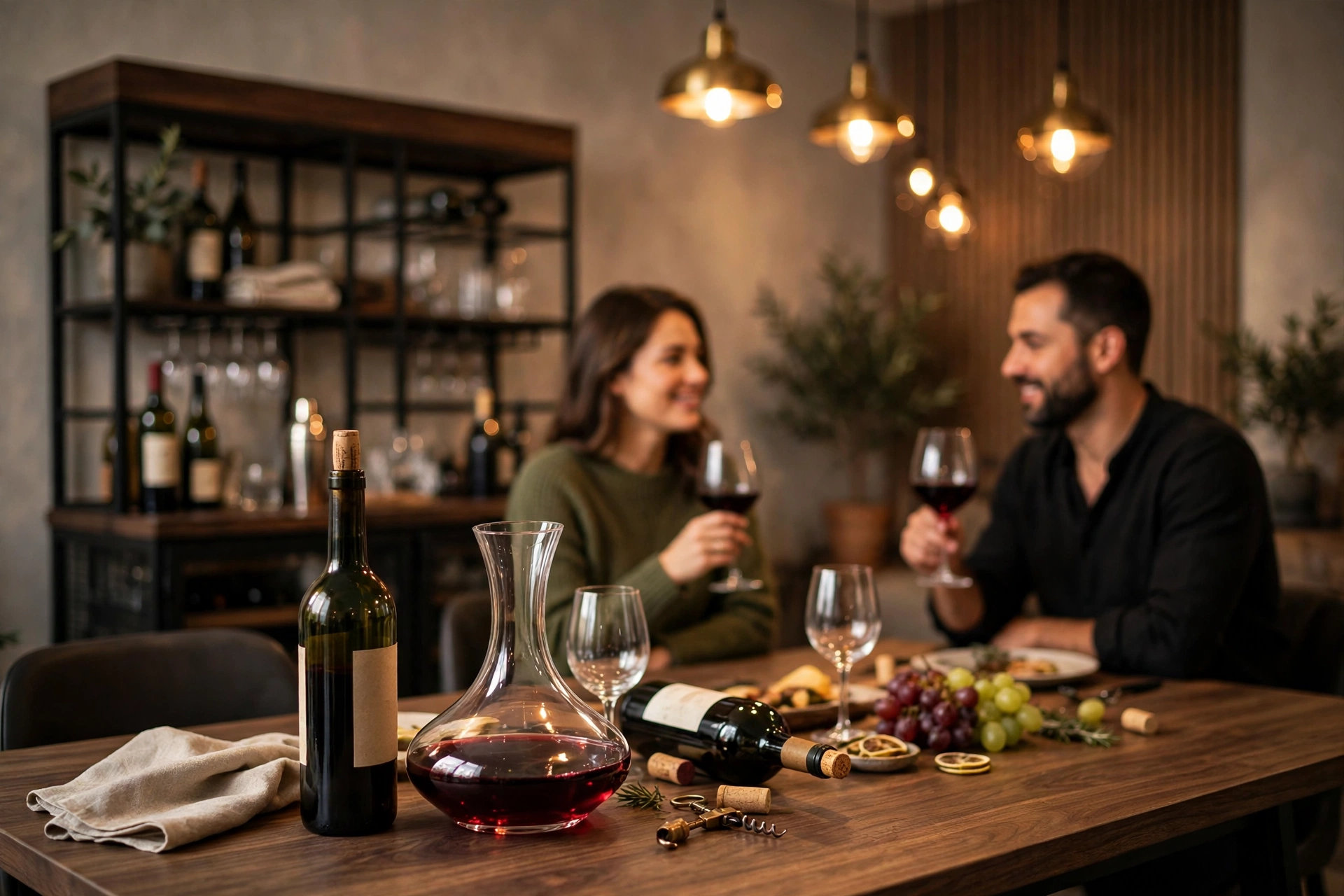
The money math is what sealed it for me. A custom built-in buffet from a contractor runs $2,000 to $6,000 per project (HomeAdvisor’s 2024 national range; my own quotes last spring landed at $3,400). Renting a portable bar setup for a single big party costs $150 to $300 around here — my rough estimate from three local rental companies. Two parties and you have already outspent this cabinet. The cabinet stays, and it works every weekend.
Specs worth understanding before you buy
- 12-bottle horizontal racks. Square-grid slots fit standard 750ml and most champagne bottles; equals a full 9-liter case.
- 9-glass stemware hanger. Standard stems fit; chunky coupes go on the shelf instead.
- Door-activated interior light. Turns on when the mesh doors open — small detail, big party effect.
- 55.12 × 13.78 × 30.31 inches, 69.3 lbs. Wide and shallow; budget 60–64 inches of wall.
- Two finishes. Brown Oak (warm, furniture-store wood) or Dark Gray (cooler, more modern).
- Assembly. Plan on about an hour with a second pair of hands — the 69-pound panels are awkward solo, not hard. Included hardware, one allen key, no special tools.
- Item code W116241634 / W116241635. Both colorways, same cabinet.
The verdict
Two months, two dinner parties, and about a dozen quiet weeknights later: this is the piece that ended the logistics accident. The wine has a home, the glasses have a home, the corkscrew lives in the open bay where I can actually find it, and the dining room finally feels like a place built for having people over instead of a room we clean before having people over.
$228 bought the end of the weekly setup ritual. If you host even three or four gatherings a year — or if, like us, you just want the bottles off the kitchen counter — an industrial wine bar cabinet like this earns its spot before the first holiday season is over. Mine did.
Ready to give your bottles a real home? See the Industrial Wine Bar Cabinet with wine racks and stemware holder on FLNORW MALL — full specs, both colors, and current stock. Prefer a taller tower or farmhouse look? Their farmhouse bar cabinet for liquor and glasses is the $299 alternative, and my farmhouse buffet cabinet review covers the $269 drawer-and-barn-door option if hosting storage is the priority.