I Bought a $288 Wooden Cat Tower. Two Months Later, My Couch Is Still Scratch-Free.
My tabby Miso weighs fourteen pounds and believes every piece of furniture I own is a rental. Pepper, his eight-pound black sidekick, is quieter but equally opinionated about where her claws go. Between the two of them, I have bought three carpet-covered cat trees in four years — each one a sad, wobbly monument to false economy, roughly seventy-five dollars apiece, and each one dead within two winters.
So when I paid two hundred and eighty-eight dollars for a wooden cat tower, I was not being extravagant. I was being tired. Two months in, the couch has zero new scratch marks, which has literally never happened before. Here is the full accounting.
What this thing actually is
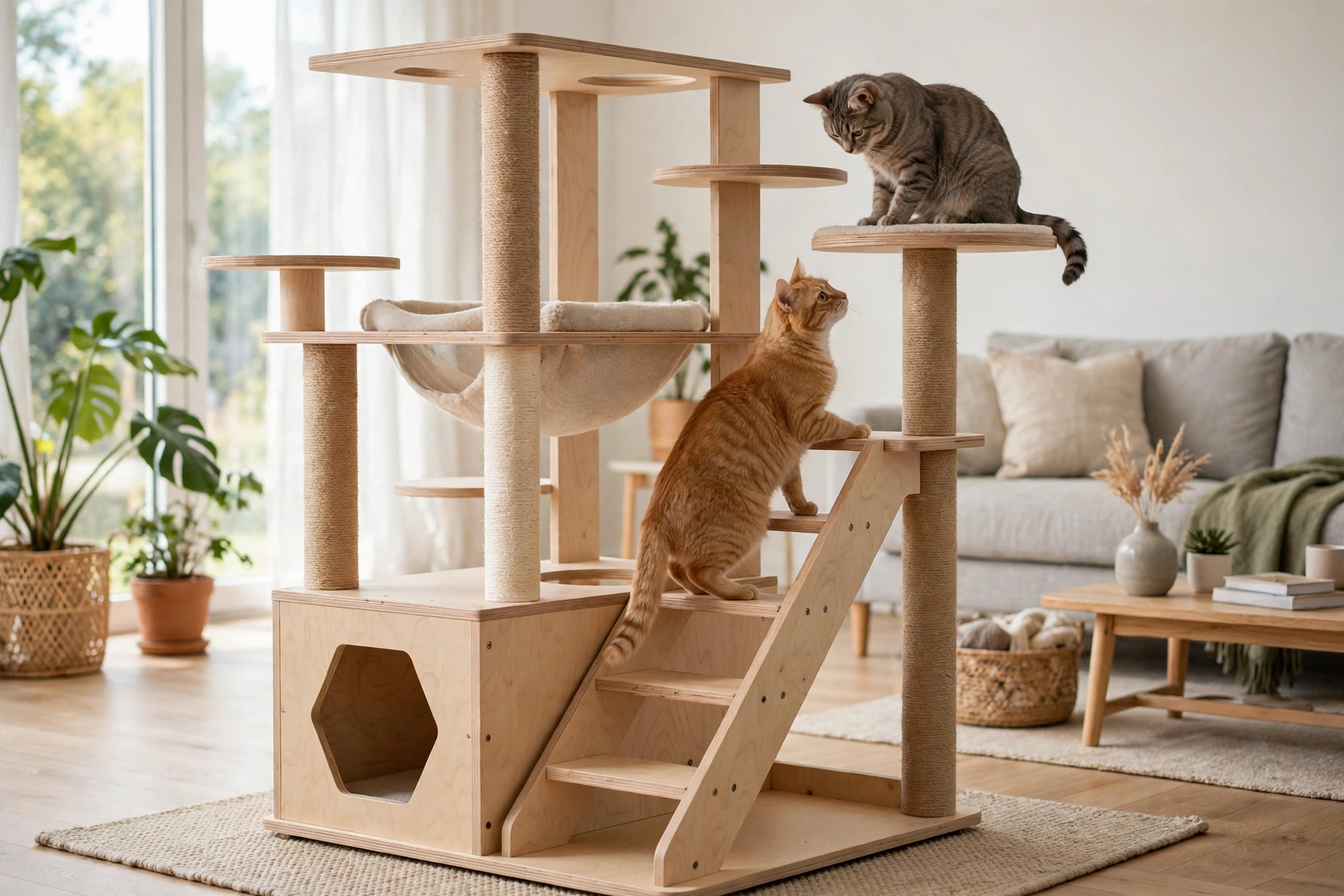
The PurrScape Elegance is a deluxe wooden cat tower from FLNORW MALL that stands just shy of fifty-nine inches tall — 58.86 inches, to be exact — with a 38.98-by-15.75-inch footprint and a listed weight of 37.49 pounds. The frame is solid eucalyptus wood, not the usual particleboard tubes wrapped in carpet, with wide platforms for lounging, an integrated staircase between levels, and several posts wrapped in high-grade sisal rope for scratching.
That is the whole pitch: a piece of furniture that happens to be for cats, rather than a carpet-covered eyesore you apologize for when guests come over. It is freestanding, which means no drilling into walls or ceilings, and the wood finish is the same warm tone as most of my living-room furniture, so it genuinely blends in instead of screaming pet accessory from across the room.
I assembled it on a Saturday afternoon. Thirty minutes, two people recommended for the top section — my partner held the uprights while I drove the bolts. The instructions were pictorial and clear enough that we only disagreed about one step, which is a furniture-assembly miracle.
Why I gave up on seventy-five-dollar carpet trees
I bought three of them, so let me be fair first. They are cheap, they ship fast, and a kitten does not care about interior design. But here is what four years of ownership taught me.
Year one: the carpet tree stood fine and the cats liked it. Year two: the sisal sections — usually thin twine glued over cardboard — shredded down to the tube, and the carpet platforms collected a grey crust of dander no vacuum fully removed. Year three: the base loosened at the joints and the whole thing developed a lean that made me nervous every time Miso launched himself at the top perch from across the room. Three trees, four years, about two hundred and twenty-five dollars spent, and the final one went out on trash day tipping sideways like a sinking ship.
Carpet trees are built for a price point: roughly forty-six and a half million American households own cats, according to the American Pet Products Association’s 2023–24 national survey, and most of those households are replacing a budget cat tree every year or two. The business model of the cheap tree is the replacement, not the tree.
Two months with Miso and Pepper: the honest field report
Miso claimed the top platform within four hours of assembly. He now spends every morning up there watching the street, and every night the same — it is, by every observable metric, his favorite piece of real estate in the house. Pepper took longer, about a week, and her route of choice is the integrated staircase, which she climbs like a lady descending a ballroom staircase, pausing on each step for dramatic effect.
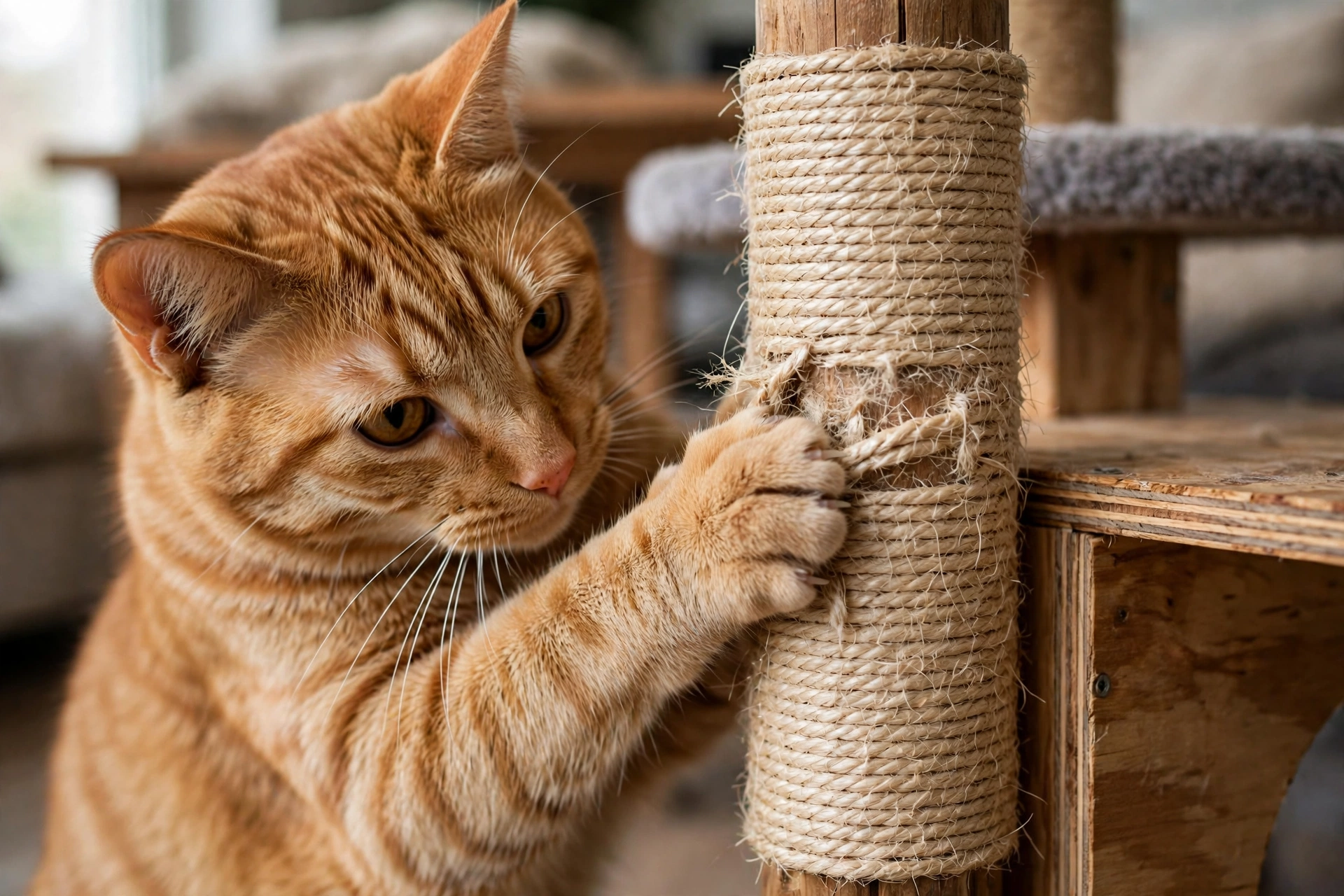
Before the tower, Miso shredded the left arm of our couch on a roughly weekly basis — I have the repair receipts to prove it. Since the wooden tower arrived, both cats go for the sisal-wrapped posts instead. The posts give a satisfying resistance when they dig in, which I suspect is the whole trick: carpet-tree sisal is usually a thin veneer that surrenders instantly, while these posts feel like they fight back a little. Two months, zero new couch marks. Pepper even abandoned her old habit of working over the hallway rug.
One honest footnote: the cats ignored the tower for the first two days, and I briefly panicked. A pinch of dried catnip on the middle platform fixed that in about ten minutes. If your cats are tower-skeptics, budget a two-week adjustment period before you judge.
The wobble test: thirty-seven pounds of wood, two flying cats
Here is the number that matters for a sturdy cat tower: 37.49 pounds at a 58.86-inch height, freestanding. My last carpet tree weighed maybe eighteen pounds soaking wet, and when Miso — all fourteen of him — launched from the arm of the couch onto its top perch, it rocked far enough that I started steadying it with one hand out of instinct.
The PurrScape does not do that. I have pushed it deliberately from the side, and the base holds; during actual use, Miso’s full-speed landings produce a barely perceptible sway and nothing more. The staircase does double duty as bracing — it ties the uprights together structurally, so the tower is not relying on a single central post the way most cheap trees do.
No wall anchors, no bracing kits — just a fourteen-pound cat using it as a launch pad. That is the entire stability review, and it passes.
Wood versus carpet: the cleaning question
The sleeper benefit of a wooden cat tower, and the one nobody mentions until they have owned both kinds: my old carpet trees developed a sour dander smell by month eighteen that no baking soda fully killed, because carpet is a sponge. This tower wipes down with a damp cloth in about three minutes. I do it weekly, mostly the platforms where the cats nap, and it looks and smells like the day it arrived.
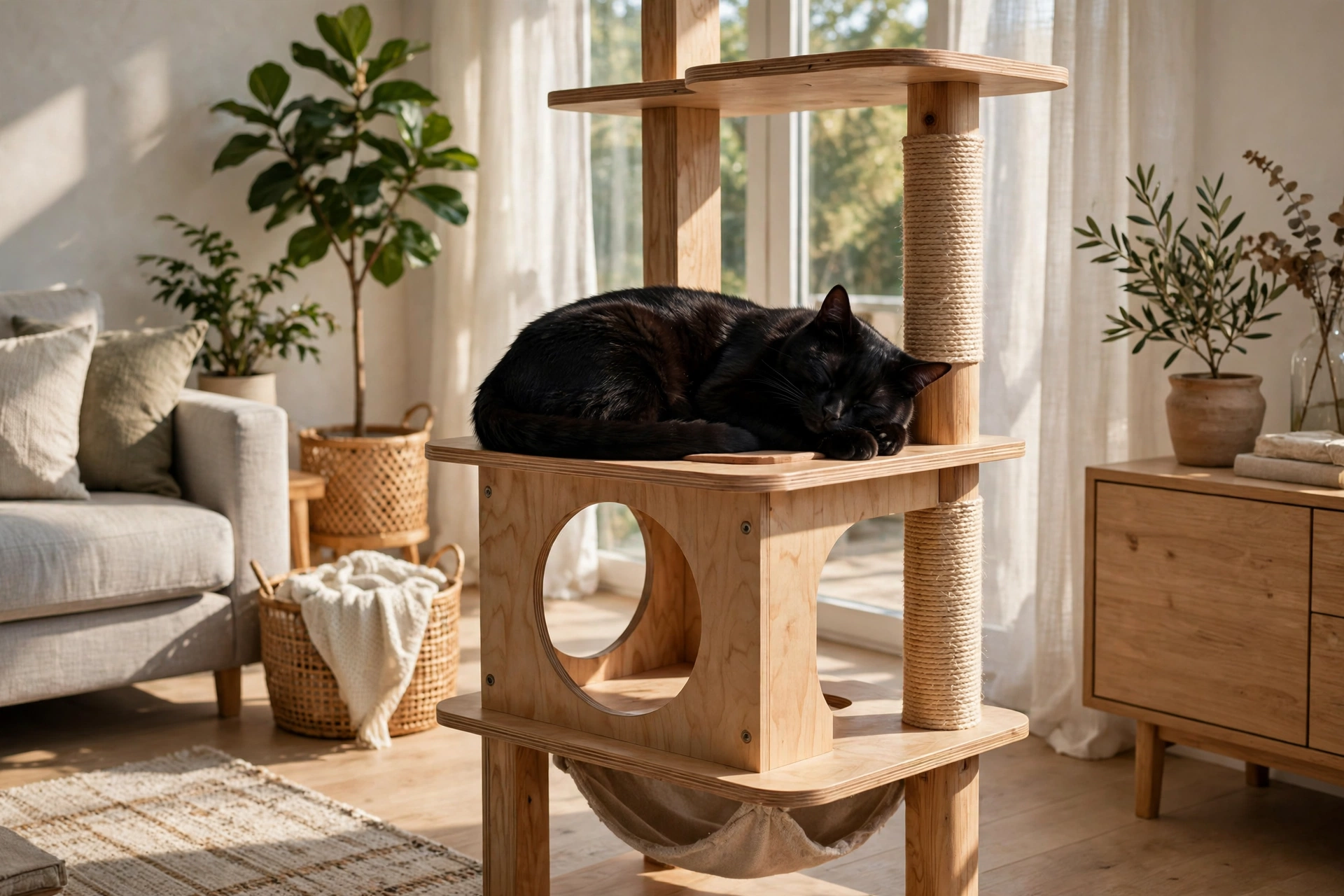
For an indoor cat tower that lives in your living room rather than a spare bedroom, that matters more than any feature on the spec sheet. The wood does not trap litter-box-adjacent odors, the platforms do not shed fibers onto my dark pants, and the whole thing photographs like actual furniture. My mother-in-law visited last week, asked where I got the nice bookshelf, and had to be told it was a cat tree. Twice.
The money math: two hundred and eighty-eight versus seventy-five
Rough numbers, flagged as rough. The arithmetic is not close.
- A decent cheap carpet tree costs about seventy-five dollars and, in my experience, survives roughly eighteen months of daily use by two cats before it is wobbly, shredded, and smelly. Over six years, that is four trees: about three hundred dollars, plus four assembly sessions and four trips to the curb.
- This wooden cat tower costs two hundred and eighty-eight dollars once. Eucalyptus is a hardwood — it will not shred, the posts are re-wrappable, and my realistic expectation is six to eight years of service. That works out to roughly forty dollars a year, versus about fifty for the carpet-tree treadmill. (Estimate, but a conservative one.)
- The couch math is where it really pays off. Having the left arm of my sofa reupholstered cost three hundred and twenty dollars last year. A new couch in the same class runs over a thousand. If a proper scratching tower redirects even one armrest’s worth of damage, the tower is free.
The honest caveat: the math only works if your cats use the thing. Most do — cats are hardwired to scratch vertically and perch up high, and the APPA’s survey data suggests owners keep buying trees precisely because cats use them — but if yours are confirmed floor-scratchers with zero vertical interest, spend the money on horizontal scratchers instead.
The one-hundred-ninety-nine-dollar sibling I did not buy
FLNORW MALL sells two smaller wooden towers in the same line, and I looked hard at both before deciding. The EliteCat Haven at one hundred and ninety-nine dollars is the direct step down: same eucalyptus wood, same sisal rope, but forty-six inches tall instead of fifty-nine and about eleven pounds lighter. For one small cat in a tight corner, it is a completely sensible pick — and I would have bought it if Miso were not fourteen pounds of flying launch mass.
I chose the tall one for one reason: height buys territory. A tall cat tree for large cats matters because big cats need the top perch high enough to feel like an actual vantage point, not a step stool. At fifty-nine inches, the top platform sits level with my window sill — Miso’s street-watching station — and a fourteen-pound cat landing on a thirty-seven-pound tower stays planted. If your cats are under ten pounds and your space is tight, save the eighty-nine dollars and get the sibling. If you have a Miso, buy the tall one.
Specs worth knowing before you buy
- 58.86 inches tall, 38.98 by 15.75-inch footprint. Measure your corner — it is tall but narrow, and it tucks against a wall nicely.
- Ships in one box, about 37.5 pounds. Have someone help you carry it upstairs; the box is awkward, not heavy for two people.
- Assembly is about thirty minutes with the included hardware. Two people make the top sections much easier.
- The sisal posts are the wear part. When they shred in a few years, you can re-wrap them yourself with a ten-dollar roll of sisal rope from the hardware store — I did this once on a store-bought post, and it took half an hour and looked factory-new.
- Freestanding, no wall anchors. Works on carpet or hardwood; the base is wide enough that it does not skate on my wood floors.
Two months in, the numbers are simple: two hundred and eighty-eight dollars, one assembly session, zero new couch scratches, and two cats who use the tower daily. Against three dead carpet trees and one three-hundred-and-twenty-dollar couch repair, the expensive wooden tower is not the extravagant option — it is the cheap one, paid upfront.
If you have cats who scratch your furniture and a living room you would rather not apologize for, you can find the full specs and current price on the PurrScape Elegance wooden cat tower product page. And if your cats run smaller than mine, the one-hundred-ninety-nine-dollar EliteCat Haven sibling is worth a look — same wood, same sisal, slightly smaller footprint.
See the PurrScape Elegance in detail: full specifications and the current price are on the PurrScape Elegance wooden cat tower product page at FLNORW MALL. For the whole pet lineup — including the smaller sibling towers and pet furniture that matches your decor — browse the pet supplies collection.