I Bought My Dad a Power Lift Massage Recliner. Here’s the $600 Math, Six Months Later.
Last winter, I watched my 70-year-old father sit on the living-room sofa for half an hour, then spend nearly a full minute bracing himself against the coffee table just to stand up. Bad knees, a cranky lumbar spine — at his age, “getting up” had quietly turned into hard work. That night I fell down an internet rabbit hole and surfaced with a power lift massage recliner sitting in my cart. Six hundred dollars. I stared at the checkout button for a full week before I clicked it. Six months later, here is the honest accounting.
What this thing actually is
It is not one of those $3,000 full-body massage chairs that look like a Transformer mid-transformation. It is a single armchair — FLNORW MALL lists it as the 350 LBS Power Lift Recliner Chair — built around three ideas: power lift, 8-point vibration massage, and lumbar heat.
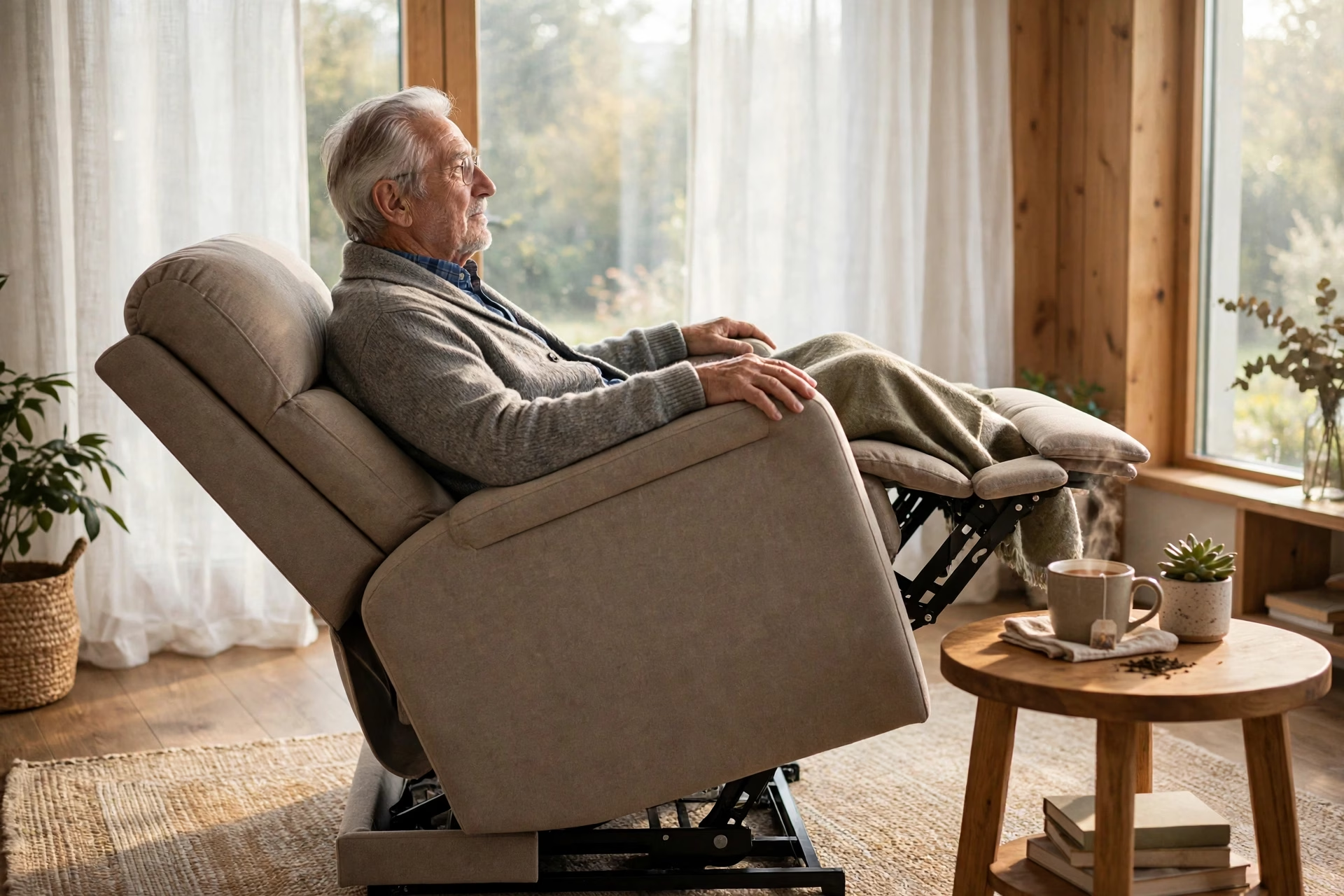
Press a button on the side and an Okin motor smoothly tilts the entire chair upward, handing you to your feet. It also reclines anywhere from 110° to 155°, so half-lying with a book and near-flat for a nap are both on the menu. Eight vibration nodes sit across the back, lumbar area, thighs, and legs, with three massage modes to choose from — each zone can run on its own, and there is a 15/30/60-minute timer so you do not doze off mid-session and wake up buzzing. A heating element in the lumbar zone is there to get blood moving across your lower back.
Then the small things that end up mattering more than you expect: dual cup holders, side pockets for the remote and reading glasses, USB-A plus Type-C ports for charging (low-power devices only — phones and earbuds, not your laptop), an extra-wide 24.8-inch seat, and cushions you can pull off and throw in the wash. Six hundred dollars lands it squarely in the going rate for lift chairs with this feature set — not cheap, not inflated.
Who actually needs one? Four scenarios from my own house
1. Parents who dread standing up. My dad hits the button every single time now. The chair rises and hands him upward; his knees no longer have to negotiate the deal. If you have ever watched a parent rock back and forth trying to gather momentum off a low sofa, you know exactly the moment this function earns its price.
2. Post-surgery recovery. The product page says it plainly — the chair suits people with leg, back, or balance trouble, or anyone coming back from surgery. It also carries a line I respect: check with your doctor first if you have health concerns. A seller that prints that instead of pretending the chair is medical equipment gets points from me.
3. Desk workers with dead backs. That is me. I collapse into it around nine at night, tilt back to 155°, plug in the phone, and run the 15-minute massage while my brain finally powers down. My lower back used to ache every morning; it still complains sometimes, but noticeably less.
4. The living-room throne. Game nights, playoff season, a full series binge — water in the cup holder, remote in the side pocket, feet up. My teenager has started calling dibs on it, which tells you everything about the comfort level.
Massage plus heat — gimmick or genuinely useful?
Let us be honest: do not expect it to replace a massage therapist. Vibration massage is high-frequency, small-amplitude muscle stimulation. It loosens you up, but it is not tuina and it is not deep tissue. Its real value is frequency — you might visit a parlor twice a month, but this chair you can use twice a day, in your pajamas, while half-watching the news.
The heat element earns its keep in winter. Once your lower back warms through, a particular kind of drowsiness follows — the good kind, the kind where your shoulders drop two inches without you noticing. On the coldest nights I run heat plus the lumbar massage zone alone, and that combination is the single best thing the chair does.
One honest footnote: vibration is stimulation, not treatment. If something in your back is genuinely wrong, a chair will not fix it — see a professional. The chair is for the everyday stiffness the rest of us collect from chairs, cars, and couches.
How many years will it last?
The motor was my biggest worry before buying — it is the one part you cannot easily eyeball. This chair runs on an Okin motor, and Okin is a well-known supplier for standing desks and power sofas with a solid reputation among people who repair this stuff. The frame is steel, rated to 350 lbs (about 159 kg); at 180 lbs I feel zero wobble, even mid-lift.
The upholstery is a soft woven fabric, and the seat, back, and armrest cushions all detach for washing. With a kid and a cat in the house, that detail matters more than any feature on the spec sheet — a regular fabric sofa looks tired in three years; washable cushions buy this chair extra seasons. The zippers hide along the back seams, and after two washes the covers still fit snugly.
Realistic expectation: five to eight years of normal daily use. The motor is a wear part, like the compressor in a fridge, but Okin units are standard enough that a replacement down the road is a solvable problem rather than a dead chair.

The industry numbers: why everyone seems to be buying one now
I went and looked up the market data, because I wanted to know whether I was early or just late to an obvious trend. The global massage chair market sat somewhere between $4.2 and $5.4 billion in 2025, depending on whose report you read, growing around 6% a year, with home use accounting for more than 70% of demand. A 2024 survey by the American Massage Therapy Association found that 61% of people sought massage for health or medical reasons — not indulgence.
Translation: people are not buying “comfort.” They are buying pain relief they can access without booking an appointment. Aging populations plus desk-bound backs — those two trends are not reversing, and this category will keep growing into living rooms like mine.
So — is $600 worth it? The math
Rough math, flagged as rough: a single massage session in the US runs $60 to $100. Six hundred dollars is six to ten parlor visits. Use the chair once a day for fifteen minutes and it “pays for itself” in about two months — everything after that is gravy. (Electricity cost: negligible. A vibration motor and a heating pad sip power.)
For context, FLNORW MALL also sells a $299 heated massage recliner — half the price, but no power lift, which for my dad was the entire point. At the top end sits a $999 full-body zero-gravity massage chair for people who want the full robot experience. The $600 chair lands in the sweet spot between them: the lift is the must-have, the massage is the daily bonus. For a household with an aging parent and a desk-bound forty-something, it is the best-value tier on the page.

Specs worth understanding before you buy
- 350-lb capacity. Heavy-duty build — no anxiety if family members are on the bigger side.
- 155° max recline. Close to flat; afternoon naps are fully supported.
- Ships in two boxes. The carrier may deliver them on different days. Do not panic that half your chair is lost.
- Tool-free assembly. Snap-together construction; one person, about half an hour.
- USB ports are low-power only. Fine for phones and earbuds — do not plan on charging a laptop.
The verdict
Six months in, my dad’s review is the only one that counts: “My legs aren’t as stiff in the morning.” Six hundred dollars cannot buy health, but it buys fifteen minutes of relief twice a day — and one steady mechanical hand getting an old man to his feet without the wobble. That math works for me.
If you want the full spec sheet and photos, they are on the power lift recliner chair product page at FLNORW MALL. The broader furniture collection has the $299 heated version and the $999 zero-gravity model if your budget or needs point elsewhere.