I Compared Two $468 Frameless Sliding Shower Doors. Here’s the One I’d Actually Buy.
Our guest bathroom has a 60-inch alcove shower with a curtain, and that curtain has been waging war on me for two years. It billows in, clings to my arms, and grows a thin orange film along the hem no matter how often I wash it. Last month I finally snapped: I was going to find proper frameless sliding shower doors that fit a standard 60-inch opening, cost less than a custom glass shop, and would not turn into a streaky mess within a year. FLNORW MALL had two candidates at the exact same price — $468 — and that is where this got interesting.
One is the MESA frameless sliding shower door, 60″ wide by 76″ tall in 3/8″ (10mm) tempered glass with matt black hardware. The other is a semi-frameless double sliding model, also 60″ by 76″, also 3/8″ glass, also $468. Same price, same dimensions, same brand family — but genuinely different doors. I spent a week measuring, reading spec sheets, and pricing local installers before deciding. Here is everything I learned.
Why a 60 Inch Shower Door Became My Weekend Project
The 60-inch alcove is the most common shower footprint in American homes — it is the standard tub-width opening builders have used for decades. My opening measured 60.25 inches at the widest point, which matters more than you would think, because a nominal 60″ door is built for an opening that is truly 60 inches, give or take a little. The curtain rod I had was a tension rod, which is to say a slow-motion collapse waiting for a guest.
I also had a budget problem. A local glass company quoted me $1,150 for a comparable 60″ frameless slider, installed — glass cut to order, two-week lead time. A big-box store semi-frameless option was $379 but only in 1/4″ (6mm) glass with chrome-tone plastic rollers. The FLNORW pair sat right in the middle: full 10mm tempered glass, real stainless steel hardware, $468 with free shipping. If the specs were honest, the value math was obvious. So I did what I always do and verified the specs line by line.
What Frameless Sliding Shower Doors Actually Mean on These Two $468 Models
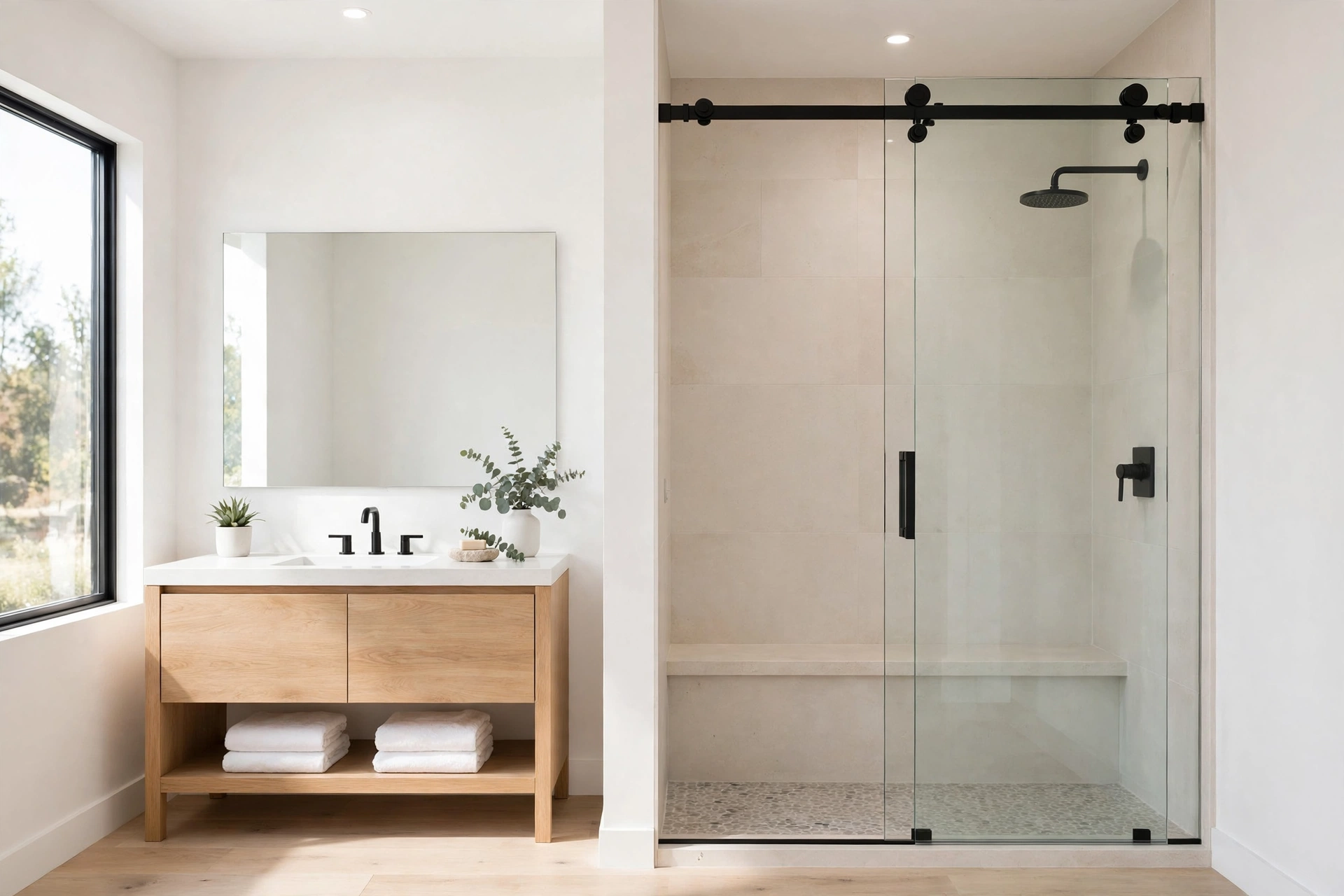
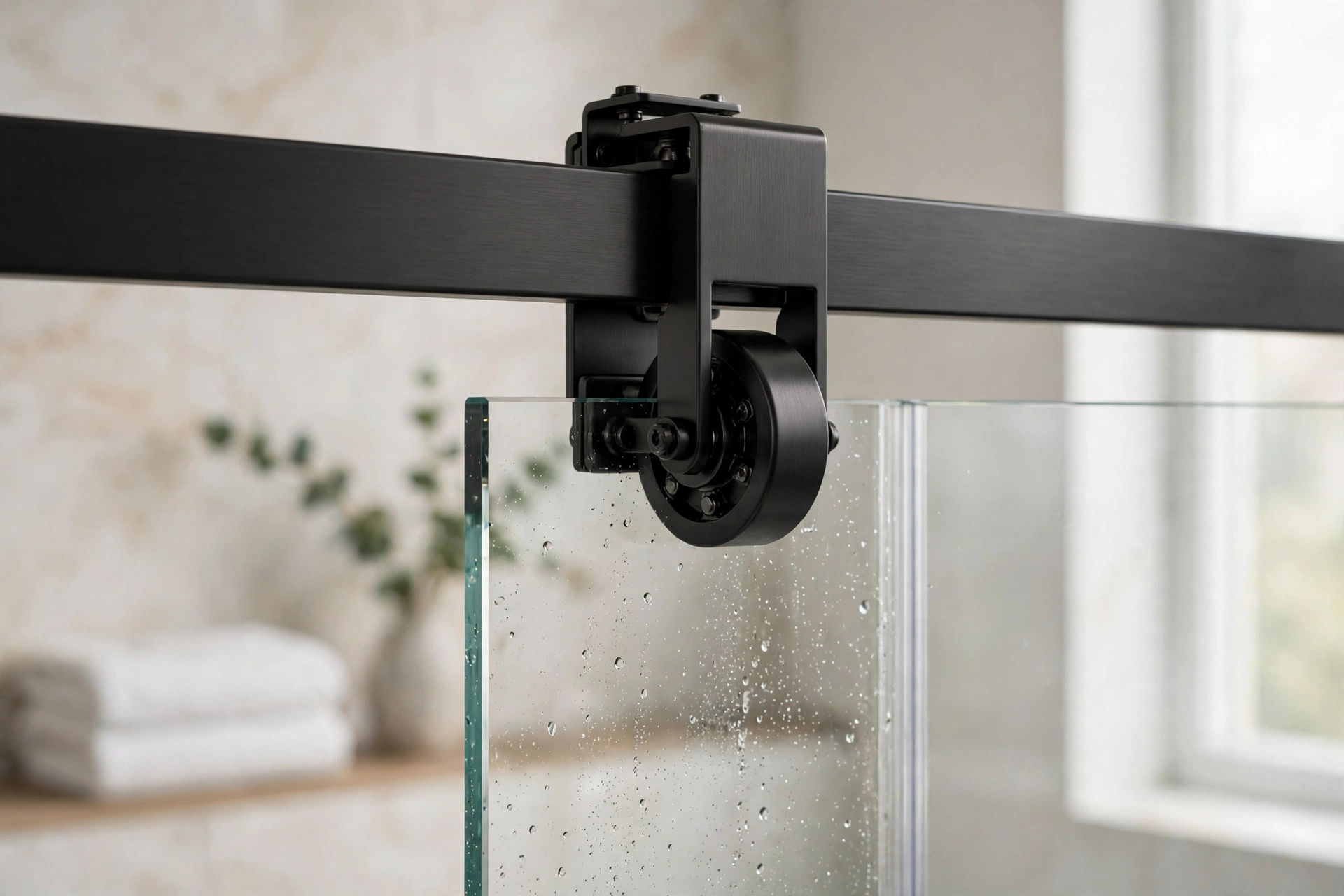
“Frameless” is doing real work in the MESA door’s name. There is no metal frame around the glass panels — just a stainless steel top support bar, rollers, handles, and full-length clear seal strips where the moving panel meets the fixed one. The glass is 3/8″ (10mm) thick clear tempered, which is the industry standard for frameless construction (thinner 1/4″ glass needs a frame for rigidity). MESA coats it with a Nano Technology protective layer that resists water spots and scratches, and the hardware is stainless steel, so corrosion is a non-issue. Total weight: 176 lbs of door.
The semi-frameless sibling keeps the same 3/8″ tempered glass and matt black finish, but adds a stainless steel top guide bar with large rollers that the marketing describes as quiet and smooth. Inside, it has a self-cleaning coating that repels water and contaminants. The hardware is finished to be rust-free and chip-resistant. Same weight — 176 lbs — same price: $468.
Both are ANSI-style safety-glass construction: tempered glass that meets the ANSI Z97.1 safety glazing standard used for shower enclosures in the US, meaning if it ever broke it would crumble into blunt granules rather than shards. That is not a marketing claim; it is building-code reality for any legitimate shower door sold here.
The Measuring Math: Three Tapes, One Opening
Here is the part people skip and regret. Shower door returns are miserable — you are shipping 176 lbs of glass back — so measure like it matters:
- Measure the width at three heights — near the curb, at mid-wall, and near the top. Walls are never perfectly straight. Use the smallest of the three as your opening width.
- Confirm the nominal fit. A “60 inch shower door” like these is sized for a true 60″ opening. My 60.25″ opening was close enough; a 59.5″ opening would need shimming or a different model.
- Check which side your plumbing is on. The MESA frameless door installs with the moving panel on the right side only — that is stated plainly on the product page and it is a deal-breaker if your showerhead wall is on the left.
- Confirm your door swing and clearance outside the shower. A slider needs none, which is the whole point — but confirm the panels will not hit a vanity or light switch when stacked.
- Check your curb. The waterproof seal strips keep water in, but only if the curb is level and the door sits on it squarely.

Frameless vs Semi-Frameless Sliding Shower Doors: The Five Differences That Actually Matter
Same price, same size — so what is the real difference? I made a list and argued with myself about each one:
1. How you get in. The frameless model has one fixed panel and one sliding panel, and the slider only works on the right side. The semi-frameless is a double slider — both panels move, giving two-way entry. If two people share the bathroom at rush hour, two-way access is genuinely useful.
2. Walk-in width. The semi-frameless specs state a 27.3-inch walk-in opening (each door panel is 30.3″ wide). The frameless gives you roughly half of 60 inches of walk-through once you subtract the fixed panel overlap — comparable, but the semi-frameless tells you the exact number, which I appreciated.
3. Install flexibility. This is the frameless door’s one hard limitation: right-side installation only. My showerhead is on the right wall, so it worked — but if yours is on the left, this door is simply not for you, and no amount of loving the look changes that. The semi-frameless double slider has no such handedness constraint.
4. Metal to clean. The frameless has the support bar and rollers; the semi-frameless adds a full top guide bar plus larger rollers — more hardware, more crevices for soap scum. In a hard-water house like mine, less metal wins.
5. The look. The frameless door disappears. Standing in the bathroom, you see glass, tile, and a slim black bar — the shower feels bigger. The semi-frameless reads as a shower enclosure: handsome, but visibly present. For a small bathroom, the visual difference is not subtle.
Glass, Coatings and the Cleaning Math
Both doors fight water spots, just with different coatings: the frameless uses MESA’s Nano Technology protective layer, the semi-frameless a self-cleaning coating on the inside surface. Coatings help, but they are not magic — in my experience with coated glass, the routine that actually works is a 60-second squeegee after every shower. It takes less time than scrolling one headline, and it is the difference between glass that looks new in year three and glass that looks tired in month eight.
Compare that to my old setup: a $28 curtain and rings, replaced roughly every eight months once the mildew won — about $42 a year, plus the weekly scrub of the liner. Over ten years, that is $420 in curtains and a decade of billowing plastic. The $468 door, amortized over a conservative 15-year glass lifespan, is about $31 a year — and you get a bathroom that looks renovated instead of tolerated. (Both lifespan figures are my estimates; tempered glass itself lasts decades, hardware is the wear item.)
Install Day: 176 Pounds of Glass and One Hard Rule
Let me be direct: I did not hang 176 lbs of 10mm tempered glass by myself, and neither should you. The product page recommends a professional plumber for installation, and it is right. My plumber charged $275 and took about two and a half hours — drilling the tile, leveling the bar, setting the seals. Two people minimum for lifting the panels; suction-cup handles are standard kit for any glass installer.
Total project cost: $468 + $275 = $743, done in an afternoon, versus the $1,150 custom-shop quote. I saved about $400 and got a door that afternoon instead of in two weeks. The one non-negotiable: measure first, confirm the right-side-only install works for your plumbing, then order. Glass this heavy does not forgive a wrong guess.
The Industry Numbers: Why Glass Wins at Resale
I checked whether this was just my own bathroom obsession or a real trend. It is a real trend. Remodeling Magazine’s 2024 Cost vs. Value Report puts the resale recoup of a midrange bathroom remodel at roughly 60 percent nationally — and the shower area is consistently one of the highest-visibility parts of that remodel. A dated curtain stall photographs like a dated bathroom; a frameless glass door photographs like a renovation.
The broader market agrees. Home-improvement industry reporting has shown bathroom upgrades holding steady as one of the top renovation categories for a decade, with walk-in showers and glass enclosures repeatedly topping homeowner wish lists. At $468 for a 10mm-glass unit, the FLNORW doors sit well under the installed cost of a custom glass enclosure while delivering the same glass thickness the pros use. That gap is exactly why factory-direct shower doors have become a category.
My Verdict
After a week of measuring, spec-reading, and installer quotes, here is where I landed: I bought the frameless MESA door, because my showerhead is on the right wall and I wanted the door to vanish. If my plumbing had been on the left, I would have bought the semi-frameless double slider without a second thought — the two-way entry and identical glass at the identical $468 price make it the more flexible pick, and its stated 27.3-inch walk-in width removes all guesswork.
Either way, the math held: $743 all-in for a 10mm tempered glass slider that looks custom, versus $1,150 from the local shop and $420 a decade of shower curtains. My guest bathroom finally looks intentional — and the curtain rod is in the garage where it belongs.
Ready to measure? See the frameless sliding shower doors (MESA, 60″×76″, $468) or the semi-frameless double sliding model at the same price. Doing the whole bathroom? My $529 freestanding bathtub review and the $199 anti-fog LED bathroom mirror cover the other two upgrades I made — or start from the FLNORW MALL homepage.