I Bought a $129 Solar LED Patio Umbrella. Two Summers Later, the Night Lights Won Me Over.
I Bought a $129 Solar LED Patio Umbrella. Two Summers Later, the Night Lights Won Me Over.
My solar LED patio umbrella story starts with a July heatwave two summers ago. Our backyard gets full western sun from about 2 p.m. until sunset, and our patio table had become a no-go zone every afternoon — the kind of hot that melts the ice in your drink before you take a sip. I had been limping along with a cheap tilt umbrella from a big-box store, and after three seasons its crank had started grinding like a coffee mill. When I found this 10-by-6.5-foot model on FLNORW MALL for $129, the solar LED lights in the canopy were what caught my eye. Two summers later, I can tell you exactly which parts earned that money and which parts just showed up.
What $129 Actually Buys: The Specs That Matter
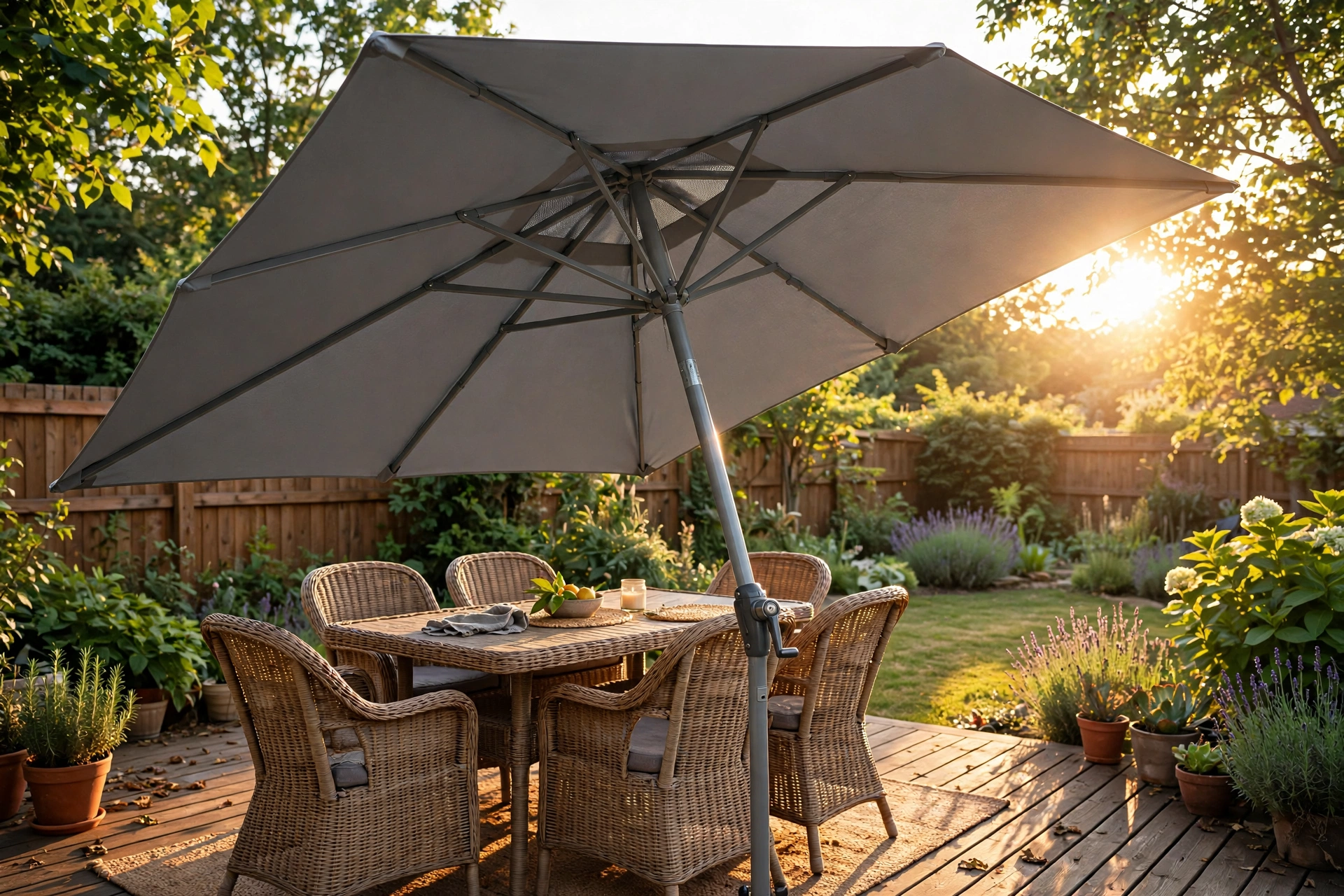
Lets get the facts on the table first, all taken from the product page (item code W65690316). The canopy measures 120 by 78 inches — a true 10-foot by 6.5-foot rectangle — and stands 98.4 inches tall at the pole. The whole thing weighs 14 pounds. The frame is steel with an aluminum pole and six steel ribs under the canopy. The fabric is waterproof, UV-resistant polyester in medium grey, and the canopy is vented at the top. Opening and angling run through two mechanisms: a crank for opening, and a push-button tilt for angling the canopy against low sun.
That rectangular shape is the first decision point. A standard 9-foot round umbrella shades a circle about 64 square feet; this rectangle shades roughly 54 square feet but in a shape that actually matches a rectangular dining table. No dead shade zones on the ends, no corners of the table sticking out into the sun. If your table is square, measure first — but for a rectangular six-seater, the coverage is about as close to perfect as umbrellas get.
Solar LED Patio Umbrella Lights at Night: The Part I Underestimated
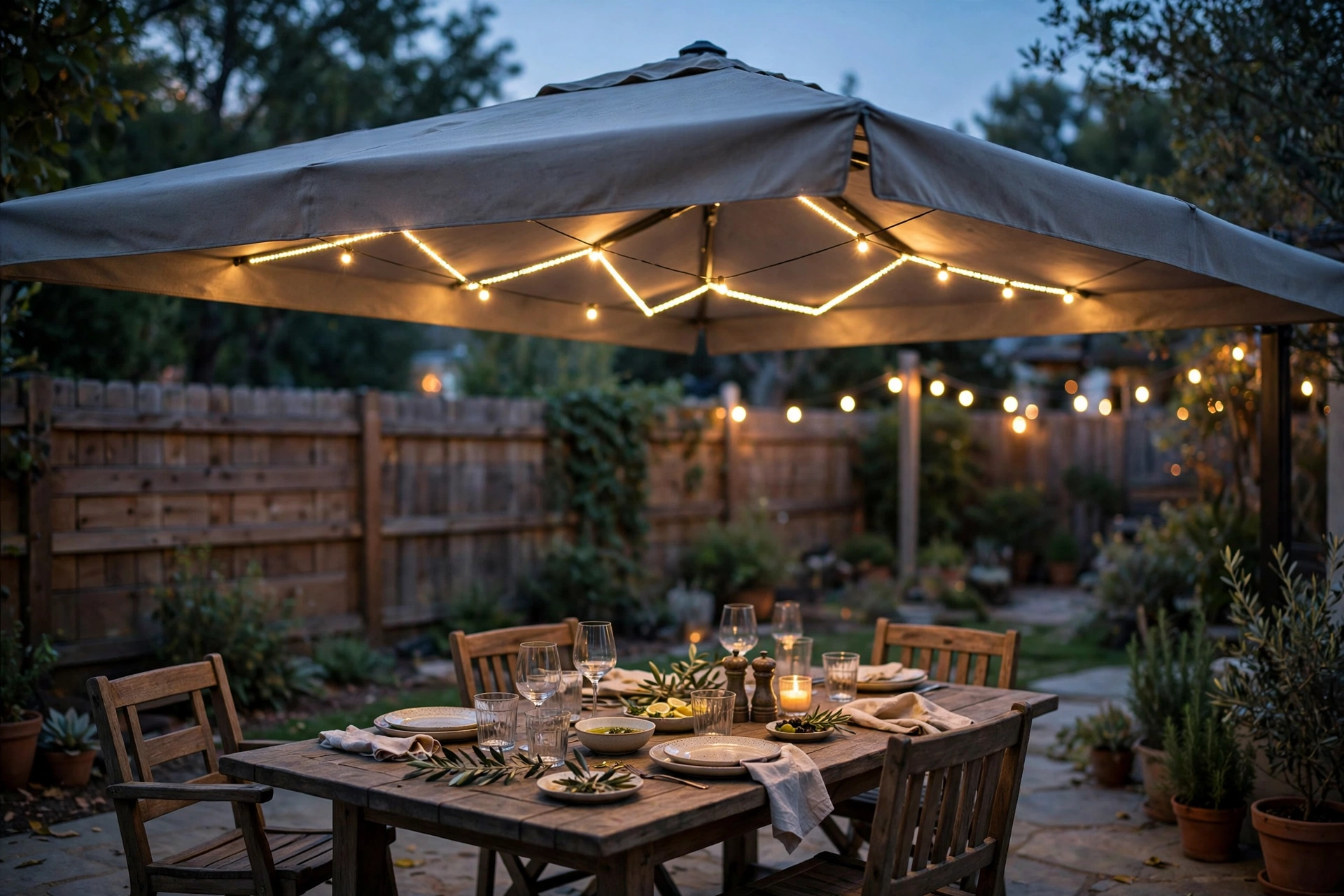
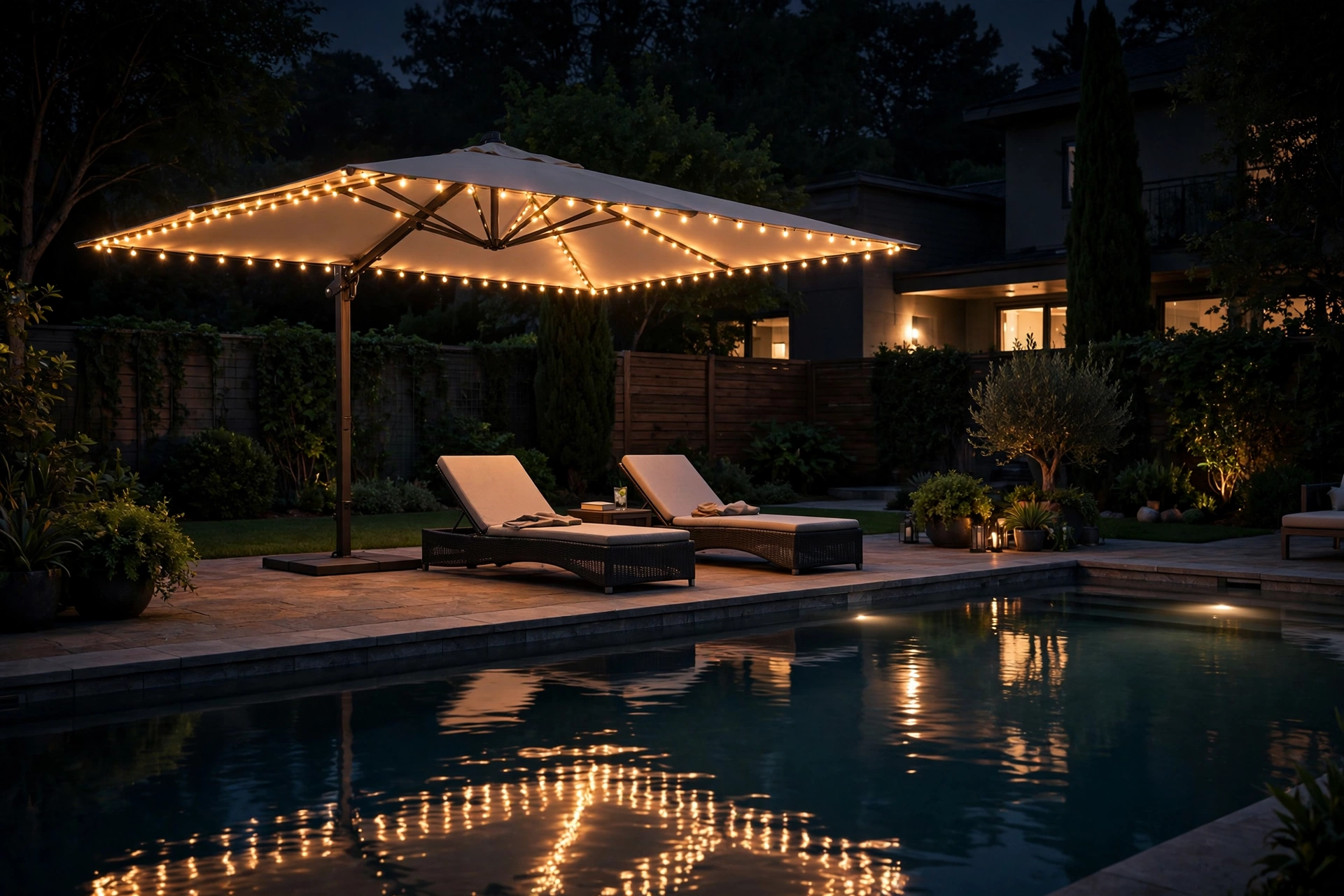
Here is the honest truth: I bought this umbrella for the shade. I stayed for the lights. The solar LED lights sit in the ribs under the canopy, charge from a small solar panel during the day, and switch on automatically at dusk. The first evening they kicked on, my wife and I were cleaning up after a cookout and both of us just stopped and looked up.
The glow is warm and spread across the whole underside of the canopy — not the harsh spotlight effect of a single clip-on lantern, and not the tangled look of string lights draped around the frame. It turns the table into a room. We started eating dinner outside three or four nights a week that summer, something we had never done consistently before, because the patio finally felt like a place and not just a table sitting in the dark.
One note for setting expectations: these are ambiance lights, not task lights. You can see your food and the faces around the table perfectly well, but you are not going to read small print under them. That is the correct design choice for what they are — mood lighting that happens to be practical.
Crank and Push-Button Tilt Through One Long Afternoon
Last August I ran an unintentional stress test. We had six people for lunch, and I spent the whole afternoon re-aiming the umbrella as the sun swung around the yard. Here is the play-by-play: the crank opens the canopy smoothly with one hand — no grinding, no skipped gears, noticeably better than the big-box umbrella it replaced. The push-button tilt is the real workhorse: press the button, lean the canopy to one of its angle stops, and it locks with an audible click.
By about 5 p.m. the sun was low enough to slide straight under a level canopy, and the tilt gave us roughly another two hours of usable shade. That is the difference between leaving the patio at four and staying until dinner. The tilt mechanism still clicks just as positively after two seasons of regular use, which is more than I can say for the old umbrella, whose tilt button jammed permanently in its second year.
The Wind Test: Six Steel Ribs and a Vented Canopy
Every umbrella eventually meets the afternoon gust that tests it. Ours arrived during a thunderstorm warning in June of the first year — the kind of wind that sends lawn chairs tumbling. I was at work; my wife lowered the canopy to horizontal and the umbrella rode it out without a scratch.
Two design details deserve the credit. First, the vented canopy: the small gap at the top lets rising hot air — and more importantly, gusts — escape instead of turning the canopy into a sail. Second, the six steel ribs genuinely flex rather than bend. On a cheaper umbrella I once watched a single gust crease two aluminum ribs permanently. The steel ribs on this one have shrugged off everything short of an actual storm, and during an actual storm I take the canopy down like any sane person.
One honest recommendation: pair it with a proper weighted base. At 14 pounds, the umbrella itself is light by design — that is what makes the crank so easy — but light means the base does the anchoring. A 50-pound base has held ours steady through every gust I would describe as normal summer weather.
The Evening Math: Built-In Solar LEDs vs. String Lights
This is the comparison that sold me in the first place, so lets run the numbers. A basic 9-foot patio umbrella with tilt runs about $60 to $80. A decent set of outdoor solar string lights long enough to wrap a canopy runs $25 to $40. Add a timer or a smart plug if you want them on automatically. All in, you are at $85 to $120 — and you still have to wrap the strands yourself, replace the set when a strand dies, and look at dangling wire every day.
This umbrella is $129 with the lights integrated into the ribs, solar-charged, and automatic. The price premium over a plain umbrella-plus-strings setup is roughly $10 to $45 (my estimate), and what you get for it is cleaner light, zero wiring, and nothing to remember at dusk. Over two summers, I have spent exactly zero dollars and zero minutes on patio lighting maintenance. That is the whole math.
The broader trend backs this up. Dataintelo puts the global patio umbrella market at $1.82 billion in 2025, growing to $3.04 billion by 2034 — a 5.9% annual growth rate — with residential buyers driving about two-thirds of demand. Market Research Intellect specifically names integrated LED lighting as one of the features pulling buyers upmarket. In other words: the industry noticed that people want exactly this, a shade product that also solves evening lighting, and the category is growing because of it.
Two Honest Annoyances
Nothing survives two summers without earning a complaint or two.
- Medium grey shows pollen. For about three weeks every spring, the canopy wears a yellow-green dusting that makes the whole umbrella look tired. A garden hose knocks it off in two minutes, and the waterproof polyester sheds it cleanly — but if you are the type who notices, pick one of the darker color options.
- The lights run on a solar budget. On overcast weeks in late fall, the LEDs burn dimmer and switch off earlier. That is physics, not a defect — a small panel can only harvest so much — but if your patio sits in deep shade all day, expect the lights to be a dusk feature rather than an all-evening one.
Neither of these would stop me from buying it again. Both are the kind of thing a product page will never tell you and a two-summer owner will.
Who Should Buy This — and Who Should Get the Gazebo
This umbrella is for a rectangular dining table and an owner who wants shade by day and ambiance by night with zero extra gear. If your setup is a six-seat table and you eat outside regularly, it is the right tool. The 10-foot by 6.5-foot canopy also works beautifully over a pair of loungers or a small conversation set.
If you are trying to cover a whole seating area plus a grill, be honest with yourself and step up to the 11×11 pop-up gazebo at $249 — that is the tool for 121 square feet of coverage, and no umbrella competes with it. And if your patio gear does a lot of traveling — beach trips, tailgates, soccer fields — the folding garden wagon at $120 has become our official equipment mule. For everything in between, the umbrella is the sweet spot.
The Verdict
Two summers in, this is one of the few purchases I never second-guess. The solar LED patio umbrella shaded every lunch, lit every evening cookout, and survived every gust that was not a full storm. The crank is still smooth, the tilt still clicks, and the lights still switch on by themselves at dusk like a small reliable ritual. At $129, the integrated lighting alone would justify it against a plain umbrella — and the shade quality would justify it against cheap string lights. Together, they make the rare product that solves two problems for the price most umbrellas charge for one.
Ready for shade that works after dark?
See the full specs, colors, and current price of the 10×6.5FT Solar LED Patio Umbrella with Crank and Push-Button Tilt on FLNORW MALL — $129, in stock, and ships in a 71-inch box that fits in any back seat.