I Tested a Room Divider for Studio Apartment Living. Here Is What $128 Bought Me.
I Tested a Room Divider for Studio Apartment Living. Here Is What $128 Bought Me.
When my lease renewal landed last spring, I did the math every renter in a big city does: stay in my 480-square-foot studio at $1,650 a month, or pay $2,100 or more for a one-bedroom so my bed stops showing up on work video calls. I stayed — the numbers were not close. Then I spent the next three months figuring out how to make one room do the work of two. The cheapest serious idea I found was a room divider for studio apartment life: a 3-panel folding wood screen from FLNORW MALL for $128. Two months later, I can tell you exactly what it fixed, what it did not, and the honest math behind it.
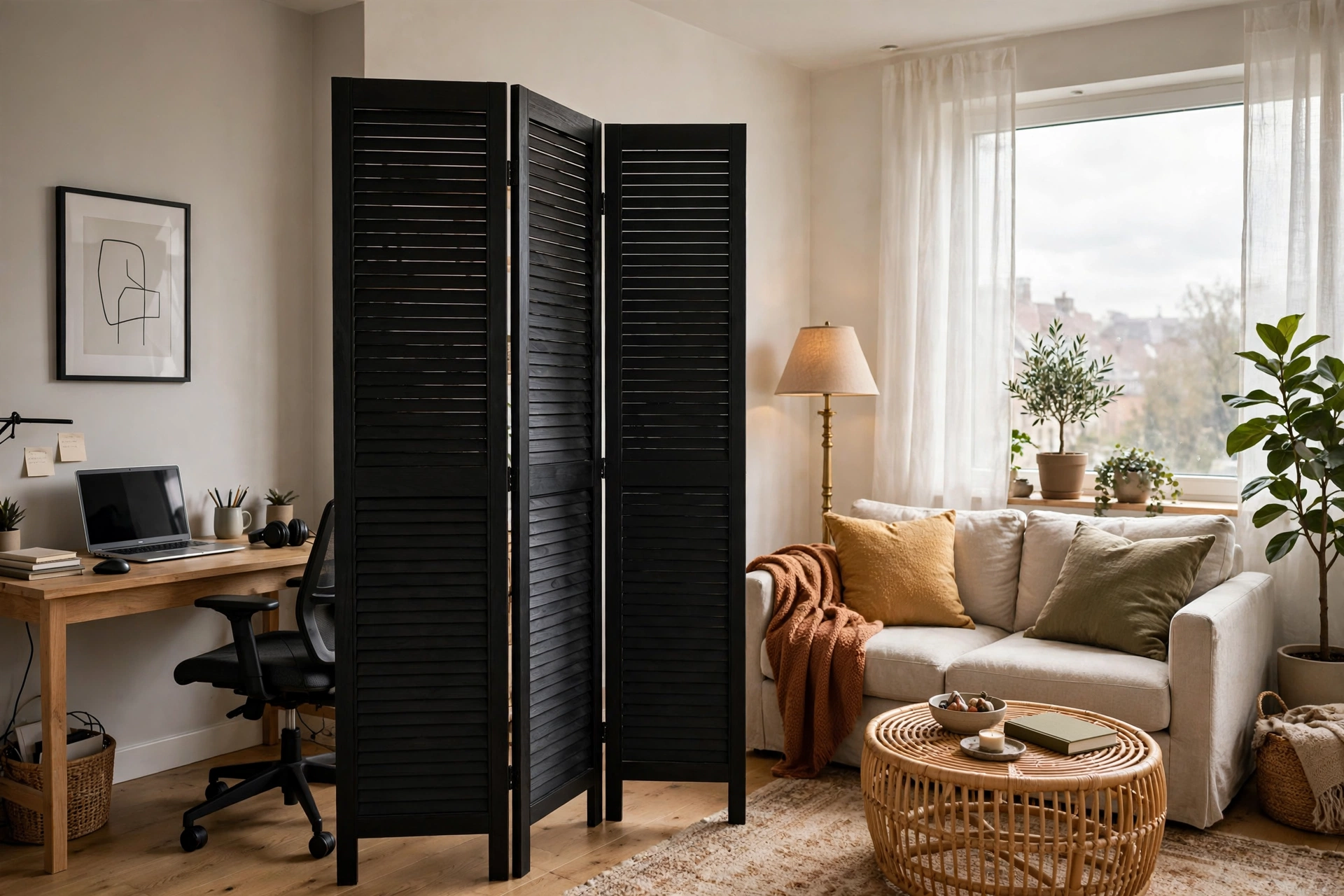
The three problems one room creates
Problem one is the video call problem. My “office” is a desk in the corner of the living area, and every call puts my unmade bed in frame behind me. I started angling the laptop so the wall was behind me, which worked until a coworker asked why I was always sitting in a corner like I was being punished.
Problem two is the shutdown problem. When your desk and your bed share a sightline, work never quite ends. I would brush my teeth while staring at my inbox tabs, and I would wake up staring at the same desk. There is no door to close, so the brain never gets the signal.
Problem three is the guest problem. My studio is 480 square feet, and everything in it is visible from the front door: bed, desk, drying laundry, all of it. Hosting a friend for dinner felt like inviting someone into my bedroom, because it literally was.
What the 6ft room divider actually is
FLNORW MALL lists it as a 3-panel room divider, 6 feet tall, and the specs are refreshingly plain: 44.49 inches long unfolded, 70.87 inches tall (about 5-foot-11), 20 pounds, a metal frame with wood panels, in black or natural finish. It is free-standing — no drilling, no wall brackets, no landlord negotiation required. It ships in one slim box (the package is 37 inches long and 6 inches deep) and it went from box to standing in my apartment in about thirty seconds: you unfold it accordion-style and it stands on its own.
That thirty-second setup is the whole renter pitch. Nothing attaches to anything. If the experiment fails, it folds flat and slides behind a door.
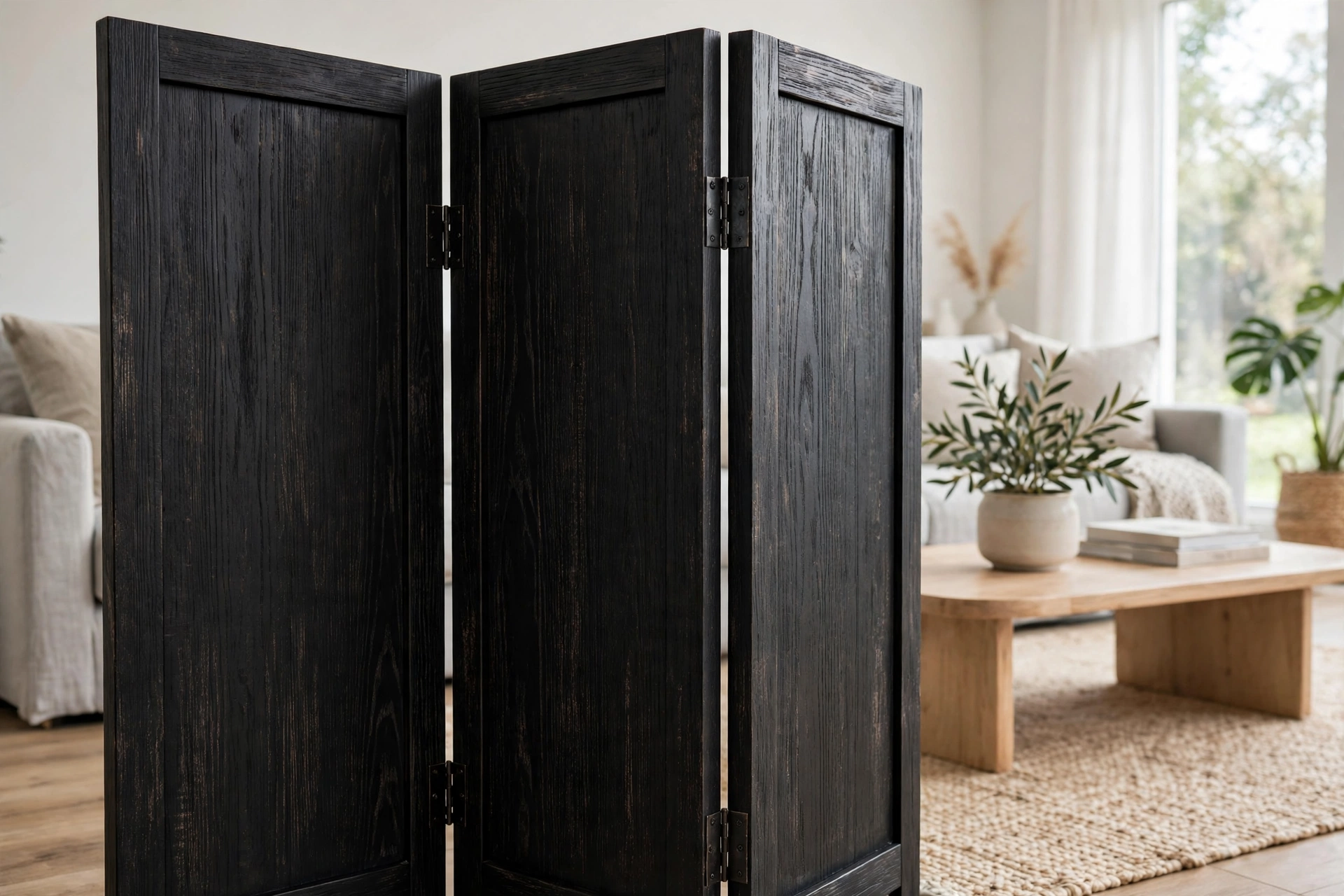
Three jobs it does in my week
I use it three ways, on a schedule I did not plan but fell into:
- Office nook by day. It stands between my desk and the bed during work hours. On video calls, my background is now dark wood panels instead of a rumpled duvet. Three coworkers have commented on it; two asked where it was from.
- Bedtime boundary. At night I swing one panel a few inches so the desk lamp does not throw light across the bed. It is a tiny change, but falling asleep without a glowing monitor in my peripheral vision is genuinely different.
- Guest mode. When friends come over, I fold it flat against the hallway wall in about ten seconds. The apartment opens back up, and nobody has to eat dinner facing my pillows.
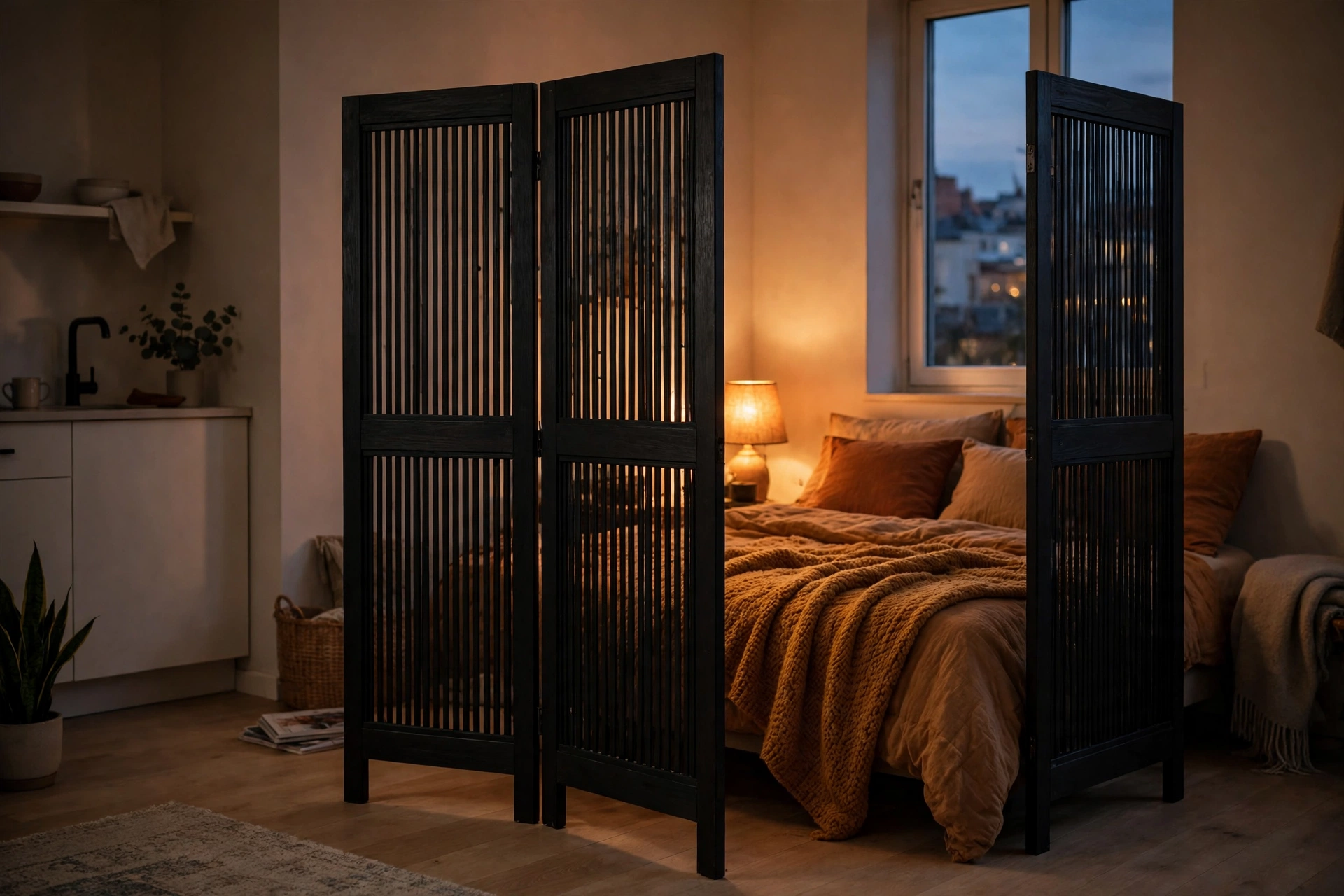
The wobble test: does it stay put?
This was my main worry before buying. Twenty pounds sounds light for something nearly six feet tall, and my studio has a ceiling fan, a drafty window, and a cat who treats all furniture as a suggestion.
Two months in, here is the honest report: the accordion fold is doing structural work. The zigzag footprint means the panels brace against each other, and the thing has not tipped once — not from the fan, not from the window draft, not from the cat shouldering through the gap where two panels meet. What it will do is slide. Lean on it with real weight and the feet scoot across the floor. It is a screen, not a wall and not furniture. Set it where it belongs and leave it alone, and it is rock solid; treat it like a handrail and it will remind you it is not one.
What it can not do — and nobody should promise it
Honesty requires the limits up front. It is 70.87 inches tall and my ceilings are nine feet, so light and kitchen smells travel over the top. It blocks sightlines, not sound: if I am on a call, the roommate-shaped absence of a roommate still lets the dishwasher narrate the meeting. And if your studio’s real problem is a galley kitchen two steps from the pillow, no screen on earth fixes that.
What it does is visual privacy. That sounds modest until you live without it. A room you can visually divide is a room where one half can look done while the other half is mid-laundry. For $128, “looks like I have my life together on demand” turned out to be the feature I use most.
The numbers behind the trend
I am clearly not the only person trying to chop a small apartment into smaller pieces. RentCafe’s 2025 analysis, published by the National Apartment Association, found the average US studio apartment reached 457 square feet in 2024 — up 13 square feet, the biggest jump of any unit type — while the average apartment overall hit 908 square feet. Studios and one-bedrooms together make up more than half of new apartment supply. (Source: National Apartment Association, “Average Apartment Sizes Increasing,” May 5, 2025.)
Meanwhile, the work-from-home numbers keep climbing. The Bureau of Labor Statistics reported in October 2026 that 36.9% of wage and salary workers could work from home in 2024-25, and about 51 million Americans worked at home at least occasionally. (Source: U.S. Bureau of Labor Statistics, The Economics Daily, October 7, 2026.)
Put those together: more people renting small units, and more of them working inside those units all day. The folding privacy screen — a product that barely existed in furniture catalogs a decade ago — is having a moment for exactly this reason. I checked: my building’s group chat has three separate threads about them.
The $128 worth-it math
I priced the alternatives before buying, and it is not close:
- Tension rod + curtain: about $40-70. Cheapest option, but it looks temporary, it billows when the fan runs, and it does nothing for the guest problem.
- Open bookshelf as divider: $150-300, and you gain storage — but it is heavy, semi-permanent, and you sacrifice a whole wall of it.
- Moving to a one-bedroom: in my market that is roughly $450-600 more per month, or about $5,400-7,200 a year. That is my rough estimate from local listings, flagged as such.
- The $128 screen: one-time cost, about $10.67 a month if it lasts a year. It has already lasted two months of daily repositioning with no loose hinges and no wobble.
If you want to extend the flexible-small-space thinking to the dining half of your studio, the stretchable dining table from the same store runs 47.24 to 62.99 inches when guests show up — same philosophy, different room. The broader furniture collection at FLNORW MALL has the rest of the small-space lineup.
The verdict
Two months in, my verdict is simple: this thing does not give you a second room. It gives you a visual door — and in a 480-square-foot studio, a visual door turned out to be worth $128. My calls look professional, my bedtime brain finally gets a “work is over” signal, and dinner guests no longer eat facing my pillows. Buy it if your problem is sightlines and layout; skip it if your problem is noise, because wood panels will not save you from a loud neighbor or a loud dishwasher.
If you want the exact specs — the 44.49-inch width, the 70.87-inch height, and the natural finish option — they are on the 3-panel room divider product page at FLNORW MALL.