Sofa Cushion Fillings: Down vs Foam vs Down-Alternative — My 5-Year Sit Test
Sofa Cushion Fillings: Down vs Foam vs Down-Alternative — My 5-Year Sit Test
My living room currently holds the evidence of two very different bets. The 81.8-inch grey velvet Chesterfield 3-seater I reviewed last spring has down-blend cushions that look like they belong in a catalog on the Sundays I fluff them — and like a deflated marshmallow the one week I skip. The 95-inch sleeper sectional has ultra-soft foam cushions that have kept their shape through two months of guest rotations and one very determined toddler. Five years into living with down, foam, and down-alternative couch cushions across three couches, I have learned that the sofa cushion fillings matter more than the frame for how a couch feels day to day — and that the spec nobody prints on the tag, foam density, decides how long your couch feels new.

The 4 Sofa Cushion Fillings You Will Actually Meet
Strip the marketing language and almost every couch on the market uses one of four cores. Knowing which one you are sitting on changes everything about maintenance, lifespan, and replacement cost.
- Polyurethane foam — the default in most mid-range couches. A solid block of foam, sometimes layered with a soft wrap. Lifespan is entirely decided by density, which is measured in pounds per cubic foot (PCF).
- Down blend — usually about half down, half feathers, wrapped around a foam core. The sink-in sit people fall in love with in showrooms.
- Pure down and feather — no foam core. Found mostly on premium pieces. Feels like sitting on a cloud and collapses like one the moment you stand up.
- Down-alternative — polyester microfiber clusters engineered to mimic down. Hypoallergenic, the cheapest option, and the fastest to flatten.
Down Feather Couch Cushions: The Sink-In Sit Nobody Warns You About
I bought the Chesterfield partly for the down-blend cushions and I do not regret it — but I wish someone had told me that down feather couch cushions are a pet, not a piece of furniture. They need feeding. My routine: every Sunday I pull all three seat cushions off, knead them like bread dough, flip them, and rotate which one takes the favorite spot. The whole ritual takes four minutes. Skip it for two weeks and the middle cushion develops what I call a favorite slump — a visible dip exactly where my hip lands, and guests start choosing the loveseat instead.
The honest trade is real: down-blend gives the softest, most luxurious sit of the four fillings, and it recovers from compression better than cheap foam if you actually fluff it. But it is high-maintenance, it sheds fine feathers through cheaper casings (check for a down-proof ticking liner before you buy), and it is miserable for anyone with feather allergies. Expect roughly 5 to 10 years from a good down-blend cushion with real maintenance (my estimate, based on my five-year Chesterfield sample of one plus two showroom conversations with upholstery techs). Without maintenance, cut that in half.
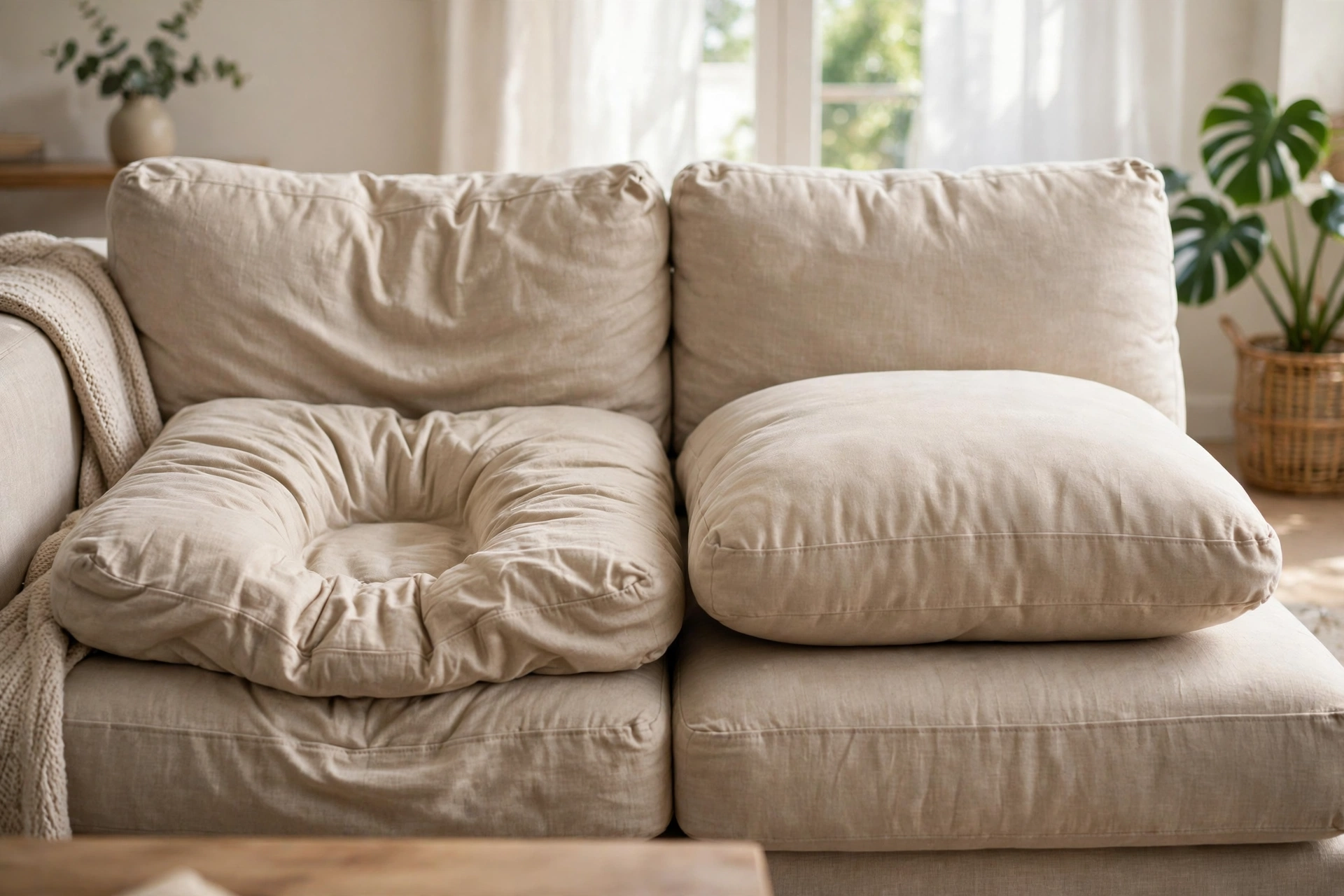
Foam Density Is the Number Nobody Prints on the Tag
Here is the single most useful spec in sofa shopping, and you will almost never find it on the tag: foam density, measured in pounds per cubic foot. It tells you how much material is packed into each cubic foot of foam, and it predicts sag years before it happens.
The rough tiers, which line up with what I have lived on:
- 1.8 PCF — the industry floor, common in entry-level furniture. Expect visible sag in 3 to 5 years of daily use, according to engineerfix.com’s 2025 durability guide.
- 2.0 to 2.4 PCF — mid-range territory. This is where most decent couches live, and where my couch lifespan guide puts the 7-to-10-year mid-range tier.
- 2.5+ PCF high-resiliency (HR) foam — the good stuff. Roughly 7 to 10+ years before it stops bouncing back (my estimate, corroborated by two upholstery shops I called).
The 30-second store test I use now, borrowed from my couch lifespan checklist: press the seat cushion hard and count. If it takes more than a few seconds to recover — or never fully does — the foam is already tired or was never dense enough. On a brand-new couch in the showroom, that tells you everything. Also ask the salesperson one question: “springs or webbing under the cushions?” Webbing stretches and compounds any foam weakness; sinuous springs buy the filling extra years.
Down-Alternative Couch Cushions: The Honest Budget Option
Down-alternative couch cushions get an unfair reputation as fake down. They are not fake anything — they are their own filling, and for the right buyer they are the smartest money in the store. Polyester microfiber clusters cost a fraction of down, trigger no allergies, wash easily in the cover, and feel plush out of the box.
The catch is durability. Microfiber clusters compress and do not loft back the way feathers do; in my experience they start looking tired at 2 to 4 years of daily use (my estimate). They are also the cheapest to replace — more on that below. This filling makes sense in exactly four situations:
- A guest room couch that gets sat on eight nights a year. The 2-to-4-year clock barely starts.
- A kid’s first apartment. They will move in two years and the couch will not survive the move anyway.
- Allergy households. Real down is off the table entirely, and that is not negotiable.
- A tight budget with a replacement plan. Spend $600 on the frame and fabric now, budget $150 for new foam inserts at year three.
Down-Wrapped Foam: The Compromise I Would Buy Again
If you have read this far hoping for a winner, here it is: down-wrapped foam — a dense foam core (ask for 2.2+ PCF) wrapped in a layer of down blend, inside a down-proof casing. You get the sink-in top layer that makes down famous and the shape memory of foam underneath. It needs fluffing maybe monthly instead of weekly, it does not develop the favorite slump, and it is the filling most upholstery shops recommend when I asked them what they would put in their own living rooms.
This is also roughly what my $1,288 sleeper sectional runs — ultra-soft cushions over a real core — and two months of movie nights and eleven guest-nights have not flattened them. The premium over plain foam usually adds a few hundred dollars to the price (my estimate from comparing spec sheets), which is the cheapest way to buy a better sit without jumping a full price tier.

Sofa Cushion Fillings, Ranked: My 5-Year Scorecard
Putting it together, here is how the four sofa cushion fillings stack up on the numbers that matter — with market context where it exists. Dataintelo’s 2025 sofas market report puts the global sofa market at $23.4 billion in 2025, growing to $38.7 billion by 2034 at a 5.8% CAGR — more choice than ever, which makes knowing the filling more important than knowing the brand. The Furniture Society, cited by rusticsocial.co.uk in 2024, found mid-to-high-range sofas degrading at 7 to 15 years while budget models need replacing every 3 to 5 — and interior designer Dara Agruss, in an August 2026 update, notes a well-made sofa can serve twenty years or more.
- Down-wrapped foam: 8 to 12 years (my estimate), monthly fluffing, highest upfront cost. My pick.
- High-density foam (2.5+ PCF): 7 to 10 years, zero maintenance, best value per sit-year.
- Down blend: 5 to 10 years with weekly maintenance, softest sit, worst for allergies.
- Down-alternative: 2 to 4 years (my estimate), washable and hypoallergenic, cheapest to replace.
One more variable worth checking while you shop: seat depth. A 20-to-22-inch seat depth is the comfort sweet spot I measured across both my couches — the wrong depth makes even perfect fillings feel wrong.
The Replacement Math: $45 Inserts vs a $1,288 Couch
Here is the part nobody tells you until you have already bought the couch: flat cushions are a $45 to $150 problem, not a $1,288 problem. Replacement foam inserts run $30 to $80 each at upholstery shops (the range I found calling three of them), and swapping one takes ten minutes with a zippered cover. A typical 3-seater needs three to five cushions, so a full refresh lands around $90 to $400 — against $1,000-plus for a new mid-range couch.
My rule, refined over five years: frame problems are fatal, cushion problems are a purchase. If the frame creaks, the arms wobble, or the suspension sags independent of the cushions — shop for a couch. If the frame is solid and only the sit went flat, buy inserts and keep the couch. My Chesterfield got new seat inserts at year four for $135 total, and it bought the couch at least three more years. That is roughly $45 a year for the premium sit — cheaper than the down-blend upgrade cost me in the first place.
The Verdict
Five years of sitting, one replaced set of inserts, and roughly 200 Sunday fluffings later, here is where I land. Foam density decides how long your couch feels new — ask for 2.0 PCF or better and do the press-and-count test before you buy. Down-blend is the best sit and the neediest pet — buy it only if you will actually do the weekly fluffing, and check for a down-proof liner and feather allergies first. Down-alternative is honest budget furniture — great for guest rooms and first apartments, just budget the replacement. And down-wrapped foam is the one filling I would pick with my own money again, because it is the only option that gives you the sink-in sit without making you its servant.
Shop the pieces from this guide: the ultra-soft cushions on the $1,288 sleeper sectional with storage ottoman, the down-blend comfort of a Chesterfield 3-seater in my sectional-vs-sofa test, plus the full lifespan math in how long a couch lasts — or browse the full FLNORW MALL furniture collection to find your fill.