Mattress Sizes Chart: What Buying the Wrong Size Twice Taught Me
I have now bought the wrong mattress size twice in my adult life, and both mistakes cost me real money and real sleep. The first time, I ordered a king for a 10-by-12 bedroom because bigger felt like a treat. The delivery crew spent twenty minutes angling it through the doorway while I stood there realizing the bed would fill the room like a parking lot. The second time, I bought beautiful deep-pocket sheets for a new mattress without checking its thickness, and the corners popped off every single night for a month. A mattress sizes chart with a few honest rules would have prevented both disasters. This is the guide I wish someone had taped to my wall before I clicked buy.
The mattress sizes chart: all seven standard dimensions
Everything below uses the industry-standard dimensions that the International Sleep Products Association (ISPA) and every major US retailer work from. They do not vary by brand in any meaningful way — a queen is a queen.
- Twin: 38 x 75 inches — one kid, one teen, one guest.
- Twin XL: 38 x 80 inches — college dorms and tall teens; the extra five inches of length matters more than it sounds.
- Full (Double): 54 x 75 inches — a couple in a tight room, or one adult who sprawls.
- Full XL: 54 x 80 inches — the sleeper size for tall single adults who want width too.
- Queen: 60 x 80 inches — the most popular size in the US, per Sleep Foundation’s mattress size guide, and the default I recommend to most couples.
- King: 76 x 80 inches — two adults with room to never touch. Needs a real bedroom to breathe in.
- California King: 72 x 84 inches — narrower than a king but four inches longer; built for tall sleepers.
Write these on a sticky note before you shop. Every rule that follows is just arithmetic on top of these seven numbers.
Twin vs full: the guest-room decision
The gap between a twin and a full is sixteen inches of width — 38 versus 54. That sounds small until you put two kids on a full and watch them each get 27 inches, which is roughly the width of a crib mattress and change. Fine for a guest room, tight for nightly use.
My rule: buy a twin for a kid under twelve or a room that doubles as an office, and buy a full for a guest room that hosts couples or teenagers. The price difference between twin and full mattresses is usually modest — often under a hundred dollars — while the comfort difference for two sleepers is enormous. The one exception is a very small room: a full is 54 inches wide, and in a room under nine feet across it starts to dominate the floor the way my king dominated mine.
Mattress sizes and room fit: the 10×10 rule
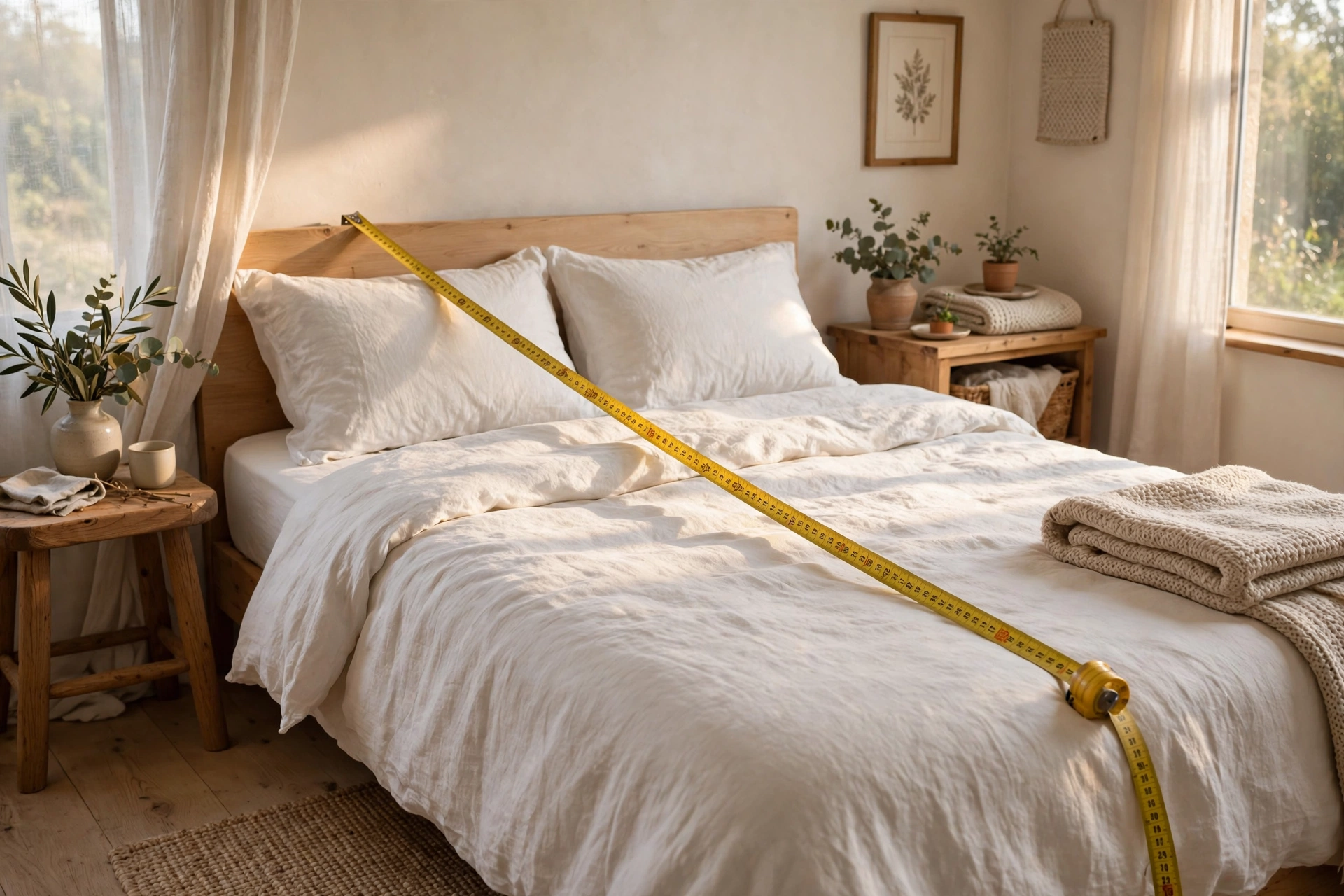
A queen mattress is 60 by 80 inches, but the mattress is not the footprint — the frame is. Add a typical frame and headboard and you are looking at roughly 63 by 88 inches on the floor, which is the number I taped out with painter’s tape in my 10-by-12 guest room and immediately understood.
The rule of thumb I live by now: a queen wants a bedroom of at least 10 by 10 feet, and a king wants at least 12 by 12. Below those numbers you can physically fit the bed, but you lose the 24 inches of walkway on each side that keeps a bedroom from feeling like a storage unit. I laid out seven floor plans for a queen in a small bedroom — centering it on the long wall, pushing it into a corner, even floating it with a dresser behind — and every plan that worked started from those two room minimums. If you are furnishing a room smaller than 10 by 10, drop to a full and thank me later.

King vs California king: four inches that matter
Here is the comparison almost nobody explains at the store. A standard king is 76 by 80 — wider than a Cal King by four inches, shorter by four inches. A California king is 72 by 84 — narrower, longer. Same price tier, completely different sleeper.
The decision is almost entirely about height. If either sleeper is over six feet tall, the extra four inches of length on a Cal King is the difference between feet hanging past the edge and feet staying on the mattress. If both sleepers are average height and you value elbow room — a partner who starfishes, a dog who claims a corner — take the standard king’s extra width. One more practical note: standard king bedding and frames are easier to find and usually cheaper than Cal King versions, which is a niche tax worth knowing about before you commit.
Mattress thickness: the detail that broke my sheet set
Mattress sizes get all the attention; mattress thickness does the damage. Profiles run from about 6 inches (thin bunk and trundle mattresses) to 14 inches and up (luxury pillow-tops). Two things depend on getting this number right.
First, your sheets. Standard fitted sheets grip mattresses up to about 12 inches; beyond that you need deep-pocket sheets rated 15 inches or more. My popping-corner month was a 14-inch mattress in 12-inch sheets — a fifteen-dollar problem that took me four weeks to diagnose because I assumed the elastic was bad.
Second, your frame. Some frames are picky. The hydraulic storage bed I reviewed recommends a 6-to-8-inch mattress — thicker than that and the lift struts strain and the lid sits too high. Check the frame’s spec sheet before you fall in love with a 14-inch pillow-top, or you will own a very expensive mismatch. The PU leather queen bed frame I keep in my spare room is the opposite: a true 80-by-60 queen footprint on slats, no box spring needed, happy with anything from 8 to 14 inches.
The frame-fit rule: measure the inside, not the box
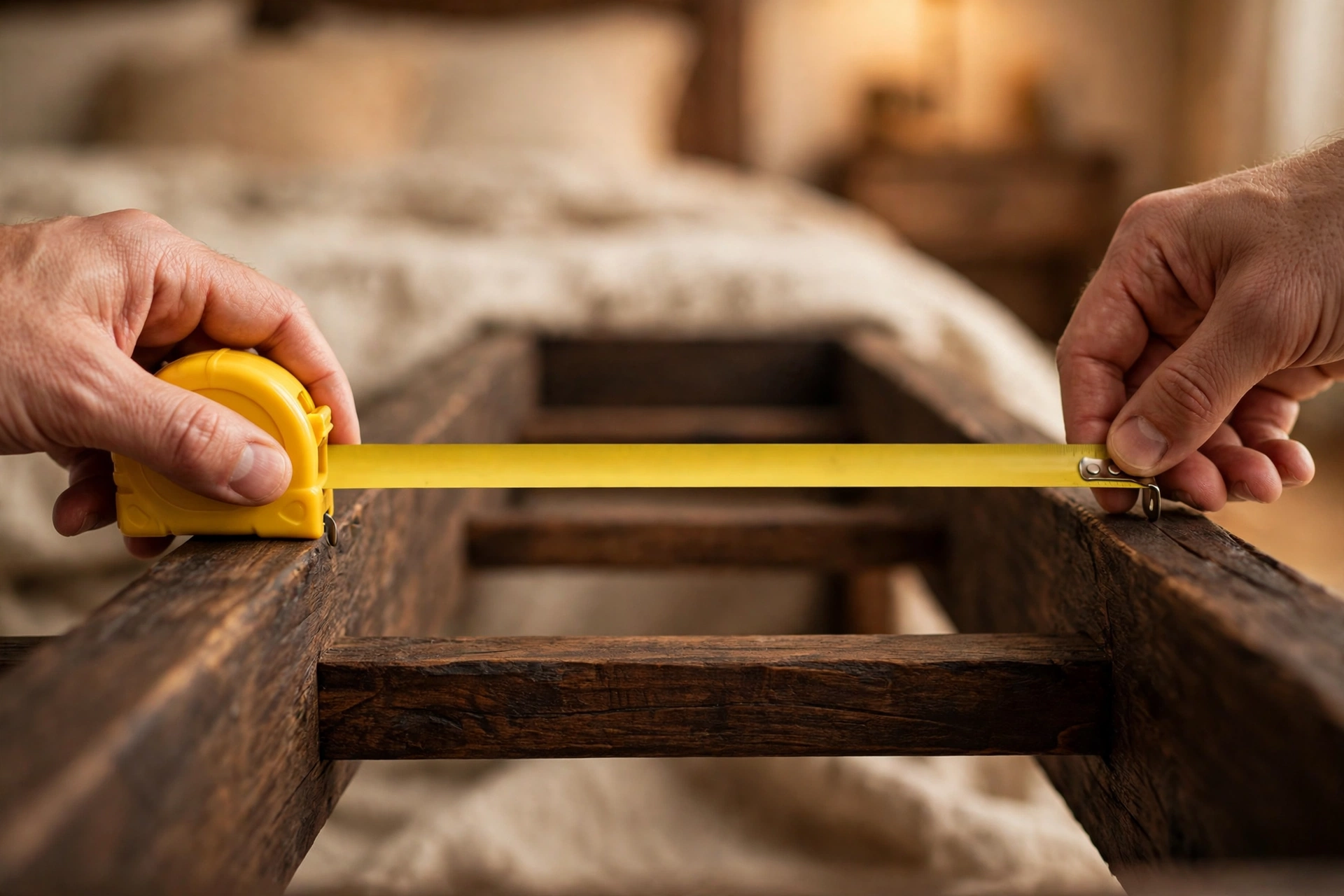
Here is the mistake that caused my first wrong-size purchase, and it was not really about the mattress at all. I measured the mattress and I measured the doorway, and I never measured the frame’s inside rails. The frame I had bought was a full-size frame; the mattress I ordered was a queen. Sixty inches of mattress does not go into 54 inches of frame, and discovering that on delivery day is a special kind of embarrassment.
The rule: measure the inside of the frame rails — the actual sleeping cavity — and compare it to the mattress dimensions. You want the cavity to be within about one inch of the mattress on each side: snug enough that the mattress does not slide, loose enough that bedding tucks in. If you are buying both at once, confirm the frame’s stated size matches the mattress size exactly, and then confirm it anyway with a tape measure when both arrive. I photograph the tape on the rails now, the way I did when checking queen-bed floor plans for a small room — it takes ninety seconds and it has saved me twice.
How long a mattress should last: the replacement math
ISPA puts the average mattress replacement cycle at 7 to 10 years, and that number is worth doing math on. A $1,000 queen that lasts eight years costs about $125 a year — roughly 34 cents a night. A $400 mattress you replace every four years because it sags costs the same per year and sleeps worse the whole time. This is the one furniture category where buying the better version once beats buying the cheap version twice, because you cannot see the sag developing and your back keeps the receipts.
The signal to replace is not the calendar, though — it is the morning. If you wake up stiff in a bed that used to feel fine, and the mattress is past year seven, the calendar is just confirming what your spine already voted on. Rotate it first (free), try a topper second (cheap), and if neither helps for two weeks, start shopping with the chart at the top of this article open.
My sizing verdict: the order I would buy in
After two wrong sizes, one sheet disaster, and more tape-measure afternoons than I care to admit, here is the sequence I would hand anyone: measure the room first, pick the size that leaves 24 inches of walkway on every used side, measure the frame’s inside rails before ordering anything, check the frame’s mattress thickness limit, and only then pick the mattress. Room, frame, thickness, mattress — in that order, no skipping.
For most couples in a normal bedroom, that lands on a queen: the most popular size in the US for good reason, big enough for two adults and small enough to leave a room livable. For tall sleepers, the Cal King earns its niche. For everyone else, the chart at the top has not changed in decades — the only thing that changes is whether you measured before you bought.
The verdict: mattress sizes are standardized, rooms are not, and every expensive mistake I have made came from measuring the wrong thing. Tape the footprint on your floor, measure the frame rails, check the thickness spec, and the chart does the rest. Two wrong sizes taught me more than any salesperson ever did — I just wish the lessons had been cheaper.
Start with the frame that fits your size: my full review of the $388 hydraulic storage bed covers the 6-to-8-inch mattress rule in detail, and the $299 PU leather queen bed frame is the true 60-by-80 footprint I measured mine against. Planning the room around it? Read the 7 queen-bed floor plans for small bedrooms and the 9-drawer dresser sizing guide first — or browse the full FLNORW MALL bedroom collection.