I Bought a $199 Kids Climbing Dome With a Slide. Two Months Later, Here’s the Honest Verdict.
I Bought a $199 Kids Climbing Dome With a Slide. Two Months Later, Here’s the Honest Verdict.
Leo, my three-year-old nephew, has exactly one speed: full sprint. My brother’s backyard in the suburbs — about 40 feet deep, fence on three sides, one very tired maple tree — is where Leo burns off the afternoons, and this past August it wasn’t working. The sandbox had become a dirt supply depot. The plastic slide he’d outgrown sat in the corner like a traffic cone. So I bought the thing I kept seeing in other people’s yards: a kids climbing dome with a slide attached.
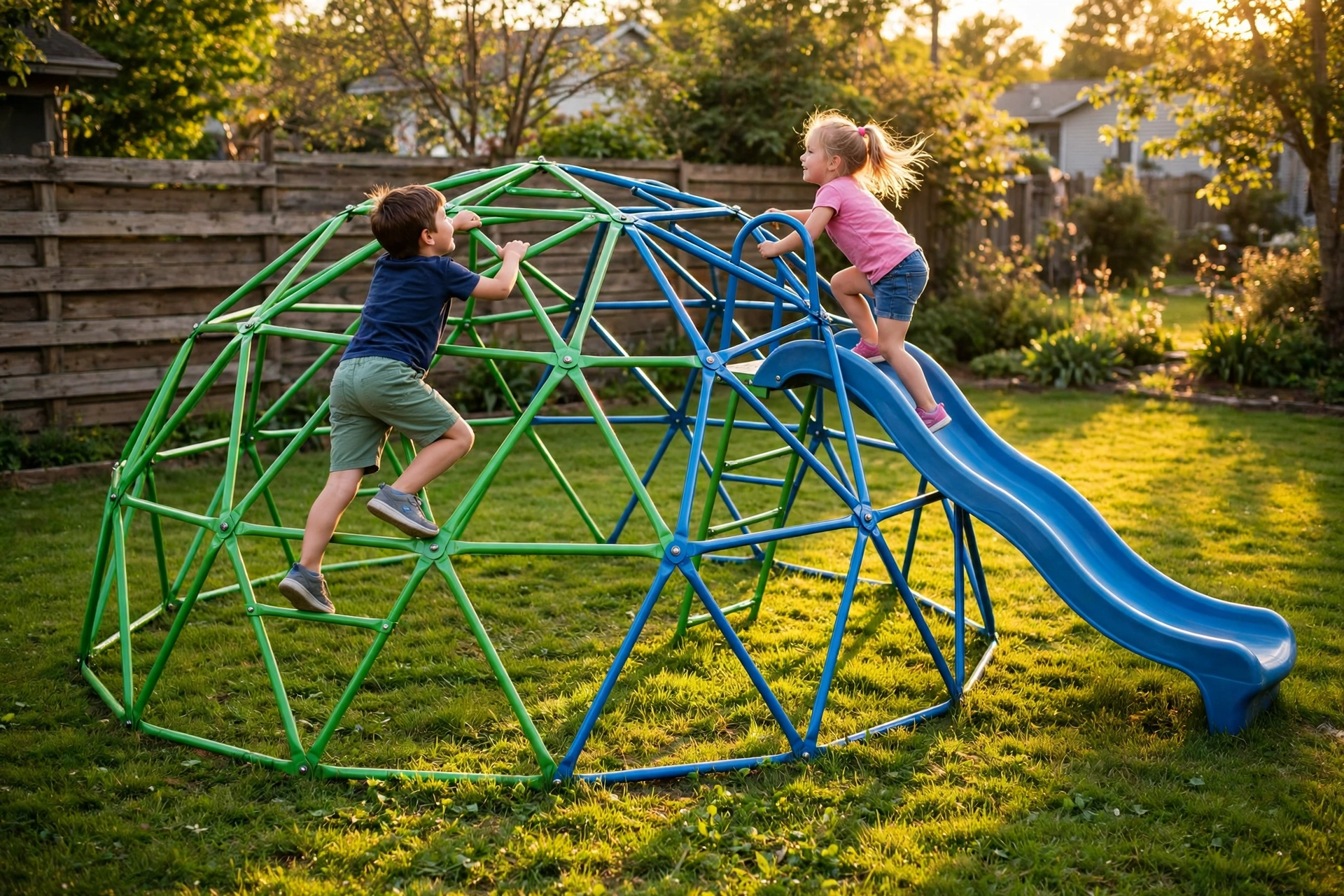
Specifically, the Kids Climbing Dome Jungle Gym from FLNORW MALL — $199, a 6-foot geometric dome plus a 4.6-foot wave slide, rust- and UV-resistant steel frame, rated to 800 pounds. Item code MS306130AAF, green and blue, weighs 51.81 pounds out of the box. I ordered it on a Friday night, it arrived the following week, and two months later — through September heat and October leaf-fall — here is everything I’d tell a friend before buying one.
Why I Bought a Climbing Dome Instead of a Full Playset
I did the math the way every uncle does: start with the dream option and work down. A full wooden swing set, installed, runs somewhere in the $2,000–$3,500 range where my brother lives. It’s also a semi-permanent structure — a commitment on the level of a marriage. The trampoline park down the road charges $20–$30 per kid for a two-hour session, which is fine as a treat but brutal as a weekly habit.
The climbing dome with slide sat in the sweet spot: $199, no concrete footings, and a footprint I could measure with a tape measure before committing — 101.6 inches long by 69.29 inches wide, about 49 square feet, roughly the size of two bath mats laid end to end. That fit my brother’s side yard with room to spare. And the 6Wresearch April 2025 report on playground sets and equipment suggests I wasn’t alone in landing here: climbers are the fastest-growing segment in the category, projected to grow at 7.5% a year through 2032, outpacing the overall market’s 5.73% CAGR ($6.9 billion in 2025 to $10.1 billion by 2032). Families are buying climbers on purpose.
What’s in the Box: The Honest Assembly Report
The box is not small — 54 inches long — but it’s flat, so it slid behind the garage shelving without drama. Inside: steel tubes, joint connectors, the slide section, a bag of bolts, and an instruction manual that is genuinely better than average. Here’s the honest inventory:
- Steel frame tubes — green and blue powder-coated, each end pre-drilled. They feel solid, not tinny.
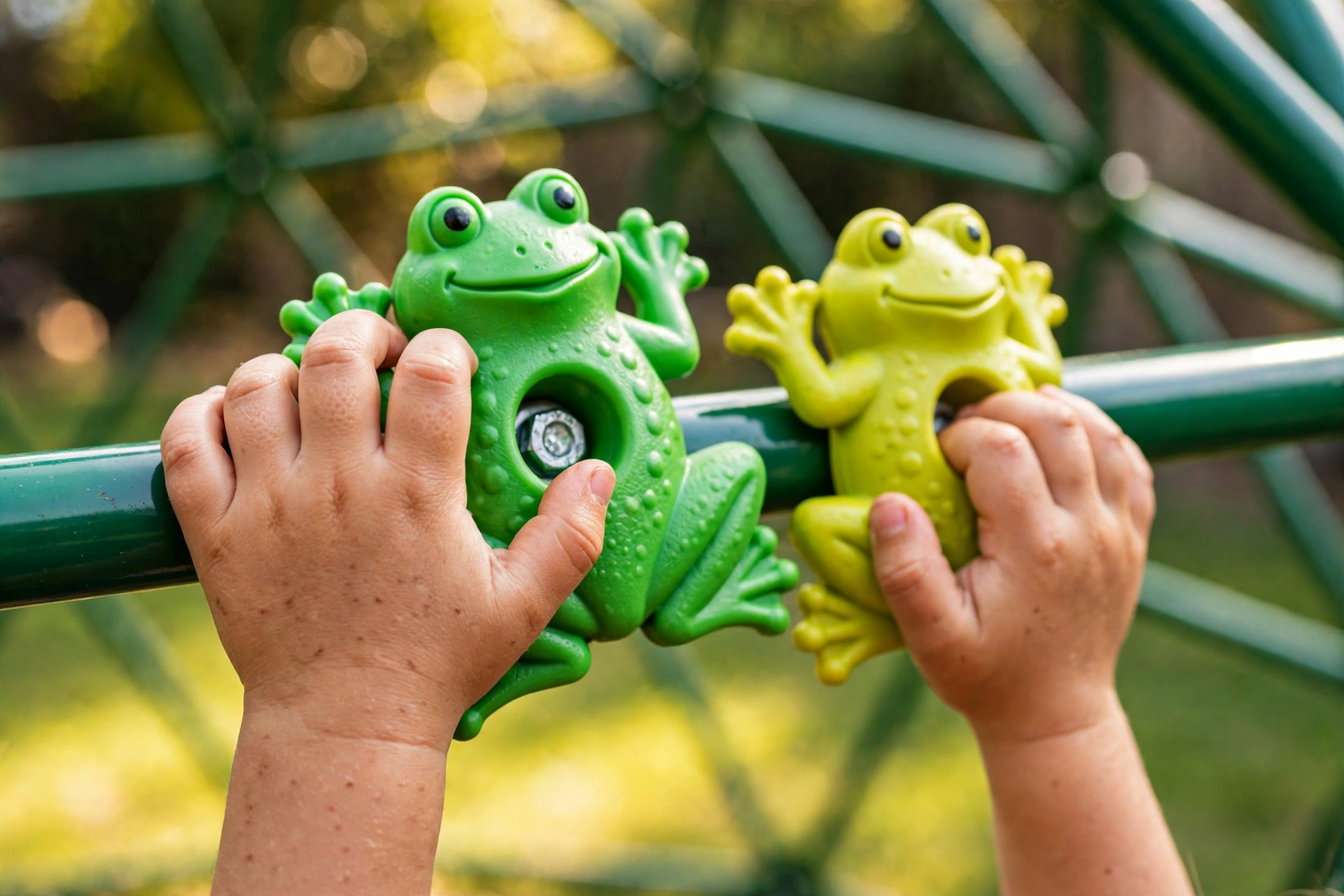
- Frog-shaped rock climbing grips — the detail that sold me. Small plastic frogs that bolt onto the frame as handholds, sized for toddler hands.
- 4.6-foot wave slide — one molded piece. The title says 4.6 feet; one bullet in the listing says 4.5. I measured: call it four and a half feet of slide. It’s a kid-scale slide, not a park slide.
- Hardware pack + manual — every bolt and cap accounted for, with two spares. I had exactly two spares left over, which is the sign of a well-kitted box.
Assembly took my brother and me about two and a half hours, including one trip back to the garage for a socket wrench the manual assumed we owned. You build the dome half on the ground, flip it, then bolt the slide to the top ring. Sort the tubes by length first — two of them look identical until you measure.
The Specs That Actually Matter on a Metal Climbing Dome
Marketing copy will bury you in adjectives. Here are the four numbers I actually checked:
Weight capacity: 800 pounds. It’s not about loading 800 pounds onto the thing — it’s headroom. Two kids at once is what the listing recommends, and at 800 pounds of rating there’s no flex when an adult (me, 185 pounds) steadies a wobbly climber from the top ring. A geodesic dome is inherently rigid; every bar braces every other bar.
Footprint: 101.6” x 69.29”. Measure your spot before ordering. You want at least six feet of clear space around every side — the industry-standard fall zone — which means this dome really needs a roughly 22-by-19-foot patch of yard to be set up properly. We have it; a narrow townhouse patio would not.
Height: 33.9 inches. The dome is low — a little under three feet at the crown. That’s a feature: the fall distance is short, and a three-year-old can reach the top ring standing on the second tier. It’s a toddler-to-early-elementary structure, and the 12-months-plus age rating is honest.
Weight: 51.81 pounds. Light enough that two adults can drag it across the lawn to mow underneath. Heavy enough that it hasn’t moved in two months of kids launching themselves at it — though I’ll say plainly that on our flat, sheltered lawn it’s fine; in a wind-exposed spot I’d want it staked down.
Safety First: What the Playground Injury Numbers Say
I’ll be blunt: I looked up the injury statistics before buying, because a metal climbing frame for a three-year-old deserves homework. The U.S. Consumer Product Safety Commission reports more than 200,000 children treated in emergency rooms each year for playground-related injuries, and the National Safety Council notes that nearly 80% come from falls. The CPSC’s own study found climbers account for the greatest proportion of injuries on public playground equipment — more than swings, more than slides.
That sounds scary until you read the fine print: the CPSC data is dominated by tall public structures with hard surfacing underneath. A 34-inch dome over grass is a different animal. Still, I run the same checklist every time Leo climbs, and it takes about thirty seconds:
- Ground surface: grass or rubber mulch, never concrete or bare dirt. We mow around the dome weekly so the landing zone stays soft.
- Fall zone: six feet clear on all sides — no fence rails, no patio furniture, no garden tools within reach.
- Supervision: one adult, eyes on, phone in pocket. About 40% of playground injuries involve a lapse in supervision, per injury-reporting summaries.
- Footwear: closed-toe shoes on the dome. Bare feet slip on the bars when they’re dewy in the morning.
- Weather check: the steel gets slippery when wet, and the slide runs fast after rain. We wait an hour after a downpour.
Two months, zero injuries. The worst event was a leaf stuck to a wet bar, which Leo announced was “a problem for the government.”
The $199 Gift Math: What It Replaced and What It Costs Per Play
Here’s the honest accounting, because “is it worth it” is the whole question. The $199 bought:
Leo uses the dome four or five times a week — after preschool, on weekends, sometimes for ten minutes before dinner. Call it 40 sessions in two months: under $5 a session today, falling every week. By next summer it’ll be under a dollar a play. The $120 robot dog I bought him last Christmas cost roughly $120 per week of actual use.
Compare it to the alternatives: the $2,000–$3,500 installed swing set would take a decade of this usage to match on cost-per-play — and my brother’s yard isn’t big enough for one anyway. The trampoline park at $25 a visit breaks even against the dome after eight visits. And unlike the park, the dome is open at 7 a.m. on a Tuesday.
There’s also the sibling math. Leo’s little sister is 18 months old, inside the dome’s 12-months-plus rating, so this purchase serves two kids across maybe four years. My own rough estimate: under 50 cents a play by the time they’re done with it. As a Christmas gift, it’s the rare big-ticket toy that gets used in February.
Climbers Are the Fastest-Growing Playground Segment
The industry numbers surprised me, so I’ll share them. Dataintelo’s 2025 playground equipment report puts the global market at $10.0 billion in 2025, growing to $15.51 billion by 2034 at a 5.0% CAGR — and climbing equipment is the leading product type with 31.0% of sales, growing at 5.7% a year. The 6Wresearch 2025 report goes further: playground climbers are the fastest-growing segment at 7.5% CAGR from 2026 to 2032.
Translation: the market is voting for exactly this kind of equipment. My read — not a statistic — is that climbers solve the modern-parent equation: they build balance, grip strength, and confidence in a footprint that fits a real yard, at a price that doesn’t require a financing conversation.
Three Things I’d Tell a Friend Before Buying
First, measure the fall zone, not just the dome. The dome is 101 inches long; the safe zone is three times that in every direction. If your yard can’t give you six feet clear on all sides, buy the backyard agility kit instead — different toy, smaller footprint, same uncle-energy.
Second, the slide is the appetizer, not the meal. Leo slides down it maybe three times a session. The climbing — up, over, through, hanging from the top ring like a tiny gymnast — is the main event. If your kid only wants slides, a standalone slide is cheaper. If your kid wants to climb everything in the house, this is the intervention.
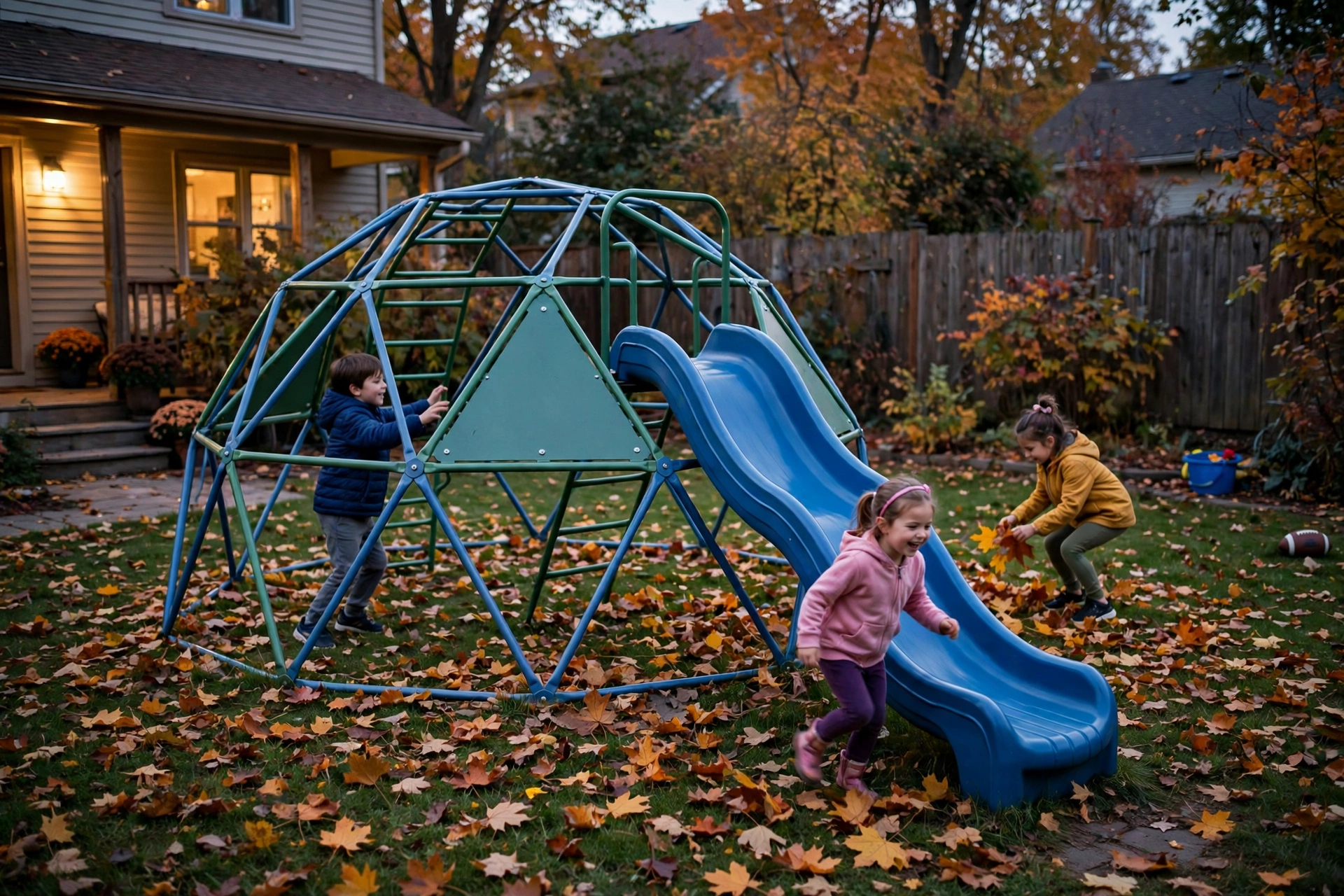
Third, plan for winter. The frame is rust- and UV-resistant steel, so it can live outside year-round — but read my winterizing guide mindset: a quick fall check of the bolts and a wipe-down of the grips takes fifteen minutes and buys you years. We’re doing ours the first weekend of November.
The Verdict
Two months in, the $199 kids climbing dome with slide is the best backyard purchase I’ve made — and that includes the balance bike kit I raved about last month. The 800-pound steel frame is rock solid, the frog grips tell you somebody watched kids play, and the cost-per-play math gets better every week. Honest complaints: the slide is shorter than the photos imply, you need a real yard for the fall zone, and I wish the box included ground anchors for windy spots.
Who should buy it: parents and grandparents of 2-to-6-year-olds with a real patch of grass, especially anyone shopping for the one big Christmas gift. Who should skip it: apartment and small-patio households, and kids who are strictly slide people. For everyone else — the dome earns its 49 square feet.
Ready to claim the backyard? See the $199 Kids Climbing Dome with Wave Slide at FLNORW MALL — or start at the FLNORW MALL homepage and browse the full outdoor and toy range.