Why Your Dining Chairs Are Uncomfortable: The Fit Guide I Wish I’d Read First
Last Thanksgiving, we finished dessert and nobody moved. That sounds like a good sign until you look closer: my brother-in-law had slid halfway off his wooden chair and was leaning on the table like it was a crutch, and my 70-year-old dad — the same dad whose knees turned “getting up” into hard work last winter — kept shifting his weight every few minutes. Nobody said a word about the chairs. Everyone felt it. That night I pulled the tape measure out of the kitchen drawer and finally asked the question nobody asks in a furniture store: what actually makes a dining chair comfortable?
Turns out dining chair comfort has almost nothing to do with how thick the cushion looks in the listing photo. It comes down to fit — a handful of measurements, most of which no product page prints. The Bureau of Labor Statistics’ 2024 American Time Use Survey puts our average time eating and drinking at roughly 1.2 hours a day. That is over 430 hours a year spent in a dining chair. A chair that is off by one inch, for 430 hours, is a year of small daily punishment. Here are the eight numbers I measured, tested, and would now check before buying anything.

Seat Height: The 10-to-12-Inch Rule
The single most important number is the gap between the top of your seat and the underside of the table: it should be 10 to 12 inches. Less than 10 and your knees jam against the apron every time you sit down. More than 12 and your shoulders creep up toward your ears to reach your plate, which is exactly the ache my brother-in-law was massaging at Thanksgiving.
This is why standard dining tables are 28 to 30 inches tall and standard dining chairs sit 17 to 19 inches high — the pairing lands the gap at roughly 11 inches by design. It is also why counter-height sets feel different: FLNORW MALL’s Pub High Dining Table 7-Piece Set has a 35.4-inch-tall table with six tall PU leather bar chairs, and its 3-piece breakfast set pairs a 34.33-inch table with 23.82-inch backless stools — a gap of about 10.5 inches, right in the sweet spot. When I checked my own old chairs against this rule, they were at 9 inches. Mystery solved.
Seat Depth: The Two-Finger Test
Sit all the way back and slide two fingers into the space between the front edge of the seat and the back of your knee. Two to three inches is the target. Less, and the edge digs into the soft tissue behind your knees — that is the “legs falling asleep during dinner” feeling. More, and you cannot reach the backrest without scooting forward, which throws your whole posture off.
For dining, a seat depth of 16 to 18 inches works for most adults. The backless stools in that breakfast set measure 17.32 by 13.19 inches on the seat — shallower front-to-back than a chair with a back, but stools are a different animal: you are not leaning back into them, so the two-finger rule matters less. On a real chair with a backrest, though, I have learned to treat a seat deeper than 18 inches as a red flag unless you are over six feet tall.
Seat Pitch: The Number Nobody Prints on the Box
Here is the number that changed how I shop: seat pitch — the angle of the seat pan plus the angle of the backrest. A comfortable dining chair tips the seat pan back about 5 degrees and reclines the backrest to roughly 95 to 100 degrees. Not flat, not lounge-y — just enough that gravity holds you into the chair instead of sliding you off the front.
My dad’s old kitchen chair was a perfect 90 degrees: a flat board with an upright back. Every meal he perched on the front edge, never touching the backrest. It might as well have been a park bench. Ergonomics guidance treats anything near 90 as task seating, not dining seating — dining needs that slight recline so your lower back actually meets the chair. Notice how the Pub High set’s listing calls its chairs “ergonomically designed” with backs: at counter height, where you are already perched, a real backrest with a hint of recline matters more, not less.

Backrest Height and the Lower-Third Lumbar Rule
You do not need a tall back on a dining chair. What you need is support in the lower third of your back — roughly 6 to 10 inches above the seat, where the lumbar curve lives. A chair whose backrest ends at mid-back is perfectly fine if the lower portion is shaped to catch you. A chair whose backrest is decorative — flat, hard, and vertical — will lose to a cheap padded chair every time.
This is also where backless stools make their trade honestly. They offer zero back support, and the breakfast set’s stools do not pretend otherwise. What they give you in return is the tuck: at 23.82 inches tall against a 34.33-inch table, they slide fully underneath, disappearing when dinner is over. In a tight kitchen that trade is worth it — but if your family lingers over meals the way mine does, backs beat tucking. Know which family you are before you buy.
Padding vs. Structure: Why Foam Dies First
I used to equate comfort with cushion thickness. Then I noticed that my padded dining chairs went uncomfortable in two years while a friend’s unpadded bentwood chairs stayed fine for a decade. The difference: padding is a consumable, structure is not.
Cheap foam — the kind in most sub-$50 chairs — compresses permanently within a couple of years of daily use. Seat pitch, seat height, seat depth, lumbar placement: none of those degrade. So when I price chairs now, I do the rough math on structure, not foam. A $200 set of four with correct geometry beats a $120 set of four with thick cushions that go flat by year two. At roughly 430 sitting-hours a year, a set that survives five years costs you under $0.10 per family dinner — that is my own rough estimate, but it is the right way to think about it.
The 20-Minute Fit Test
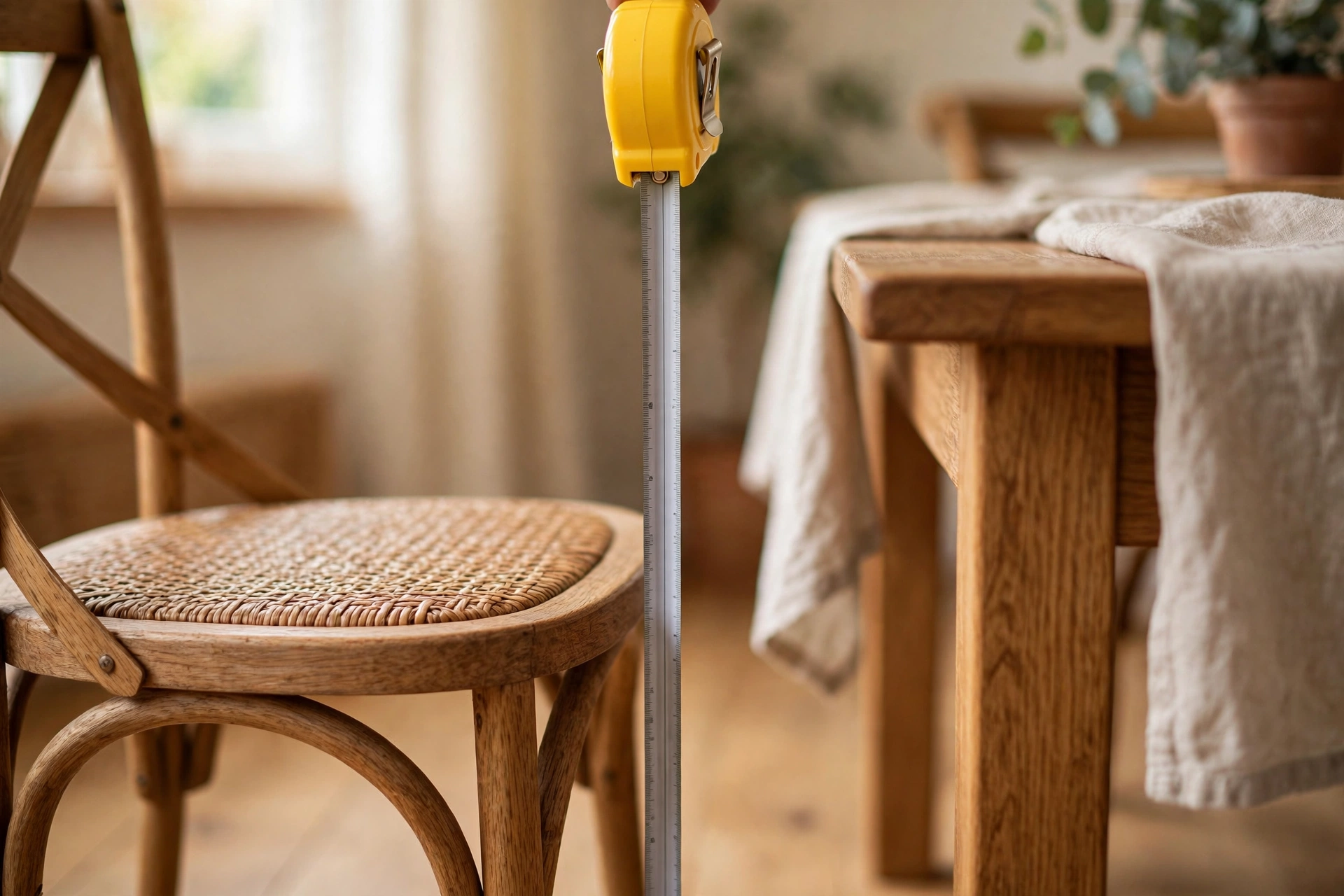
No listing gives you all eight numbers, so here is the test I now run on any chair before it earns a place at my table. It takes twenty minutes and a tape measure:
- Measure the gap. Seat top to table underside: 10 to 12 inches. If it fails this, stop here.
- Sit flat and check your feet. Feet flat on the floor, two to three inches between seat edge and the back of your knee.
- Lean back. Your lower back should meet the chair in its lower third — not air.
- The book test. Sit for 15 minutes with a book. Fidgeting before minute ten means the pitch is wrong.
- The plate test. Mime eating: lean forward slightly. If you have to slide forward off the seat to reach an imaginary plate, the depth is wrong.
- The tuck test. Push the chair fully under the table. In a small dining room, this matters weekly.
What I’d Actually Buy Now
After all this measuring, my advice splits by household. If you are outfitting a small kitchen or rental where floor space is the constraint, backless stools that tuck away are the honest answer — the dining table set with stools at $322 gets the 10.5-inch gap right, the stools have footrests (a small detail that buys a lot of comfort), each stool holds 299.83 lbs, and the two open shelves under the tabletop swallow the microwave and the cookbooks.
If your family lingers — holiday dinners, weekend breakfasts that become lunch — buy chairs with backs and real lumbar contact. The bar-height dining set at $288 seats six in PU leather with backrests, and at counter height the ergonomics of the chair matter more, not less. And if you are still choosing the table itself, my round vs rectangle dining table guide walks through the seating math — 24 inches of table edge per diner, the standard the industry keeps citing because it works.
Padding Fades; Geometry Doesn’t — My Verdict
Here is my verdict after a month of tape-measure archaeology on my own dining room: comfortable dining chairs are a geometry problem, not a cushion problem. The 10-to-12-inch gap, the two-finger seat depth, the 95-to-100-degree pitch, lumbar contact in the lower third — get four of those right and almost any chair becomes a chair people stay in. Get two of them wrong and no amount of foam saves the evening.
My brother-in-law is coming back for Christmas. The chairs will be measured by then — and this time, nobody is sliding off onto the table.
Shopping for a set that gets the fit right? Browse the FLNORW MALL dining collection — every set lists real dimensions, so you can run the 20-minute fit test on paper before a single box arrives.