I Bought Dog Agility Equipment for $70. Two Months Later, the Backyard Math.
What the $69.99 dog agility equipment set actually includes
Moose is my three-year-old, forty-five-pound rescue mix, and until this spring his official sport was sleeping. The vet called him “a healthy dog with a sedentary lifestyle,” which is a polite way of saying my dog had become a throw pillow with a heartbeat. The agility foundations class near me quoted $180 for six weeks, and private sessions start around $60 to $90 an hour — typical prices, and steep ones for a dog whose main trick was snoring.
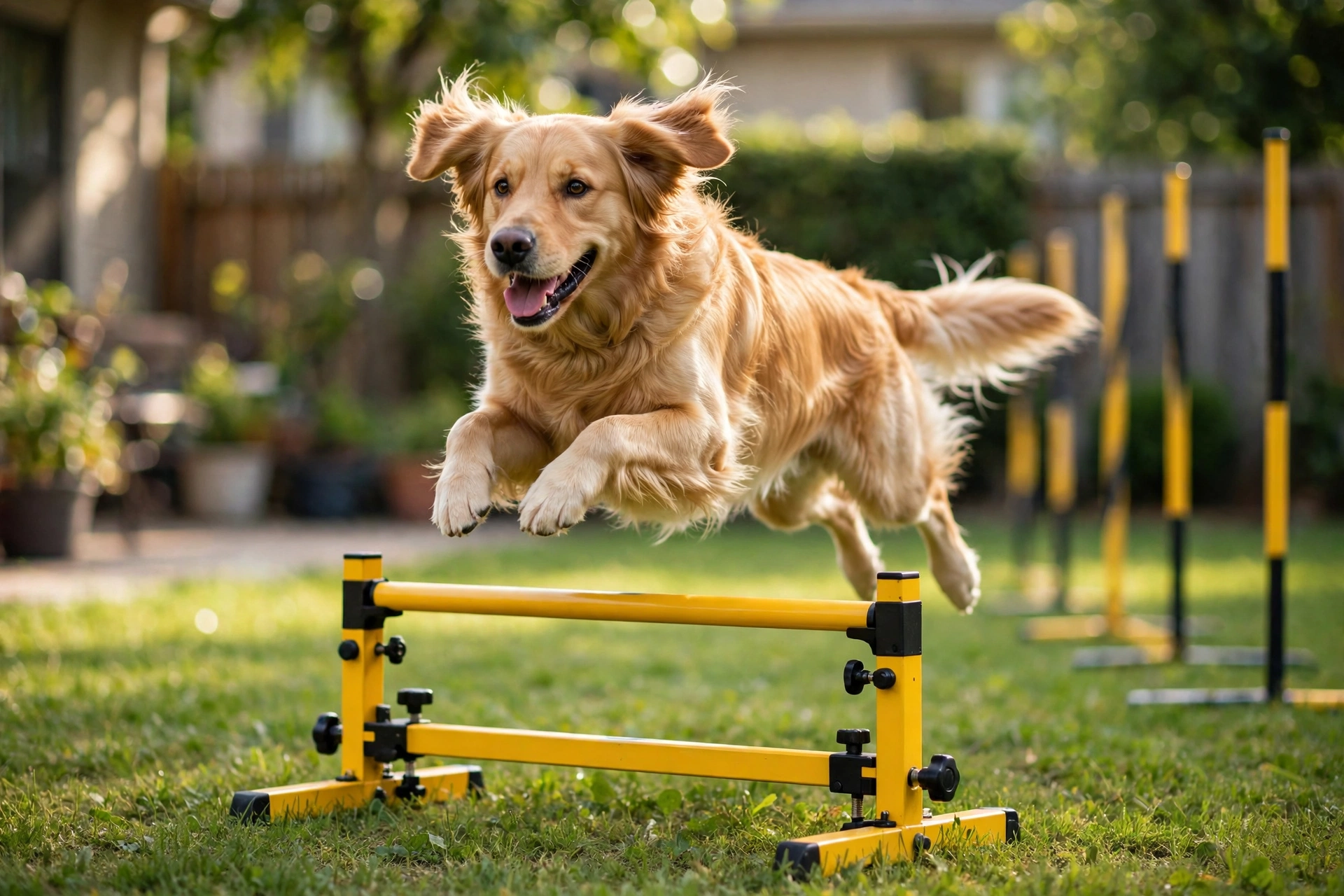
So I bought the 3PC Dog Agility Equipment Set from FLNORW MALL for $69.99 instead. The kit includes an adjustable hurdle, a jumping hoop, a set of weave poles, and a carry bag that fits all of it. It is plastic, white, weighs 9.81 pounds total, and stretches 127.25 inches — just over ten and a half feet — when fully laid out. The product page lists it as a general item, item code W1922114876, shipping within the USA. The hurdle and hoop heights adjust by simply sliding them up and down with no tools, and the listing promises one-person assembly. Two months in, here is what all of that turned out to mean in a real backyard.
Setup took 25 minutes, one person, zero tools
The box arrived on a Saturday. I unboxed it on the patio with a coffee, and Moose performed his customary supervisory role, which consisted of sitting on the instructions and then on the carry bag. The hurdle poles snap into their bases, the weave poles press into short ground sleeves, and the hoop frame goes together in two pieces. I timed myself out of habit: 25 minutes from box to first jump, including one coffee refill and a detour to convince Moose the bag was not a bed.
The carry bag deserves its own sentence. Everything — hurdle bars, hoop frame, poles, sleeves — fits inside one bag that lives on a garage shelf. I have bought too many “portable” things that were only portable in the sense that you could theoretically drag them somewhere. This one genuinely packs down, which matters because I move the course off the lawn every time I mow.
Sixty days of backyard dog training: the honest week-by-week diary
I am not a trainer. I am a guy with treats and a stopwatch app. We did ten-minute sessions, about five evenings a week, which the vet said was the right dose for a dog Moose’s size and age. Here is how it actually went.
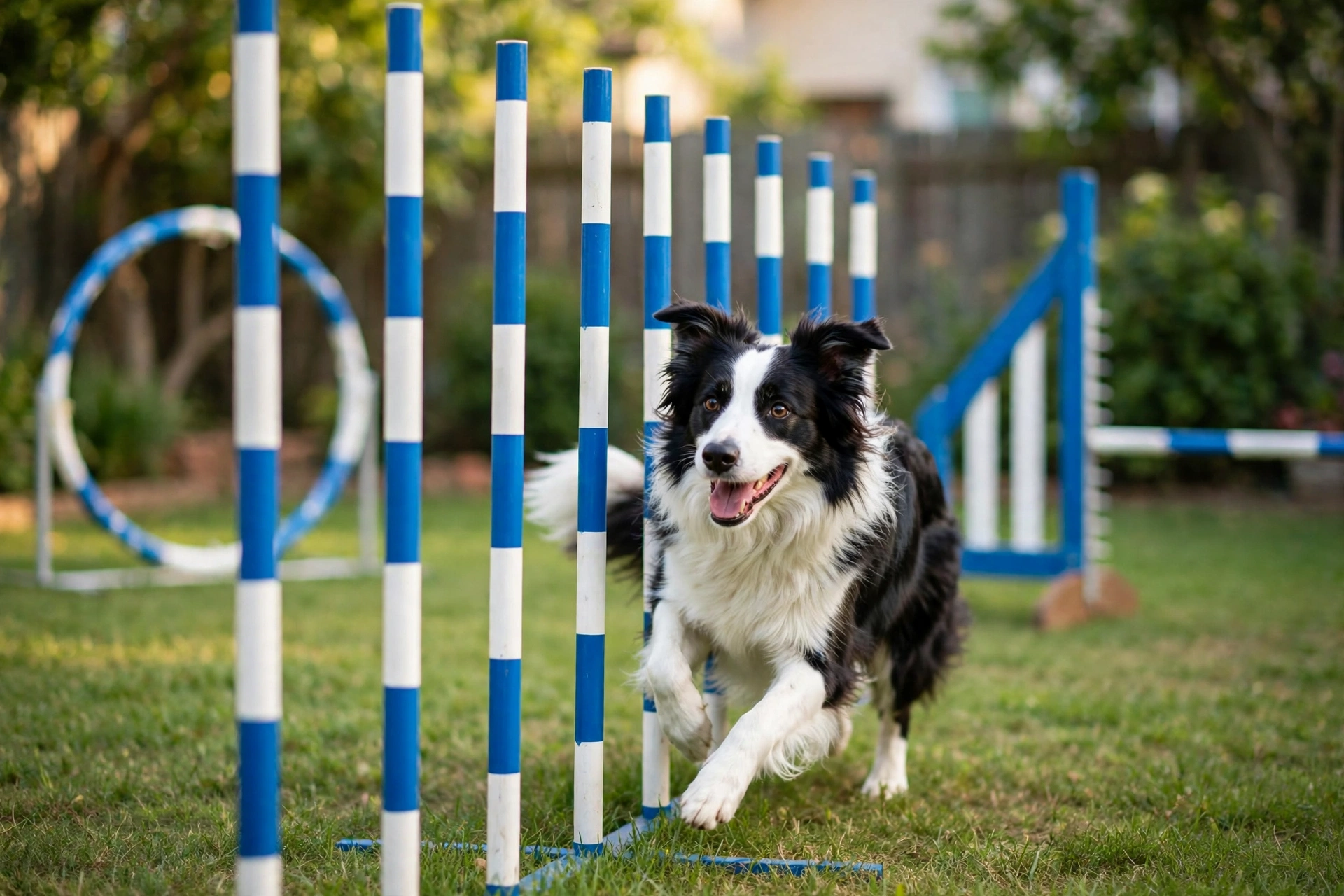
Weeks one and two were comedy. I set the hurdle at its lowest setting and lured Moose over it with a treat trail like I was leaving breadcrumbs for a very large duck. The hoop became a treat tunnel — I held it low and let him walk through for snacks. The weave poles were a lost cause; he treated them as a slalom course designed by someone who had never seen a dog.
Weeks three and four were the turn. The hurdle went up a few inches, and Moose started jumping it on voice cue instead of treat bribe — a genuine milestone. The hoop became a real jump. The weave poles were still a zigzag, but I could lure him through all six with one continuous treat drag instead of resetting every two poles.
Weeks five through eight are why I am writing this. Moose can now run a mini course — hurdle, hoop, weave poles — in about twenty seconds, off a single “go” cue. More importantly, the evening zoomies that used to end with my couch cushions on the floor have calmed down noticeably. He lost two pounds, too: 45 down to 43 on the vet’s scale at his checkup last week. The vet asked what changed. “Agility,” I said, and she laughed and wrote it in his chart.
The money math: $70 vs classes
Let us do the arithmetic the way I did it before buying. All of these are my real local numbers, with the usual caveat that prices vary by city.
- A six-week agility foundations class near me: $180. Two rounds — foundations plus intermediate, which is what most beginners need — runs $360, plus gas and scheduling your evenings around it.
- Private trainer: $60 to $90 a session. Four sessions and you have spent more than five times the kit.
- Dog daycare for exercise: $30 to $45 a day where I live. Two days of daycare costs more than this entire set.
- The kit: $69.99 once, used five evenings a week for eight weeks and counting. That is about $1.75 a session so far, falling every week.
The honest comparison is not quite apples to apples — a class gives you a coach who spots your mistakes, and no plastic hurdle can do that. But for basic exercise, obedience reinforcement, and the pure joy of watching your dog learn something, the backyard dog training math is not close. The kit paid for itself the moment we stopped needing a class to keep Moose moving.
Adjustable dog hurdles vs weave poles: which piece earned its keep
Three pieces, three different report cards.
The adjustable hurdle is the star. The height slides up and down with no tools, which is the single feature that makes this kit beginner-proof. I started Moose at the lowest setting — basically a raised bar he could step over — and raised it a notch every few days as his confidence grew. A fixed-height hurdle would have been either boring or terrifying; the adjustability meant the equipment grew with the dog.
The weave poles are the humbling one. They took the longest to teach and still look the messiest when Moose is tired. But they are also the piece that taught him the most — weaving requires the dog to think and listen, not just run. If your goal is a tired brain as well as tired legs, the poles are the point.
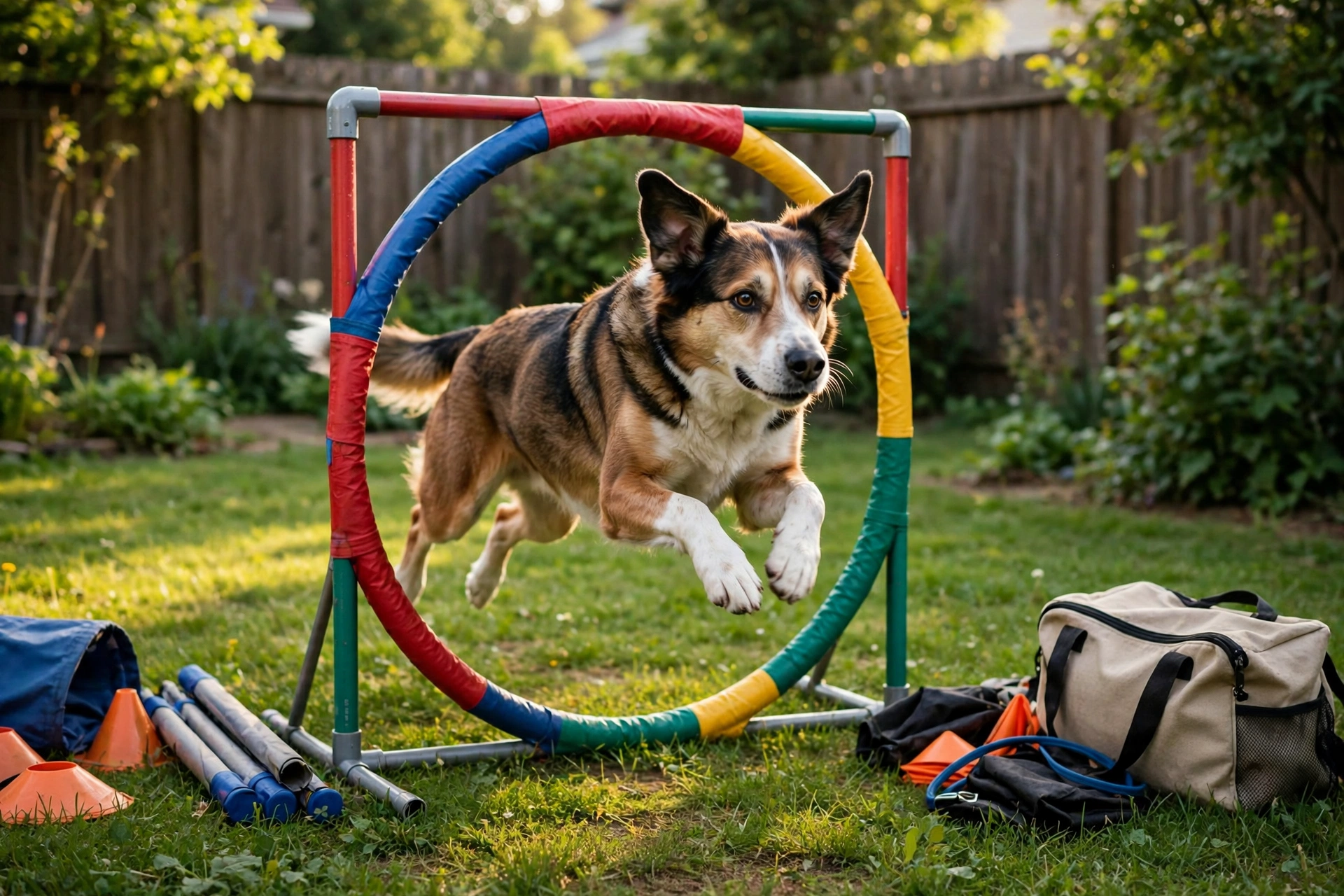
The jumping hoop is the party trick. Every dog I have shown it to understands the hoop instantly, and it photographs beautifully, which I mention because my phone’s camera roll is now 40 percent Moose mid-hoop. For households with kids, the hoop is the piece that turns training into a game the whole family watches.
The space math: 11 feet of yard, not a soccer field
This was my biggest worry before ordering, and it turned out to be nothing. The course assembles at 127.25 inches long — 10.6 feet. My yard is about 25 feet deep, and I run the whole thing diagonally with room to spare. If your outdoor space is a narrow side yard, you can split the kit: hurdle and hoop in one spot, weave poles in another. A strip of grass roughly 6 by 12 feet handles the full layout comfortably.
One honest surface note: the weave poles press into ground sleeves, so they need soil or grass to stake into. On a concrete patio or balcony, use the hurdle and the hoop — both freestanding — and save the poles for the park. I take the whole bag to the dog park on Saturdays, and setup there takes under ten minutes because I have done it fifty times.
Two honest complaints
First: it is plastic, not aluminum. That is how you get a full agility set for $69.99 instead of $300-plus for professional aluminum gear, and for backyard training it is the right tradeoff — except on gusty days, when the hurdle can scoot. I fixed it with an $8 sandbag from the hardware store draped over one base foot. Problem solved, eight dollars, no engineering degree required.
Second: the weave pole spacing is fixed, not regulation. Competition agility has precise pole spacing, and this kit is built for fun and fitness, not for trialing. The American Kennel Club has called agility one of the fastest-growing dog sports in the country, and if your goal is eventually competing, you will outgrow this kit the way a kid outgrows a first bike. For everyone else — the 59.1 million American dog households the American Pet Products Association counted in its 2023–24 survey, most of whom just want a happier, healthier dog — it is exactly enough equipment.
The $78.99 sibling I did not buy
FLNORW MALL also sells a 4 Pack Adjustable Dog Agility Jumps set for $78.99: four jump bars that adjust up to 37 inches, with a fixed bottom bar designed to sit on almost any surface — concrete, grass, dirt — plus a carry bag. I considered it seriously. If your dog is already a confident jumper and you want a serious jump-training ladder, the 4-pack is arguably the better buy, especially on a concrete patio where weave poles cannot stake in. I chose the 3-piece set because a beginner dog benefits more from variety — the hoop and poles teach different skills than a fourth hurdle — and for Moose’s first two months, variety was the right call.
The verdict. Who should buy it: anyone with a dog over about six months old and a patch of grass, especially owners of high-energy breeds whose exercise needs exceed the neighborhood walk; families with kids who will turn training into an evening ritual; and anyone who priced agility classes and winced.
Who should skip it: owners of very small or very old dogs who should clear jumping with a vet first; apartment dwellers with no access to a yard or park; and anyone training for actual competition, who should invest in regulation aluminum gear from the start.
Two months in, the $69.99 dog agility equipment set is the rare purchase that changed a daily routine. Moose is fitter, calmer, and — I say this with full awareness of how it sounds — proud of himself in a way that makes the ten minutes a night feel like the best part of my day. The plastic is honest plastic, the wind needs a sandbag, and the weave poles took six weeks. Everything else about it was better than the price had any right to be. If you liked this kind of hands-on pet gear review, you might also enjoy my furniture dog crate review — Moose sleeps in that crate every night — and for the cat people, my colleague’s wooden cat tower review is the same honest treatment.
Start your backyard course: full specs and the current price are on the 3PC Dog Agility Equipment Set product page at FLNORW MALL.