Mattress Sizes: Twin vs Full vs Queen Chart
When the delivery truck dropped a queen mattress at my door last spring, the box leaned against my front porch like it owned the place — and I stood there doing math on my fingers. My bedroom is eleven feet by twelve. The doorway is thirty-two inches wide. And I had just bought the most popular mattress size in America without checking whether it would fit through either one. That afternoon taught me what a lot of mattress shoppers learn the expensive way: mattress sizes are the kind of detail you either measure once or regret for a decade.
I got lucky. Mine fit — barely — and only because the mattress arrived compressed in a box rather than flat like a door. But the scare sent me down a rabbit hole of mattress size charts, room-fit rules, and replacement-cycle data. This is the guide I wish someone had handed me before I clicked “buy”: the six standard US sizes, the two debates that actually matter (twin XL vs full, queen vs king), the 24-inch rule that decides whether a bed works in your room, and the 7-to-10-year replacement test from the people who study this for a living.
The Six Standard US Mattress Sizes, in One Honest Chart
Every American mattress is built to one of six sizes. These numbers are industry standard — same at every retailer in the country — so once you memorize them, no showroom can confuse you:
- Twin: 38 x 75 inches. The kids’-room classic — bunk beds, daybeds, first apartments. One adult fits; two do not.
- Twin XL: 38 x 80 inches. Same width as a twin, five inches longer. This is the size under most college dorm bunks, and the reason your teenager’s feet finally stay on the bed.
- Full (Double): 54 x 75 inches. The guest-room workhorse. A single adult gets room to sprawl; two adults get 27 inches each — cozy, but workable for a weekend.
- Queen: 60 x 80 inches. The default. Big enough for two adults, small enough for a standard bedroom.
- King: 76 x 80 inches. Each partner gets 38 inches of width — a twin bed apiece, side by side.
- California King: 72 x 84 inches. The oddball. Four inches narrower and four inches longer than a standard king — for very tall sleepers.
Notice the pattern: everything below a queen is 75 inches long, everything queen and up is 80 inches. That is why the twin-to-twin-XL jump (five free inches of legroom) feels so dramatic, and why a six-footer sleeps fine on a queen but hangs off a full.
Twin XL vs Full: The Dorm and Guest-Room Decision
My son’s freshman dorm had a twin XL, and when he came home for the summer I faced a real question: buy him a full for the guest room, or stick with another twin XL? Here is the math that settled it.
A twin XL mattress (38 x 80) gives one sleeper full adult length and takes up 21 square feet of floor. A full size mattress (54 x 75) gives sixteen extra inches of width but five fewer inches of length, and takes up 28 square feet — about a third more floor space. For a single sleeper, the twin XL wins on both comfort and footprint: the extra five inches of length matter more at night than width you do not use.
The full only wins in one scenario: the room regularly sleeps two adults. A guest room that hosts your parents twice a year justifies the full. A teenager’s bedroom does not — my son got the twin XL, and the 7 extra square feet stayed in the room for his desk.

Full vs Queen: Six Inches That Change Everything
This is the upgrade most couples actually make, and the numbers explain why. A full gives each partner 27 inches of width — about the width of a crib. A queen gives each partner 30 inches, the same sleeping width as a solo twin. Those six inches sound trivial on paper; in practice they are the difference between taking turns rolling over and sleeping through the night.
The cost of the jump is modest: a queen takes up 33 square feet of floor versus the full’s 28 — roughly one extra nightstand’s worth of space. If your room can absorb five more square feet, the full-to-queen move is the single best sleep-per-dollar upgrade in the entire mattress size chart.
The market agrees, decisively. According to Mordor Intelligence’s 2026 US mattress market report, American mattress sales were worth $18.11 billion in 2025, projected to reach $22.41 billion by 2031 — and queen-size mattresses captured 44.65% of sales in 2025, the largest and fastest-growing share of any size. That dominance is self-reinforcing: queen bedding has the deepest selection and the sharpest prices, which keeps queen the rational default.
Queen vs King: The 16-Inch Debate
So why doesn’t everyone just buy a king? Floor space, and it is not close. A queen covers 33.3 square feet; a king covers 42.2 — nearly nine extra square feet. In my 11-by-12-foot bedroom, the queen plus two nightstands leaves comfortable walking room. A king would have eaten the walkway on one side down to 22 inches — below my 24-inch minimum, which means daily hip-checks on the dresser corner.
Then there is the money, and not just the mattress. King bedding runs roughly 30–50% more than queen across sheets, comforters, and protectors (my estimate from comparing the same brands in both sizes), and the selection in stores is thinner. The queen vs king decision is really a room-size decision wearing a budget costume: if you have 24 inches of clearance on both sides and the foot, king is wonderful. If you do not, queen is not a compromise — it is the right answer.
One more wrinkle worth knowing: the California king is narrower than a standard king (72 vs 76 inches) but longer (84 vs 80). Unless someone in the bed is over six-foot-four, the standard king is the better buy — and standard king bedding is far easier to find.
The 24-Inch Rule: Will the Bed Actually Fit Your Room?
Here is the rule that would have saved my spring delivery-day panic: leave at least 24 inches of walking space on every side of the bed you use, and 30 inches on the side where you get dressed. Anything less and you are shimmying sideways for the next decade.
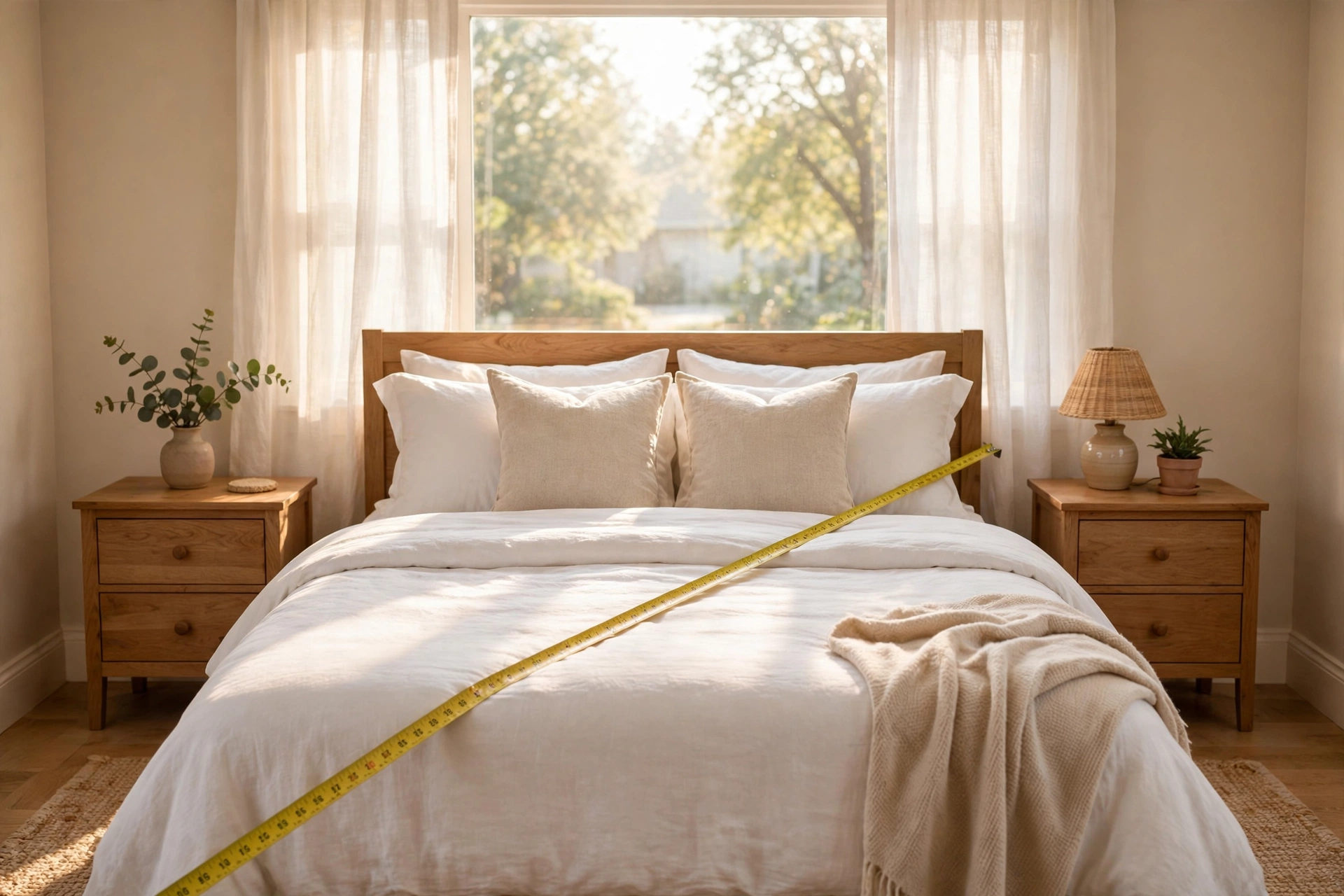
The practical test costs four dollars and takes ten minutes. Buy a roll of painter’s tape, mark the mattress footprint on your bedroom floor, and live with the outline for a day. Tape the nightstands in too — mine are 21.6 inches wide each (FLNORW MALL sells a solid wood nightstand in exactly that size, $248), which is how I learned that a queen plus two nightstands needs 104 inches of wall — nine feet minus change — to sit properly. My 11-foot wall gave me 28 inches of breathing room. Perfect.
And do not forget the delivery path. Measure the narrowest doorway, the tightest hallway turn, and any stairwell — before the truck arrives, not after. A 32-inch doorway passes a queen boxspring on edge with about an inch to spare, which is exactly the margin I had and exactly the sweat I do not want to repeat.
Mattress Size Cost Math: What the Upgrade Really Costs
Mattress prices scale with size, but not linearly — and the hidden costs are in the bedding. Comparing equivalent models from the same brands, expect roughly these step-ups (my estimates, 2026 pricing): twin to full adds about 15–20%, full to queen another 15–20%, queen to king roughly 25–35%. Then sheets, duvets, and mattress protectors cost 20–50% more at each jump, and you replace bedding far more often than the mattress.
That is why I counsel friends to buy the biggest size their room honestly fits, once. Trading up later means rebuying the mattress and every sheet you own. My queen cost more than the full I almost bought — but one sheet set, bought once, beats two sheet sets bought twice.

The 7-to-10-Year Test: When Your Mattress Tells You It Is Done
Size is only half the decision; timing is the other. The Better Sleep Council — the consumer-education arm of the International Sleep Products Association — uses seven to ten years as its rule of thumb for mattress replacement. And their 2023 consumer survey of 1,039 adults (reported in Sleep Savvy magazine) shows how that plays out in real bedrooms: most people expect a mattress to last eight to ten years, but nearly half actually replace within seven. Millennials cycle fastest at an average of 6.5 years; baby boomers hold out longest at 11.7. The number-one trigger, cited by 77%, was simple deterioration — sagging, lumps, noise.
Their earlier 2021 survey found that 60% of people reported sleeping better on a mattress younger than eight years old. My own signal was unmistakable: I started waking up with a stiff lower back around year eight on my old full, blamed my pillow for a month, then finally admitted the mattress had given up. If you are reading a mattress size guide at 2 a.m. because your back hurts, the size question might be secondary — check the manufacturing date first.
The Verdict
A year into my queen, here is my honest accounting. The twin XL is the smart single-sleeper buy. The full is the guest-room sweet spot. The king is glorious if — and only if — your room has the clearance. And the queen is the default for a reason: it fits real bedrooms, sleeps two real adults, and owns nearly half the US market, which keeps its bedding cheap and plentiful. Measure the room with painter’s tape, buy the biggest size that leaves 24 inches on every side, and check the calendar — if your current mattress is pushing eight years, the size upgrade and the replacement can be the same purchase.
Setting up the bedroom to go with it? The frame I built this whole guide around is FLNORW MALL’s queen size upholstered bed with LED headboard — $288, a 600-lb capacity, footboard storage drawers, and it fits 8-to-14-inch mattresses with no box spring required. Pair it with the solid wood nightstand ($248) on each side and you have the exact 104-inch wall setup from my tape test. Browse the full furniture collection, or start from the FLNORW MALL homepage — and measure twice.