Sofa Seat Depth: The Comfort Number Nobody Talks About
The first time I measured a sofa’s seat depth, I was crouched on a showroom floor with a borrowed tape measure while my wife pretended not to know me. We had just returned our second sofa in three years. The first one swallowed me whole — 24 inches of seat that left my feet swinging like a kid at the counter. The second one was 18 inches and pushed my thighs so far forward I could not lean back without sliding. The number that explained both sofas was right there on the spec sheet the whole time. I had never once looked at it.
Sofa seat depth is the distance from the front edge of the seat cushion straight back to the backrest. It decides whether your thighs get support, whether your feet reach the floor, and whether you will read comfortably for an hour or end up slumped like a melting candle. It is also the one measurement most product pages bury in the last line of the specs. I check it before I check the price now. Here is everything I have learned, measured in real living rooms, so you can skip the two-return embarrassment.
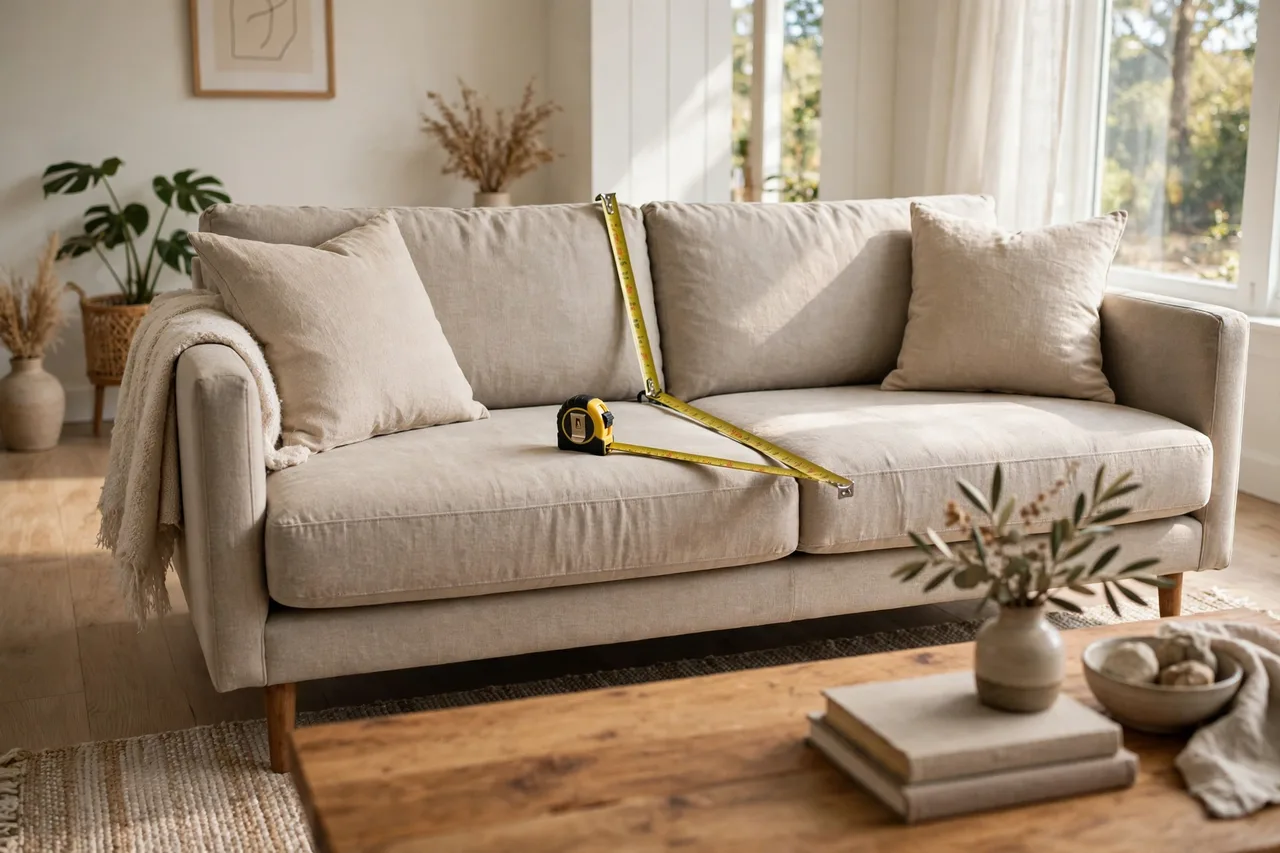
What Sofa Seat Depth Means: the 20-to-22-Inch Sweet Spot
Seat depth is not the full depth of the sofa. The full depth — say, 38 inches — includes the backrest thickness, the arms, and everything else. Seat depth is only the part you sit on: front edge of the cushion to the back cushions, measured in a straight line along the seat. On most adult sofas it lands between 20 and 22 inches, and that range exists because it fits the middle of the bell curve. You, of course, are not the middle of the bell curve.
One thing to know before you start measuring: cushions compress. Measure with the cushions in place and give the tape a firm press so it follows the shape you actually sit on. Measure the cushion, not the frame — the wooden frame edge tells you nothing about comfort.
Walk through any furniture store and you will find the industry quietly agrees with itself: the standard sofa seat depth is 20 to 22 inches. It is not a law; it is a consensus built from decades of returns, complaints, and comfort surveys. It fits the average American adult because it supports roughly three-quarters of an average thigh while keeping feet near the floor.
The choice pool keeps growing. Dataintelo puts the global sofa market at $23.4 billion in 2025, growing to $38.7 billion by 2034 at a 5.8% CAGR. More choice means more depth variants — shallow European-style frames at 18 inches, lounge monsters at 26. The sweet spot is a starting point, not a verdict. Your height writes the real answer.
Sofa Seat Depth by Height: Match the Couch to Your Body
I am 5’6”. My sister is 6’0”. We cannot share a favorite chair, and we stopped pretending years ago. Seat depth that works for her makes me look like a child in dad’s recliner. Here is the rough guide I give friends, based on years of sitting and one very patient returns department:
- Under 5’4”: 18 to 20 inches. Anything deeper and your feet will not touch the floor, which gets old fast.
- 5’4” to 5’9”: 20 to 22 inches. This is the industry sweet spot, and for once the industry is right.
- 5’10” to 6’1”: 22 to 24 inches. Your thighs need the extra runway or you will perch on the edge.
- Over 6’1”: 24 inches and up, or buy a chaise end and stop fighting it.
These are starting points, marked as my own rule of thumb from experience, not lab science. The real test takes ten seconds and works for any body: sit all the way back, feet flat on the floor. You want about two to four fingers of space between the front edge of the seat and the back of your knee. Less than that and circulation gets pinched on long evenings. More than that and the edge digs into your calves, or you slide forward and your lower back takes the penalty.
Deep Seat Sofas: Who Loves Them (and Who Regrets Them)
A deep seat sofa — call it 23 inches or more — is a lounging machine. Curl up sideways with a book. Nap with your knees bent. Let two kids and a dog pile on without territorial disputes. If your living room doubles as a movie theater, deep seats earn their floor space. Long, low lounge-friendly layouts like this 129.5-inch L-shaped sleeper sectional are built around exactly that instinct.

Now the honest half: deep seats are terrible for upright sitting if you are under about 5’6”. You will either stack throw pillows behind your back — turning your $2,000 sofa into a pillow fort — or slide forward and ruin your posture. They also eat floor space: a 26-inch seat on a 40-inch frame leaves less room for the coffee table, the walkway, and your sanity. And getting up from a deep, soft seat at age seventy is an athletic event. I bought the deep one first. I loved it for movies. I hated it for everything else, including the twelve weeks it took to admit it.
Shallow Seat Sofas: Better Posture, Fewer Naps
Under 20 inches, a sofa stops being a lounge and becomes proper seating. Feet plant flat on the floor. Your back finds the backrest without a pillow expedition. Conversations feel natural because everyone sits upright instead of half-melted. In small rooms, shallow seats are a gift — you save four to six inches of floor depth that reads as a lot in a 12-by-14 living room.

The trade: your thighs hang past the edge, so on a long evening the front of your legs does extra work, and curling up sideways is off the table — literally, there is no sideways room. The classic example is the Chesterfield: upright, buttoned, all business. The gray velvet Chesterfield three-seater sits you tall and proper, which is exactly right for a formal living room or an office, and exactly wrong for Sunday nap wars.
How to Measure Seat Depth at Home in 60 Seconds
Do this before you order anything, in the store or at home with a tape measure. Sixty seconds, no special tools:
- Leave the cushions in place. You sit on the cushion, so measure the cushion.
- Press the tape along the seat from the front edge straight back to where the back cushion starts. Read the number. That is your seat depth.
- Sit all the way back with your feet flat. Check the knee gap — two to four fingers between the edge and the back of your knee.
- Test every seat. On sectionals, corner seats and chaises often run deeper than the middle seats. The spec sheet usually lists one number; your body sits in several.
- Write it down. When the next sofa’s page lists “22.5-inch seat depth,” you will know exactly what that feels like before the delivery truck arrives.
The Rest of the Comfort Equation: Seat Height and Cushion Firmness
Seat depth does not work alone. Seat height — floor to the top of the cushion — runs 17 to 19 inches on most adult sofas, and it has to cooperate with depth. A deep seat with a low height is a trap: you sink, your knees rise above your hips, and standing up becomes a two-hand job. A shallow seat with a high edge cuts off circulation at the thigh. The pair should leave your feet flat and your knees at roughly a right angle.
Then there is cushion firmness, the silent partner. A soft cushion on a perfect 21-inch seat still hammocks you into a slouch, while a firm cushion at the same depth holds you where you sat. When we finally kept a sofa — the seven-seat U-shaped sectional with the storage chaise — the win was not just the depth. It was the depth plus a seat height that let my wife’s feet touch the floor plus cushions firm enough that I did not sink past the point of no return. Comfort is a team sport.
Common Sofa Seat Depth Mistakes (and What They Cost)
I have made most of these. The tuition was nonrefundable:
- Buying on looks without measuring. Returning a sofa typically costs $100 to $300 in delivery and restocking fees — my rule of thumb from two returns — and a full weekend of your life.
- Assuming every seat on a sectional matches. Corner and end seats often run deeper. Measure each one.
- Designing for the average instead of your tallest and shortest regular. A sofa that fits you and strands your 6-foot teenager is a daily argument.
- Confusing seat depth with overall depth. A 40-inch-deep sofa with thick arms and a chunky back can hide a stingy 19-inch seat. Always read the seat number, not the silhouette.
- Forgetting the recline factor. If you always sit with a throw pillow behind you, subtract about four inches — that is your real, lived-in seat depth. Buy accordingly.
Verdict: The Number I Would Not Buy Without
Here is my verdict after sitting on more couches than I can count and returning two of them: seat depth is the single most predictive number for sofa comfort, and it takes ten seconds to check. Get the 20-to-22-inch standard unless your height says otherwise. Sit-test with the finger rule. Measure every seat, not just the one in the photo. And do not let a beautiful silhouette talk you into a depth that fights your body every evening for the next eight years — because a sofa you have to argue with is the most expensive one you will ever own.
If you are shopping with the tape measure in hand, start with the couches that tell you their depth up front instead of burying it. Browse the full seating collection at FLNORW MALL — and when a product page hides the seat depth, email and ask before you order. Your knees will thank you.