I Bought a $178 4-Step Folding Step Ladder. Eight Months Later, Here’s the Honest Verdict.
The smoke detector started chirping at 2 a.m. Not the polite daytime beep you can deal with later — the full-throated, every-thirty-seconds, where-is-it-coming-from chirp. I stood in the hallway in socks, stared up at the ceiling, and did what I had always done: dragged a dining chair over, stood on the seat, and wobbled on tiptoe with a 9-volt battery between my teeth. That was February. By March I owned a ladder.
Not a tall orange extension ladder from the hardware store. A black aluminum 4-step folding step ladder from FLNORW MALL — $178, rated for 300 lbs, with a retractable handgrip and wide anti-slip pedals. Eight months later it is one of the most-used things I own that nobody ever asks about. Here is the honest accounting.
What $178 actually bought
Let me get the specs out of the way, because they are all real numbers off the product page and they matter more than they look. The ladder is aluminum — 20.08 lbs, so no feathers involved — finished in black, with PC filler parts at the joints. It folds down to 62.24 inches long, 19.53 wide, and just 2.13 thick. The load rating is 300 lbs, which covers me, my toolbox, and whatever I am carrying up in the other hand. Each step is a wide pedal with an anti-slip texture, not a round rung, and there is a handgrip that pulls up out of the top step and pushes back down when you are done. Item code W134355909, if you want to look it up yourself — that is the 4 Step Ladder with Retractable Handgrip on the site.
The folded footprint surprised me most
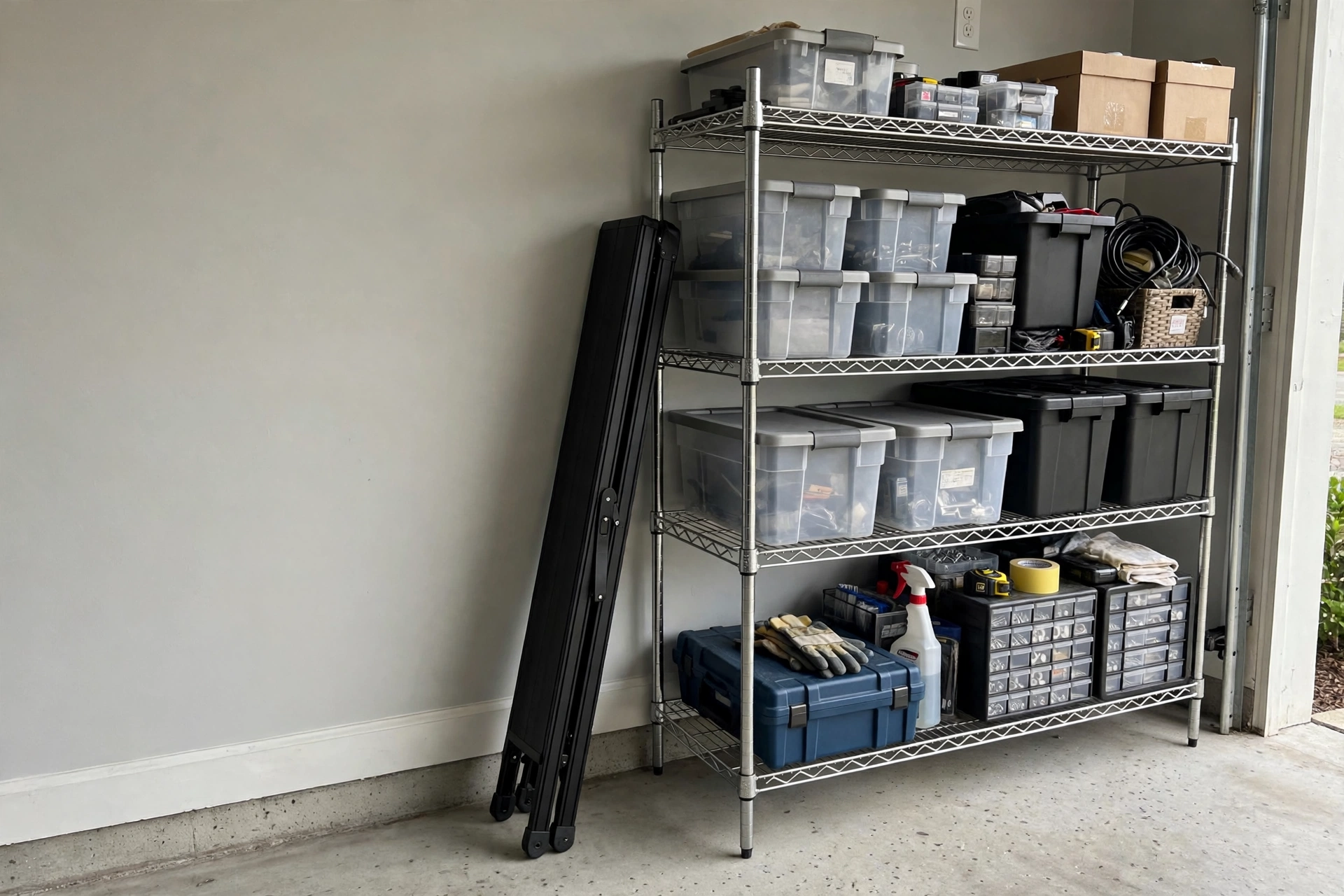
I expected a ladder to be a storage problem. It is not. At barely over two inches thick when folded, this thing slides into gaps I did not know I had — behind the water heater, between the freezer and the wall, flat under the guest bed. Right now it hangs on two hooks on the garage wall next to my lockable garage tool cabinet, taking up less room than the garden hose. The product page claims 2.13 inches folded and I measured mine at a hair over two. Close enough that I trust the rest of the numbers.
Six jobs it has already done
Here is the unglamorous truth about a household ladder: its value is the pile of small jobs you kept postponing. My pile, in order:
- The 2 a.m. smoke detector. Twenty minutes, including the part where I stopped being annoyed. Standing on a proper step instead of a chair seat, I reached the ceiling unit easily, swapped the battery, and — while I was up there, because it was easy — tested it and wiped the dust off the sensor grille. The National Fire Protection Association recommends replacing smoke alarms every 10 years and testing them monthly; a ladder turns that from a chore into a non-event.
- Recessed LED bulbs in the entryway. Our entryway ceiling is ten feet up and the builder put two can lights in the middle of it. A chair got me to about chin level. The ladder’s top step put the cans at chest height, bulb swap took five minutes.
- Ceiling fan dusting. Every spring the fan blades collect a gray felt that launches itself across the room the first time you flip the switch. Handgrip up, damp cloth, done in ten minutes.
- Curtain rod rehang. My wife wanted the living-room rod two inches higher. The old plastic step stool flexed under me; the aluminum pedals on this one did not move a millimeter.
- Top-shelf pantry rescue. There is a shelf in our pantry that I had mentally written off as decorative. It now holds the good serving bowls.
- Holiday lights. Last December I hung gutter clips along the front of the house without renting anything or bribing a neighbor. That alone was worth the price of admission.
The pedals and the handgrip are the whole product
If you are wondering what separates a $178 folding step ladder from the $40 plastic step stool at the discount store, it is two things: the pedals and the handgrip.
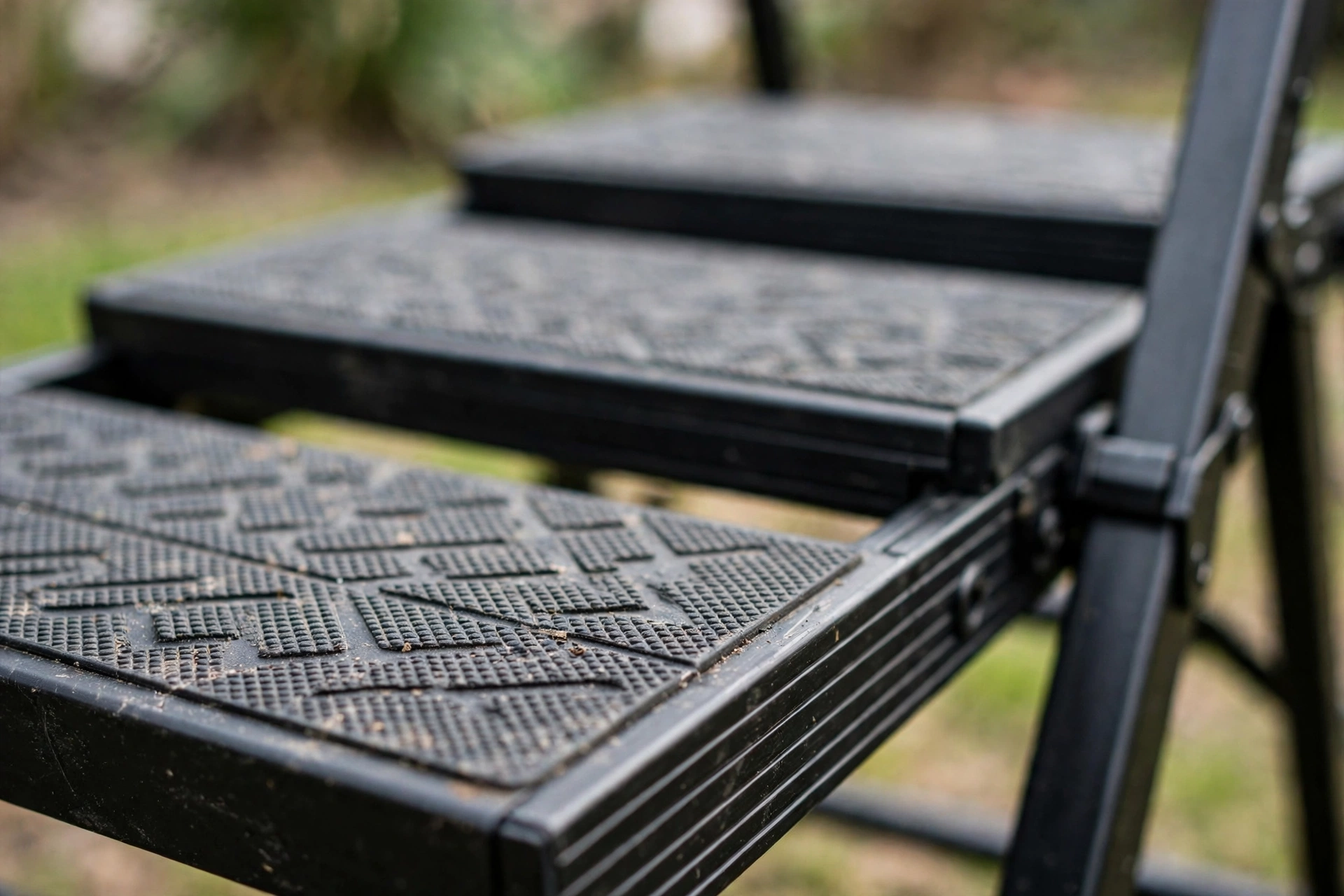
The pedals are wide, flat, and textured — you stand on them with your whole foot, the way you would stand on a stair. My old stool had narrow rungs that concentrated all my weight on the arches of my feet, which is fine for thirty seconds and miserable after three minutes of changing a light fixture. The anti-slip texture is the raised-diamond kind; in socks, on a damp garage floor in April, I never once felt a slide.
The retractable handgrip pulls straight up out of the top step and clicks into place. It gives you something solid to hold while you climb, and then it pushes back down flush so the ladder folds flat. I reach for it every single time I go up — that is the difference between feeling balanced and performing balance. It is also the one part of the ladder I would tell you to try in person if you could: it is sturdy, but the first week I was convinced mine was stuck until I learned it wants a firm, straight pull.
Ladder safety rules I follow now (and the numbers that scared me into it)
I will be blunt: I used to stand on chairs, coolers, and once a stack of moving boxes. Then I read the numbers. The American Academy of Orthopaedic Surgeons, citing federal safety data, reports that more than 500,000 Americans are treated for ladder-related injuries every year. Most of them fell from six feet or less — stepladder height, not rooftop height. That statistic lives rent-free in my head now, and it changed how I treat this thing.
My house rules, borrowed from OSHA’s ladder standards:
- Three points of contact. Two feet and one hand, or two hands and one foot, at all times while climbing. The handgrip exists for this reason.
- Never stand on the top cap. OSHA is explicit: the top step and the top cap of a stepladder are not steps. The top usable step on this ladder is the fourth pedal — that is the working position, and it is plenty.
- The 300-lb rating includes everything. The rating covers you plus tools plus whatever you are carrying. I am 180; add a toolbox and a box of bulbs and I am still well inside the margin. That margin is the point.
- Level ground, locked open. I check the spreader locks every time before climbing. Takes two seconds.
4-step vs 3-step: which one is yours
FLNORW also sells a 3-step version — aluminum, anti-slip pedals, an eye-catching 580-lb capacity, $188. I almost bought it instead. Here is how I think about the choice now.
The 3-step is the kitchen-and-office ladder: lower ceilings, grab-the-top-shelf use, and that huge weight rating is reassuring if the whole family shares it. The 4-step is the whole-house ladder: ten-foot entryway ceilings, gutter clips, smoke detectors mounted high in a two-story hallway. The rule of thumb I landed on — and this is the same measuring logic behind my measure-before-you-buy habit — is to stand where you will work and hold your hand flat overhead: your target step should be roughly three feet below the thing you need to reach. If that math says four steps, buy four steps. The $10 difference between the two models is irrelevant next to buying the wrong height.
The handyman math
Rough numbers, flagged as rough: a handyman visit in most US markets runs $100 to $150 for the first hour, and that is an estimate, not a quote. I have done six jobs with this ladder that I would previously have either ignored for a year or bundled into a service call. Two of those jobs alone would have covered the $178 price tag.
The deeper math is behavioral. A $178 ladder sitting on the garage wall is a standing invitation to fix the small stuff the week it breaks instead of the season it becomes a project. The smoke detector battery at 2 a.m. would have been a $120 service call and three days of chirping if I had waited for a professional. Instead it was twenty minutes and a battery I already had in a drawer.
The verdict
Two honest complaints first. It is not light — at 20 lbs it is heavier than the plastic two-step stool it replaced, and carrying it one-handed up the attic pull-down stairs is doable but not graceful. The aluminum is the reason, and I will take the weight over flex. And the retractable handgrip has a learning curve: the first week I thought the mechanism was broken, but it just wants a confident straight pull. Once I learned the motion it has never jammed.
Eight months in, this folding step ladder has done exactly what I bought it for and nothing I did not ask it to do. It stores flat, climbs solid, and the handgrip plus wide anti-slip pedals make it feel like furniture that happens to reach the ceiling rather than equipment I am borrowing courage to use. At $178 with a 300-lb rating, it paid for itself the first time I did not call anyone.
If you have been standing on dining chairs, this is your sign. The chairs will thank you.
See the ladder: 4 Step Ladder with Retractable Handgrip, Anti-Slip Pedals, 300-lb Capacity — $178 at FLNORW MALL. Prefer fewer steps? The 3-step version with 580-lb capacity is $188. And if you are shopping for the rest of the house, start at flnorw.com.