Wood vs Metal Bed Frame: I Own One of Each. Here’s the 10-Year Winner.
When I moved my old queen mattress into the guest room last spring, I stood between two bed frames and realized I had accidentally set up the perfect experiment. I own two wood vs metal bed frame contenders from FLNORW MALL: a $299 PU leather bed frame built on strong wooden slats, and a $388 hydraulic storage bed built on MDF, plywood, PU and metal. Same house, same sleeper, months of use. Here is the honest material comparison, with the lifespan numbers and the 10-year math.
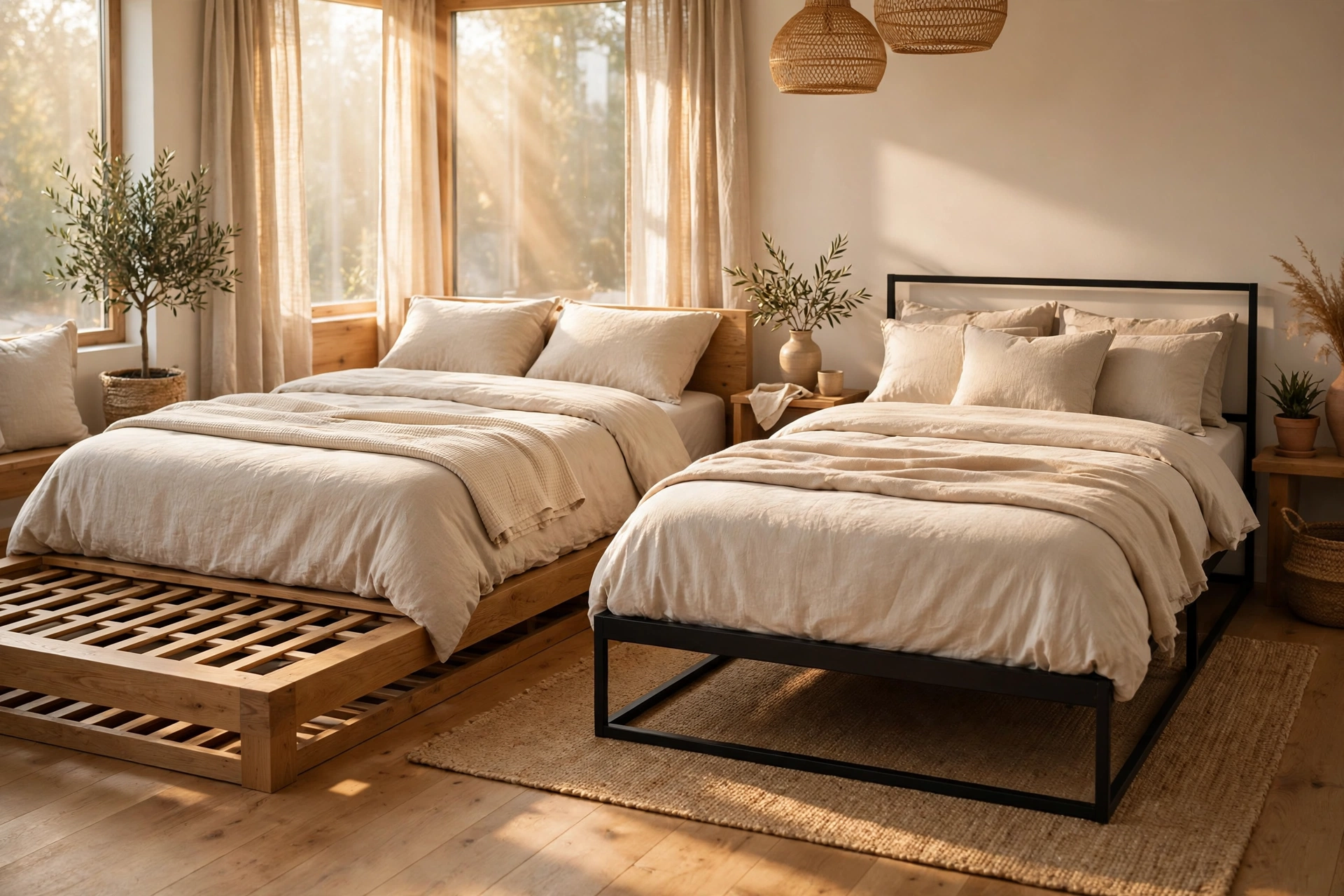
The two beds I am actually comparing
Full disclosure, because nobody should trust a comparison where the specs are hidden. Bed one is the Stylish Queen Size PU Leather Upholstered Bed Frame — $299, item W69167506, 79.92 × 60.24 × 15.75 inches, 80.4 lbs, black PU leather, stitched wingback headboard with LED accent lighting, strong wooden slats, no box spring needed. Bed two is the Queen Size Tufted Upholstered Platform Bed with Hydraulic Storage — $388, item HL000090AAD, 87.9 × 63.8 × 38.2 inches, 175 lbs, construction listed as MDF + plywood + PU + metal, 400-lb weight capacity, 10 slats, motion-activated night light, USB ports, and a hydraulic lift compartment under the mattress.
Notice what is missing: a pure solid-oak heirloom bed and a bare-bones steel platform frame. These are the beds real people actually buy in 2026 — and the honest secret is that each one is secretly the other: my “wood” bed is PU upholstery over engineered supports, and my “metal” comparison bed is a hybrid.
Wood bed frame pros and cons — and what “wood” really means
The wood bed frame reputation is built on solid hardwood: oak, maple, walnut. A frame made from real hardwood can last 20 years or more, and it fails gracefully — it creaks before it cracks, and you can usually see the damage coming. Wood also absorbs vibration, so a good wooden bed feels quiet and settled, and it looks warm rather than industrial without trying.
Here is the part the marketing skips: most beds sold as “wood” at the $200–$400 level are particleboard or MDF under the upholstery. Per HouseDigest’s 2026 lifespan guide, a particleboard frame typically lasts only 3 to 7 years, and it fails catastrophically — once a screw pulls out of particleboard, that hole never holds again. My $299 bed sits in the honest middle: strong wooden slats carrying the mattress, so the load-bearing parts are real wood, but it is not a solid timber frame and I do not pretend it is. Eight months in, the slats are silent and unbowed. My realistic expectation for it is 8 to 10 years — solid value at $299, but not an heirloom.
Metal bed frame pros and cons — cheaper, lighter, louder
The metal bed frame case is simple and strong. A basic metal platform frame typically runs $150 to $250 — half the price of most upholstered beds — and it is the easiest thing in the bedroom to move. Metal does not warp in humidity, does not split along a grain, and a decent one lasts 10 to 12 years (HouseDigest, 2026). For a guest room, a rental, or a first apartment, that price-to-lifespan ratio is genuinely hard to beat.
The tradeoffs are real, though. Bare metal frames look utilitarian — there is no hiding it. In damp rooms, cheap steel rusts at the joints unless the coating is good. And then there is the noise. Metal-on-metal connections loosen under a bouncing load, and a loose metal bed does not creak politely like wood. It clanks. Which brings us to the section I did not expect to write.
The noise test: why metal bed frames squeak and the 5-minute fix
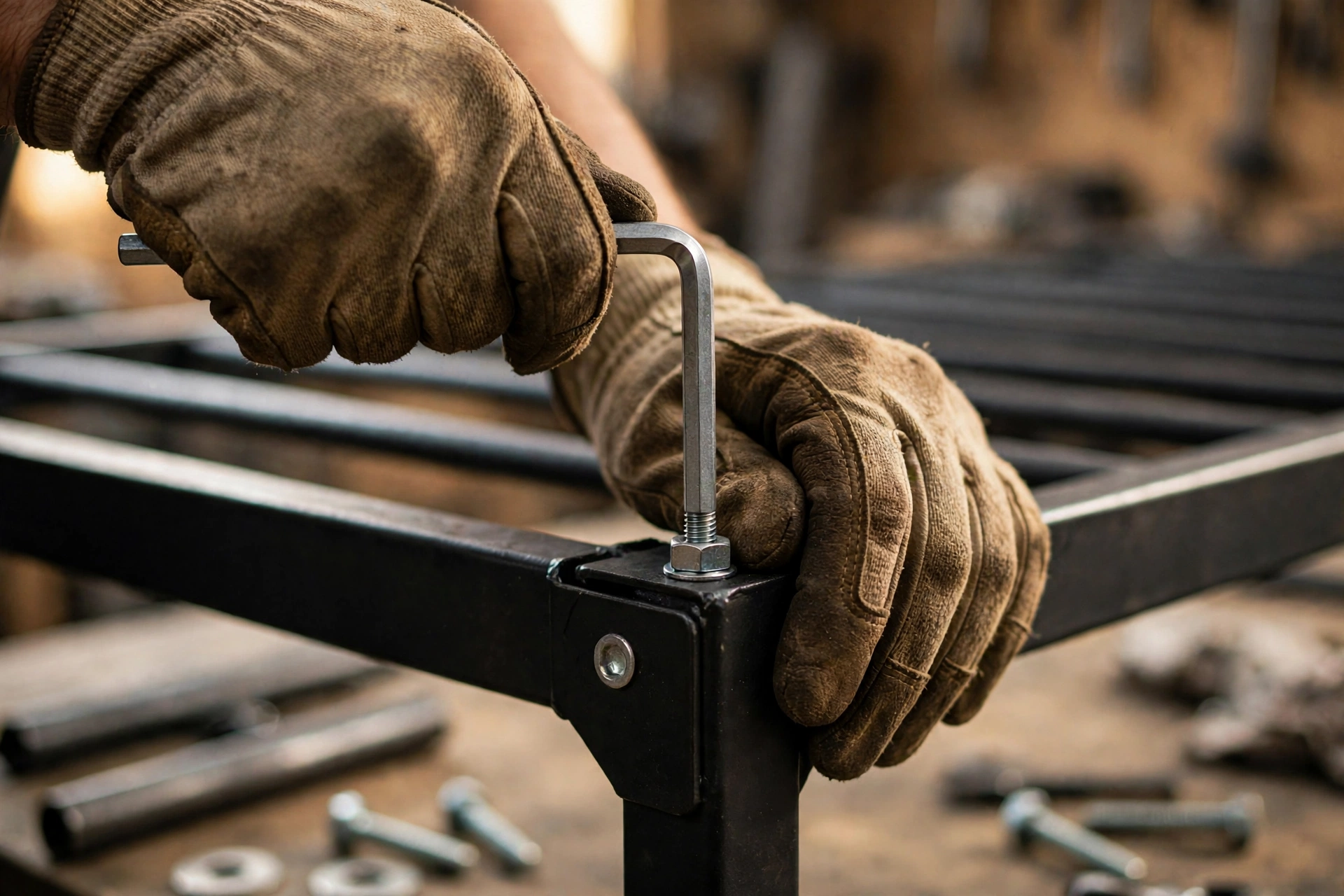
My $388 bed has a metal-reinforced core, and two months after assembly it developed a metallic tick every time I rolled over. Not the mattress — I lifted it and reproduced the sound by pressing the frame. The culprit was exactly what it almost always is: a bolt that had backed off a quarter turn. Wood compresses as it settles, and the hybrid construction meant the wood-to-metal joint had loosened. Here is the fix that actually works, in order:
- Find the joint, not the mattress. Have someone sit on the bed while you listen at each corner. The squeak is almost always at a bolt, never at a slat.
- Tighten everything with the right wrench. Do not use pliers on hex bolts — you will round them. One minute per joint with an Allen key is enough.
- Add felt pads at metal-to-metal contact points. A few cents each, and they stop the micro-movement that makes the clank.
- Check the slats. A cracked slat drops the mattress onto its neighbor and changes the load path — replace one for a few dollars instead of ignoring it.
Five minutes, zero dollars, and the tick was gone. I now do this once a year on both beds — mattress off, every bolt tightened, slats inspected. A squeak is almost always a loose bolt, not a broken bed. Tighten before you panic.
Weight capacity: the spec that actually matters
Here is a number most shoppers skip and almost everyone should check: bed frame weight capacity. The $388 hydraulic bed is rated for 400 lbs. That sounds like plenty until you do the math. A queen mattress runs 100 to 130 lbs depending on type. Two adults at 170 lbs each add 340. Add bedding, and you are at roughly 480 lbs of static load on a 400-lb frame — and that is before anyone sits on the edge to put on shoes, which concentrates the load.
The $299 PU leather bed does not list a rated capacity on its page — common for upholstered budget frames, and honestly a small mark against it. The strong wooden slats handle my 180 lbs plus a mattress with zero flex so far, but I would not put two large adults on it without thinking first. My rule of thumb now: rated capacity should exceed mattress + sleepers by at least 100 lbs. If a bed does not publish a number, treat that as information, not an oversight.
One more number worth knowing: the average American bed frame is already 9.3 years old, and nearly three in ten are 11 years or older (Dreams UK Sleep Survey, 2026, 2,000 adults). If yours is past ten and the bolts need tightening every month, the frame is telling you something.
Lifespan and the 10-year cost math
Lifespan is where the wood vs metal bed frame debate gets honest. Pulled from the best published numbers I could find, flagged as industry estimates rather than promises:
- Solid hardwood frame: up to 20 years (HouseDigest, May 2026). The 10-year winner if you can afford it.
- Metal platform frame: 10 to 12 years (HouseDigest, May 2026); 10 to 15 years for well-built frames (Bedpost, NZ furniture retailer, 2026).
- Particleboard / MDF frame: 3 to 7 years (HouseDigest, May 2026) — and failure is sudden, not gradual.
- Upholstered bed frame: 5 to 8 years (HouseDigest, May 2026), with good care pushing toward the high end.
Now the cost-per-year math, my estimates using realistic lifespans. The $299 PU leather bed at 8 years works out to about $37 a year. The $388 hydraulic storage bed at 9 years is about $43 a year — but that includes a storage compartment that replaced a $150 dresser for me, so the honest number is lower. A basic metal platform frame at a typical $200 lasting 11 years is about $18 a year — the cheapest honest sleep on this page, at the cost of looks and features.
The timing matters too. The Better Sleep Council — the consumer-education arm of the International Sleep Products Association — uses seven to ten years as its mattress replacement rule of thumb, and its 2023 survey of 1,039 adults (reported in Sleep Savvy) found 77% replace because of simple deterioration — sagging, lumps, noise. When the mattress goes at year eight, the frame usually goes with it. Buy the frame for the same horizon as the mattress, not for forever.
Upholstered bed frames: the third player
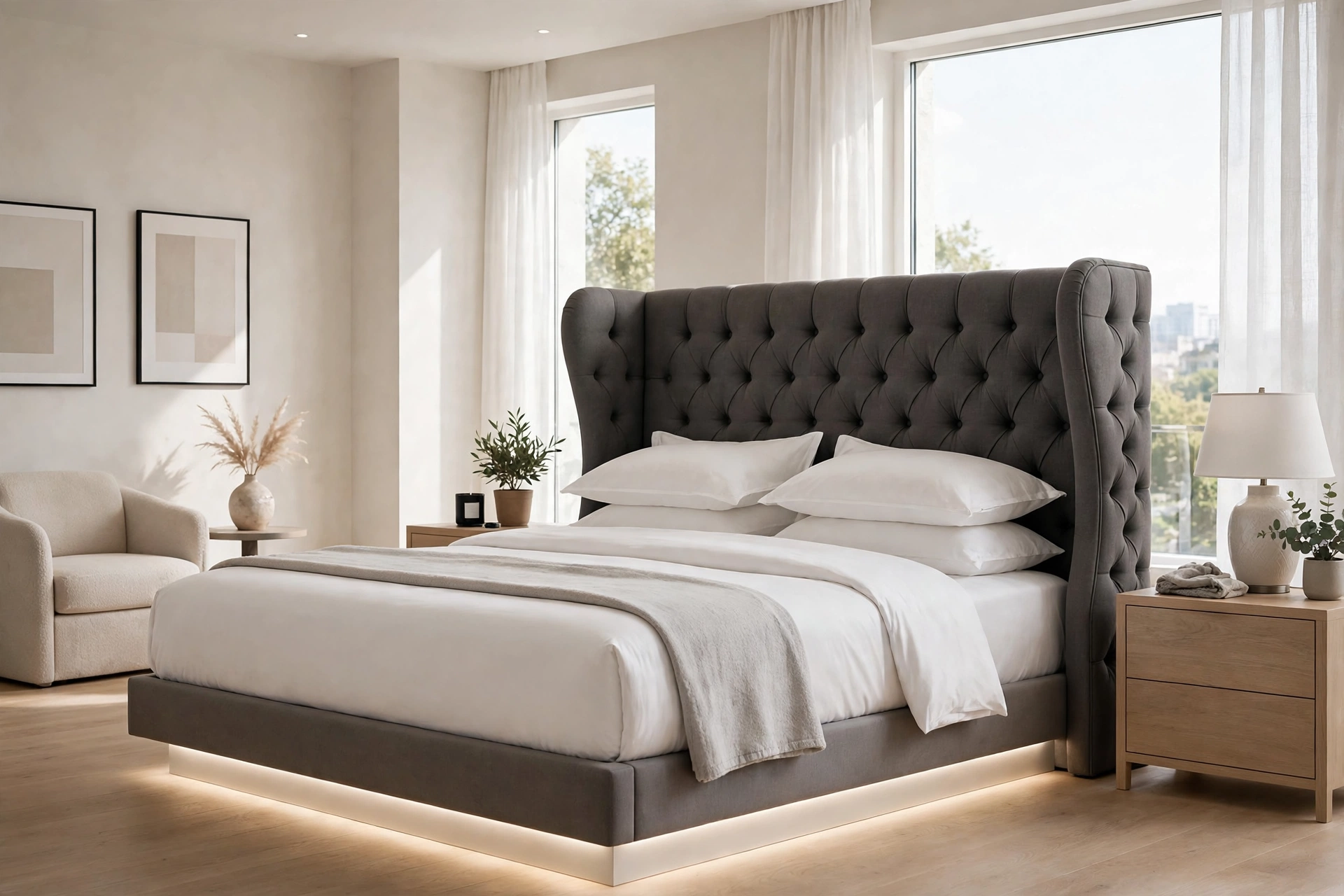
Most shoppers think they are choosing between wood and metal. They are actually choosing between wood, metal, and upholstered — and upholstered is quietly winning the bedroom. My $299 bed’s selling point was never its slats; it was the stitched wingback headboard, the LED accent lighting that makes 2 a.m. bathroom trips civilized, and the boutique-hotel look for the price of a nice dinner out.
The honest catch is the upholstered bed frame lifespan: 5 to 8 years for the fabric or PU coating (HouseDigest, May 2026), shorter than the wood or metal underneath. PU leather is polyurethane film over polyester — its enemies are heat, UV, and harsh cleaners, and once the coating cracks there is no going back. My brother’s two-year-old faux-leather headboard started peeling like a sunburn; the fix is all prevention, which I wrote up in my PU leather bed frame care guide. Eight months in, mine still looks like delivery day, and I expect five to seven years of good-looking service — my estimate, earned with a cloth in my hand.
My verdict: who should buy what
After months of sleeping on both sides of this argument, here is the wood vs metal bed frame verdict I would give my own sister. Buy the $299 PU leather upholstered bed frame if you want the bedroom to look expensive for cheap, sleep with a partner who gets up at night (the LED strip earns its keep), and are willing to spend fifteen minutes a week keeping PU leather alive. Buy the $388 hydraulic storage bed if your bedroom is short on closets — the lift compartment swallowed two comforters, four pillows, and my winter coat collection — and you want the only 400-lb rating on this page.
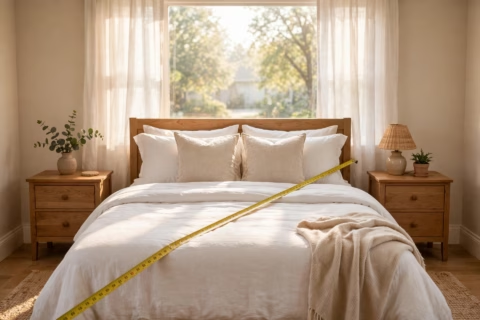
Buy a basic metal platform frame for a rental or guest room, move it yourself, and spend the savings on the mattress — replaced every 7 to 10 years, it is what your back actually notices. And whatever you buy, measure the room with painter’s tape first; my mattress size guide shows why.
Ready to pick your frame? See the exact beds from this comparison: the $299 PU Leather Upholstered Bed Frame with wooden slats, LED headboard lighting, and no box spring needed — or the $388 Hydraulic Storage Bed with a 400-lb capacity, motion-activated night light, and USB charging. Browse the full FLNORW MALL collection — USA-wide shipping, delivered within 8 days.