How to Winterize Patio Furniture: My $990 October Experiment
The weather app said first frost by Thursday. I stood on my 12-by-14-foot patio and did the arithmetic I always do when seasons change: the wicker 7-piece set that cost me $489.99, the cast aluminum 5-piece set at $499, and the solar LED umbrella at $129 — just under $1,120 of backyard sitting out there with ice on the way. Learning how to winterize patio furniture properly is the difference between spending ninety minutes this weekend and spending another thousand dollars in April. Here is exactly what I did, what I would skip, and the cost math that made the decision easy.
Why You Winterize Patio Furniture: The Real Enemy Is Not Cold
Winter damage comes from moisture sitting on and inside furniture for weeks, not from the cold itself. Water gets into cushions, frame joints, and hollow tubes. Then it freezes, expands, and pries things apart from the inside, repeating the process dozens of times per winter. So before you buy a single cover, figure out what your set is made of — and be honest about where it sleeps from November to March.
The 30-Minute Clean That Prevents 90 Percent of Spring Repairs
Nothing goes under a cover or into the garage dirty. This is the rule every winter-storage guide agrees on, and it is the step everyone skips. Storing a dirty set seals a season of pollen, bird evidence, and food residue against the frame for five months. Come spring, you are not unwrapping furniture — you are opening a chemistry experiment.
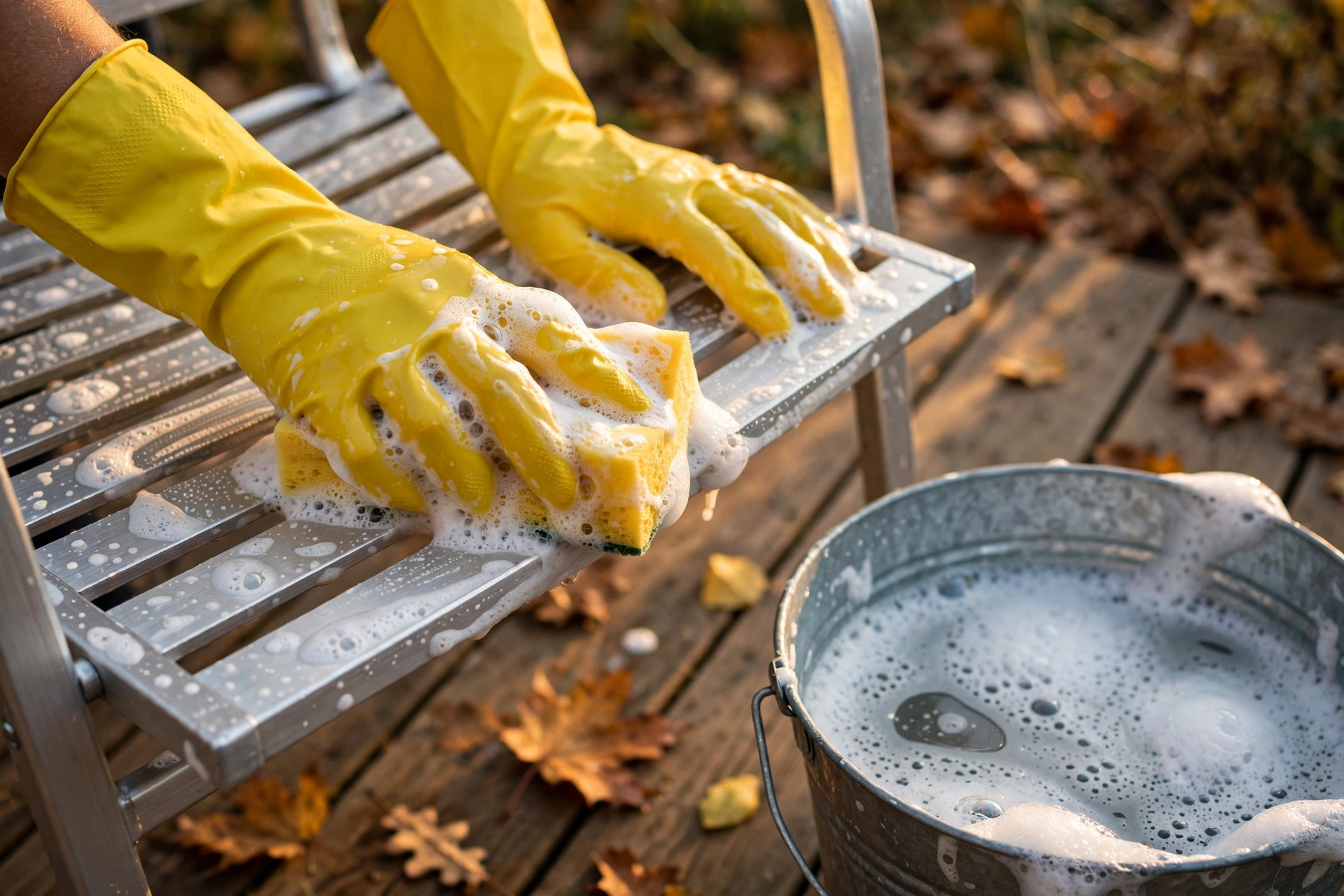
My routine takes about half an hour for both sets. Brush off leaves and grit first, because grit under a sponge scratches powder coating. Then wash frames with warm water and a little mild dish soap; a soft brush gets into the weave of the rattan and the lattice pattern of the aluminum chairs without grinding. Hose down the cushion covers if the care tags allow it, or spot clean the stubborn spots. The critical part is what comes after: let everything dry completely. Cushion foam can take a full day in the sun to dry all the way through, and storing even slightly damp foam is how mildew starts.
While things dry, do the rust check. Run your fingers along the leg joints, the underside of the table, and anywhere two pieces meet. On my wicker set, I found exactly one paint chip on a chair leg — about the size of a grain of rice, with a pinhead of orange starting. Caught now, it is a two-minute fix. Caught in April, it is a spreading rust bloom.
The Material Cheat Sheet: What Can Stay Outside, What Must Come In
Different materials need different winter plans. Here is the honest version, built from my two sets plus the storage advice I have collected:
Cast aluminum is the low-maintenance champion. My 5-piece cast aluminum patio set — round table at 35.43 inches across, four lattice-weave chairs, rust-proof weather-resistant coating, 23 pounds total — can stay outside all winter under a breathable cover. Aluminum does not rust, and the coating handles the rest. Storage cost for this set: the price of a cover.
Powder-coated steel needs one extra look. My wicker set’s frame is powder-coated rust-free steel with reinforced aluminum feet, so the steel never touches wet concrete — the detail that separates a five-year frame from a two-year frame. Touch up any chip now, because winter moisture spreads rust fast on bare steel. With chips sealed, the frame stays out under a cover just fine.
All-weather (resin) rattan handles cold well. The synthetic weave on my set has survived six months of full southern sun without fading or brittleness, and cold does not bother polyethylene either. Covered outside is fine.
Wood is where people get hurt. Acacia is dense and oily and shrugs off rain, but repeated freeze-thaw cycles crack wood finishes. My acacia table top gets its annual thin coat of teak oil (fifteen minutes, did it in September), and the set stays out under the cover. In a harder-freeze climate, a wood-topped set would get garage priority.
Natural wicker — the plant-fiber kind, not resin — should come indoors, period. And lightweight plastic pieces should come in too if you get real freezes; cold makes cheap plastic brittle enough to crack.
Patio Furniture Covers vs Indoor Storage: The Honest Trade-Off
For outdoor furniture winter storage, the honest ranking is simple: dry indoor space first, vented covers second. My umbrella’s cushions live on a garage shelf all winter, and I have never thought about them twice.
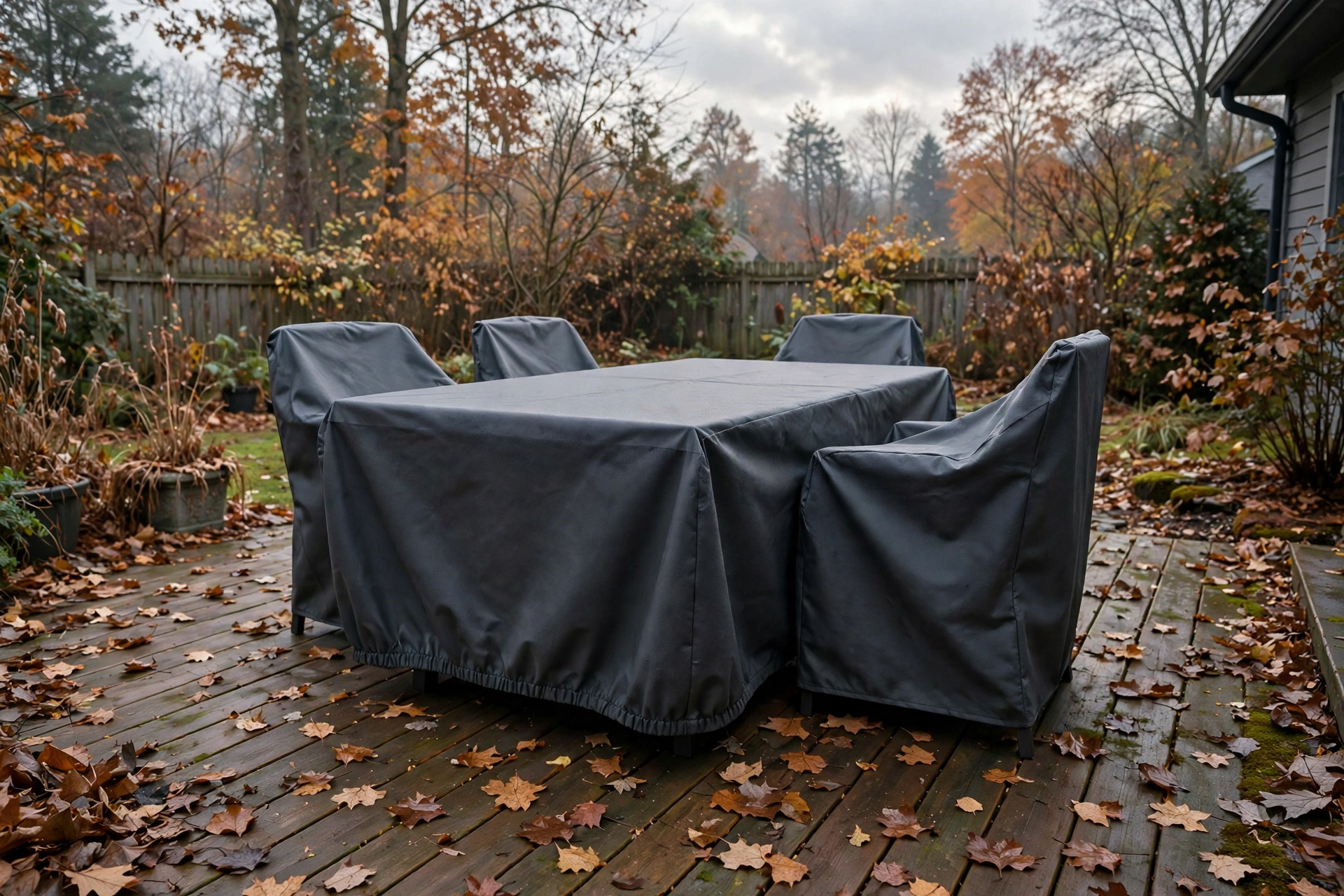
But indoor storage costs floor space — a 7-piece dining set eats a serious chunk of a garage. For the frames, I use patio furniture covers — and the cover has to be the right kind. Look for durable waterproof fabric, vents that let moisture escape, and straps or buckles so wind cannot balloon it off. The vents matter more than the waterproofing: a sealed, unvented cover traps humidity and gives you a damp cocoon. Skip shrink wrap and garbage bags for the same reason.
I paid $40 for a breathable, vented cover last fall. Two small pro moves: raise one side slightly, or tuck a small ball under the cover, so rain runs off instead of pooling — and after big storms, brush snow off the covers before it melts in.
Cushions Come Inside. No Exceptions, No Debate
Cushions are the first thing winter ruins, and I have the receipts from last year. The wicker set’s cushions are rated mildew-resistant, and they survived an accidental June soaking with no smell — but winter is a different animal. Freeze-thaw inside foam, five months of trapped moisture, and spring opens with a science fair. The two minutes it takes to unzip them and carry them inside is the highest-return maintenance on this whole list.
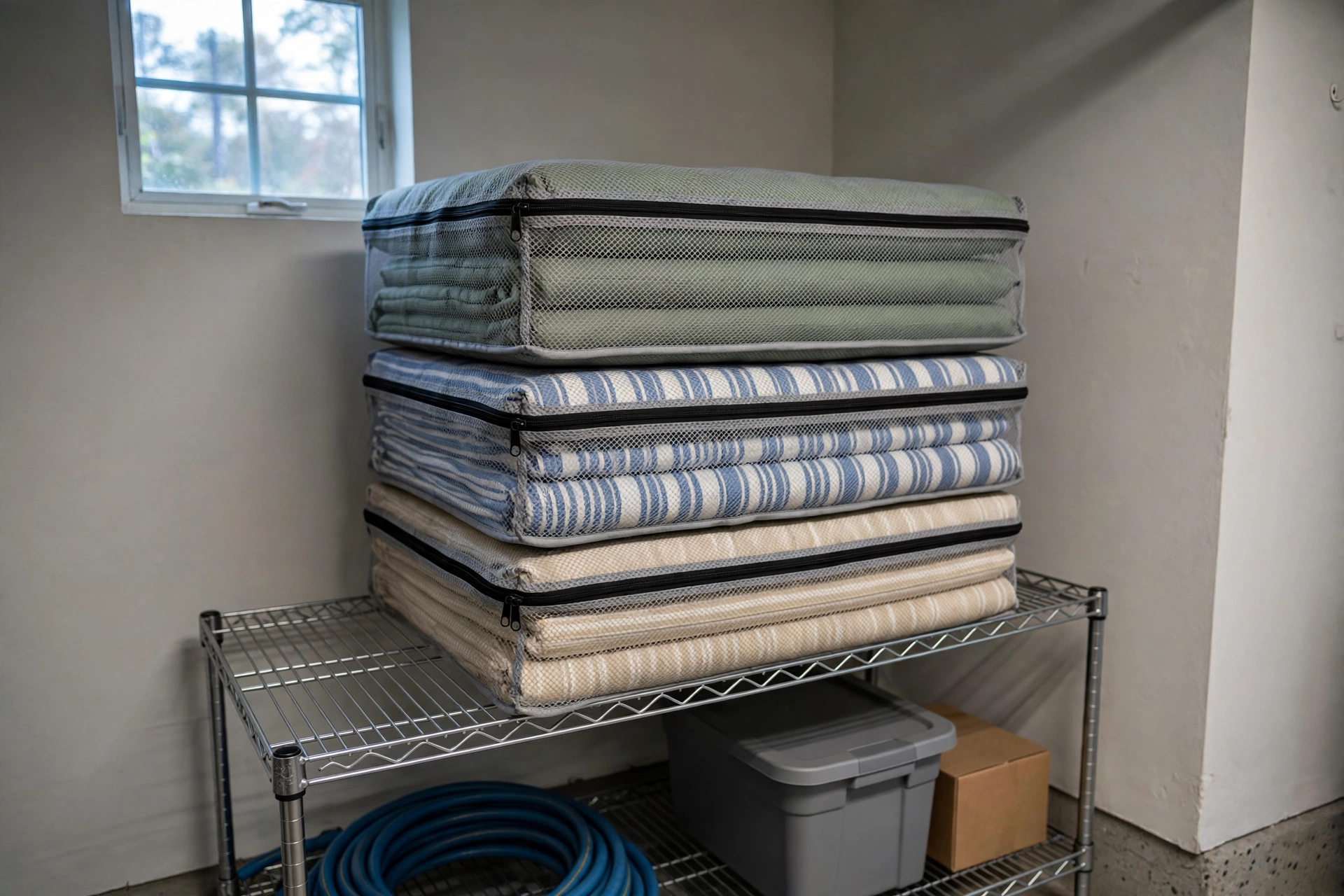
Store them in a dry garage, shed, or deck box that seals well, standing loosely so air can move around them. Breathable fabric storage bags beat plastic bins with tight lids, because leftover moisture needs somewhere to go. Keep them off bare concrete, and a few cedar blocks discourage spiders from settling in for the season.
The Rust Math: A $12 Touch-Up Pen vs a $499 Replacement
Let me run the numbers the way I run them for every outdoor purchase. The full patio furniture rust prevention kit: one enamel touch-up pen ($12), one bottle of mild soap (already under my sink), one breathable cover ($40), and ninety minutes of my Saturday. Total out-of-pocket: about $52, plus a Saturday I was going to spend in the yard anyway.
The alternative: skip winterizing, let the chip spread, let moisture into the joints, and discover in April that the frame wobbles and the rattan weave has pulled loose where a rusted joint shifted. A replacement 5-piece set runs $499, a 7-piece $489.99. Even partial repairs — re-powder-coating a frame — run well past $100 once you price a shop hour.
Conservative math: the $52 winterizing kit protects $989 of furniture through one winter. If it buys the sets even one extra season each, that is roughly $500 of deferred replacement cost for $52. My estimate, based on my own two sets and the prices I paid. The industry trend makes the stakes higher every year — Grand View Research’s 2026 report puts the global outdoor furniture market at $53.3 billion in 2025, growing to a projected $86.6 billion by 2033 at about 6.4 percent a year, and the US market alone at $14.47 billion in 2025. Millions of Americans are about to learn this lesson at once.
Umbrellas, Rugs, and Everything Else on the Patio
The umbrella deserves its own paragraph because people forget it. My $129 solar LED patio umbrella — 10-by-6.5-foot canopy, six steel ribs — gets closed, cleaned, and stored standing in a dry garage corner so the fabric does not mildew along the folds. One honest note: the solar panel earns nothing in a dark garage, so the lights will be dim the first week of spring while it recharges.
Outdoor rugs need a wash and a full dry day, then roll them rather than fold them to avoid creases. Glass-top tables deserve a spot under a roof if you have one — a heavy snow load can crack glass. If a glass top must stay out, store it standing on edge against a wall with a blanket between the glass and the ground. And the one I always forget until March: drain the garden hose and coil it indoors. Water left inside freezes, expands, and splits the walls.
Winterize Patio Furniture Checklist: The 90-Minute October Plan
Here is the whole thing, in order, the way I run it every fall:
- Brush off leaves and grit from every piece
- Wash frames with warm water and mild soap; soft brush for weave and texture
- Spot clean cushion covers; dry everything completely in the sun (foam can take a full day)
- Run the rust check along joints and leg feet; touch up any chip immediately
- Oil wooden tops (acacia, teak) with a thin protective coat
- Cushions go inside to breathable bags on a shelf — never under an outdoor cover
- Frames get vented, strapped covers; raise one side or tuck a ball underneath for runoff
- Umbrella closed, cleaned, standing in a dry corner; rugs rolled; hose drained indoors
- Midwinter: brush snow off covers after storms; lift covers on dry days to air things out
That is the full playbook. Ninety minutes, $52 in supplies, and two patio sets that will look the same in April as they do today. This is the same pair of sets I covered in my two-season review — the wicker set with the acacia top and the cast aluminum 5-piece — and the plan I sketched out last October held up: cushions inside, frames covered, one chipped leg touched up before the freeze.
The verdict: winterize patio furniture the boring way: clean it, dry it fully, match the storage to the material, and never seal anything airtight in plastic. Cast aluminum and resin rattan can sleep outside under a vented cover. Cushions, natural wicker, and anything wood-topped in a hard-freeze climate belong indoors or under a roof. A $40 cover and a $12 touch-up pen are protecting nearly a thousand dollars of furniture, and the whole job costs less time than one trip to the big-box store. Do it before the first frost — not the weekend after.
Ready for next spring? Shop the same gear: the 7-piece wicker patio dining set with acacia top ($489.99) and the 5-piece all-weather cast aluminum set ($499) are both in stock at FLNORW MALL — buy them now, winterize them in October, and skip the April replacement bill.