Velvet Accent Chair: My 6-Month Real-Life Durability Test
Velvet Accent Chair: My 6-Month Real-Life Durability Test
When I clicked “order” on my first velvet accent chair last spring, I did it braced for regret. Every furniture tip I’d ever absorbed said velvet was for show — pretty in photos, ruined by week three of real life. Six months later, that same chair is the seat everyone in my house fights over. Here is what actually happened, including the coffee spill I was sure would kill it.
Why I Kept Buying This Velvet Accent Chair After the First Scare
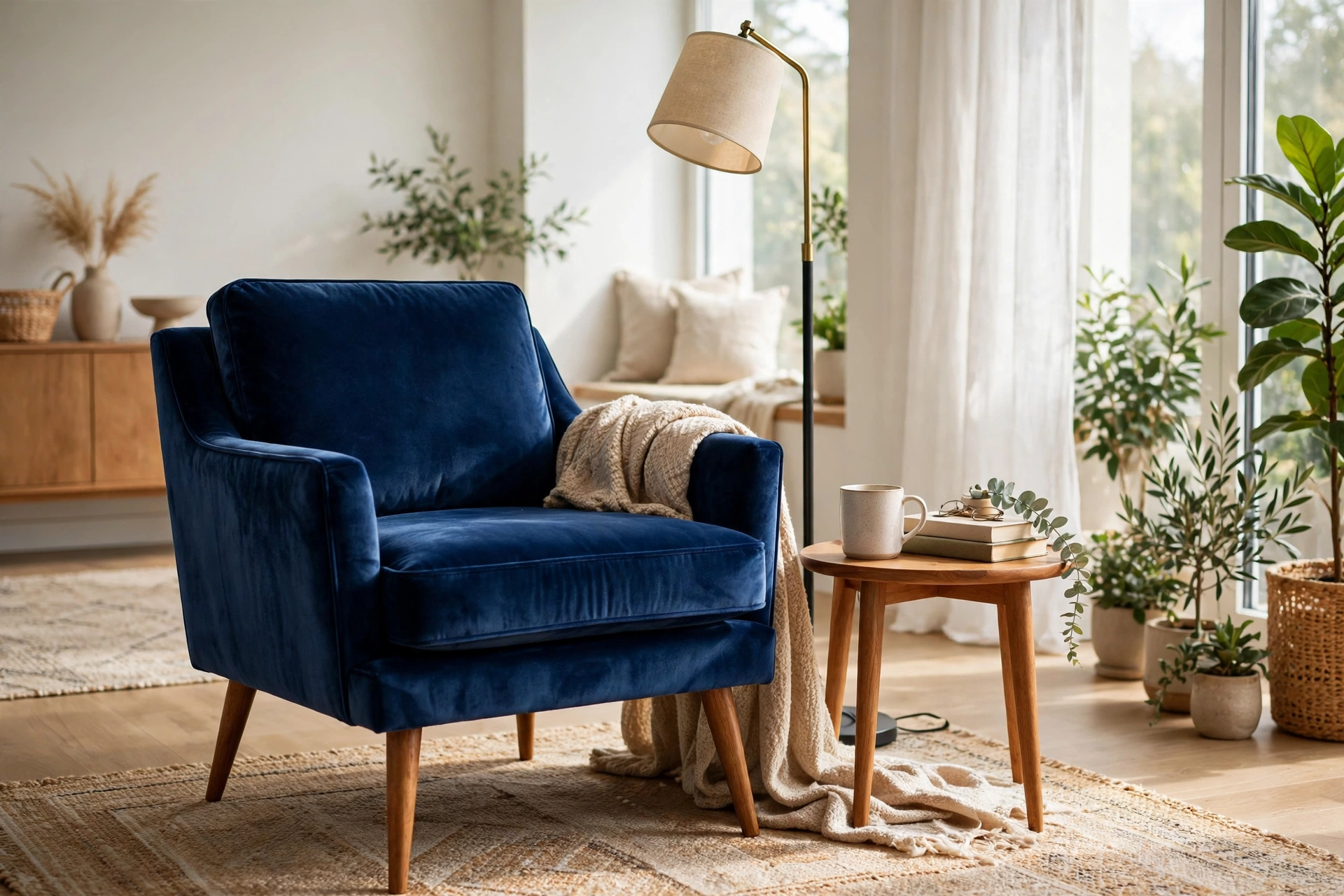
The first velvet piece was the $328 navy velvet accent chair from FLNORW MALL, and honestly I bought it for looks. The solid wood frame, the wooden legs, the 18-inch seat height that matched my sofa exactly — it ticked every box on paper. But I am the kind of person who reads the care tag and gets nervous, and “velvet” on the tag made me imagine dust, crushed pile, and a fabric that shows every fingerprint.
Three weeks in, nothing bad had happened. That surprised me enough that I did something impulsive: I ordered two more velvet pieces to stress-test the theory. A taupe three-seat sofa for the living room and a set of four suede-brown dining chairs. If velvet was going to fail, I wanted it to fail everywhere at once.
The Three Pieces I Put Through Six Months of Real Life
For the record, here are the actual specs — because most velvet reviews online are about a vibe, not a product:
- Navy velvet accent chair — $328. 29″L x 29″W x 34.25″H, 18″ seat height. Solid wood frame, TB117-rated foam, soft velvet upholstery. It also comes in black and taupe. This one lives in my reading corner and gets roughly two hours of use a day.
- Taupe velvet 3-seat sofa — $468. 74″L x 29″W x 34.25″H, 18″ seat height, rubberwood legs in an espresso finish, 75.9 lbs. Medium-soft cushion plushness. This is the family workhorse: movie nights, naps, the dog’s favorite spot.
- Set of 4 suede-brown velvet dining chairs — $268. That is $67 per chair. 15.75″W x 16.34″D x 33.46″H, 18.9″ seat height, 250-lb weight capacity per chair, powder-coated steel tube frame. These eat every breakfast, lunch, and dinner in this house.
Combined investment: $1,064 for a chair, a sofa, and four dining chairs. That number matters later.

What “15,000 Double Rubs” Actually Means (and Why It Matters)
Before the test, I did my homework on how velvet durability is even measured. In the US, the standard is the Wyzenbeek test: a machine rubs cotton duck fabric back and forth over the upholstery, and each full back-and-forth pass counts as one “double rub” — essentially simulating years of sitting, shifting, and scooting. It is the furniture industry’s honest proxy for how a fabric ages.
The benchmarks, from furniture-durability guides published by upholstery specialists in 2026:
- Under 15,000 double rubs: decorative territory. Accent pieces that get sat on occasionally — fine for a bedroom corner chair nobody uses.
- 15,000–30,000: moderate residential use. OK for a sofa in a one- or two-person household with no pets.
- 30,000–40,000: heavy residential — the go-to range for a main family sofa, especially with kids and pets.
- 50,000+: performance velvets, engineered synthetics that often outlast the foam underneath them.
Europe’s version is the Martindale test, rubbing in a figure-eight; fabric publisher Zepel notes 20,000 Martindale rubs covers about 90% of residential use. The catch with velvet specifically: abrasion tests measure surface wear, not whether the pile bounces back after six months of real sitting. One velvet-buying guide from Alibaba’s fabric-insights desk (2026) flags that a velvet can pass 20,000 rubs and still lose a big chunk of pile height if its recovery is poor.
Here is the awkward part: the product listings for my three pieces do not publish rub counts. No double-rub rating, no Martindale number — just “soft velvet fabric.” So I could not lean on a lab number. The six months were the test. And six months of a 41-year-old man, a teenager, a cat, and one very spilly toddler is, I would argue, a harder standard than a lab machine.
The Coffee Test: Stains, Cat Claws, and a Toddler
Month two, the disaster I had been dreading: my morning coffee — black, no sugar, thankfully — went straight into the navy chair’s seat cushion. Full cup. I froze a full ten seconds, then did the one thing every fabric guide agrees on: blot, do not rub. Paper towels first, then a barely-damp cloth with a drop of dish soap, then dry towels with a heavy book on top to wick it out.
The result? Nothing. No ring, no dark spot. The navy dye and the tight pile just did not hold onto it. I am not claiming velvet is stain-proof — a red wine or a marinara spill would have been a different story, and I would not volunteer to test those. But a realistic, everyday coffee accident disappeared with twenty minutes of calm blotting. That changed how anxious I was about owning velvet, permanently.
The cat, to my surprise, is the bigger endorsement. She claws everything — couch arms, rugs, my favorite sweater. She has tried the taupe sofa’s armrest exactly twice. Polyester-based velvets have a tight, short pile with no woven loops for claws to catch on, and pet-focused fabric guides from 2026 consistently note that modern synthetic velvets are among the most pet-tolerant upholstery options available. My cat agrees: there is nothing satisfying to hook into, so she moved back to her scratching post.
The dining chairs took the hardest beating. Six months of meals means pasta sauce splatter, a ketchup incident, juice boxes squeezed by small hands. The suede-brown color hides sins beautifully. Quick wipe-downs with a damp cloth handled everything except one ketchup spot that needed the soap-drop treatment. After roughly 540 meals, all four chairs look… the same as month one. The steel tube frames have zero wobble, and at $67 per chair, each one has hosted more than a hundred dinners — that is under a dollar per meal and falling.

Velvet Sofa Care: My 90-Second Weekly Routine
Whatever velvet costs you, it repays this small habit. Once a week, I do three things:
- Lint-roll the seat and armrests (30 seconds). Velvet’s pile traps dust and cat hair visibly. A roller makes it look new instantly.
- Brush the pile back with a soft clothes brush (30 seconds). Brush one way, then against, to lift flattened spots. My navy chair’s seat cushion had a “me-shaped” dent by month three; this routine mostly erased it.
- Vacuum crevices with the upholstery tool (30 seconds). The gap between seat cushion and armrest collects crumbs like a bank collects interest.
Once, after a houseguest sat on the taupe sofa for a six-hour visit, the cushions looked flattened. A handheld steamer held six inches away, followed by brushing, brought the pile back. If you own velvet and no steamer, get a $30 one — it is the single best accessory for this fabric.
Navy vs Taupe vs Suede Brown: Which Color Forgives Most?
The honest ranking after six months, from most forgiving to least:
- Suede brown (dining chairs): camouflages everything. Food, dust, fading — brown wins by a mile.
- Taupe (sofa): hides dust and pet hair well but shows water spots if you clean in patches. Always damp-clean a full cushion panel, edge to edge.
- Navy (accent chair): the diva. Shows dust and lint within days, but lint-rolling fixes it in seconds, and the color has faded not at all despite a window three feet away.
One caution: velvet crushes — the pile lies flat in high-use spots and looks slightly lighter there, a phenomenon called “bruising.” It is temporary (steam + brush fixes it) but it is most visible on darker colors in bright rooms. If your room gets direct sun, expect to rotate cushions monthly.
Velvet Accent Chair Cost-Per-Sit Math: $67 a Seat vs $468 a Sofa
Here is where velvet stopped being a luxury question and became a math question. My cost estimates, six months in:
- Navy accent chair ($328): ~2 hours of daily use over ~180 days. If it lasts a conservative 5 years at this pace, that is under 40 cents a day — cheaper than the coffee I spilled on it.
- Taupe sofa ($468): ~4 hours of daily family use. A decent polyester-blend sofa at this price range has no business feeling this good; the foam has lost maybe 10% of its firmness (my estimate).
- Suede-brown dining chairs ($67 each): the runaway value winner. Four chairs for $268, surviving 540+ meals with zero failures. I have bought $67 bar stools that lasted six weeks.
The average sofa replacement cycle in American homes runs roughly 7–10 years by most surveys. If these pieces deliver even 5 years, the per-day cost is trivial compared to reupholstering or replacing cheap alternatives twice. Velvet’s reputation as the expensive, fragile choice only holds if you compare it to nothing.
My Verdict: Who Should Buy Velvet (and Who Should Skip It)
Six months ago I expected to be writing a warning. Instead: the velvet passed. The pile recovered, the stains lifted, the cat gave up, and the frames — wood on the chair and sofa, powder-coated steel on the dining chairs — are all as tight as day one. The dining chairs, honestly, are the single best furniture value I have ever bought.
Buy velvet if: you will spend 90 seconds a week on the pile, you like rich color that photographs well, and you have a cat rather than a dog with muddy paws (a dog that dries muddy feet on the sofa will test any fabric’s limits).
Skip it if: you will never lint-roll anything, your dining table is a homework-and-crafts zone where glue sticks are involved (nothing saves velvet from glitter glue), or your budget forces you to pick between fabric quality and frame quality — always pick the better frame.
My navy velvet accent chair remains the seat everyone fights over. At $328 for five-plus years of daily use, that fight costs me about 18 cents a day. I will take that deal all day long.
Want to try velvet yourself? Browse FLNORW MALL’s velvet collection — the navy velvet accent chair ($328), the taupe velvet 3-seat sofa ($468), and the set of 4 suede-brown velvet dining chairs ($268) — plus pairing ideas like the coffee table size guide I wish I had read before buying three tables. Start at FLNORW MALL and pick the velvet your life can actually keep up with.